Avoiding the Technical Debt Collector
Why is this TechDebt meme funny?
Level 1: Can’t Run Forever
Imagine a group of kids in a classroom who each day are supposed to tidy up, but none of them actually do it. One kid after another sneaks out of the room every afternoon, leaving the trash and toys behind for the next person. At first it seems like they’re off the hook – Not my problem! they giggle as they run out to play. But as this keeps happening, the mess in the classroom just grows and grows. Eventually, the pile of junk becomes so huge and nasty that it’s like a big scary monster lurking in the room. Finally the teacher opens the door, and all that mess comes tumbling out. The kids who thought they escaped cleaning now have a much bigger, scarier cleanup waiting for them. The meme is funny in the same way: it shows that if everyone tries to run away from a problem instead of fixing it, the problem will only get bigger and come back to surprise (and spook) them later.
Level 2: Bus Factor Blues
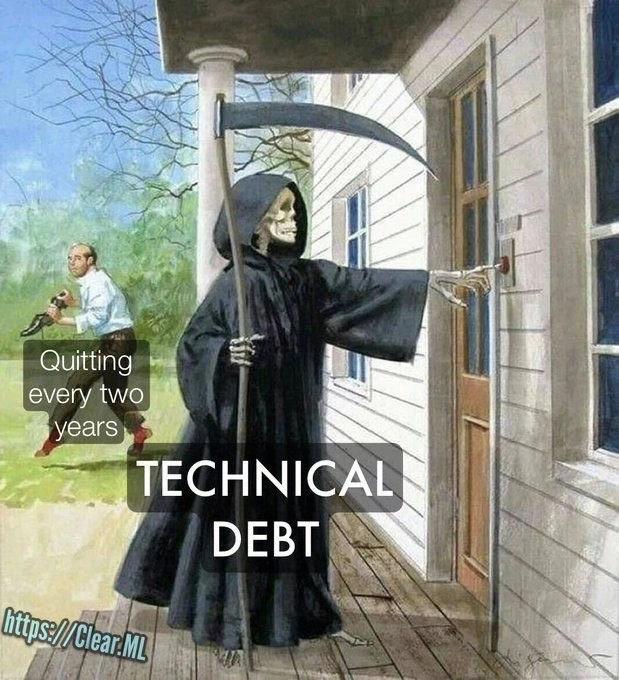
Let’s break down what’s happening in simpler terms. The meme shows the Grim Reaper (a skeleton in a black cloak who usually represents death) at someone’s door with the label “TECHNICAL DEBT.” That’s a way of saying the project’s accumulated problems (technical debt) have come knocking. The guy sprinting away with a laptop bag, labeled “Quitting every two years,” represents a software developer who changes jobs frequently – basically job-hopping every couple of years. He’s running away, leaving whoever is still inside to deal with the scary technical debt figure at the door.
Technical debt in software is a metaphor similar to financial debt. When a team takes shortcuts in code – maybe writing messy quick fixes or postponing necessary improvements – they “borrow” time and convenience at the cost of future trouble. Just like real debt, it accrues “interest”: the quick-and-dirty code might make adding new features or maintenance harder down the line. If you don’t pay off that debt by refactoring or cleaning up, it keeps growing and can eventually cripple the project. In the meme, technical debt is personified as a Grim Reaper to illustrate that if ignored for too long, it can be fatal to your codebase (or at least to your deadlines and sanity!). It’s a fun, exaggerated way to say “this hidden problem will come back to bite you.”
Now, what about “quitting every two years”? This refers to a common practice in the tech industry where developers switch jobs frequently (often every 1–2 years) to seek better positions, salaries, or just a change of scene. While it can be great for an individual’s career growth, it’s rough on the projects they leave behind. When key team members keep leaving, a lot of important knowledge leaves with them. Imagine you join a project and the last person who really understood a certain component isn’t around anymore – that knowledge gap is what we call knowledge drain. Over time, continuous team attrition (people leaving the team) means nobody remembers why certain decisions were made or how specific, tricky parts of the system work. It’s like trying to solve a puzzle with missing pieces.
Engineers sometimes talk about the Bus Factor. This is a slightly morbid joke term: it’s the number of team members who could get hit by a bus (or quit unexpectedly) before the project is in serious trouble. If only one person knows a critical system and they leave, the bus factor is 1 (very risky). A high bus factor (say 5 or 6) means many people have the knowledge, so losing one isn’t a disaster. In our scenario, “quitting every two years” suggests a low bus factor – people keep leaving, so fewer and fewer folks truly grasp the whole system. Eventually the bus factor might drop to 1 or even 0, meaning no one remaining fully understands the code anymore. That’s a recipe for a maintenance nightmare, because when something breaks, everyone will be scratching their heads.
And what is legacy code? “Legacy code” basically means old code that’s still in use, often written by someone who has since left. It might be out-of-date or written in a hurry, and usually it lacks proper documentation or tests. New developers (like you, early in your career) often inherit this kind of code. It can feel scary to work on because you’re afraid of breaking something – especially if the original authors aren’t around to ask. If every developer before you only stayed long enough to add new features but never fixed the underlying issues, you end up with a stack of unresolved problems. That’s the technical debt piled high.
So why is the Grim Reaper ringing the doorbell in the meme? It’s showing that sooner or later, all those unresolved issues (bugs, messy code, “I’ll fix it later” hacks) will demand attention. In a team with constant developer turnover, everyone tends to hope “well, I won’t be here when this becomes a big problem.” But eventually, somebody gets stuck facing it. Picture starting a new job as a junior dev and discovering half the code is held together by duct tape and TODO comments left by folks who quit. It’s overwhelming, but it’s also a common scenario in software teams. The humor in this meme comes from recognition: many developers have experienced a project where the technical debt felt almost alive, growing more menacing with each departure. The “Grim Reaper” is a tongue-in-cheek way to say “the bad stuff you ignored is here now.”
In short, the meme uses a scary-funny image to convey a real lesson: if a team doesn’t address problems and everyone just keeps leaving, those problems don’t disappear. They only become harder to deal with, until one day the bill comes due. For a newer developer, it’s a hint to not leave chaos for the next person, and to learn about those old parts of the system rather than just avoiding them. Because when technical debt finally comes to collect, someone will have to answer the door – and if you’re the one still around, it might be you!
Level 3: Debt at the Door
In this meme, Technical Debt is literally personified as the Grim Reaper pressing a doorbell, while a developer labeled “Quitting every two years” flees in the background. It’s a darkly comic depiction of a maintenance nightmare that veteran engineers know all too well. When developer turnover becomes a revolving door, unresolved issues pile up like a tab that’s never paid. Each programmer who jumps ship after a short stint leaves behind a few more hacks and legacy code quirks. Eventually, inevitably, the accumulated technical debt comes knocking – and it’s wearing a hood and carrying a scythe.
This grim scene satirizes the industry’s worst corporate culture habits. Frequent attrition and job-hopping (quitting every two years for the next gig) create a vicious cycle: no one stays long enough to truly own the code or refactor the brittle parts. Critical knowledge evaporates with each departure (knowledge drain), lowering the project’s Bus Factor to dangerous levels. The Bus Factor is an infamous metric – how many team members can be hit by a bus (or quit the company) before a project is in serious trouble. Here, the bus factor has effectively dropped to zero: the last dev out the door took the project’s understanding with them. The result is a codebase full of “skeletons” that nobody fully understands, just waiting to cause trouble. Technical debt behaves like an insidious loan growing with interest: you can ignore it for a while, but the longer you wait, the more painful the reckoning. In the meme, that reckoning is the Grim Reaper casually ringing the bell – “Ding dong, remember all those shortcuts? I’m here to collect.”
Seasoned developers will recognize the humor as painfully true. We’ve seen codebases where successive short-term contributors treat problems with band-aid fixes, assuming “I’ll let someone else clean this up later.” Well, "later" eventually becomes "now" after enough folks bail. The meme captures that moment of truth: the project can’t outrun its technical debt forever. For example, imagine a critical module nobody touched in years suddenly failing in production. The original author left two companies ago, documentation is nonexistent, and now a junior dev (the unlucky person who didn’t quit yet) gets a 3:00 AM on-call alert. It’s at that ungodly hour, debugging a crashing service via Slack, that you truly meet the Grim Reaper of developer pain points. The code’s skeletons in the closet come out, and there’s no one left to blame but the spectral sum of all those postponed fixes. This scenario is a classic bit of developer humor: we laugh about it because otherwise we’d cry – it’s humor born from a shared trauma.
We can practically recite the telltale signs of a project haunted by technical debt and turnover:
- Abandoned TODOs: The code is littered with
// TODO: fix this latercomments (often dated or signed by ex-devs who left years ago). “Later” never came. - Haunted Modules: Entire sections of the system are informally labeled “Don’t touch this!” because the last person who understood them quit. Everyone treats these parts of the code like a Jenga tower ready to collapse.
- Patch on Patch: Quick fixes get piled on top of earlier quick fixes. For instance, a kludge like
if server.is_overloaded(): time.sleep(1)remains in production as a “temporary” throttle that became permanent when its author walked out the door. Each departing dev leaves behind a few suchlandmines“features.”
# Quick fix to prevent crashes (meant to be temporary)
if server.is_overloaded():
time.sleep(1) # crude throttle instead of real load balancing
# (The dev who wrote this hack left the company before implementing a real solution)
In short, this meme highlights a classic technical debt horror story: when everyone keeps sprinting to the next job, nobody sticks around to pay the debt. It’s analogous to renting an apartment, shoving trash under the bed, and moving out every year – eventually the new tenant (or the landlord) is going to discover that hidden mess. The Grim Reaper at the door is a perfect metaphor: debt is calling, and there’s no one left to answer except the poor soul or team who can’t escape in time. The joke has a cynical edge because it rings so true in the software industry. We often talk about the mythical Bus Factor and attempt knowledge transfers, but time after time companies tempt fate by letting code quality slide amidst endless resignations. In the end, someone will have to open that door and face the skeleton – and it’s usually at the worst possible moment (hello, production outage!). So the meme’s message to anyone in tech is crystal clear (and darkly funny): you can’t outrun technical debt. It will eventually catch up, especially in a culture of constant turnover.
Description
This meme uses the 'Death Knocks' painting format. In the foreground, the Grim Reaper, depicted as a skeleton in a black, hooded robe holding a scythe, represents 'TECHNICAL DEBT'. He is standing on a porch and ringing the doorbell of a white house. In the background, a man in a white shirt and dark pants, labeled 'Quitting every two years', is seen fleeing the scene with a panicked expression. A watermark for 'https://Clear.ML' is visible in the bottom-left corner. The meme humorously illustrates a cynical career strategy where a developer contributes to or ignores accumulating technical debt and then leaves the company before the long-term consequences manifest. For senior engineers, this is a relatable and often frustrating scenario, as they are frequently the ones left to deal with the 'debt' left behind by predecessors who prioritized short-term gains over sustainable, quality code
Comments
9Comment deleted
That's not technical debt; it's a 'long-term architectural bond' that fully vests with the next engineer who touches the code
Leadership calls 24-month attrition “fresh perspective”; we call it the Bus-Factor summoning ritual - tech debt hears the chant and shows up at the doorbell
The two-year mark: when you realize the "temporary workaround" from your onboarding is now load-bearing infrastructure and the senior who wrote it is already at their second company since
The modern software engineer's career strategy: accumulate technical debt faster than compound interest, then execute a strategic exit before the principal comes due. It's not abandoning ship - it's 'pursuing growth opportunities' before your architectural decisions achieve sentience and hunt you down. The two-year mark isn't arbitrary; it's precisely calibrated to be after vesting but before anyone realizes that 'temporary workaround' you shipped is now load-bearing infrastructure supporting half the company's revenue
Quitting every two years: the ultimate tech debt refactor - nuke the repo and git init a new career
You can load-balance your career by quitting every two years; technical debt still has server-side session affinity and keeps ringing your doorbell
Keep average tenure at two years and your ADRs become Slack lore - the bus factor hits one and technical debt doesn’t knock; it already has a badge and prod access
this is not a dev problem. If PM (customer) requests to implement features instead of dealing wit tech debt - its their decision and their headache in the future. Devs have no reason to quit because of tech debt, because they would have to deal with someone else's tech debt on the other project. At the same time - solving your own mistakes is very useful for your growth. PS: meme is good btw 😅 Comment deleted
Well said. Sir Comment deleted