Elon Musk's X vs. The EU's Digital Services Act
Why is this DataPrivacy meme funny?
Level 1: Play Fair or Time-Out
Imagine you’re playing a big game, and there are some important rules everyone has to follow. The teacher (or referee) secretly tells all teams, “If you quietly follow this extra rule I’m giving you and don’t tell anyone, I won’t punish you for breaking other rules.” Most teams, not wanting to get in trouble, say, “Okay, we’ll do it,” and they keep it hush-hush. But one team – let’s call them Team X – says out loud, “No, that secret rule isn’t fair! We won’t do it!” They keep playing their way.
What happens next? The teacher/referee immediately blows a whistle and holds up a big red card for Team X. 🚩 They announce, “Team X isn’t following the official rules everyone can see!” Team X basically refused to do the secret thing, so now they’re in trouble for not following the regular rules. It’s like when you don’t do your homework the proper way – you can try to skip a step, but the moment the teacher checks, you get a big red X on your paper. The meme is a funny way of saying: if you don’t play by the rules, especially the ones meant to keep things fair and transparent, you’re going to get a time-out or penalty. In simple terms, always follow the important rules (even if someone tries to give you a sneaky shortcut), or you might suddenly have to stop what you’re doing when the big red light comes on!
Level 2: Laws and Linters
Let’s decode this meme in simpler technical terms. First, remember that X is just the new name for Twitter (yes, the social network with tweets – it got rebranded as “X”). Now, what’s this about a secret EU-compliance linter? In programming, a linter is a tool that automatically checks your code for problems or style violations. It’s like a spellchecker for code, but instead of typos it catches things like noncompliant patterns or bad practices. Many development teams have lint rules (for example, “no debug statements in production code” or “use === instead of == in JavaScript”) that must pass, otherwise the CI/CD pipeline will fail. CI/CD stands for Continuous Integration / Continuous Deployment, which is a series of automated steps that test and deploy code. In those pipelines, a gate turning red means one of the steps failed – typically marked by a red X or red light indicator in the build system UI. Red is bad (stop!), green is good (go!). So if your code doesn’t meet some rule (say, you forgot a semicolon or a security scan found a secret API key), the pipeline stops and flags the issue in red.
Now, compliance in a corporate sense means following rules or laws. The meme references the Digital Services Act (DSA) – a major European Union law that big online platforms (like X/Twitter, Facebook, etc.) have to obey. This law’s goal is to make platforms more transparent and accountable. For instance, under the DSA, platforms must be transparent about their content moderation (who they ban, what posts they remove, etc.), maintain an ad repository (a public database of all the ads they show, to prevent hidden political ads or misinformation), and share certain data with researchers who study online harms. These are like requirements in a spec document for a project, but here the spec is mandated by law. If a platform fails to implement these features, they risk fines or other penalties (kind of like how failing tests might prevent your app from being released).
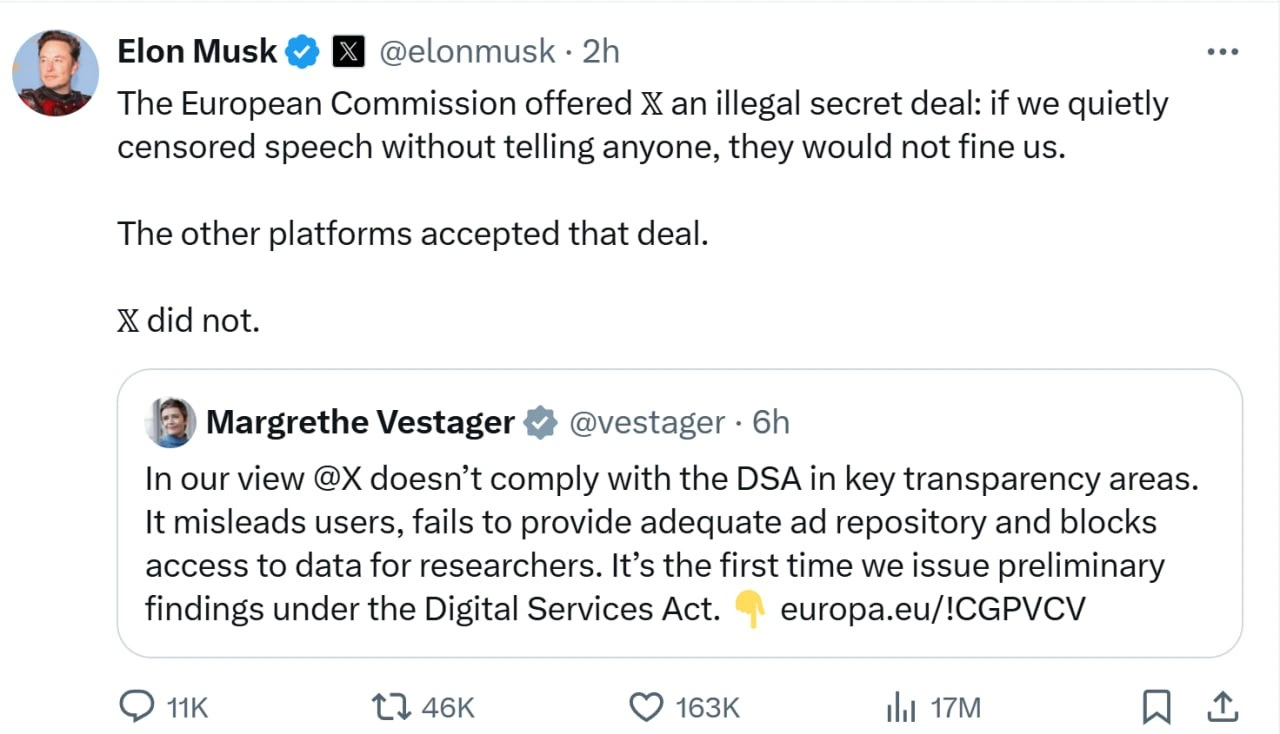
In the screenshot, Elon Musk is basically saying: “The EU regulators tried to give us a secret deal – they wanted us to quietly censor content (remove certain speech) without telling the public, in exchange for not fining us for non-compliance. Supposedly, other social media companies took that deal, but X did not.” Musk frames it as X taking a principled stand (no quiet censorship). Margrethe Vestager, on the other hand, is a high-ranking EU official (she’s known for enforcing tech regulations). Her post says, in formal terms: “In our view, @X doesn’t comply with the DSA in key transparency areas…” and she lists the failures: misleading users (maybe X’s user policies or labels are unclear), no adequate ad repository (Twitter might not be providing the full searchable database of ads that the law requires), and blocking data access for researchers (perhaps after Musk’s takeover, X restricted its API, which researchers used to study things like misinformation – that would violate DSA rules). She notes it’s the first time they’re issuing preliminary findings under DSA, which is like an early official warning that “you’re not following the law, fix this or face consequences.” The 👇 emoji and link is pointing to an EU website with details, much like referencing a bug report.
So how is this like a CI/CD pipeline failing? Imagine the EU is like a QA (Quality Assurance) team or an automated checker that inspects the “product” (the social platform) for required features (transparency, data access features). The secret deal linter in the meme is a playful concept: it implies the EU gave X a special hidden check or a chance to meet requirements quietly. If X had implemented those censorship or data-suppression measures (met the secret criteria), the “CI” (Compliance Inspection) would silently pass – i.e., no fines (the pipeline stays green). Other platforms accepted that deal: meaning other companies might have quietly complied – picture other dev teams quickly adding a hidden config file or patch so their build passes compliance tests. But X did not – X’s leadership chose not to do those secret changes. In developer terms, they intentionally skipped adding a required file or function that all the others added. So when the automated check (the EU’s review) ran, X’s product failed the test. Boom, red light. Their compliance status is failing, just like a build failing unit tests. The meme caption “CI/CD gate instantly turns red” nails this image: the moment X refused the compliance fix, the next compliance check results came back negative – a red failing status in record time.
For a junior developer or someone new to these terms, here’s a quick analogy: think of the CI/CD gate as a final exam for your code. A linter is like the examiner’s checklist of required things. If you refuse to prepare for one big section of that exam (like ignoring an entire chapter that will be tested), you’re going to get a failing grade. In the corporate tech world, failing compliance means the company might get fined or publicly called out by regulators (very bad for business). The meme humorously frames Elon Musk’s public tweet (which was a bold claim painting X as a lone rebel) in dev-speak. It’s basically saying “Elon skipped the compliance tests, and unsurprisingly, the app didn’t pass the review.” Developers know that feeling: maybe you thought you could slip something past QA, or you commented out a test to save time... but then something catches you and the whole build is busted. Compliance is that non-fun requirement that you just can’t ignore, much like how you can’t ignore tests or lint rules without consequences. And now X has a big red “failed check” mark from the EU to deal with.
In summary, at this level we’re seeing that:
- X = Twitter platform (the “codebase”).
- Secret EU-compliance linter = hidden content rules/tests the EU wanted applied.
- CI/CD gate turns red = the automated compliance check failed (EU found X non-compliant).
- Other platforms accepted = other companies quietly adjusted to pass EU’s checks.
- X did not = X chose not to adjust, thus got a failing mark.
This is all about DataPrivacyAndCompliance in a fun way, showing how even huge tech companies have to play by the rules (or their “build” breaks). It also reflects on CorporateCulture: one company’s leadership proudly rejecting an unattractive requirement, and the immediate backlash from an authority – something anyone who’s pushed code to production without approval can relate to. The tags like gdpr_flashbacks hint that folks in tech have seen a similar movie before (with the GDPR law, suddenly every site needed cookie consent banners, many devs had late nights implementing those!). So, a junior dev can learn that compliance is a big deal in real-world software: sometimes you encounter “we must do X or legal will kill the release.” This meme just dramatizes that with a current event in the tech industry.
Level 3: When Law Breaks the Build
At the most technical level, this meme equates a high-stakes regulatory showdown with a failing build in a developer’s pipeline. X (formerly Twitter) is portrayed like a dev team that skipped integrating a crucial compliance linter – basically an automated rule-checker – offered by EU “regulators” (the European Commission). In dev terms, a linter scans code for forbidden patterns or policy violations. Here it’s metaphorical: the secret EU-compliance linter represents a set of content moderation rules or censorship directives that the EU allegedly wanted enforced under the radar. Elon Musk’s post claims X refused to merge this clandestine “patch” into their platform’s moderation pipeline (“we did not quietly censor speech”), whereas “the other platforms accepted that deal.” The result? The CI/CD gate (Continuous Integration/Continuous Deployment quality gate) instantly turns red 🚨 – meaning X’s “build” fails the compliance check. In real life, that red light is Margrethe Vestager (Europe’s tech regulator) publicly declaring that X is not in compliance with the DSA (Digital Services Act) and starting enforcement. It’s a brilliant parallel: just like broken tests stop a software release, broken compliance triggers a regulatory blockage. Senior engineers see the humor in how platform-scale moderation pipelines and EU enforcement collide exactly like code quality pipelines and release gates.
This analogy cuts deep into DataPrivacyAndCompliance and CorporateCulture. It’s highlighting the “familiar dance” between moving fast and breaking things versus obeying rules. In big tech companies, product teams often sprint ahead (driven by leadership’s vision and PublicPerception) while legal requirements lag until late in the game. Here, Musk (as CEO) essentially bragged about skipping a secret test suite, saying in dev-speak: “We didn’t add that hidden check that would make our code compliant but impose silent censorship.” To an experienced dev, that sounds like a cowboy coder proudly merging to main with failing tests – a recipe for a Friday 5 PM disaster. And sure enough, production (the platform’s operation in the EU market) hits a red flag. The stakeholderPressure dynamic is obvious: regulators expect conformity (like a security team mandating lint rules), while the CEO values an open “free speech” stance and speed. This tug-of-war often results in late-stage scramble or a complete pipeline halt as we see here.
Let’s break down the parallels in a way a battle-hardened engineer might chuckle at:
| DevOps Pipeline Situation 🎛️ | X vs EU Compliance Situation 🌍 |
|---|---|
| A compliance linter stops a build if code violates policy rules (style, security, etc.) | The Digital Services Act threatens platform ops if X violates transparency rules (content & ad policies) |
| Some devs quietly add hacky fixes to appease tests (sneaking code changes to turn the build green) | Other platforms quietly accepted secret censorship measures (behind-the-scenes content filtering to appease regulators) |
| Team lead boasts “We skip static checks to move faster, trust me!” 😬 | CEO boasts “We refused the secret censor deal, we won’t quietly comply!” 😬 |
| Pipeline goes red (build fails) when checks aren’t met, blocking the deploy | EU issues red alert (preliminary violation finding) when DSA rules aren’t met, threatening fines & an operational freeze |
The humor (tinged with TechIndustrySatire) comes from how tech vs regulators friction is lampooned as a dev joke. The Digital Services Act is essentially a new “spec” that big platforms must implement – things like an ad repository (a transparent database of ads shown), data access for researchers (so academics can audit what’s happening on the platform), and honest user communication about content policies. In coding terms, these are new features/requirements landing late in the release cycle. If you don’t implement them (or try to cheat), your CI pipeline — here, compliance audit — will catch you. X’s refusal of the “illegal secret deal” can be seen as Musk saying “we won’t add this code secretly.” But from the EU’s perspective, that means X shipped a version of the platform that fails the acceptance tests of the law. Senior engineers recognize the archetype: a last-minute requirement from the “compliance department” that’s burdensome, maybe even ethically questionable, but everyone else grudgingly merged it to avoid trouble… except that one renegade team (X) that said “nope!” and now faces the consequences. It’s a blend of CorporateHumor and real-life tech policy: the boss’s public stance becomes a PR statement (“We stand for free commit—I mean free speech!”) even as the system breaks in production under regulatory scrutiny.
From a high-level perspective, this meme also jabs at how PublicPerception is managed. Elon’s post is casting X as the lone principled dev shop that refused to insert backdoors “silent censorship” into the codebase. It’s like claiming “our product respects the users so much, we won’t include that sneaky filter even if it means breaking the build.” Meanwhile, the EU’s official response (Vestager’s post) reads like an automated error report from the compliance_linter: X “doesn’t comply… in key transparency areas,” “misleads users” (failing a transparency check), “fails to provide adequate ad repository” (failing the ad data check), “blocks access to data for researchers” (failing the researcher API check). It’s essentially a list of test failures under the DSA spec. Engineers who lived through gdpr_flashbacks will appreciate this: it harkens back to 2018 when everyone suddenly had to implement new features (privacy controls, cookie banners) to satisfy EU’s GDPR law or face fines. Back then, teams scrambled to patch codebases with compliance fixes at the last minute. This time, X’s leadership is publicly refusing such a patch, and – surprise, surprise – the “CI pipeline” run by the EU watchdogs immediately failed their build. The CI/CD gate turning red is the equivalent of a big red flag from the EU, saying “Deployment halted! Fix your code (platform) or face penalties.”
In short, at this senior level of analysis, we see that the meme cleverly fuses tech and law: the secret linter is a metaphor for surreptitious content_moderation_policies, the red CI/CD gate is the regulatory enforcement kicking in, and the whole drama encapsulates the eternal struggle between fast-moving tech culture and slow, rule-bound compliance. And just like a grizzled engineer has learned: if you try to skip those pesky tests or ignore compliance checks, sooner or later, you’re going to break the build in spectacular fashion.
Description
A screenshot of a post from the social media platform X, detailing a public dispute between Elon Musk and the European Commission. In the primary post, Elon Musk claims that the European Commission offered X an 'illegal secret deal' to quietly censor speech to avoid fines, a deal he alleges other platforms accepted but X refused. This post is a direct response to a quoted post from Margrethe Vestager, an EU official, which states that X is not in compliance with the Digital Services Act (DSA) regarding transparency, ad repositories, and data access for researchers. The image captures a significant moment in the ongoing global debate about tech regulation, platform governance, and content moderation, pitting a major tech platform's free-speech-absolutist stance against a powerful regulatory body's new legal framework. It is highly relevant to tech professionals as it illustrates the real-world legal and ethical challenges of operating global platforms
Comments
54Comment deleted
The EU's 'preliminary findings' are just the result of X failing the CI/CD pipeline for the 'Digital Services Act' compliance check. Elon's claiming the test itself is a backdoor
Somewhere in the monorepo, a freshly merged ‘silence_user(…)’ function just tripped the new EU-DSA linter - apparently /* TODO: don’t tell anyone */ isn’t an acceptable privacy notice
Ah yes, the classic 'git blame --everyone-else' defense strategy - where your production incident response is just tweeting that competitors accepted the same bug as a feature while you heroically refused to merge the compliance PR
When your platform's compliance strategy is 'move fast and break regulatory frameworks' but the EU's GDPR team has entered the chat with a preliminary findings document. Classic case of optimistic locking meets distributed consensus failure - except the transaction can't be rolled back and the fine is measured in percentage points of global revenue
EU's DSA preliminary findings on X: like a linter flagging your repo for missing transparency commits, but X refuses the auto-fix squash
DSA requirement: “provide a research API”; enterprise response: “we did - behind OAuth, a CAPTCHA, 10 req/day, and a Kafka topic named compliance_opt_out.”
Nothing says platform transparency like a write-only audit log and an API gateway rule that returns 200 to ad buyers, 451 to researchers, and a press release to regulators
Elon said this, thus must be true Comment deleted
Guy which delete viewing someone likes, bcs someone spotted him liking cuck porn can't lie, right? Comment deleted
Where you live? Comment deleted
North Dakota uwu Comment deleted
Well this sounds like the EU to me... and I am European Comment deleted
didn't know Japan embassy provides living space Comment deleted
✨Delusional✨ Comment deleted
𝒻𝓇𝑒𝒶𝓀𝓎💅 Comment deleted
"Elon is bad because Elon is bad" so him saying the EU is a maffia must be a lie and not important Comment deleted
I've never said that. Comment deleted
I sense high level of sarcasm here Comment deleted
EU is mafia, so no surprise Comment deleted
The CCP here wants to tell that the EU isn't a mafia, so don't worry Comment deleted
Ah if the CCP says it I think I can believe Comment deleted
You better Comment deleted
Shitstorm about to start, or not Comment deleted
i hope it will Comment deleted
I am taking that with a lot of salt for it coming from Elon... Comment deleted
Otherwise I am aware of the EU having a lot of room for improvement when it comes to ICT https://www.patrick-breyer.de/en/posts/ Comment deleted
also, don't forget that Elon is guy which love sucking himself more than breathing Comment deleted
one sec. Comment deleted
https://www.businessinsider.com/tesla-prioritizes-musk-vip-data-self-driving-2024-7 Comment deleted
Didn't expect him to be that big Comment deleted
It doesn't change the fact that EU is doing something terribly wrong Comment deleted
that just means, that both on them are shit-talkers, and it's very likely that Elon just lying (but i can say thank you to EU for 1 thing, and that for making apple use USB-C) Comment deleted
EU my beloved Comment deleted
I really doubt Elon is lying here. As much as I think he's not the best human possible, the EU has been doing a LOT of evil things lately. Also, making Apple use USB-C is indiferent as it changes absolutely nothing Comment deleted
You're not getting Schengen any time soon Comment deleted
Elon is the free speech absolutist until it makes him feel bad Comment deleted
Yeah. Agree Comment deleted
Gold quote, im gonna save this one Comment deleted
Except it makes apple use the standard EVERYONE ELSE uses instead of basically cable DRM Comment deleted
It will not, tho. They'll find a way to screw you. And if people don't like it, they should not buy it. Simple as that Comment deleted
Except they won't because apple has also made it so if you don't have an iPhone but your friends do it fucks you over Comment deleted
So? Don't buy an iPhone You don't agree with the idea, you don't buy the product Comment deleted
iPhones aren't essential and aren't even the best phones Comment deleted
Ah yes, the apple fanboy take Comment deleted
Nah. I hate Apple and I don't buy ANY of their products after I lost a Apple pencil because I forgot to fucking charge it for 2 months Vote with your wallets Comment deleted
As does practically any other coubtry in the whole world Comment deleted
Yeah. Sadly. Doesn't excuse anything tho Comment deleted
Its just a matter of ability, anyone would do it, if were able to Comment deleted
Free speech, sure. Comment deleted
Musk is a clown Comment deleted
Or was I wrong? Comment deleted
🧐🧐🧐🧐🧐 Comment deleted
https://www.allsides.com/story/free-speech-trouble-eu-elon-musk-s-x Comment deleted
Though is was unblocked quickly after 🙂 Comment deleted