Google Chrome's Alleged Private API for Google Sites
Why is this Security meme funny?
Level 1: Playing Favorites
Imagine a classroom where the teacher has a rule that no one can use cheat-sheets on a test — everyone must be equal. But then the teacher secretly slips their own kid (who’s in the class) a complete answer sheet and a calculator under the desk. That kid gets a huge advantage, seeing all the answers while everyone else has to rely on memory. If the other students found out, they’d shout “No fair!” because the teacher is playing favorites. That’s basically what’s happening here. Chrome is like that teacher, and Google’s websites are like the teacher’s pet getting special help. The browser is quietly giving Google’s sites extra information and abilities that no other site gets to have. It’s not hard to see why the other kids (in this case, every non-Google website and its users) would feel upset and betrayed — the game is rigged, and the rules suddenly don’t apply evenly to everyone.
Level 2: For Google’s Eyes Only
Let’s break down what’s happening in simpler terms. Google Chrome (the web browser so many of us use) has a hidden feature — a special set of tools or an API (Application Programming Interface) inside it — that can report very detailed information about your computer’s performance. This includes things like how busy your CPU (the computer’s brain) is, how much of the GPU (graphics card) is in use, and how much memory (RAM) is being used. It can even tell specifics about your processor (like exactly what model it is) and it provides a way to send logs (reports of what’s happening) back through the browser. Essentially, it’s like a secret dashboard of live hardware stats.
Here’s the kicker: Chrome only lets websites on the google.com domain use this secret dashboard. In tech terms, any web address that ends in *.google.com (for example, mail.google.com for Gmail or docs.google.com for Google Docs) has the keys to this hidden info. If any other site — say example.com or your personal blog — tries to access that API, Chrome will simply act like that feature doesn’t exist. Google’s websites get a VIP pass to monitor system and browser performance data that other sites aren’t allowed to see at all.
Why would anyone care about this? For one, it’s an issue of fairness and transparency. Web browsers are supposed to treat all websites the same when it comes to what they’re allowed to do. There’s a basic web security rule (the "same origin" rule) that says a web page can only do certain safe things and can’t just access whatever it wants on your computer or in other tabs. Normally, no web page can peek at your system’s resource usage directly because that could be a security risk or a privacy concern. For example, if random websites knew your exact CPU or memory usage, they might figure out what other apps you’re running or even uniquely identify your device (a technique known as fingerprinting). That’s why browsers usually keep that info off-limits.
But in this case, Chrome bent the rules by making an exception for its maker’s own sites. Google’s pages can essentially do something akin to opening your computer’s Task Manager via the browser — seeing how hard your system is working when you visit them. Other websites? They’re left in the dark with no such privilege. This secret perk raises eyebrows because users and other developers weren’t told about it. It feels like Google is playing by a different rulebook on their own browser. People worry that it undermines trust: if Chrome quietly gives Google special access today, what’s to stop more behind-the-scenes favoritism tomorrow? It’s a bit like discovering that the browser has a one-way mirror: Google’s side can look through and observe details that no one else on the web can see.
Level 3: The VIP Telemetry Lounge
For seasoned developers and security engineers, this revelation hits like déjà vu from tech history. Private, undocumented APIs that only the platform owner’s products can use? We've seen that movie before. Back in the ’90s, Microsoft was notorious for leveraging hidden Windows calls to give Microsoft Office and other in-house apps a speed or feature boost that third-party competitors couldn’t access. It smelled like an unfair advantage then, and here we are in 2024 with Google — in many ways the new Microsoft of the web — quietly giving its own sites preferential treatment inside Chrome. The browser’s very maker is bending the rules of its platform for itself. If you listen closely, you can almost hear the collective groan of senior web architects: “Not this again...”
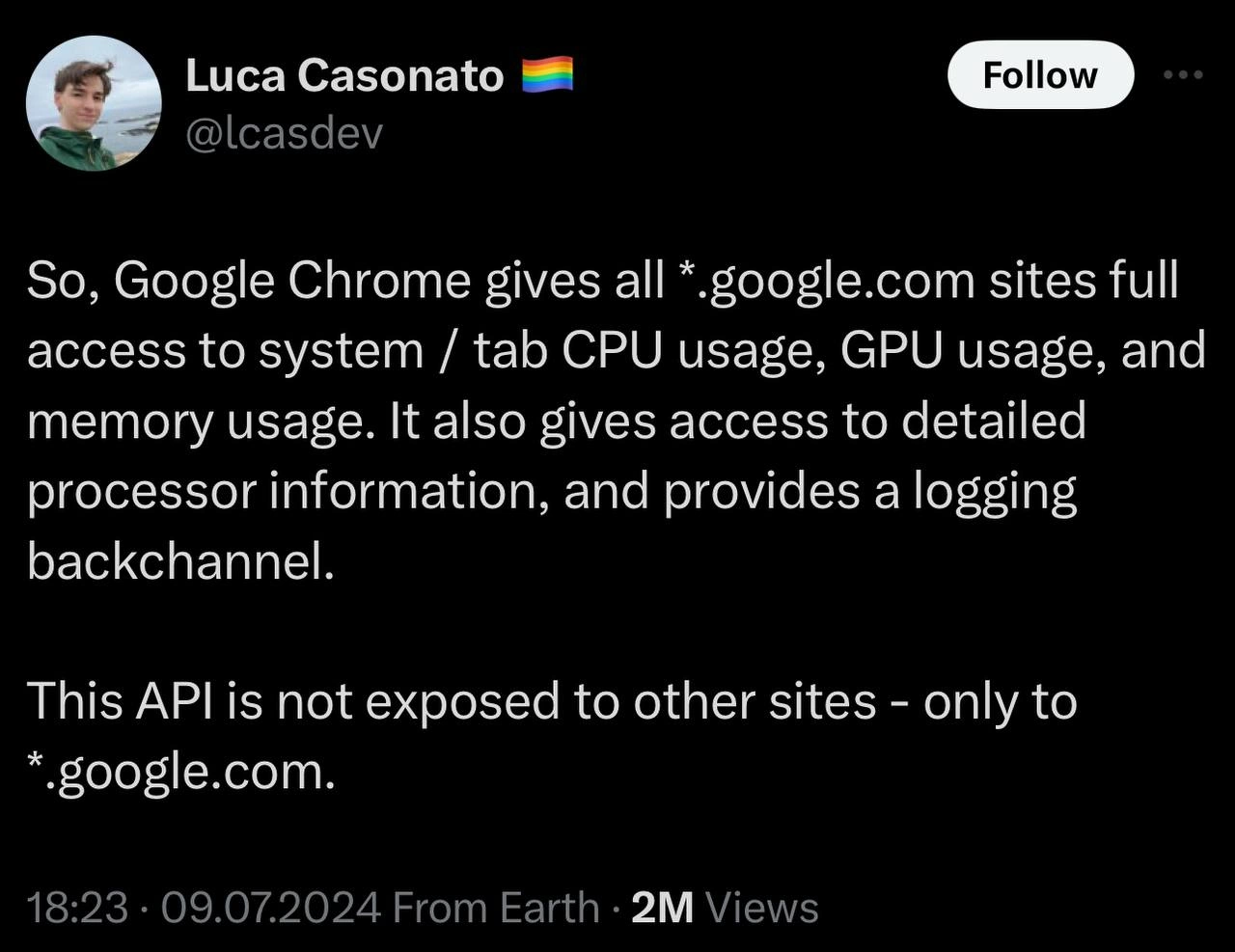
The tweet by Luca Casonato lays out the situation in plain terms: Chrome has a special metrics API providing hardware telemetry (CPU load, GPU usage, memory stats, detailed processor info) and even a mysterious logging channel, but only for pages served from Google’s domains. It's like Chrome built a VIP lounge and handed Google the only key. Any other website knocks on that door and Chrome pretends it isn’t there. This isn’t a documented feature in any web standard or developer guide — it’s more like an Easter egg for the home team. In code form, one imagines something like:
// Hypothetical snippet of Chrome's internal logic:
if (requestingSite.domain.ends_with(".google.com")) {
enableMetricsAccess();
enableLoggingBackchannel();
}
To a veteran coder, that kind of hard-coded exception raises an eyebrow (or six). It's the very definition of browser vendor privilege: the browser maker giving itself powers that no one else can have. The humor (tinged with frustration) comes from how blatant this is. Google has repeatedly branded itself as a champion of the open web — pushing standards, preaching Privacy (with a capital P) in marketing campaigns — yet here we find a bit of privacy theatre in action. They say everyone's equal on the web, but behind the curtain Chrome is playing favorites with its first-party sites.
From an engineering perspective, you can guess how this might have unfolded. Perhaps the Chrome team working with internal Google product teams (like those building Google Docs or Gmail) needed finer-grained performance data to optimize their apps. Rather than exposing these capabilities to the whole web (which would spark debate and privacy reviews in the standards community), someone decided to quietly slip in an exception for *.google.com. After all, they might argue, “we trust our own sites not to misuse it.” But that rings hollow to the rest of the dev community: web security rules aren’t supposed to bend based on who owns the site; they’re meant to be uniform for all. Today it’s metrics access; tomorrow it could be some other hidden superpower reserved for the favored domain. It’s a slippery slope that undermines confidence in the browser as an impartial platform.
The meme’s caption — “Such a thing never happened before but now happened again” — drips with sarcasm. It echoes the sentiment that every time a tech giant pulls a stunt like this, they claim it’s an unprecedented one-off — until it inevitably happens again. Senior devs have a dark-humor mantra for moments like this: “I’m not angry, just disappointed (and not the least bit surprised).” The joke here isn’t laugh-out-loud funny; it’s more of a knowing chuckle followed by a sigh. It's the absurdity of seeing a security vulnerability (or at least a privacy loophole) introduced intentionally by the very team that should be safeguarding against it. When the browser referee starts playing for one of the teams, you can bet the other players are going to cry foul.
Level 4: Breaking Same-Origin Sanctum
The same-origin policy is a bedrock security principle of the web. It dictates that content from one origin (a combination of domain, protocol, and port) cannot freely access data or resources from another origin. This browser sandbox ensures that a random website can’t reach into your system or peek at what other tabs are doing. Historically, only extremely trusted contexts (like a chrome:// diagnostics page or a user-installed extension with broad permissions) could ever step outside this sandbox to query system details. General websites have never been given that direct line to your machine’s internals—browsers simply don’t trust the web that much. Yet here we have Chrome making an exception written straight into its source code: any site under *.google.com is treated as a quasi-internal page, granted access to an exclusive telemetry API that violates the usual rules of isolation.
Why is that a big deal? Consider the lessons from microarchitectural side-channel attacks like Spectre and Meltdown. These exploits showed that if untrusted code can measure CPU timings or subtle hardware behavior, it might infer secrets from other processes or the OS. In the aftermath, browser developers clamped down hard: they reduced the precision of JavaScript timers, limited high-resolution performance APIs, and sandboxed CPU-heavy operations to defend against cross-process leakage. Now along comes this hush-hush metrics pipeline: a hidden backdoor where Google’s own websites can monitor system and tab CPU usage, GPU stats, and memory in fine detail. Essentially, Chrome is whispering privileged information to Google’s scripts that no other site can access. It's a trust boundary breach that feels antithetical to those post-Spectre security measures—like reinforcing all the doors in a building, then handing a master key to one favored tenant.
Another concern is device fingerprinting. Browser makers usually go out of their way to minimize how much a site can learn about your exact hardware and environment because an aggregation of seemingly harmless details (CPU model, number of cores, exact RAM size, graphics capabilities, etc.) can uniquely identify you. Typically, you might get a rough value from navigator.hardwareConcurrency (e.g. "8" for an 8-core CPU) or navigator.deviceMemory (e.g. "8" meaning ~8 GB of RAM), but not the nitty-gritty specifics. Google’s internal-only API flips that script. By granting access to detailed processor info and live resource usage, Chrome effectively lets Google web apps build a far richer profile of your device’s characteristics and even its current load. That’s a treasure trove for performance tuning, sure, but also a potential privacy nightmare. In short, the very browser purporting to safeguard users is selectively lowering its shield — not due to a technical necessity or open standard, but simply to give one entity (the browser’s owner) a secret advantage.
Description
A screenshot of a tweet from developer Luca Casonato (@lcasdev) that makes a serious allegation against Google Chrome. The tweet, posted on July 9, 2024, claims that the Chrome browser provides all '*.google.com' domains with special, privileged access to sensitive system information, including CPU, GPU, and memory usage, detailed processor info, and a 'logging backchannel'. Casonato explicitly states, 'This API is not exposed to other sites - only to *.google.com.' The image captures a viral moment in the tech community, sparking a significant conversation about browser security, user privacy, and potential antitrust behavior. For developers, this raises concerns about the web's level playing field and whether a browser vendor is giving its own services an unfair, hidden advantage

Comments
44Comment deleted
It's not a 'logging backchannel,' it's a 'proactive performance telemetry service' that just happens to pipe directly into the ads division's revenue dashboard
SOP apparently now stands for 'Special Origin Privilege' - as long as your CNAME resolves to google.com
Ah yes, the classic 'it's not a backdoor, it's a feature' - except this time Google didn't even bother with the pretense. Nothing says 'Don't be evil' quite like giving your own domains the kind of system access that would make a rootkit jealous, while telling everyone else they need to respect the sandbox for 'security reasons.'
Ah yes, the classic 'do as I say, not as I do' approach to web standards. Google Chrome essentially gave itself root access to the browser while everyone else is stuck in userland. It's like being the only developer with production SSH keys because you also happen to own the data center. Nothing says 'open web' quite like a hardcoded whitelist of your own domains getting privileged system APIs. At least when Microsoft did this with IE and ActiveX, they had the decency to make it exploitable by everyone equally
Chrome's genius: Your tabs' CPU confessions go straight to Google, but only if the site's wearing the right domain badge
Chrome’s idea of origin privacy: google.com gets /proc; everyone else gets navigator.hardwareConcurrency and hope
New web primitive: navigator.syscalls() - works when eTLD+1 === 'google.com'; everyone else gets NotAllowedError and a lecture about the open web
That's a Firefox propaganda Comment deleted
Except that Mozilla slowly becomes what it "fights" with Comment deleted
examples plz Comment deleted
Anonymous advertisement using "anonymous identifier" Comment deleted
You mean in thr anonys tabs? Comment deleted
No, i mean literally "mozilla" adsense Comment deleted
They fight privacy violations. So far this ad method was not proven privacy-invasive. WTF are you talking about? Comment deleted
so far Comment deleted
Everything is so far. Innocent until proven guilty, you know? If it will be at some time, I will gladly join you with pitchforks. Comment deleted
you have missed the part with words "slowly becomes" Comment deleted
https://blog.mozilla.org/en/mozilla/mozilla-anonym-raising-the-bar-for-privacy-preserving-digital-advertising/ Comment deleted
But you know, they have to pay those bills somehow Comment deleted
(c) CEO i am perfectly fine with buying subscription for this browser, can't find one Comment deleted
- The latest one was the removal of censorship circumventing extensions regionally from Russia. I do highly believe stuff like this also happens in other places, where actually fighting for freedom may lead you to some undesirable situations with a big fist up your arse. This was resolved with extension access restored, but only because the community started the fire. - Firefox client on every platform is filled with various telemetry features, that only can be disabled with editing values in about:config. Opting out from the main GUI doesn't disable them all. - Mozilla does everything it can, instead of actually improving the browser stability and performance (especially on Android). A good example of that will be the acquisition of Anonym, "privacy preserving" ad tracking company. And guess what? It's already opt-out integrated in 128.0 release. Mozilla points their fingers at any easy target to gain "respect", but completely ignores their own actions. Comment deleted
Now this is a bit better finger pointing Comment deleted
People choose Firefox because at least it's not Google Comment deleted
Yet they should not consider Mozilla the messiah of internet privacy and freedom. Or this will end up with yet another addition to Alphabet. Comment deleted
When did Mozilla fight adds? Comment deleted
Sure, no other browser would do the same Comment deleted
Попался Comment deleted
Ага))) Comment deleted
Никогда такого не было и вот опять Literally what this posts text says Comment deleted
Колись админ, куришь?) (с) Comment deleted
https://fxtwitter.com/simonw/status/1810731216796324080 Comment deleted
Wait wait wait! Did he just used chatgpt answer as a solid proof? Comment deleted
So let me get this straight - people are freaking out because Google has an extension preinstalled to enhance certain first party sites in their own browser and said extension uses a standard API to get CPU info? Comment deleted
Yes. And this feature has been in the source code for the last ~10 years. Comment deleted
Wait til they hear how Vivaldi and brave implement a lot of their features Comment deleted
You mean that essentially it all is just JS? Comment deleted
That and a background page. Some UI customization can't be done that way but a lot of other customization they do with extensions Comment deleted
Knowing that gnome desktop devs use JS as main language for gnome client apps....info that a browser uses JS to render all it "outside the page" interface is less scandalous Comment deleted
Also it's easier to maintain across chromium upgrades Comment deleted
Yes. So we are going to allow it. Especially for a browser that retained iconic Opera 12 interface and functions Comment deleted
Imo it's more about browser fingerprinting which only google is allowed to do, nobody else. And yeah ff has lots of things I dont like like DRM plugin by Google, and other crap I can't remember rn. But who knows how much more hidden gems the 80GB google source code has that benefits only threm... Comment deleted
there are actually some rather eery permissions that, if i inderstand correctly, are given by default, without asking the user Comment deleted
You forgot to mention; its built into chromium, and accidentally edge left the cade in there too. Comment deleted
POV Microsoft: "let's avoid getting another anti trust lawsuit and help google this time" Comment deleted