
Firefox's Terms of Service Surprise
Description
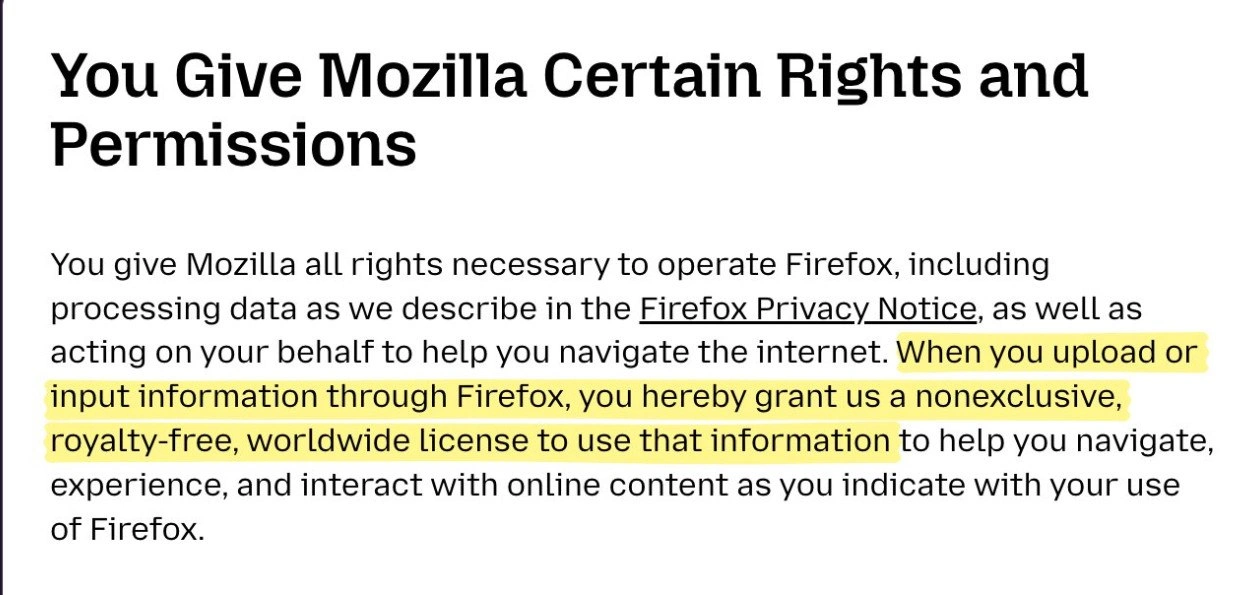
A screenshot of a legal text from Mozilla's terms of service. The heading in bold black font reads, 'You Give Mozilla Certain Rights and Permissions'. Below this, a paragraph details these permissions, with a key section highlighted in yellow. The highlighted text states, 'When you upload or input information through Firefox, you hereby grant us a nonexclusive, royalty-free, worldwide license to use that information...'. This image serves as a meme by highlighting the often-overlooked and far-reaching clauses in software terms of service. For developers and tech-savvy users, it's a cynical reminder that 'free' services often come at the cost of data privacy, with users legally granting broad licenses to their own information without realizing it. The humor is dry, stemming from the stark, legalistic language that contrasts with the user's everyday experience of simply browsing the web

Comments
93Comment deleted
We spend weeks debating the right license for a 10-line open-source library, but click 'I Agree' on a 10,000-word EULA in 0.2 seconds to get our browser update
Firefox just claimed a royalty-free, worldwide license to everything I type - great, now my 3 AM outage post-mortems are officially open-source training data for their “Stack Overflow But With Your Secrets” model
We spent years fighting IE's monopoly just to end up granting every browser vendor a "nonexclusive, royalty-free, worldwide license" to our localhost:3000 typos and accidentally pasted API keys
Ah yes, the classic 'royalty-free, worldwide license' buried in a privacy notice - because nothing says 'we respect your privacy' quite like asking for perpetual rights to everything you type into our browser. It's the legal equivalent of 'trust me bro,' but with more lawyers and fewer GitHub stars. At least they highlighted it in yellow, so you can't say they didn't warn you before you clicked 'I agree' without reading
Firefox legal: “By typing, you grant us a nonexclusive, royalty‑free, worldwide license.” Cool - my keystrokes now have a clearer IP strategy than half our deps and better global rollout than our CD pipeline
Firefox: Open-source browser where your privacy notice ships with Mozilla's data-harvesting hooks pre-installed
Nothing says “privacy-first” like a ToS granting your browser a nonexclusive, royalty‑free, worldwide license to whatever you type; my DPIA just turned into a P0
Probably just try to comply with GPDR Comment deleted
No. Thats data exfil to train some garbage AI Comment deleted
I love how it stops highlighting right before it gets to the part where it tells you what it's used for, like "stop reading where it's convenient for our narrative" Comment deleted
evil methods used for "good" things are still evil Comment deleted
"By using our browser, you give us permission to use your inputs with our browser so you can browse the net." Please explain to me how this is evil. Comment deleted
To help you do that, not so you're able to. Which means they collect these inputs and no, a browser client process doesn't have to send any inputs to Mozilla servers to function properly, it is not required Comment deleted
Where, pray tell, in that statement, does it say sending to "servers owned or operated by Mozilla or it's affiliate(s)" Comment deleted
this isn't about sending to mozilla, it's about 3rd parties and guess what a website is? a third party. well done Comment deleted
it literally just says "if you want to upload data, our program will use that data to upload it for you" Comment deleted
Sorry, but not sorry Whatever is written in intentions there doesn’t matter at all, because in reality data will be simply sold. Because, you know, earning money for Mozilla helps end user! Comment deleted
as if chrome doesn't do the same Comment deleted
1. Google doesn’t sell you data. They use it themselves for all kinds of fuckery 🌚 2. Main reason a lot of people used FF is to stay away from those practices Comment deleted
as if it is better... Comment deleted
You and @RiedleroD understand that "Bad guys do it too" is a weak reasoning, right? 🌚 Comment deleted
weak reasoning if this anti-mozilla bullshit didn't drive people to use chrome all the time Comment deleted
I'm so tired of obvious chrome marketing dividing privacy-aware users Comment deleted
The thing is that Mozilla wasn’t privacy caring company for years Comment deleted
no company is privacy caring. not a single one. if you think there is one, you're delusional. the mozilla-nonprofit is probably still fine, but the profit-driven company is obviously just as evil as any other corp Comment deleted
the difference is that if google chrome wins, the web is fucked. they already have way too much control over web standards, and if firefox actually dies at one point, there'll be zero resistance, and people will just have to follow suit with whatever google says. safari and individual khtml-based browsers don't matter, nor do forks. mozilla is already struggling to keep google from bloating the standards with new bullshit to keep new browsers from achieving usability. Apple already doesn't really care about keeping up with the standards. if google wins, it'll be worse than the IE era. and it'll be incredibly hard to get back to normal. just believe a poor webdev for once and keep using firefox Comment deleted
tip: you can disable telemetry in FF and use it without an account. they won't sell your data if they have none Comment deleted
it just means Mozilla is slowly becoming a bad guy too Comment deleted
it's more like having to decide between lex luthor co. and some guy with a relatively ok track record who has to pickpocket to survive for a few years because lex luthor co. is driving him out of business Comment deleted
as if it's true! I mean, c'mon, believing google doesn't sell your data is basically believing in santa clause Comment deleted
If anything, Google buys your data Comment deleted
Kind of honestly Comment deleted
also, I believe mozilla didn't have any problems with violating the GDPR yet. unlike google Comment deleted
Like MAYBE if there was actually something in the Privacy Notice, but this is a nothingburger. Comment deleted
Agree, also your avatar is cute Comment deleted
at most this is probably a legal safety net so they don't get sued Comment deleted
Is mostly a "if you tell Firefox to send data after clicking "Submit" you give the right to send that data to the destination" in legal language. On social media that means "if you send a message or a photo, you are giving us a permission to store and share that message/photo on whatever means we have". It is just that legal language is often very complex to explain simple things. Comment deleted
yea, makes sense. like people being afraid of the word "dihydrogen monoxide" when it's just water Comment deleted
Now dioxide, that shit kills Comment deleted
can't spell "dioxide" without "die"👍 Comment deleted
O₂ - ha! Comment deleted
O2 when O3 walks in: 🤯 Comment deleted
ozone, the devil incarnate… I will never forgive O₃ for obliterating my perf and attacking my UB Comment deleted
(gcc joke, to be clear xD) Comment deleted
Clang >> Comment deleted
perish the thought /j Comment deleted
Fine, TinyCC Comment deleted
I have no opinion on tinyCC tbh Comment deleted
Tl;Dr it literally turns C/++ into a binary. Zero optimization, zero tricks, gives no fucks about performance or error checking or anything Comment deleted
TCC is heading torward full ISOC99 compliance. …it doesn't even support full C99 yet? Comment deleted
…the website is outdated, nevermind Comment deleted
No idea never seriously used it Comment deleted
after some scouring, it seems that after 7 years of development, they still don't fully support C99 at least that's what their current documentation says: TCC not only supports ANSI C, but also most of the new ISO C99 standard and many GNUC extensions including inline assembly. This doesn't seem to be a serious C compiler, rather more of a hobby project Comment deleted
Ofc Comment deleted
Ofront+ supports being built on TCC Comment deleted
Originally it was made for International Obfuscated C Code Contest with a footprint of 3KiB. Comment deleted
"to help you navigate, experience, and interact" is a nothingburger, just a generic marketing bullshit which hides real intentions. Although this whole abstract is corpo-speak which really says nothing, but gives off bad vibes. Comment deleted
That's not how legalese works, so I guess you are the target audience of this "meme" Comment deleted
Whatever, I don't speak legalese nor do I want to, it's retarded. Comment deleted
Try tccboot Comment deleted
Heard of Comment deleted
Literally compiles your entire linux kernel with tinyCC on boot Comment deleted
what the fuck Comment deleted
Can't believe there's a dude out here using the word retarded unironically in 2025, all while referring to how they're too uneducated to care about having reasons for having their own opinions. Please touch grass. Comment deleted
Actual misinformation, I just took this screenshot from their live repo. Verbatim: "we don't sell access to your data" Comment deleted
There's also a difference between their terms of use and their privacy policy. There's an if statement there for a reason, it's so that forks of Mozilla can decide whether or not they want to sell your data, it doesn't reflect mozilla's policy as to whether or not they will. They say themselves that this does not give them a license to sell your data. Comment deleted
you have no idea how many people do this Comment deleted
https://github.com/mozilla/bedrock/commit/d459addab846d8144b61939b7f4310eb80c5470e Comment deleted
Nice work Mozilla Comment deleted
do we know what firefox-tou means Comment deleted
Its a url Comment deleted
Yes and I explained it above, it is their Terms Of Use and not related to their privacy notice. Comment deleted
does that mean that they can only sell your data if you break the terms of use? Comment deleted
…no? Comment deleted
It means downstream forks can decide if they want to sell your data, they wouldn't need to update both the terms of use and the privacy notice. Separation of concerns. Comment deleted
A commit regarding the new TOS. I guess they will sell your data anyways Comment deleted
that's the FAQ not the ToS Comment deleted
Fuck you Comment deleted
i mean it's not bad that they don't sell data if you don't agree to tou Comment deleted
Still has absolutely nothing to do with the terms of use. Whether or not they sell your data is outlined in the privacy notice, and that has not changed, and they said it will not change. Comment deleted
The privacy notice is a legal document. You can't just make up intentions behind words without defining them in the document. Comment deleted
https://adguard.com/en/blog/mozilla-deletes-promise-to-never-sell-your-data.html Comment deleted
skimmed the article. 90% of it is just unnecessary fluff and the other 10% says that we don't know jack yet before they actually start changing concrete things Comment deleted
So typical attention grabbing titles n pic Comment deleted
myea, pretty much Comment deleted
What did you expect with that AI cover?😭 Comment deleted
benefit of the doubt ig Comment deleted
This is the internet 😭 Comment deleted
aminda sent it without comment, I thought it might be interesting idk Comment deleted
I mean it was but the way you said it "fluff" perfect description Comment deleted
I thought it was a good summary for the uninitiated while not saying anything new to anyone following it, but I did fail to say that in the message Comment deleted
I see Comment deleted
omg Firefox in 2025 Comment deleted