Skip to content
DevMeme
6459 of 7435
MongoDB Stock Skyrockets After Trump Puts Tariff on Joins Joke
Databases Post #7082, on Aug 28, 2025 in TG

MongoDB Stock Skyrockets After Trump Puts Tariff on Joins Joke

Why is this Databases meme funny?

Level 1: Connecting Costs Candy

Imagine you’re playing with LEGO blocks. Normally, if you want to build something cool, you click pieces together – a wheel piece to a car piece, a door to a house, etc. Now pretend the playground boss (let’s call him Mr. Trump) makes a rule: “Every time you connect one LEGO piece to another, you have to pay one candy.” Uh oh! Suddenly, using lots of little pieces to make a big creation becomes really “expensive” for you in candy terms, because each connection (like each join) costs sweets.

What would you do? Maybe you’d start using those special big LEGO pieces that have everything in one. For example, instead of building a tree out of separate leaf and trunk pieces (and paying a candy for each join), you use one big pre-made tree piece. If a toy company sells these all-in-one pieces, you’d probably grab those to save your candy. In our pretend scenario, that company’s popularity would shoot up like a rocket, because everyone wants pieces that don’t need connecting.

This is exactly what the meme is joking about, but with databases. “Connecting pieces” is like how a database JOIN connects data from different places. If a new rule made connecting data costly (like our candy tax for LEGO), people would love a database that doesn’t need to connect pieces as much. MongoDB in the meme is like that toy company selling one-piece solutions – it stores data in one big chunk so you don’t have to join (connect) multiple parts. When the meme shows MongoDB’s stock chart spike straight up, it’s like saying “Everyone rushed to get those one-piece solutions when the new silly rule came out, making that company suddenly super valuable!” And the little joke about “foreign keys” is like saying the boss is worried about “foreign” pieces (a play on words, since foreign key is a tech term, but it sounds like something foreign, which the boss character is known to fuss about).

So, it’s funny because it’s a goofy what-if: What if a crazy rule made putting things together cost candy (or money)? The winners would be those who sell things that are already together. It’s making us laugh at how a simple rule change can flip things upside down, and it’s extra silly because it mixes a serious real-world idea (tariffs by a famous president) with a totally nerdy idea (database joins). Even if you don’t get all the tech words, you can giggle at the idea of someone taxing the act of connecting stuff, and how one clever group avoids that and comes out on top. It’s like a make-believe story where a weird law makes one toy super popular overnight – pretty zany, right?

Level 2: No Joins, No Problem

Let’s break down the key concepts and references for someone newer to databases or the industry, so the joke becomes clear:

Relational Databases and JOINs: In traditional SQL databases (like MySQL, PostgreSQL, Oracle), data is organized into tables. Each table holds rows of a specific entity (for example, a Users table for user info, and an Orders table for purchases). A JOIN is an operation that allows you to combine data from two (or more) tables into a single result, based on a related column they share. For instance, if we have a users table and an orders table, the orders table might have a column user_id that stores the ID of the user who made each order. That user_id in orders is a foreign key – basically a reference to the primary key (usually an id) of the corresponding user in the users table. If you want to list users along with their order totals, you would "join" the two tables on users.id = orders.user_id. The SQL might look like:

SELECT users.name, orders.total
FROM users 
JOIN orders ON users.id = orders.user_id
WHERE users.id = 42;

Here, JOIN ... ON ... tells the database to match each row in users with the rows in orders that have the same id (user ID). Foreign keys ensure referential integrity, meaning the database prevents an order from referencing a user that doesn’t exist, and they make joins possible by providing that common link. In plain terms, a join is like matching puzzle pieces by the labels on their backs: “Oh, this order has user_id 42, let me find the user with id 42 and stick these together.” Joins are super powerful because they let you keep data organized (no duplication) but still query it all together. The trade-off is that if you have to join a lot of tables or very large tables, it can become slow or resource-intensive (imagine trying to cross-match two huge lists — it’s work for the computer).

NoSQL Databases and MongoDB: NoSQL stands for “Not Only SQL.” It’s an umbrella term for databases that don’t use the traditional table-based relational model. There are key-value stores, column-family stores, graph databases, and document databases – MongoDB is a popular document-oriented database. Instead of tables, MongoDB stores data in collections of documents. A “document” is basically a JSON-like object (technically BSON, a binary JSON) that can hold nested fields and even arrays. For example, instead of having separate users and orders tables, in MongoDB you might have a users collection where each document not only has the user’s basic info, but also an embedded array of that user’s orders. That means all of a user’s orders are stored inside the user’s document. When you need the user with all their orders, you just retrieve one document – no need to JOIN across collections because the data is already together. This is what we call denormalization: you’re not splitting data into normalized tables; you’re keeping related data together even if it means copying some things. There’s an old joke slogan, “No joins, no problems,” which playfully describes how document databases avoid the whole complexity of join operations by design.

Now, why would someone do this? One reason is speed/scalability: if your data is already joined (embedded) within one document, queries can be faster, especially in a distributed setting. It also simplifies scaling horizontally: each document can live on a shard (a separate server), and you can often get what you need with a single lookup on one shard. With a relational DB, a complex join might require pulling data from multiple shards or doing more in-memory work. However, the flip side is that NoSQL might duplicate data or lose those nice integrity guarantees (for example, it’s up to your application to ensure an order actually aligns with a valid user, since the database might not enforce a foreign key constraint in the same way).

Tariff (Tax) and the Political Joke: A tariff is basically a tax on imported goods. Governments use tariffs to make imported items more expensive, hoping to encourage people to buy domestic products instead. In the meme, saying “Trump puts a tariff on joins” imagines a world where using a join (a database operation) incurs a tax or financial penalty, as if join operations were “imports” from a foreign land that the government doesn’t like. This is a joke, of course – no government is taxing computer operations! But it’s poking fun at real-world events: the reference to Trump is likely about the period when President Trump was known for imposing various tariffs (taxes on steel, electronics, etc., often to push an agenda of buying American or as part of trade negotiations). By substituting “foreign goods” with “foreign keys/joins,” the meme creates a whimsical scenario that is both geeky and satirical.

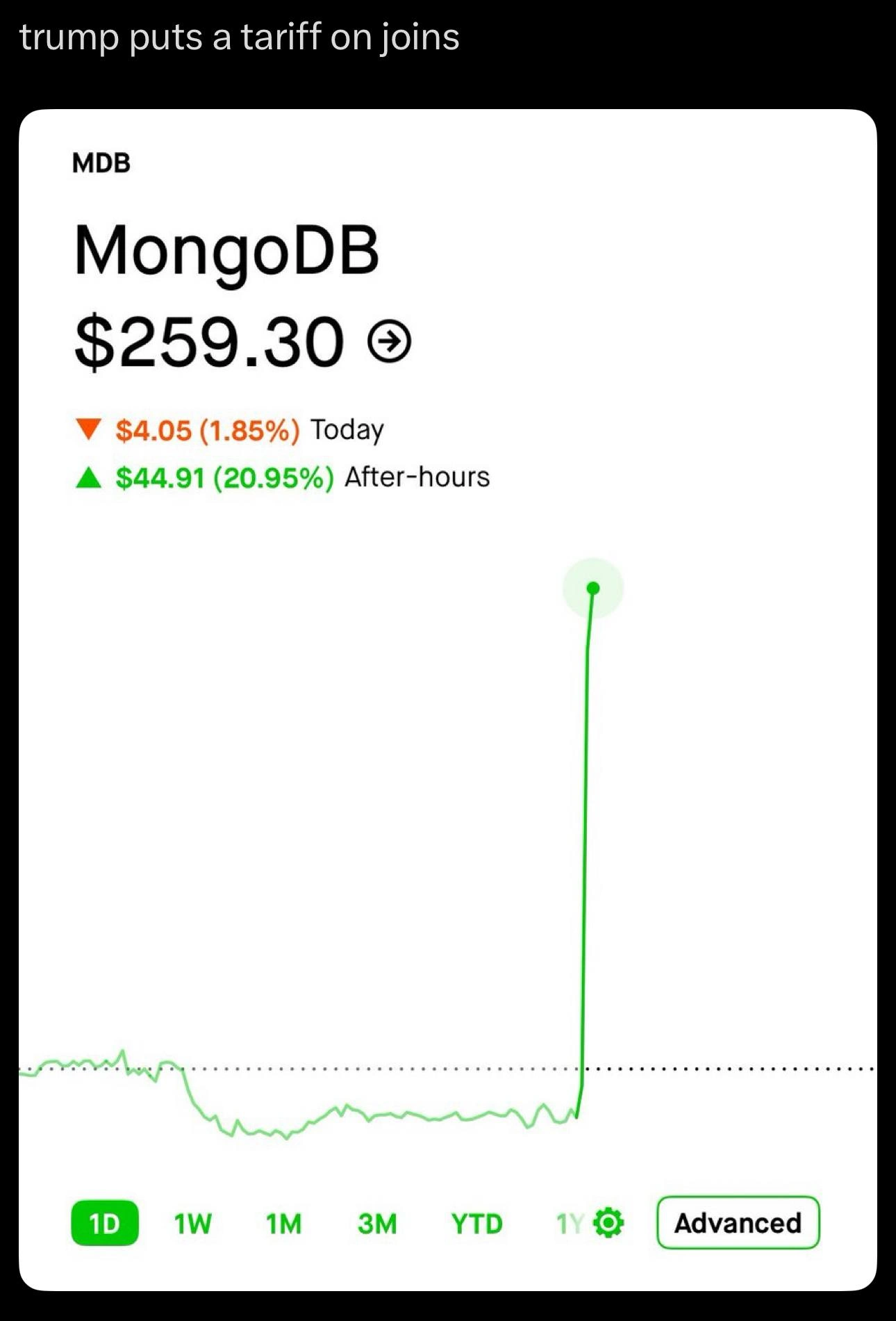
MongoDB Stock Spike and After-hours: The meme shows what looks like a stock trading app (similar to Robinhood or others) with MongoDB’s stock chart. It’s showing two numbers: one for “Today” (down a bit, in red) and one for “After-hours” (up a lot, in green). In real stock markets, after-hours trading is what happens once the regular trading day is over (markets usually close around 4pm). Prices can still move in after-hours if some news breaks or in lighter trading. Often, if a big piece of news hits (like earnings reports or a big announcement), a stock might jump or dive after-hours when people react, even though most people won’t trade it until the next day’s regular session. In this image, the after-hours movement is ▲ $44.91 (20.95%), which is huge – about a 21% increase. That kind of jump might happen if, say, a company announced amazing earnings… or, humorously, if suddenly their market opportunity expanded because the competition got handicapped by a policy. Here, the joke is: as soon as the tariff on joins is announced, investors think “Relational databases are doomed or more costly to use; everyone will move to MongoDB!” and so the MongoDB stock price rockets up. The green line on the chart is basically flat (maybe MongoDB stock was quiet all day) and then it shoots straight up like a vertical line – that represents that sudden spike after the announcement. It’s an exaggerated representation but gets the point across instantly.

“Too concerned with foreign keys” – the pun explained: This was the poster’s comment. It’s a play on words. In database lingo, foreign keys are those references that allow joins (linking one table’s foreign key to another table’s primary key). In everyday/political lingo, “foreign” often refers to other countries. Trump was (in)famously concerned with “foreign” entities – whether it was foreign products (hence tariffs), foreign countries in trade, or foreign nationals in immigration. The commenter jokes that he’s “too concerned with foreign keys,” implying Trump has extended that concern to something as geeky as database keys that happen to be called “foreign.” It’s a classic dad-joke style pun that makes techies snicker and facepalm at the same time.

In simpler terms, the meme is saying: If you make traditional database joins expensive (like by a law or tax), then a database that doesn’t need joins (MongoDB, a NoSQL database) suddenly becomes a superstar. It’s poking fun at how an external change in rules can flip the tables and make one technology way more desirable. It also gently satirizes tech hype: sometimes one change or new idea suddenly makes everyone flock to a particular technology. Here that “one change” is absurd (a tariff), but it mirrors how, say, a big shift in industry practice (like mobile computing rising, or a new framework becoming popular) can send companies scrambling to adopt a tech (and investors scrambling to buy stock in it).

To anyone new: don’t worry, there’s no real tariff on database operations! This is a meme blending the worlds of politics, economics, and geeky database humor. The key things to know are that SQL joins are a fundamental but sometimes heavy operation in old-school databases, MongoDB is a modern database that avoids joins by design, and tariffs are taxes on things – combining those concepts is what makes this a fun, tongue-in-cheek joke.

Level 3: NoSQL to the Moon

Now let's unpack the humor from a seasoned developer’s perspective. The meme mixes tech jargon with political absurdity and a dash of investor hysteria to create a perfect storm of IndustryIrony. The top caption reads, “trump puts a tariff on joins,” instantly provoking a double-take: it yanks the idea of trade tariffs (famously associated with politicians like Trump imposing taxes on imported goods) into the realm of databases. Seasoned devs immediately recognize “joins” as something completely unrelated to politics – they’re a database operation – so the incongruity is laugh-out-loud silly. It’s as if government trade policy suddenly cared about our database query patterns! That’s step one of the humor: a surreal collision of worlds.

The punchline lands with the image of a stock chart for MongoDB (MDB) that’s flat during normal hours and then spikes vertically upward after hours, showing a huge ▲ 20.95% jump. The implication is clear to anyone who knows the classic SQL vs. NoSQL debate: MongoDB – a document database that doesn’t require joins for data retrieval – just got a huge boost because the competition (relational databases) got kneecapped by a tariff on doing joins. It’s like a bizarre alternate universe where government policy suddenly punishes relational database designs. If such news actually hit, investors might indeed think, “Whoa, MongoDB’s market just got bigger,” and the stock would moon-shot accordingly. The visual of the hockey-stick graph – a flat line and then a straight-up spike – is a common meme trope for something “going to the moon” after a catalyst. Here the catalyst is outrageously specific and nerdy, which makes it even funnier. We’re essentially looking at a NoSQL stock surge propelled by political whimsy.

Why is this so funny to those of us in tech? Because it satirizes both tech hype cycles and the sometimes nonsensical reasons stocks soar. We’ve all watched some new technology get massively hyped for allegedly solving a big problem. In the late 2000s and early 2010s, NoSQL databases were the hype darlings. They promised incredible scale, easy replication, and schema flexibility – often summarized as “we don’t need no stinkin’ JOINs or schemas, we’re web-scale!” Many of us remember that tongue-in-cheek phrase “MongoDB is web scale” from a famous viral rant – a satire poking fun at MongoDB’s hype by exaggerating its features. The meme here taps into that memory: MongoDB’s marketing angle has long been that you can get rid of the complexity of joins by storing data in a single nested document. DatabaseHumor often revolves around these trade-offs: if you’ve ever been burned by a slow 5-table join or struggled with complex foreign keys relationships, the idea of a database that “just saves JSON blobs” sounds enticing.

Of course, experienced engineers also carry the scars of NoSQL’s limitations. Sure, you avoid joins… but then you might deal with duplicated data or need to do pseudo-joins in your application code. (I.e., you avoided SQL join syntax, but maybe now you have to manually stitch data from multiple Mongo queries, or you lose some data integrity guarantees that relational DBs gave you.) There’s an unspoken camaraderie in having seen both the overzealous relational purists and the overzealous NoSQL adopters learn these lessons. So the meme’s scenario tickles that part of us that’s a bit jaded: “Wouldn’t it be crazy if, instead of technical merits, a goofy external factor like tariffs made everyone switch to NoSQL? Ha, as if architecture decisions weren’t already sometimes made on silly bases!”

This leads to another layer of humor: IndustryTrends_Hype and the absurd drivers behind tech decisions. In real life, companies sometimes adopt technologies for questionable reasons (buzzword compliance, anyone?). Maybe the CEO read an article about how “NoSQL will save millions” and decreed a switch, or investors pushed a startup to use the “hot new database” to sound more cutting-edge. This meme exaggerates that phenomenon to the extreme: here it’s not a tech blog or a Gartner report influencing architecture, but a political decree with economic incentives. It’s a playful jab at how fickle and hype-driven the tech industry (and the stock market that loves it) can be. In reality, could a government policy ever be so granular as to affect database joins? Highly unlikely (and technically ridiculous!). But that’s what makes it satire. It’s taking a real concept – tariffs impacting markets – and colliding it with a totally unrelated domain – databases – to highlight the craziness of both worlds. After all, we did see odd political tech tangles in the past (encryption export laws, social media regulations, etc.), but “architecture by government mandate” is next-level absurd.

The “foreign keys” pun in the post message, “I guess he’s too concerned with foreign keys,” is the cherry on top for those in the know. A foreign key in databases is a field that links one table to another (essentially what you use to join tables). The word “foreign” gives the pun its bite because of Trump’s well-known focus on “foreign” matters (foreign trade, foreign nationals, etc.). It’s implying: He’s so paranoid about foreign things, he even targets foreign keys! This kind of pun is classic TechSatire – it’s a groaner for sure, but it’s exactly the sort of wordplay that makes developer memes endearing. We groan and laugh because it connects two disparate meanings of “foreign” in a single jab.

From a senior developer angle, there’s also a wink here about how we sometimes optimize for cost in cloud architectures. If you squint, “tariff on joins” resembles the reality that heavy join queries in cloud databases (like a massive join in BigQuery or a complex multi-table join in AWS Aurora) do end up costing more – not by law, but in actual cloud compute seconds or memory. Seasoned devs often talk about how certain queries “tax the database” or how over-normalizing can lead to “taxing joins” in terms of performance. We usually solve that by caching or denormalizing hot data, effectively avoiding the costly join — just like switching to MongoDB in the meme. It’s a case of a joke that mirrors real strategies in a ludicrous way.

And let’s not ignore the stock market parody element. Many tech folks also follow the industry stock trends. We’ve seen bizarre after-hours jumps when some news hits – sometimes rational, often not. For example, if a major government contract is announced for a cloud provider, their stock might spike, or if a regulation hurts a company’s product, their competitor’s stock might soar. The meme lampoons this by creating a fake scenario where a regulation (join tariff) hurts traditional SQL database companies, thus MongoDB’s stock rockets up ~21%. The “Robinhood-style” interface (green and red arrows, the After-hours label, even the 1D 1W 1M… range buttons and the little gear icon) is immediately recognizable to modern audiences who’ve seen screenshots of meme stocks or have traded themselves. It sets the stage: this is TechIndustry meets Wall Street meets absurdity. A senior dev or tech worker can appreciate how it captures the essence of hype – one announcement and boom, a graph that looks like a rocket launch. It’s “NoSQL to the Moon!” in visual form.

Overall, this level of analysis reveals the multi-layered humor:

  • Absurd literalism: Taking “tax on foreign imports” and turning it into “tax on foreign keys (joins)” – silly in a literal sense.
  • Tech insider nod: Only in our world do “joins” and “foreign keys” mean something, and seeing them in a political-economic context is bizarrely funny.
  • Hype cycle commentary: It pokes fun at how non-technical influences (like politics or fashion) sometimes drive tech adoption more than actual technical merit. The NoSQL vs SQL debate had its fair share of irrational exuberance, just like stocks do.
  • Shared pain: Most experienced devs have at least one story of a monstrous join or a time they pondered switching a project to MongoDB/Cassandra just to handle scale, only to trade one set of problems for another. This meme gets a knowing chuckle because it alludes to that reality in a roundabout way. “Haha, if only a tariff could justify that refactor!”

In essence, the meme resonates on multiple frequencies of tech humor – political satire, database in-joke, and commentary on hype economics. It’s the kind of thing you’d share in your dev team’s Slack and watch people react with 🤣 and 🤦 emojis simultaneously. MongoDB being the star of the show is apt: it’s been both celebrated and mocked in our industry. Seeing its stock “moon” due to something as ludicrous as a join tariff is a perfect hyperbole of the NoSQL IndustryTrends_Hype we’ve witnessed. And if you’ve been around long enough, you can’t help but smirk and think, “Well, stranger things have happened in tech!”

Level 4: Denormalization Dividend

At the most technical level, this meme hints at fundamental database theory and data modeling trade-offs. In relational algebra (the mathematical backbone of SQL databases), a JOIN is a core operation that merges two sets (tables) based on a common attribute. Edgar F. Codd first defined these operations in 1970 as part of the relational model. Performing a join essentially computes a combination of rows from Table A and Table B where some key matches – conceptually similar to an intersection in set theory. The cost of a join can explode combinatorially if not optimized, especially for large tables: a naive nested-loop join takes $O(n \times m)$ time (where n and m are table sizes). Modern relational databases employ sophisticated query optimizers and algorithms like hash joins and merge joins to make this feasible on millions of rows. They also use indexes (like B-trees on foreign key columns) to cut down search time dramatically. Still, a join remains one of the heavier operations in an RDBMS, often requiring reading a lot of data and matching keys. It’s the reason a whole branch of computer science is devoted to query optimization and why DBAs get wary eyes when someone writes a 12-table join without proper indexes.

In this meme’s absurd scenario, “trump puts a tariff on joins,” we're treating the JOIN operation’s cost as if it were a literal economic cost or tax. Interestingly, database systems already have the concept of “cost” — not in dollars, but in computing resources. Cost-based optimizers assign a numeric cost to each possible query plan (e.g., performing a join vs. using a subquery vs. an index lookup) and choose the lowest “cost” plan. So, the meme tongue-in-cheek suggests: what if an external policy imposed an actual monetary cost on using JOINs? This would immediately change how we model data, echoing one of the oldest trade-offs in database design: normalization vs. denormalization. In a fully normalized design (3rd normal form or higher), data is split into many tables to avoid redundancy, and you pay the price (in time/complexity) of join operations to put the data back together at query time. In a denormalized design (favored by many NoSQL systems), you store related data together (even if it means duplication) so that queries can retrieve a whole object without joins – effectively paying a storage cost up front to save on query-time cost.

If joins suddenly carried a literal tariff, the “denormalization dividend” becomes huge: systems designed to avoid joins entirely would have a massive economic advantage. This is exactly what the meme shows: MongoDB, a popular NoSQL (document-oriented) database, sees its stock price rocket upward when news breaks that joins are taxed. Why? Because MongoDB’s data model encourages storing all related info in one document (a BSON/JSON record), meaning you typically don’t do server-side join operations like in SQL. The joke leans on the fact that MongoDB’s marketing and design philosophy for years has been “no joins, no problem”. Under the hood, MongoDB sacrifices some relational capabilities – it doesn’t enforce relationships with foreign keys at the database level – in exchange for quick retrieval of self-contained documents. That works great for many modern applications where data for an entity (say a user and their posts) can be aggregated in one place, at the cost of duplicating some info. It’s grounded in the CAP theorem and distributed system design: avoiding multi-collection transactions (like multi-table joins) makes it easier to scale horizontally and remain available under partitioning, because each query hits a single document on a single node.

Historically, the tension between relational databases and NoSQL arose from scaling demands. For instance, companies like Google and Amazon published seminal papers (Bigtable in 2006, Dynamo in 2007) pointing out that the conventional RDBMS approach struggled with the massive scale and partitioned clusters needed for the web. Their solutions sharded data and often eschewed complex operations like joins. Instead of performing a join at query time, Bigtable-style systems encourage one big wide table or row with lots of repeated data, and Dynamo-style key-value stores leave relational logic to the application. This makes distributed consistency easier but pushes the burden elsewhere. Academically, this is a classic example of trading compute complexity for data redundancy – a bit like paying a tariff vs. investing domestically.

So, at this deep level, the meme highlights a geeky economic metaphor: A “tariff” on joins accentuates the inherent cost of relational algebra’s join operation. It underscores why NoSQL emerged (to avoid paying that cost under certain conditions) and slyly nods to how even the best optimizers can’t completely magic away the fundamental costs of combining large datasets. If you literally tax joins, you formalize a cost that was always there in CPU cycles. Naturally, data architects would react by nearly eliminating normalized, join-heavy schemas in favor of pre-joined (denormalized) data models – exactly what NoSQL advocates. The denormalization dividend would be reaped by technologies like MongoDB that have already oriented themselves around a join-less paradigm. It’s a perfect, if comically exaggerated, illustration of how economic incentives (or penalties) can drive technical architecture choices – a concept sometimes discussed in system design (e.g., thinking of each microservice call as having a “cost” encourages fewer, more coarse-grained calls, similar to how thinking of each join as having a cost encourages denormalization). In short, by imposing a literal cost on a fundamental set operation, the meme cleverly exposes the underlying computational economics that engineers juggle when picking a database architecture. And it’s hilariously fitting that a political figure known for literal tariffs and obsession with the word “foreign” is the one introducing this hypothetical technical tariff – leading to a (fictitious) market frenzy favoring the join-free world.

Description

A screenshot with the caption 'trump puts a tariff on joins' above a stock ticker showing MongoDB (MDB) at $259.30, down $4.05 (1.85%) during regular trading but surging $44.91 (20.95%) in after-hours trading. The stock chart shows a massive vertical spike in the after-hours session. The joke is that since MongoDB is a NoSQL database famously known for not supporting joins (or making them very expensive), if the US government put a tariff on SQL joins, MongoDB would benefit enormously as companies would be forced to use NoSQL databases instead

Comments

29
Anonymous ★ Top Pick Finally, a government policy that aligns with MongoDB's architecture: making joins prohibitively expensive is just fiscal policy now
  1. Anonymous ★ Top Pick

    Finally, a government policy that aligns with MongoDB's architecture: making joins prohibitively expensive is just fiscal policy now

  2. Anonymous

    Finally, a macro-economic justification for that decade-old "we chose Mongo because it doesn’t need joins" slide

  3. Anonymous

    Ah yes, the classic architectural pattern where your NoSQL database stock moons 21% because someone threatened to make JOINs more expensive - though at this rate, MongoDB's market cap will soon exceed the total cost of all the denormalized data duplication it's ever caused

  4. Anonymous

    Finally, a tariff policy that makes sense to database architects: MongoDB stock soars 21% after-hours on news that SQL JOINs will be taxed. Turns out the real cost of normalization wasn't just the N+1 queries - it was geopolitical all along. Meanwhile, senior engineers who've been denormalizing data for performance are now being hailed as economic visionaries, and every startup is pivoting to document stores to avoid the 'relational overhead tax.' The irony? MongoDB's $lookup operator is basically a JOIN in disguise, but apparently the market hasn't read the aggregation pipeline docs yet

  5. Anonymous

    Tax JOINs and every architect’s cost‑optimization deck becomes denormalization, with finance asking if MongoDB’s $lookup qualifies as a foreign trade agreement - latency being the hidden tariff

  6. Anonymous

    Tariffs on joins? MongoDB architects: 'Finally, geopolitics validates our duplication strategy over that relational tax.'

  7. Anonymous

    If joins get “taxed,” everyone migrates to Mongo and then reimplements them in microservices - congrats, you’ve built a slower distributed join with egress fees

  8. F 10mo

    Left join liberals and Right join conservatives

  9. @vladyslav_google 10mo

    Actually, MongoDB doesn't inherently support joins 🤓🤓🤓

  10. Deleted Account 10mo

    scam detected! it's honeypot token - foxy said

    1. @deadgnom32 10mo

      have you ever heard of a slavic drink "cumpot"?

      1. Deleted Account 10mo

        Wait, thats a real thing?

        1. @deadgnom32 10mo

          sure.

        2. @deadgnom32 10mo

          it's spelled differently but pronounced exactly like this.

      2. Deleted Account 10mo

        ahhh, I got now what's cumpot

      3. Deleted Account 10mo

        thanks god I didn't think "cum" pot

      4. @RiedleroD 10mo

        called kompott in german … but I wouldn't drink that. I mean I guess technically it's similar to a smoothie, but like. no. it's sauce for kaiserschmarrn and similar things.

        1. @RiedleroD 10mo

          ok I did some more research, apparrently: - what we call Kompott here in upper austria is called Mus or Dauch elsewhere, and is more similar to "apple sauce" in english than "Kompott" in other german-speaking regions and really the rest of europe

          1. @RiedleroD 10mo

            - the thing you mean is indeed Kompott in german, and also Kompott here, but since we use the word Kompott for both this and apple sauce, the less popular one normally has to be specified

            1. @RiedleroD 10mo

              - I still wouldn't drink it tho

            2. @RiedleroD 10mo

              to elaborate on this: - if we say "apfelkompott" we mean apple sauce - if we say "pfirsichkompott" we mean peach cumpot (more commonly called "einglegter pfirsich" though, meaning roughly "preserved peach")

          2. @deadgnom32 10mo

            yeah, the composition differs across countries.

        2. Deleted Account 10mo

          Oh, i know whats that. Compota in spanish

  11. @RiedleroD 10mo

    idk it just feels wrong. doesn't help that I don't like cumpot in the first place (apple sauce is nice tho)

    1. @pdsnrc 10mo

      maybe you need slav genes to be able to drink it

      1. @RiedleroD 10mo

        yknow what, imma ask my gf what she thinks about this

        1. @RiedleroD 10mo

          she says it's drinkable… (she's polish)

    2. @Algoinde 10mo

      компот is literally just boiled berries/fruits with sugar in drink form

      1. @RiedleroD 10mo

        still don't like it

Use J and K for navigation