Skip to content
DevMeme
6458 of 7435
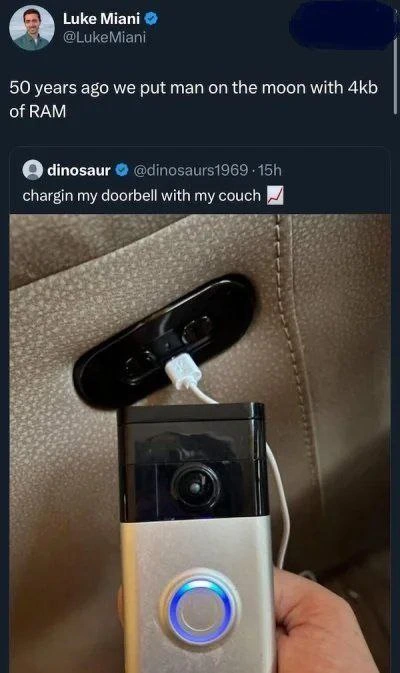
IoT Doorbell Charged Via Couch USB Port Despite Moon Landing With 4KB RAM
IoT Post #7081, on Aug 28, 2025 in TG

IoT Doorbell Charged Via Couch USB Port Despite Moon Landing With 4KB RAM

Why is this IoT meme funny?

Level 1: Huge Tech, Tiny Job

Imagine your grandparents tell you a story: when they were young, they had a tiny little car with a very small engine, and with it, they managed to drive all the way to the top of a huge mountain. Now, today, you have a giant, super fancy SUV with a big engine just to go buy groceries down the street – and somehow you’re still worried it might run out of gas on the way. That’s the kind of funny feeling this meme gives us.

A long time ago, humans did one of the most amazing things ever – we sent people to the Moon. And get this: the computer that helped navigate that spaceship had about as much memory as maybe a single page of a comic book scanned into a computer. It was incredibly small and simple by today’s standards. Think of it like a really basic calculator – yet with a lot of clever planning, that little brain guided a rocket all the way to the Moon and back. Wow!

Now fast-forward to today. We love making “smart” versions of everything – even a doorbell, the thing that rings when someone’s at your door. A smart doorbell has a camera and connects to your phone so you can see who’s there or get a video of visitors. Cool, right? But because it does so much, it’s kind of like having a little smartphone stuck to your door. And just like a phone, it needs to be charged regularly or its battery dies. In the picture from the meme, someone took their doorbell off the wall to charge it, and they plugged it into their couch – yes, the sofa in the living room – because the couch has a USB power outlet on it (some modern couches do, for charging phones). So essentially the couch is “feeding” the doorbell some electricity so it can work again. It’s a pretty silly scene if you think about it: the couch is charging the doorbell.

The reason this is funny is the contrast: big accomplishments with tiny technology before, versus tiny convenience with big technology now. It’s like if you heard your ancestors built an entire house using just a hammer and nails, and nowadays you need a whole construction crew and power tools just to fix a mailbox. It feels backwards, right? Sending astronauts to the Moon was a huge job, and they did it with a tiny computer. But answering the door is a small job, and we’re doing it with a huge computer (the smart doorbell) that’s so high-maintenance it even needs to suck power from the nearest couch.

Emotionally, it makes us laugh and shake our heads. We’re amazed at how resourceful people were back then, and we’re poking fun at how spoiled and complicated we’ve made things now. It’s not that new doorbells or gadgets are bad – they’re super handy in many ways – it’s just funny that with all our advanced technology, we end up in situations that are a bit ridiculous. It’s as if someone from the past asked, “So in the future, with all those powerful computers, what are you doing?” and our answer is, “Well… sometimes we use them to make doorbells that need to be charged by our sofas.” That would probably make them laugh, and maybe feel a little puzzled!

In simple terms, the meme is humorously saying: We used to do great big things with just a little tech, and now we need great big tech even for little things. It’s a playful reminder to not over-complicate things, and it makes us appreciate how far tech has come – for better or for sillier.

Level 2: Smart Home Overkill

This meme highlights a big TechHistory contrast using a simple image and text. Let’s break it down in plain terms. The top part references the Apollo Moon missions: “50 years ago we put man on the moon with 4kb of RAM.” Here, 4 KB of RAM means just four kilobytes of memory, which is an incredibly tiny amount by today’s standards – roughly enough to store only a few paragraphs of text. Back in 1969, however, that was the cutting edge. The Apollo Guidance Computer was the onboard computer that helped astronauts navigate and land on the Moon, and it ran with that minuscule amount of memory. Despite being so limited, it successfully guided an enormous rocket and the Lunar Module. That line is basically saying: “Can you believe how little computing power we had, and yet we achieved something as monumental as a Moon landing?” It’s setting up a sense of awe about old-tech efficiency.

Now, the second part of the meme leaps to present day and shows how different things are now. It’s a tweet that says: “chargin my doorbell with my couch 📈” accompanied by a photo. In the photo, someone is literally charging a doorbell using their couch. How? The person has a smart video doorbell (it looks like a Ring doorbell, which is a brand of internet-connected doorbell with a camera). This doorbell is usually mounted by your front door and lets you see video of visitors on your phone. It runs on a battery. In the picture, the person has removed the doorbell from its mount (probably because its battery died) and plugged it into a USB port on their couch to recharge. Yes, you read that right: many modern couches come with a built-in USB port in the armrest or side, intended for charging phones or tablets while you lounge. So the phrase “charging my doorbell with my couch” is literally true in the image – the couch is acting like a phone charger for the doorbell. The 📈 emoji is like a playful indicator of something trending upward or reaching a new high; here it suggests “This is next-level ridiculous (or awesome, depending on how you see it).”

So why is this funny? It’s pointing out the absurdity of modern gadgets – we’ve made even a doorbell into a mini-computer that needs as much charging as a smartphone. A doorbell, historically, is just a simple device that rings when someone presses a button. It might use a tiny battery or be wired to house power, and you’d rarely think about it. But a “smart doorbell” today has a camera, a microphone, a speaker, motion sensors, Wi-Fi connectivity to the internet, and it sends video to your phone. Essentially, it’s like a little IoT security camera stuck to your door. Because of all these features, it consumes a lot more power than a traditional doorbell. If it’s not hardwired, it relies on a battery, which can drain in a matter of weeks or even days if there’s a lot of activity. That means you have to recharge it regularly – which is a pretty weird concept if you think about it: recharging your doorbell! In the photo, the person chose the convenient route of using the couch’s USB port rather than removing the battery or bringing the doorbell to a wall outlet. It’s a funny visual because the doorbell is this chunky gadget bigger than your hand, and it’s plugged into the side of a couch — something you’d never have seen or needed to do in the past.

The meme’s punchline comes from comparing those two scenarios:

  • Then (50+ years ago): We could send people to the Moon and back using a computer with only kilobytes of memory. No fancy user interface, no internet, just pure optimized code running on brutally limited hardware – and it worked!
  • Now: We have billions of times more computing power available in everyday life. We use some of that to create smart home devices, like a video doorbell that connects to the internet. But the result is that this doorbell, despite all its advanced tech, can’t even keep itself powered for very long. We end up plugging high-tech gadgets into random things (like couches equipped with outlets) to keep them running.

This contrast is often expressed as “over-engineering” or “using a sledgehammer to crack a nut.” In other words, we’ve thrown a lot of technology at a simple problem (wanting to see who’s at the door), and it solved the problem – but introduced new hassles (like remembering to charge the doorbell). It feels over-the-top. The meme exaggerates it to make us laugh: imagine telling an engineer from 1969 that in the future, doorbells will have more electronics than the Apollo spacecraft and you’ll have to charge them using your living room sofa which itself has a computer port — it sounds like a joke. And yet here we are!

For someone early in their tech career or just learning about this stuff, there are a few key concepts and terms here:

  • Internet of Things (IoT): This refers to ordinary objects that are now made “smart” with sensors, chips, and internet connectivity. A smart doorbell is a perfect example of IoT. Others are smart fridges, smart lights, even smart toasters. The IoT trend is all about convenience and connectivity – your devices can be monitored or controlled via the internet – but it often means these devices are much more complex than their traditional counterparts.

  • 4 KB of RAM: RAM is like a device’s short-term memory where it stores data it’s working on. 4 KB is a tiny amount – for perspective, a single small photo on your phone can be 500 KB or more, so 4 KB is about 1/125th of that. That’s all the memory Apollo’s computer had to work with at any given time. Modern computers and devices have many thousands of times more. For instance, a typical smartphone might have 4 GB of RAM (which is about 1,000,000 times more than 4 KB!). Even something low-end, like a simple smart watch or likely a video doorbell, will have tens of megabytes of RAM (tens of millions of bytes) at least, to run its programs.

  • Charging via USB: USB ports provide a standard way to supply power (5 volts) to devices, which is why you see them on battery packs, cars, and yes, even couches. The couch in the meme has a built-in USB port, probably connected to the house’s electricity (through the couch’s power plug) so that you can sit and charge your phone or tablet. Here it’s being used to charge the doorbell. That’s not the intended use of a couch, of course – couches are for sitting and relaxing – but modern life has blended furniture and tech together.

  • Over-engineering: This term means adding more complexity or features to something than is actually necessary to fulfill its basic function. A classic simple doorbell just rings a bell. A modern smart doorbell does that and a ton of other things (video streaming, etc.), which arguably is more than necessary just to answer your door. Over-engineering often leads to more points of failure or more maintenance – as illustrated by the need to charge it.

  • Tech nostalgia vs. reality: There’s a bit of wistfulness (a nostalgic feeling) in the top tweet: “we did so much with so little back then,” implying maybe we should be able to do great things easily now given we have so much more power. On the other hand, reality is shown in the bottom tweet as somewhat comical: “look what we actually end up doing – we use all that power to make even doorbells complicated.” It’s a tongue-in-cheek way to critique modern tech trends.

In simpler terms, the meme is saying: “We went to the Moon with a tiny computer, but now our fancy doorbells are so high-tech they need to be charged by our furniture. Kinda crazy, right?” It’s poking fun at how far technology has come (in terms of power), and yet how we sometimes apply that power in ways that seem silly or inefficient.

For a junior developer or tech enthusiast, it’s a gentle reminder and lesson: just because you have more resources (CPU, memory, etc.) available, doesn’t mean you have to use all of them for a basic task. Simplicity and efficiency can be very powerful – the Apollo team had no choice but to be efficient, and they achieved something incredible. Today, we often have the luxury of powerful hardware, which can lead to sloppy or extravagant designs (because we assume the hardware can handle it). This isn’t to say modern smart doorbells aren’t useful – they are! – but it’s funny to see the extreme contrast in scale. It encourages a bit of reflection: Are we adding tech to things just because we can, rather than because it truly makes them better? And if we do, are we okay with the new inconveniences that come along (like yet another device to charge)?

In summary, Smart Home Overkill is when your simple home devices become so advanced that you end up with new “modern problems” – like a doorbell that needs a recharge. The meme gets this idea across in a way that’s easy to chuckle at, even if you’re not deeply technical, because anyone can appreciate how ludicrous “charging a doorbell with a couch” sounds. It’s a snapshot of our current tech moment, contrasted against a historic tech achievement, to highlight just how wild the difference is.

Level 3: Overengineering Odyssey

At first glance, this meme’s two-part tweet seems absurdly funny – and for those of us in tech, it’s achingly relatable. The top tweet reminds us: “50 years ago we put man on the moon with 4kb of RAM.” TechHistory at its finest – a single sentence that highlights how astronomically (pun intended) ambitious engineers were with ridiculously limited hardware. The quoted reply shows a present-day reality: “chargin my doorbell with my couch 📈”, alongside a photo of a chunky Ring-style video doorbell literally tethered by a USB cable to a port in a couch armrest. The humor hits like a rocket booster because it contrasts two eras and achievements in a single frame. It’s the ultimate ModernVsLegacy comparison: Apollo-era minimalist design vs. modern InternetOfThings gadget glut.

Why is this so funny (and a bit painful) to those of us in the industry? Because it highlights an IndustryIrony we joke about all the time: we accomplished spectacular feats with primitive tech, yet today we often throw excessive tech at trivial problems. Landing humans on the Moon in 1969 with a 70-pound onboard computer running on 4 KB of memory – that’s the ultimate “moonshot” project done with minimalist means. Meanwhile, here in 2025, we have a doorbell – a device whose primary goal in life is to ring and maybe show who’s at the door – that contains more computing power than entire rooms of 60s hardware… and somehow it still runs out of battery to the point that you’re charging it from your living room furniture! This is OverEngineering in everyday life, and the meme perfectly captures that ridiculous escalation. The phrase “charging my doorbell with my couch” sounds like a non sequitur, like something out of a tech comedy sketch, yet it’s real. Many of us have been there: the smart home gear that was supposed to make life convenient ends up needing its own babysitting. SmartHome Overkill is when your simple doorbell now: records 1080p video, streams to the cloud, sends smartphone alerts, uses AI to distinguish between a person and a stray cat – and as a result, demands a recharge every few weeks or days. Compare that to a traditional doorbell: a simple chime powered by a low-voltage wire or battery that might last a year. The meme exaggerates it by showing even the couch has been conscripted into this technological circus. Many modern couches indeed come with built-in USB ports (often tied into the couch’s power recliner or lamp plug) for charging phones or gadgets. It’s a handy feature, but here it becomes part of the joke: even our furniture has to adapt and serve our power-hungry gizmos. A couch, of all things, is now effectively a charging station for a doorbell. That’s a level of consumer_electronics_escalation no one in 1969 would have believed.

The 📈 emoji in the tweet (“charginn my doorbell with my couch 📈”) is the cherry on top. In Twitter vernacular, people use this upward trending arrow to imply “peak” or “increasing trend.” It’s like the author saying: Look how over-the-top things have gotten – it’s only going up from here! The doorbell plugged into a sofa is presented as a new high (or low) in technological absurdity, a trend line spiking straight into the comedic stratosphere. The senior engineers among us chuckle (and maybe groan) because we recognize plenty of similar scenarios. Think of all the times software and hardware over-complicate something simple: refrigerators with touchscreens that need rebooting, lightbulbs that won’t work during a Wi-Fi outage, or your IoT coffee maker that refuses to brew because the app is down for maintenance. It’s a RelatableDeveloperExperience to have an instinctive skepticism whenever someone says, “Let’s make it a smart device!” Sure, a smart doorbell that shows you video of your doorstep is genuinely useful – no one’s denying the convenience of seeing the delivery driver or talking to a visitor from your phone. But the trade-off is yet another device that needs constant electrical feeding and software updates. The meme hits home for developers and techies because we know the backstory of how these products are built. We can imagine the product meeting: marketing wants a wireless doorbell anyone can install without an electrician, so it must run on a battery. They also want HD video recording, night vision, two-way audio, motion detection, and cloud connectivity. The engineers sigh, realizing that means Wi-Fi modules, an infrared camera, a decent processor, and that the tiny battery will drain fast. So perhaps they add a low-power mode, but if you get a lot of motion alerts or forget to charge it monthly, you end up with a dead doorbell when the pizza delivery arrives. And thus, scenarios like plugging your doorbell into your couch USB port are born – just to avoid having to uninstall the doorbell and bring it near a wall outlet every time. It’s an ridiculous solution to a modern problem: essentially using a piece of furniture as a makeshift power supply.

This comedic contrast also nods to how expectations (and definitions of “necessary tech”) have shifted. TechHistory has countless examples where “doing more with less” was the norm – think of games that ran in 64 KB of memory, or the fact that the entire Unix V6 kernel in the 1970s was about 9,000 lines of C. By contrast, today a single smartphone app easily uses tens of megabytes of RAM just to show a news feed. Seasoned developers often joke about bloat – how software seems to become more resource-hungry as hardware improves. The meme crystallizes this: We could send astronauts to the Moon on 4 KB, but now it seems we can barely get through a day without charging our IoT doorbells. It’s both funny and a tad depressing – a shared “too real” moment. We laugh, but maybe also feel a pinch of shame or resignation at how over-engineered modern everyday tech can be. After all, the people in the 60s would probably expect by now we’d have cities on Mars given how much computing power we wield in daily life. Instead, we use part of that power to make sure our Ring doorbell can tell us when the mail arrives – and then scramble to find a charger for it.

To really drive home how far we’ve escalated, consider this tongue-in-cheek comparison between the Apollo mission computer and a smart video doorbell:

Apollo Guidance Computer (1969) Smart Video Doorbell (2025)
~4 KB RAM (magnetic core) + 32 KB ROM (rope memory) 💾 Dozens of MB of RAM + Several GB flash storage 📱
1.024 MHz single-core CPU (custom) 🛰️ ~1 GHz multi-core ARM CPU (off-the-shelf) 📶
Programmed in handcrafted assembly 🚀 Runs on high-level frameworks (maybe even Java/Python) 🎥
No networking; completely offline 🌐❌ Always online via Wi-Fi; cloud-dependent ☁️✔️
Power: constant from spacecraft fuel cells 🔋 Power: tiny battery, needs frequent recharging 🔌
Mission: Navigate to the Moon and land safely 🌕 Mission: Notify about doorstep visitors and packages 📦
Uptime critical – can’t reboot mid-landing 🚫🔄 Often rebooted via updates or when it crashes 🔄🤷‍♂️
Failure could mean loss of human life 😨 Failure means you miss the delivery guy 😅
Did a lot with very little Does a little with a whole lot 🔋📈

Notice the last row especially: the Apollo computer was an example of achieving a lot with very little, whereas our modern doorbell is doing a little with a whole lot of resources. That encapsulates the meme’s satire perfectly. It’s not that modern IoT devices are useless – they provide conveniences our predecessors might marvel at – but from an engineer’s perspective, the inefficiency and overkill are glaring. We have OverEngineering Odyssey: a journey where splitting the atom eventually led us to… USB-equipped couches feeding energy to doorbells that get software updates. It’s equal parts amusing and mind-boggling.

For experienced folks, there’s also an underlying commentary on how design priorities have changed. Apollo’s computer was optimized for reliability and efficiency because it had to be; you couldn’t exactly push a patch to the Moon or ask astronauts to “turn it off and on again.” Modern consumer tech, conversely, assumes an environment where updates are easy, hardware is cheap, and being a bit wasteful with resources isn’t a showstopper. We’ve traded meticulous optimization for speed of development and feature richness. The couch-charging scenario represents that trade-off in a nutshell: rather than rethinking the doorbell’s power design (e.g., maybe providing a smarter low-power mode or a solar panel on it), we accept that we’ll just charge it like a phone. Furniture_as_power_supply becomes a viable solution because, well, everything has USB ports now anyway. Why not? For better or worse, the industry often solves problems by throwing more tech at them. Need a doorbell camera but don’t want to wire it? Sure, give it a battery and Wi-Fi; when battery life is poor, give the user more chargers (put them in couches, walls, wherever). It’s a very 2020s kind of solution.

So, the meme resonates on multiple levels: it’s a tech historian’s favorite contrast, a hardware geek’s laugh at HardwareHumor, and a software engineer’s facepalm at OverEngineering. It reminds us of the staggering inefficiency we’ve normalized. And yet, it’s hard not to also appreciate the convenience we get out of that inefficiency. Yes, we may be charging doorbells with couches, but hey, we also get to deter porch pirates with motion alerts and check on our homes from anywhere in the world. The meme wryly suggests that maybe we’ve taken a silly detour on the way to the future (“couch-charged doorbells, seriously?”), but it’s a detour born of genuine technological advancement coupled with a dash of laziness. It’s the kind of joke you forward to your team with the caption, “We’ve come so far… and yet…” followed by a laughing emoji. Everyone who’s dealt with modern gadgets’ quirks gets it immediately.

Level 4: Moonshot Minimalism vs IoT Maximalism

In the late 1960s, NASA’s Apollo Guidance Computer (AGC) was a marvel of minimalist engineering. It had only 4 KB of RAM (just 4096 bytes of working memory!) and about 32 KB of read-only storage woven from physical wires in core rope memory. Every bit was literally hand-stitched in ferrite cores, encoding the software that would navigate a spacecraft quarter of a million miles to the Moon. The AGC’s architects operated under extreme hardware constraints: every instruction, every byte of data was precious. They crafted tight assembly code and invented ingenious time-sharing scheduling so the computer could juggle guidance, navigation, and control tasks with virtually no slack. This was computing on a razor’s edge – a triumph of efficiency where software had to earn each byte because there simply weren’t many to spare. The AGC didn’t even have a display as we know it; astronauts interacted through two-digit address codes and noun/verb commands on the DSKY interface. Despite these limitations, the system proved robust. Famously, during the Apollo 11 landing, the AGC started throwing alarm codes (1201, 1202) when its modest CPU (around 1 MHz) was overloaded by unexpected radar data. Yet, thanks to elegant design, it gracefully shed non-essential tasks and kept the Lunar Module on course. In essence, minimal hardware, maximally clever software – that’s how we reached the Moon.

Fast forward to today’s Internet of Things (IoT) era, and we witness the polar opposite: maximal hardware, often minimal efficiency. Consider a smart video doorbell – essentially a tiny computer taped to your front door. Inside, it likely has a multi-core ARM processor running at hundreds of MHz (or even a GHz+), hundreds of times the clock speed of the AGC. It might sport dozens of megabytes of RAM and gigabytes of flash storage, not to mention a high-definition camera and a Wi-Fi radio. It runs a complex software stack: perhaps an embedded Linux OS or real-time operating system, complete with device drivers, networking (TCP/IP, Wi-Fi, Bluetooth), encryption protocols (TLS for secure video streaming), cloud connectivity, machine learning for motion detection, and a mobile-app API. In sheer computing terms, your “smart” doorbell is orders of magnitude more powerful than the computer that guided astronauts to Tranquility Base. Yet what is all this silicon muscle doing? Mostly waiting idly for someone to press a button or walk by, then waking up to capture video of the delivery person at your door. The device spends its days in low-power standby, punctuated by bursts of intense activity (streaming video to the cloud or your phone). This duty cycle — dormant 99% of the time, frantic when triggered — is a far cry from the AGC’s constant real-time flight control. But when active, the doorbell’s computational workload (encoding HD video, handling network stacks) ironically dwarfs the math behind a lunar landing guidance equation.

The meme’s juxtaposition exposes a grand irony of technological progress known in computing folklore through adages like Moore’s Law vs Wirth’s Law. Moore’s Law observes that hardware capacity (transistors, memory size, CPU speed) roughly doubles every couple of years. Indeed, since 1969 we’ve had a roughly million-fold increase in affordable computing power. But Wirth’s Law (coined by Niklaus Wirth) counters that software (and its demands) expands to consume those gains, often at an even faster rate. In practice, this means today’s consumer devices and applications are incredibly more complex and resource-hungry than the lean systems of the past. The Apollo code that fit in 72 KB of storage might be equivalent to less than a single high-resolution JPEG image or a tiny fraction of a modern app’s JavaScript bundle. Yet, modern developers often rely on layers of abstraction, high-level languages, hefty frameworks, and ever-growing feature sets — which all eat up cycles and bytes. “What Moore giveth, Wirth taketh away,” as the saying goes. The result? We carry in our pockets or stick on our doorframes computers vastly superior to 60s mainframes, but we paradoxically end up with battery anxiety and bloat. A smart doorbell’s firmware plus the cloud services behind it might involve millions of lines of code (most of them not mission-critical by any stretch). With great power comes great… appetite: more memory invites fancier image processing algorithms; faster CPUs tempt developers to use inefficient managed code; abundant flash storage means shipping frequent updates and feature add-ons. Over time, the once-unimaginable surplus of resources becomes the new baseline that software casually assumes — until even a doorbell demands frequent recharges and firmware patches.

At a hardware level, we’ve also gone from bespoke minimalism to commodity maximalism. The AGC was custom-built with constraint-driven design; it had no ounce of silicon that wasn’t strictly needed for guidance and control. Today’s IoT gadgets indiscriminately embed general-purpose chips (often repurposing smartphone components) that bring along many “bells and whistles” – quite literally in a doorbell’s case – that might be overkill for the core task. Power management is a prime example: The Apollo computer drew a steady current from the spacecraft’s ample power supply. Our video doorbell, on the other hand, runs on a tiny lithium-ion battery to avoid wiring into the house electrical system. Despite low-power modes, the combination of a Wi-Fi transmitter, a camera sensor, and a mini-computer means it sips energy constantly, inching the battery down day by day. The LED-lit ring on the front (glowing blue in the meme photo) is a further drain for a bit of high-tech flair. So here we are: furniture has become part of the power grid. The photo of the doorbell plugged into a USB couch port epitomizes this absurdist full-circle. In the Apollo era, memory was literally made of woven iron cores; now we casually weave a USB charging cable from a couch to a doorbell. It’s as if the concept of “core memory” has been replaced by “couch memory” – instead of threading wires to store bits, we thread cables through our living room to feed energy to bits. The meme nails a fundamental engineering irony: we achieved astounding feats with so little, yet decades of progress later, we need a sofa with an electrical outlet to keep a doorbell running. It’s a heady cocktail of nostalgia and dark humor for technologists – a reminder that bigger and better hardware doesn’t always mean simpler or more efficient solutions. In the quest to make everything “smart,” we often pile on so much complexity that even a doorbell becomes a mini space station of technology (minus the reliability safeguards – and minus the Moon journey, of course). The modern IoT absurdity lies in that image: charging my doorbell with my couch, an Apollo-era engineer’s fever dream, now an everyday reality.

Description

A tweet from Luke Miani (@LukeMiani) that reads '50 years ago we put man on the moon with 4kb of RAM' as a quote tweet of @dinosaurs1969 who posted 'chargin my doorbell with my couch' 15h ago. The photo shows a Ring-style smart doorbell being charged via a USB cable plugged into what appears to be a USB port built into a couch/sofa's armrest. The juxtaposition highlights the absurdity of modern IoT devices: we went to the moon with minimal computing power, yet now we need to charge our doorbell cameras using furniture USB ports

Comments

14
Anonymous ★ Top Pick Apollo 11 ran on 4KB of RAM and reached the moon. Your Ring doorbell has 512MB and still can't last a week without being plugged into your IKEA couch
  1. Anonymous ★ Top Pick

    Apollo 11 ran on 4KB of RAM and reached the moon. Your Ring doorbell has 512MB and still can't last a week without being plugged into your IKEA couch

  2. Anonymous

    When your doorbell runs a full Linux distro and still needs to borrow couch power, you start to appreciate how the AGC shipped humans to the moon on what’s basically today’s stack trace buffer

  3. Anonymous

    The Apollo Guidance Computer ran mission-critical navigation with 4KB of RAM and never needed a firmware update, while my doorbell has 512MB, requires weekly charging, and still can't reliably detect the difference between a person and a leaf blowing by. But hey, at least it can stream 1080p video of package thieves to the cloud!

  4. Anonymous

    We went from landing humans on the moon with 4KB of RAM to needing gigabytes just to tell us someone's at the door - and the doorbell still needs charging more often than the Apollo missions needed course corrections. At least the AGC never needed a firmware update mid-flight or complained about WiFi signal strength

  5. Anonymous

    Apollo navigated to the Moon on 4 KB; my doorbell needs a couch USB port to survive its 200MB OTA plus telemetry

  6. Anonymous

    1969 reached the moon with 4KB; 2025 needs a couch UPS, an OAuth flow, and a 300MB firmware update just to say “someone’s at the door.”

  7. Anonymous

    Apollo's 4KB RAM nailed lunar rendezvous; your Ring doorbell can't survive one ping without couch USB life support

  8. @nanashi1003 10mo

    No, you didn't.

  9. @f0cu53d 10mo

    Thats what im talking about, waste of resources. Meanwhile another react app was spun up somewhere out there.

  10. @SamsonovAnton 10mo

    We can hardly send a man to the Moon again, we don.'t have flying cars (except for a Tesla at low orbit), we can't time-travel. But we have AI that generates videos of cute kittens, pocket phones that are good at many things except making calls, and a global network of computational power orders of magnitude surpassing that was needed to send a man to the Moon but used to watch cute kittens and spend electricity orders of magnitude surpassing that would presumably needed to send a man through time (according to Sci-Fi) to produce virtual and blatantly volatile currency.

    1. @azizhakberdiev 10mo

      one gigawatt of electricity 🤣

  11. @callofvoid0 10mo

    huh?

  12. @Stepan_Poznyak 10mo

    Wtf, who thought that doorbell on batteries is good idea? Its stationary thing, every house already has wires on that place. Whats next, freezer on battaries?

    1. @NickNirus 10mo

      istg don't give them ideas 😭

Use J and K for navigation