Japanese Workers Denied Retirement Thanks to Robotic Exoskeleton Suits
Why is this Robotics meme funny?
Level 1: A Robot Instead of Rest
Imagine you’ve been doing chores all day and you’re really, really looking forward to a break. You see that big yellow “Rest Time” coming and you reach out for it because yay, you’re done! But suddenly, instead of letting you stop, your parent gives you a cool robot suit that makes you super strong and says, “Great news, now you can do even more chores!” How would you feel? It’s kinda funny in a silly way, right? They could have just let you relax, but nope – they’d rather use a fancy gadget to keep you working.
That’s exactly what this picture joke is about. An older person thinks they’re finally going to retire (which is like a long, long rest after working for many years). But instead of letting them retire, the company gives them a special robot outfit so they can keep working longer. It’s like if Grandpa was about to sit down after a hard day, and instead someone strapped a jet-pack and steel arms on him and said “Keep going, you got this!” It’s funny because it’s an absurd, exaggerated situation – we know real life isn’t exactly like this (companies don’t literally force Grandpa into a robot suit... usually!), but it highlights a feeling that sometimes people aren’t given a chance to rest even when they’re older. So the big joke is: instead of a nice retirement party, Grandpa gets a high-tech work suit and his retirement drifts away like a balloon. It makes us laugh because it’s so over-the-top and unexpected.
Level 2: Retirement Delayed, Robot Deployed
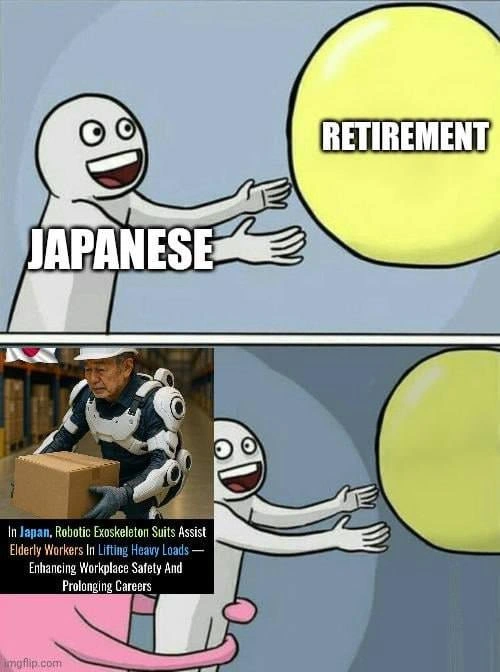
In this meme, we have a simple cartoon character and a bit of real-life news mashed together to make a point. The top panel shows a happy, round-eyed stick figure (labeled “JAPANESE” to represent Japanese workers or Japan in general) reaching eagerly for a big yellow ball labeled “RETIREMENT.” That ball represents the idea of retiring – finally finishing work and relaxing after a long career. The character looks excited, like “Yes, I can almost grab retirement!”
But then in the bottom panel, the picture changes. The retirement ball has floated up and away, out of the character’s reach. The poor character is still reaching, but now retirement is literally further off. In the lower-left of this panel, there’s an actual photo of an older Japanese worker wearing a big white-and-black robotic exoskeleton suit and lifting a cardboard box. There’s also a headline visible that says something like:
“In Japan, Robotic Exoskeleton Suits Assist Elderly Workers In Lifting Heavy Loads — Enhancing Workplace Safety And Prolonging Careers.”
That is basically a news headline explaining what’s going on in the photo: in Japan, companies are using robotic wearables (exoskeleton suits) to help elderly workers lift heavy things. The idea is that these suits make physical work safer and easier for older people, which in turn lets them keep working longer (thus “prolonging careers”).
Now, how does this relate to the meme text “When HR invests in exoskeletons instead of a retirement plan”? HR stands for Human Resources, the department of a company that handles hiring, benefits, and employee well-being – including things like retirement plans (pensions or 401(k) matches, the money set aside for when you stop working). The meme joke is saying: imagine a company (or Japan as a society) that has a budget to spend on its older employees. Instead of putting that money into helping those employees retire comfortably (like giving them a good pension or retirement package), they spend it on these high-tech exoskeleton suits so the employees can keep working even longer. It’s a form of dark humor about priorities: “We won’t let you retire; we’d rather buy a robot suit to keep you on the job.”
For a junior developer or someone early in their career, you might not be thinking about retirement yet, but you likely know what it is – the time when you’re old enough (say in your 60s or later) to stop working and live off your savings or a pension. A retirement plan is typically how companies help you prepare for that (through savings plans, investments, etc.). Here the company is essentially saying “Retirement? What’s that? Let’s gear you up so you can work more!” It’s exaggeration, but pointed.
The robotic exoskeleton suit in the photo is a real example of technology in the Robotics and Automation field. An exoskeleton is like a mechanical outer shell that a person can wear. It has motors or hydraulics at the elbows, back, or legs that give extra strength. If you’ve ever seen the movie "Iron Man" or "Aliens" (where Ripley wears a power loader suit), it’s a bit like that concept, but used in real life workplaces. The suit in the photo helps an older worker lift a heavy box, taking strain off his body. It’s meant to prevent injuries and help people who aren’t as strong as they used to be continue doing physical jobs safely. So technology is augmenting (increasing) human ability. That’s why one of the tags is physical_labor_automation – usually automation might mean a machine does the whole job, but here it’s partly automating the strain on the person’s body. It’s a human_augmentation device.
Now, why is this funny or interesting to developers or engineers? It’s a commentary on WorkplaceCulture and priorities. In many companies (especially big tech firms), you see fancy perks aimed at making you work more rather than letting you rest. For example, some offices have free dinner – sounds great, but it often encourages employees to stay late. Or they add sleeping pods at work – nice, you can nap at the office, but it also implies you might be working such long hours you need to sleep there! This meme takes that idea to an extreme: instead of a nice retirement, here’s a robot suit so you can stick around and be productive a few more years.
For someone newer to the industry, you might not have experienced it yet, but a lot of senior folks joke about how they keep delaying retirement because of one more project or because they’re still needed to untangle some mess (like an old system no one else understands). The tags like SeniorEngineerLife hint at that – senior engineers often carry a lot of knowledge and sometimes feel they can’t step away or the system will fall apart. This meme riffs on that: they’ll prop you up with machinery if they have to, just to keep your knowledge and labor a bit longer.
Also, culturally, Japan is mentioned specifically because Japan has a well-known aging population. There are many older people and fewer young people, so companies and society are finding ways to cope with more elderly folks still working. Using robotic suits is one innovative approach they’ve actually tried. It’s automation meeting labor economics: fewer young workers means instead of replacing older workers, they just equip the older ones with better tools. It’s a bit optimistic – “look, technology will save the day!” – but also wryly humorous, because one might think, “or you could just let the poor guy retire.” In the tech world, we often see optimism around technology solving problems, and sometimes we poke fun at it when it seems to miss a human point.
So, in simple terms: The meme is funny because it shows a person reaching for retirement, but retirement keeps slipping away because the company/society literally gives them a robot suit to keep working. It’s like moving the finish line just when you were about to cross it. It mixes career humor (the idea of never getting to retire) with tech humor (fancy robots fixing everything). And for those of us in the trenches of corporate life, it’s a chuckle (and maybe a groan) at the idea that the company would rather invest in something crazy to keep you working rather than celebrating you calling it a day.
Level 3: No Retirement, Only Upgrades
This meme hits that nerve where corporate culture and technology collide in a wry joke. We see a cartoon figure labeled "Japanese" reaching for a big yellow sphere labeled "Retirement," which then drifts out of reach when an exoskeleton-clad elderly worker photo-bombs the scene. The humor here is a bit dark for anyone who’s been around the block: it’s highlighting how, instead of giving employees a break at the end of a long career, companies (or in this case, society at large) find ways to keep them working. For senior engineers, this feels too real. How many times have we joked that “I’ll retire when the codebase retires” only to find the codebase gets another rewrite or “extension” and so do our working years? The meme takes that feeling and makes it literal: you finally think you’re reaching the finish line (retirement), and then management rolls in with a fancy new gadget to push that finish line further away. HR isn’t investing in a better retirement plan or pension; nope, they’re pouring money into robotics so you can lift more crates (or crank out a few more releases) in your golden years. It’s a classic corporate prioritization punchline – why give you rest when they can give you gear?
This resonates in the tech world because we often witness analogous scenarios. Consider the veteran coder who is about to retire just when the critical legacy system needs a migration – suddenly the company dangles a lucrative contract or part-time role (the metaphorical exoskeleton) to keep them coding a bit longer. Or think about how instead of replacing an aging, fragile system (hello legacy code), companies just containerize it, monitor it with five new tools, and declare it “modernized” – essentially strapping an exoskeleton on that creaky app to prolong its life. The meme’s scenario is the human equivalent: rather than letting the aging employee ride off into the sunset, they kit them out in a robotic wearable and say, “Good news, you can keep going!” It’s both absurd and something many of us cynically suspect could happen. After all, we joke in software that old systems never die as long as someone can keep them running. Here it's old employees never retire as long as an exo-rig can keep them lifting.
There’s also a cultural nuance with Japan specifically: Japan is known for its strong work ethic and also facing an aging_workforce problem (lots of older people, not as many young workers coming in). Companies there truly have experimented with exoskeleton_suits for older employees. That news headline in the meme ("In Japan, Robotic Exoskeleton Suits Assist Elderly Workers... Prolonging Careers") is real-world context. It underscores how technology and automation trends can be double-edged: on one hand, it's sold as enhancing workplace safety – great, fewer injuries for older workers – but on the other, it’s clearly about prolonged_careers, meaning folks are lifting boxes in their 70s instead of retiring. The senior engineers seeing this will nod knowingly because it echoes something in our industry: companies tout new tools or processes to make work “easier,” but often the unspoken goal is to get more years of productivity out of us. It’s like when management introduces a fancy new DevOps pipeline that will “make on-calls less painful” – sure, it automates some toil, but now they expect you to handle even more systems simultaneously. The goalpost moves, productivity goes up, but does your stress go down? Debatable.
From a Career_HR perspective, the meme satirizes how HR or leadership might choose a high-tech solution over a humane one. Retirement plan contributions, pensions, or hiring more staff to relieve overworked seniors – those are boring (and costly). But exoskeletons? Shiny and “innovative”! It’s the same energy as a company that won’t increase the 401(k) match but will spend millions on bean-bag chairs, free sushi lunches, and state-of-the-art standing desks to keep you coding longer hours. In this case, the free sushi has been upgraded to a full-blown powered suit. As a battle-scarred dev, you chuckle because you’ve seen this pattern: rather than fixing the core issue (people need to retire, systems need rewrites), management applies a band-aid in the form of fancy tech.
The humor also lies in the absurdity. It’s a literal depiction of a phrase we often use sarcastically: “They expect me to work until I drop.” Here, with a robo-suit, you might actually not drop – you’ll be propped up by hydraulics like some weekend-at-Bernie’s office edition, still merging pull requests or hauling packages. It’s a morbidly funny exaggeration of real trends. For senior engineers, it also pokes fun at the idea that we must constantly update our skills and adapt – an intellectual exoskeleton of sorts – to stay relevant. The ever-moving retirement orb is like that ever-evolving tech landscape: you think you’ve mastered the last thing and can finally relax, but nope, here comes the next framework, or the next crisis that “only you know how to fix.” So of course, the orb labeled “Retirement” just floats away, leaving you with an exoskeleton and another decade of stand-ups to attend.
To put it bluntly, the meme is saying: “They’ll invest in keeping you working, rather than let you stop working.” It’s funny because it feels uncomfortably true. As an older engineer you might smirk and think, “Yeah, I bet my company’s five-year plan involves strapping me into a mech suit at my desk.” We laugh, because if we didn’t, we might cry. The next time HR talks about “extending careers” or “leveraging automation for employee longevity,” you’ll remember this meme and wonder if there’s an exoskeleton charging in the break room, waiting with your name on it.
Level 4: Bionic Overclocking
At the cutting edge of robotics and human augmentation, companies are essentially overclocking their aging workforce. A robotic exoskeleton suit is a wearable mechanical frame equipped with sensors, motors, and microcontrollers that amplifies a human's strength and endurance. Think of it as a hardware patch for the human body: industrial-grade servo motors at your joints, force-feedback sensors on your limbs, all controlled by algorithms that detect your intended movement and then add some mechanical oomph. These suits use techniques from control systems engineering – monitoring muscle signals or movement inertia and responding in milliseconds – to synchronize with the wearer's motions. In Japan, some exoskeletons like the HAL suit (no, not the rogue AI from 2001, but ironically named) even pick up bioelectric signals from your muscles to anticipate movement. It’s like a cyber-physical assistive device that turns a 70-year-old into something resembling a forklift with a pulse.
From a technical perspective, this is mechatronic manpower at work. The suit’s onboard computer must solve complex problems in real time: balancing assistance so it’s helpful but not jerky, conserving battery power (because imagine your strength-boost suddenly dying mid-lift – talk about a sudden core dump of the human-kind), and ensuring safety through limiters (you don’t want Grandpa bench-pressing a refrigerator just because the actuator can lift it). It’s a delicate dance of hardware and wetware. The constraints are real: actuation torque vs. weight of the suit itself, power supply vs. continuous work hours, sensor accuracy vs. human variability. In essence, the exoskeleton extends the degrees of freedom of a human body similarly to how adding more CPU cores extends a server’s throughput – but with the added complexity that human joints and metal hinges must align perfectly without shearing the user in half. The fundamental trade-off here is managing physical load via external means: instead of the muscles doing all the $F=ma$ grunt work, electric motors share some of that force. This is rooted in real engineering research, from NASA studying astronaut suits to military DARPA projects for soldiers.
However, notice the wry twist: this high-tech prosthetic productivity booster is being deployed not just as a cool innovation but as a lever to defy biological retirement. It’s a bit like keeping an old server running by bolting on new hardware – you haven’t refactored the humans out of the system, you’re just scaling them vertically with machinery. Fundamentally, biology has a kind of “garbage collection” called retirement, where wear and tear demands a halt. But with an exoskeleton, it’s akin to disabling the stop condition and pushing the process into overtime. We’re augmenting humans to mitigate the inevitable declines of age – a flashy solution to the aging workforce problem. It’s as if HR saw the aging_workforce and said: why retire our legacy systems when we can just put them in a new chassis? It’s both ingenious and a little dystopian: prolonged_careers by brute force. In theoretical terms, we are shifting the constraint: instead of labor capacity being bound by human aging (a natural limit), it’s now bound by mechanical endurance and battery life. You’ve effectively turned the human into a hybrid cyborg node in the workforce.
From a system architecture standpoint, this is reminiscent of adding a caching layer to an old, slow database. The legacy workforce support here is a literal support structure – an exoskeleton_suit that caches the worker’s waning strength with mechanical power. Just like how we might avoid rewriting a monolithic legacy app by sticking an API gateway and some microservices around it, companies avoid dealing with retirements by wrapping employees in steel and circuits to keep them operational. It’s an extreme form of physical_labor_automation: not replacing the worker with a robot, but fusing the two. The darkly funny part for engineers: we usually automate to eliminate human toil, yet here automation is used to extend the toil. It’s a high-tech paradox – solving a labour economics problem (too few young workers, too many tasks) with a gadget instead of a policy. The math checks out for them: if workforce_output can be increased by exoskeletons, you postpone the need for expensive pensions. This is the performance tuning of human capital, with a side of uncanny valley. In short, the meme’s scenario is savagely logical in a cyberpunk sort of way – when confronted with human limits, why not just upgrade the human?
Description
A two-panel meme using the 'Running Away Balloon' format. In the top panel, a stick figure labeled 'JAPANESE' reaches toward a yellow balloon labeled 'RETIREMENT'. In the bottom panel, the balloon is yanked away, and an inset photo shows a news headline: 'In Japan, Robotic Exoskeleton Suits Assist Elderly Workers In Lifting Heavy Loads -- Enhancing Workplace Safety And Prolonging Careers'. The image depicts an elderly Japanese worker in a warehouse wearing a robotic exoskeleton suit while carrying a box, implying that instead of letting elderly workers retire, Japan invented exoskeletons to keep them working longer
Comments
18Comment deleted
Japan's retirement plan: why fund pensions when you can fund R&D for exoskeletons that turn grandpa into a warehouse Iron Man?
Sure, rewrite the 90-million-line COBOL system - or just strap the authors into exoskeletons and keep the SLA green for another decade
When your country's solution to technical debt is literal exoskeletons instead of refactoring the retirement system - it's like fixing a memory leak by just adding more RAM until the heat death of the universe
Ah yes, the classic product-market fit problem: we built exoskeletons to help humans transcend physical limitations, but management saw 'extend productive working years by 15%' in the ROI spreadsheet. Now we're optimizing for MTBR (Mean Time Between Retirement) instead of MTBF. At least the elderly workers are getting better uptime than our Kubernetes clusters - though both require frequent maintenance windows and occasionally need a hard reboot
Principal engineers don't retire - they exo-suit up to lift legacy monoliths forever
In our enterprise, retirement is just a feature flag - finance toggles it off and issues an exoskeleton, because it’s cheaper than migrating three million lines of COBOL
Leadership said “retire the monolith,” finance heard “strap on adapters and sidecars so the COBOL can lift Q4” - an exoskeleton for software
shinji, get in the exoskeleton Comment deleted
“It’s either this or immigrants.” Comment deleted
What's arekkusu? Comment deleted
Alex Comment deleted
I mean if they are good enough Better than sitting home all day Comment deleted
I'm not an expert, but it seems that the problem with "AI will take our jobs" is not that they will take the jobs, but that they will take our salary Comment deleted
and have fun with thot bots Comment deleted
then other bots will detect their unethical behavior and ban them into blocklist prison Comment deleted
Or just forward it to big companies' shareholders ! That'd be fun but it's more likely Comment deleted
especially now when we know, that huge companies enforce usage of AI and we see security flaws appearing in their solutions, which previously weren't possible during decades of human work. Comment deleted
> "prolonging careers" > image of a man doing most low-level work > "careers" Comment deleted