How to Source a Contact Number for Responsible Disclosure
Why is this Security meme funny?
Level 1: Leaving the Door Open
Imagine you have a big box full of private family photos and letters that you want to keep safe. You decide to send one of the letters to a friend using a special locked container that only you and your friend can open – kind of like a secret code so no mailman or stranger can peek at it on the way. That part is super secure, just like WhatsApp messages are protected by special coding (encryption) so only the people chatting can read them.
Now, let’s say after sending the letter, you take that big box of all your other photos and letters and you leave it on your front porch with the door wide open. In fact, anyone walking by your house could just stroll in and take a look inside that box because you didn’t lock your door or the box. Pretty silly, right? That’s like the company in the meme leaving their database (which is where they keep all their users’ information, like phone numbers) completely unprotected on the internet.
In this little story, a friendly person comes by, notices the door is open and that your sensitive box of letters is out in the open. They pick up one of the letters (maybe it has your phone number in it) and use that to give you a phone call: “Hey, I just wanted to let you know your door is open and all your secret stuff is lying around. You should really fix that!” You’re relieved someone told you, and you thank them. But then you ask, “Wait, how did you even get my phone number to call me?” And the caller says, “Uh, I found it from that box of letters you left out.” Cue facepalm. You realize even your own private info (your phone number) was available because of the door you left unlocked. You’d probably feel a mix of gratitude (that they told you) and embarrassment (that it was that easy to get your info).
This is exactly what’s happening in the meme. The company secured the “chat” (the way the message was delivered) really well – that’s the lockbox for the letter, or the helmet in an analogy – but they forgot to lock the “house” containing the data. The humor comes from that lapse in common sense: it’s such an obvious thing in hindsight. It’s funny and a bit ironic because it’s such a simple mistake. It’s as if you bragged about how strong your front door is, while all along your back door was completely open. In the end, the meme is a lighthearted way to remind us: protect the important stuff at its source, not just in the way it’s delivered. Always lock your doors (literally and digitally) so you don’t end up in a situation where someone says “I found the key under your doormat” when warning you about a break-in.
Level 2: Open Database, Exposed Data
Let’s break down what’s happening in simpler terms. The meme involves MongoDB, which is a type of database used by many applications to store data (kind of like a big digital filing cabinet for information, but instead of spreadsheets and tables, MongoDB stores data in JSON-like documents). Now, any good database should be password-protected or authenticated – meaning you need to prove you’re allowed to see what’s inside, usually by logging in with a username and password. When a database has no authentication, it means anyone who finds the database can just open it up and look at all the information, without any login. That’s a huge problem! It’s like having a personal diary but not putting a lock on it – if someone discovers it, all your secrets are immediately visible. In the security world, this kind of mistake is called a security misconfiguration (basically, something was set up incorrectly in a way that makes it unsafe). And one big result of such a misconfiguration is sensitive data exposure: private info that should have been hidden ends up being out in the open.
In this case, the sensitive data included things like phone numbers. Imagine you gave your phone number to a company (for example, when signing up for a service) trusting they’d keep it private. That phone number was stored in their MongoDB database. But because the database wasn’t secured, that number (along with likely many others) became visible to anyone who knew where to look. This situation is often referred to as a data leak or data breach – data that was supposed to stay inside the company “leaked” out to the wider internet. It’s a bit like having a list of all your friends’ phone numbers and accidentally posting it on a public website – ouch, not good for privacy.
Now, along comes a security researcher – basically a tech-savvy person who looks for these kinds of problems so they can alert the company and get them fixed (instead of using the data for bad reasons). This researcher found the company’s open MongoDB and all that personal data sitting unprotected. Doing the right thing, they decided to warn the company. But here’s a challenge: how do you contact a company to tell them about a security hole? Large companies often have dedicated emails or forms for this (like “[email protected]”), but smaller ones might not. In our meme, the researcher chose to send a message over WhatsApp to someone at the company. The funny part is where they got the phone number to send the message – it came from the very same leaky database! In other words, while browsing the exposed data, the researcher likely found a contact number (perhaps it belonged to an IT manager or a person listed as a security contact in the data) and used it to reach out. This adds a bit of irony: the researcher is warning them about a privacy breach using a phone number that was breached.
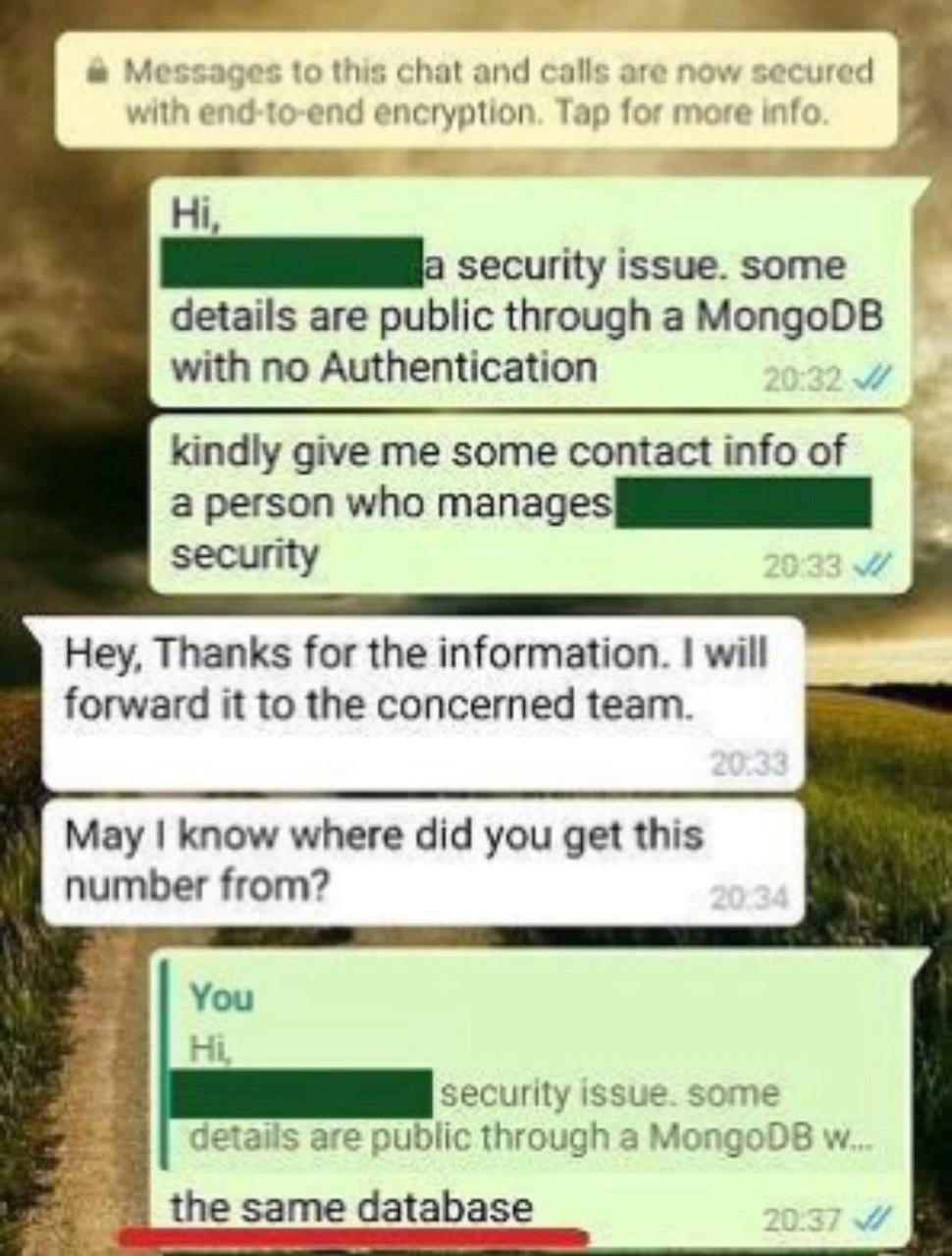
So the conversation in the meme goes like this: the researcher says “Hi, I found a security issue... some details are public through a MongoDB with no authentication. Could you connect me to the person in charge of security?” The company person responds, “Thanks, I’ll pass it on. By the way, how did you get this number?” – which is a reasonable question if they weren’t expecting to be contacted on their personal line. The researcher then admits, “from the same database.” You can almost hear the thud of realization on the other side. That answer basically means: “I got your number from the data that your company accidentally left visible to the whole world.” It’s a bit embarrassing for the company guy – it means even his own contact info wasn’t safe! The red underline under “the same database” in the image is there to emphasize that this is the zinger or punchline of the joke.
Now, let’s talk about that little yellow banner at the top of the WhatsApp chat: “Messages to this chat and calls are now secured with end-to-end encryption.” WhatsApp shows that to let users know their messages are private and can’t be read by anyone else except the sender and receiver. End-to-end encryption (often abbreviated as E2E encryption) is a technology that scrambles your message in such a way that even the company (WhatsApp) can’t read it; only the person you’re chatting with can decrypt and read it. That’s generally a good thing for privacy and security – it stops hackers or governments or any third parties from snooping on your conversations.
But here’s the catch in our scenario: the problem wasn’t with the messages or the chat app at all. The problem was with the database that stored user information. The chat between the researcher and the company is indeed encrypted and secure from prying eyes. Yet, the information they’re discussing had been freely available to prying eyes via the database! It’s a bit of situational irony: the channel of communication (WhatsApp) is very secure, but the content (the data in the database) was not secure at all. Think of it like this: WhatsApp provided a secure envelope for the message, but the letter inside is talking about how the house was left unlocked. That’s why it’s funny to those who understand the context – two very different sides of security are colliding.
To a junior developer or someone new to cybersecurity, the takeaway here is: securing one part of a system doesn’t automatically secure everything. You have to cover all bases. The company might have used encryption for their chat or other parts of their service, but if they forget to simply put a password on their database, all that other security doesn’t help much. It’s a bit like wearing a helmet and safety gear (which is great) but then forgetting to close the door of the airplane before takeoff – the safety gear won’t matter if you fall out! Always remember to lock down the basics: if you set up a database, ensure you enable authentication, use strong passwords or keys, and don’t expose it directly to the open internet if you can avoid it. Also, it’s wise for companies to have a clear way for researchers to contact them (like a security contact or bug bounty program), so that if someone finds a vulnerability, they can report it easily without having to resort to using leaked info to say “Psst, you have a leak!”.
In summary, an open database led to exposed data, including a phone number that was then used to report the problem. The situation is both a lesson in basic security practices and, as depicted in the meme, a kind of tech-world comedy of errors.
Level 3: NoSQL? No Security!
From a seasoned developer or security engineer’s perspective, this meme is painfully on-point and darkly funny. It highlights a classic case of Security Misconfiguration that senior folks have seen countless times in the real world. Here’s the scenario: a company is using MongoDB (a popular NoSQL database), and someone stood it up without enabling authentication. In plain terms, that means the database was open to the internet with no username or password – anyone could connect and rummage through the data. This isn’t a sophisticated zero-day exploit or a nation-state hacker at work; it’s the digital equivalent of leaving your front door not just unlocked, but wide open. If you’ve been around in tech, you’ll recall waves of incidents where thousands of MongoDB instances were found unsecured online, often indexed by search engines like Shodan for any curious party to find. In fact, the joke “NoSQL? More like No-Sec” comes directly from how common it was to see breaches involving misconfigured NoSQL databases.
So in our meme, an ethical hacker or security researcher stumbles upon such an open database exposure. They find a treasure trove of sensitive data that should have been private – possibly user details, emails, phone numbers, maybe even internal records. Following good practice, the researcher attempts responsible disclosure: they reach out privately to the company to alert them of the issue, rather than posting it on Twitter or selling it on the dark web. The twist? The researcher doesn’t have an official contact for the company’s security team, so they use a phone number that was literally obtained from the very leak they’re reporting. Yes, you read that right – the database was so unprotected that it even exposed the contact info of the people responsible for protecting the data! It’s as if the company’s security officer’s phone number was sitting in the leaked database, so the researcher just picks it up and sends them a WhatsApp message.
Now imagine being on the receiving end of that WhatsApp chat. You’re presumably an IT admin or a security officer for the company. You get a polite message: “Hi, [redacted], a security issue. Some details are public through a MongoDB with no Authentication… kindly give me contact info of a person who manages [redacted] security.” In other words: “Hey, I found a serious security hole in your system, data is out in the wild.” That alone is enough to make a tech professional’s stomach drop. The recipient responds professionally, “Thanks for the information. I will forward it to the concerned team.” But then curiosity (or a bit of suspicion) kicks in: how did this random person get my personal number to WhatsApp me? So they ask: “May I know where did you get this number from?” This is the moment of truth, and also the punchline of the meme: the researcher replies, “the same database.” Boom – there’s the mic drop.
For a senior dev or security engineer, that reply is both hilarious and horrifying. Hilarious, because it’s a perfect gotcha moment – the person asking the question unwittingly walked right into the evidence that their data breach is so bad it even exposed their own contact info. Horrifying, because it underscores just how extensive the leak might be. The red underline in the image highlights “the same database” to drive home that punchline visually. It’s a facepalm moment: the security team member just realized “Oh no, even my phone number was in that leak. We really messed up.” You can almost hear the awkward silence and the giant sigh on the other end of that chat.
The presence of the WhatsApp end-to-end encryption notice at the top of the chat adds a delicious layer of irony for the experienced reader. WhatsApp is touting that “messages to this chat and calls are now secured with end-to-end encryption” — meaning the conversation between the researcher and the company rep is perfectly secure from any eavesdroppers. Yet, the content of that conversation is about a breach where data was exposed publicly due to no security on a database. It’s a prime example of missing the forest for the trees in security. The company (or the product they use) has world-class encryption for communications, but they neglected basic database security hygiene. In practice, it’s like boasting that you have an unpickable lock on your mailbox (so no one can spy on your mail in transit), while simultaneously leaving copies of all your letters on a public bulletin board. The irony isn’t lost on any of us: end-to-end encryption is great, but it doesn’t matter one bit if your database security is nonexistent. The meme juxtaposes these to poke fun at how organizations often trumpet one aspect of security while flubbing another.
From an industry standpoint, this situation exemplifies an OWASP Top 10 issue: Sensitive Data Exposure / Security Misconfiguration. It’s embarrassingly common. Veterans in IT can recount numerous incidents where the root cause of a data breach was not some deep, complex hack, but simply someone forgetting to set a configuration or update a default. In the early days of MongoDB (and other NoSQL databases like Elasticsearch or Redis), the default settings were developer-friendly (open and no auth) but not secure. If a developer spun one up for a quick prototype and then that instance somehow ended up accessible from the internet, presto — you had a leak waiting to happen. DataPrivacy goes out the window when your database isn’t locked down. And the fallout is real: personal data gets exposed, companies face reputational damage or fines, and users lose trust.
This meme resonates with the Security and DevOps crowd especially. It’s essentially a real-life anecdote turned joke — the kind of thing you might hear swapped at a security conference happy hour: “Remember that time a company’s database was so open that the researcher texted them using a number from the leak to tell them about it?” It’s absurd, yet plausible. The humor here has a bit of a “laugh so you don’t cry” element. Professionals laugh because it’s better than screaming in frustration at how such slip-ups keep happening. It also has that element of schadenfreude (finding mirth in someone else’s foible) — because let’s be honest, we’re all just glad this time it wasn’t our company. And you can bet the people involved will never forget to put a password on a database again.
In short, at the senior level, this meme is a wry commentary on the state of cybersecurity practices: even in 2019, even with all our advanced tech, humans will still forget to secure the obvious things. It’s a gentle poke at those who put too much faith in one layer of security while ignoring another. The next time someone says “Don’t worry, our chat is secure with encryption,” the seasoned folks might quip, “Sure, but is your database open to the world?” with a raised eyebrow. The meme’s chat literally answers that question in the most comedic way possible.
Level 4: Encryption Theater
At the extreme technical end, this meme highlights a clash between strong cryptography and a glaring security oversight. WhatsApp’s banner proclaiming “end-to-end encryption” references a robust cryptographic protocol (the Signal protocol) that uses asymmetric keys (think Diffie-Hellman key exchange and ephemeral session keys) to ensure messages can only be read by the sender and receiver. In transit, the chat content is virtually unbreakable — even WhatsApp’s servers can’t decrypt those messages thanks to this end-to-end design. This is cutting-edge security in practice, built on solid mathematical foundations.
However, the irony is that all that fancy encryption doesn’t mean anything once the data reaches its end. In this case, one “end” is a MongoDB database that was left with no authentication and likely no encryption at rest. Authentication is a fundamental security layer: it’s supposed to require credentials (a username/password or keys) to access a system. But here, the database was essentially wide open. A MongoDB server with no auth can be queried by anyone who finds its address, no decryption or hacking required. The result? All the sensitive information is sitting in plaintext, as if published for the public. This is a textbook example of the weakest link principle in security: even if you employ state-of-the-art end-to-end encryption for data in motion, a misconfigured database at rest will compromise confidentiality the moment someone connects to it. It’s like using an armored truck to transport valuables securely across town, only to dump the treasures on the sidewalk at the destination.
Under the hood, this situation underscores the difference between protecting data in transit versus at rest. End-to-end encryption covers the transit part – scrambling the WhatsApp messages so that an eavesdropper or malicious intermediary (even a nation-state attacker cracking packets) gets nothing but gibberish. But once that message is safely delivered and perhaps stored in a database, if that storage isn’t protected, it’s game over for secrecy. There’s no cryptographic magic in the world that can save data that’s openly accessible. In formal security terms, the system’s attack surface had a giant hole: the database’s lack of access control means the Confidentiality in the CIA triad was completely broken at the data layer. From a theoretical standpoint, you could say this scenario mocks the notion of “end-to-end” – here one of the ends had no end-to-end security at all! All the elegant math and protocols (like elliptic-curve key agreements and perfect forward secrecy) were effectively negated by a single configuration oversight. In essence, we have encryption theater: impressive cryptography on display in one area, while behind the scenes the real secret was left sitting unguarded. It’s a stark reminder that security is holistic – a chain of many links where one weak link (military-grade encryption **no encryption or auth at all on the DB) can undo even the strongest cryptographic safeguards elsewhere.
Description
The image is a screenshot of a chat conversation, likely on WhatsApp, depicting an interaction between a security researcher and a company representative. The researcher initiates contact, stating: 'Hi, [redacted] a security issue. some details are public through a MongoDB with no Authentication' and asks for a security contact. The representative thanks them and then asks, 'May I know where did you get this number from?'. In a perfect punchline, the researcher quotes their own initial message and replies, 'the same database', with the words underlined in red for emphasis. This meme humorously and painfully highlights a common and severe security misconfiguration where databases, particularly MongoDB, are left publicly exposed without authentication. The irony is that the company's own contact information was part of the data leak, showcasing a complete lack of security awareness and making the representative's scripted question absurd
Comments
8Comment deleted
That awkward moment when your bug bounty program is just a public `SELECT * FROM contacts;`
Great job on the end-to-end encryption banner - meanwhile your MongoDB on port 27017 is livestreaming the CISO’s phone number to anyone who can spell “shodan.”
When your MongoDB is so open it's basically a public API, but at least it's consistent - even the incident response contact info follows the same security model
MongoDB's legacy default of trusting the network so much it didn't ask for a password - the only auth in this story is the WhatsApp encryption banner
The beautiful irony of reporting a MongoDB security breach through WhatsApp's 'secured with end-to-end encryption' banner, only to reveal you found their contact info in the same unsecured database - a perfect demonstration of why defense in depth matters. It's like leaving your front door wide open while installing a state-of-the-art safe inside. The researcher essentially said 'I found your vulnerability' and when asked 'how did you find us?' replied 'through your vulnerability' - the most elegant proof-of-concept possible. This is what happens when you secure the application layer but forget about the data layer: your MongoDB becomes the world's most helpful phone book for security researchers
MongoDB's ultimate self-audit: leak the hotline, then field calls on the leak from the leak
Defense in depth: the chat is end-to-end encrypted, but one end is an unauthenticated MongoDB with bindIp 0.0.0.0 - where I found your phone number
Great E2E on WhatsApp; shame the backend is E2W - db.users.find({}) on :27017 shouldn’t be your incident contact directory