
RAID Levels Explained with Water Coolers
Description
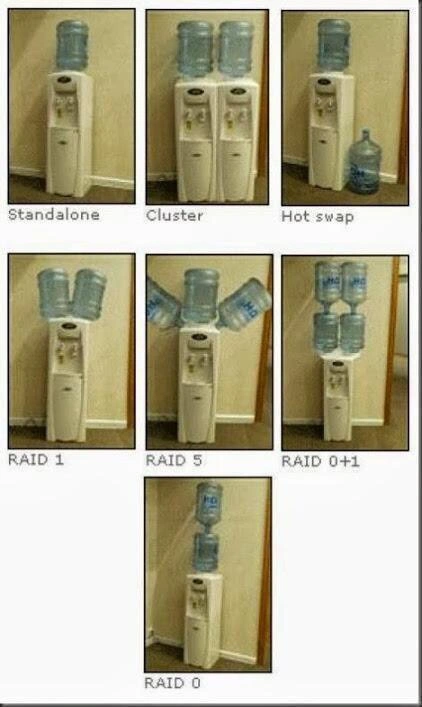
A seven-panel meme that uses office water coolers to visually explain fundamental data storage and server architecture concepts. Each panel has a label at the bottom. 'Standalone' shows a single water cooler. 'Cluster' shows two side-by-side. 'Hot swap' depicts one cooler with a spare water bottle on the floor. 'RAID 1' shows a cooler with two bottles angled into it, representing mirroring. 'RAID 5' has three bottles in a distributed-like configuration. 'RAID 0+1' features a complex stack of four bottles. Finally, 'RAID 0' shows two bottles stacked vertically on a single cooler, representing striping. The humor comes from applying complex IT concepts to a mundane office object. This meme is a classic piece of tech humor, serving as a simple analogy to explain different types of redundant array of independent disks (RAID) and other high-availability concepts. It effectively visualizes trade-offs between performance, redundancy, and complexity, making it relatable for anyone who has had to manage physical or virtual storage systems

Comments
8Comment deleted
This is how you explain storage to the new project manager. Just don't forget to mention that with the RAID 0 setup, the '0' stands for 'zero data recovered' when one bottle leaks
Design review recap: CEO insists on RAID 0 throughput, CISO demands RAID 1 redundancy, procurement funds exactly one bottle - congrats team, we’re shipping “Stand-alone with optimistic hydration retries.”
Finally, a RAID explanation where the only thing that corrupts is Karen from accounting who keeps refilling her personal bottle from the RAID 5 array during the quarterly backup window
RAID 0 in one photo: double the throughput, and the entire array fails the moment someone bumps the cooler - which, like disks, is always during the demo
Finally, a RAID explanation that makes sense to management - though I'm still not sure they'll approve the budget for RAID 6 after seeing how many water jugs we'd need. Also, that RAID 0 configuration is giving me the same anxiety as running production databases without backups: technically it works until physics inevitably intervenes
RAID 5: Perfect parity until the one jug with a slow leak turns your array into a single point of thirst
Call it a 'cluster' all you want - if both bottles share one tap, you've shipped Single-Point-of-Failure-as-a-Service; just hope the RAID-5 rebuild doesn’t become an Unscheduled Liquid Event
Hydration architecture in a nutshell: RAID‑1 keeps morale up, RAID‑5 looks clever until the rebuild, and RAID‑0 proves the CFO optimizes for pour throughput over employee uptime