Skip to content
DevMeme
2314 of 7435
Explaining Monads in the Post-Apocalypse
FunctionalProgramming Post #2573, on Jan 11, 2021 in TG

Explaining Monads in the Post-Apocalypse

Why is this FunctionalProgramming meme funny?

Level 1: Campfire Ghost Story

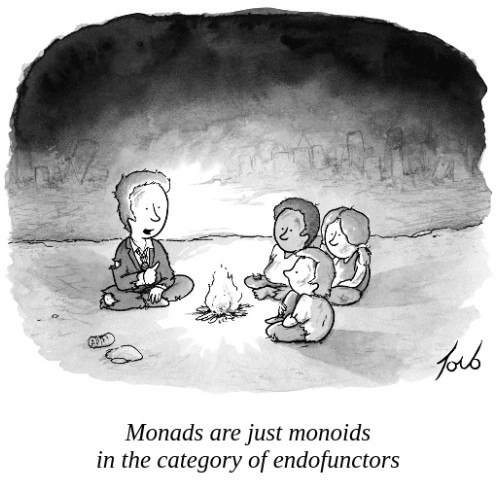
Imagine you’re sitting around a campfire at night with an older, super-smart friend. You ask them to tell a story, and they start using really big fancy words that you’ve never heard before. They say something like “Blah blah in the category of blah-blahs,” and it sounds almost like a magic spell or a secret code. The scene feels a bit spooky because you’re in the dark, the fire is crackling, and you have no idea what those words mean. Your eyes get wide and you shiver, not because there’s a ghost, but because the story makes you feel completely lost! This meme is funny in the same way: the kids around the fire are listening to a confusing tale about “monads and monoids” as if it were a ghost story. The older person might as well be telling them about monsters, because to the kids those big words are just as mysterious and scary. In simple terms, it’s showing how using overly complicated language can turn a normal explanation into a bewildering campfire story. The humor comes from seeing the grown-up treat a programming idea like an eerie legend, leaving the poor listeners astonished and a little spooked by all the mumbo-jumbo.

Level 2: Monads for Mortals

Let’s break down those intimidating terms in that quote into plain concepts:

  • Monoid: In math (and CS), a monoid is a simple algebraic structure. Think of it as a set of things plus a way to combine them, where combining is associative (you can regroup without changing the result) and there’s a neutral element that does nothing when combined. A classic example is addition over numbers: combine numbers by adding (e.g. 2 + 3 = 5), it doesn’t matter how you group additions ( (1+2)+3 is the same as 1+(2+3) ), and 0 is the neutral element (adding 0 to any number leaves it unchanged). In programming, a list with concatenation is a monoid: you can concatenate lists in any grouping and an empty list is the identity (since adding an empty list changes nothing). Monoids pop up in CS fundamentals when talking about things like aggregation or folding data – they’re a way to formalize “combine this stuff” with a safe default.

  • Functor (and Endofunctor): A functor is a concept from category theory and also a staple in functional programming. Put simply, a functor is something you can map over. If you have a container or context (like a list, or a Maybe optional value), a functor lets you apply a function to the contents without breaking the container. For example, a list is a functor because you can apply a function to each element (that’s what something like map in many languages does). An endofunctor is just a functor that operates on one kind of thing and gives you the same kind of thing back (endo = “within the same”). In programming terms, it usually means a type constructor that takes a type A and returns another type B of the same kind (often you’ll see something like F<A> mapped to F<B>). For instance, a List<Int> can map to a List<String> by applying a function from Int to String – List is an endofunctor on the category of types. It sounds fancy, but you use functors all the time whenever you call a map or transform function on collections or wrapped values.

  • Monad: Finally, a monad is a design pattern (or type class in Haskell) used heavily in FunctionalProgramming that builds on functors. A monad is like a functor “plus extra powers.” Apart from mapping over a value, a monad lets you sequence operations while keeping context. It provides two main operations (often called return/unit and bind in many languages, or flatMap in others). The idea is you can take a raw value and put it into a default context (that’s unit), and you can take a value that’s already in a context and chain another operation on it (that’s bind, which handles combining contexts). If that sounds abstract, think of a real example: an Optional (or Maybe) type is monadic. Say you have a value that might be there or might be null/nothing. With a monad (Optional), you can chain a whole series of computations on that value without constantly writing if checks for the null case – the monad’s rules handle that for you. The bind operation for Optional says: “if the value is present, apply this next function to it; if it’s not, just propagate the nothing.” This way, you can string together multiple steps and the monad will take care of passing the context (or short-circuiting if a step yields nothing). Many languages use monad-like patterns without calling them monads: for example, JavaScript Promises (for async sequencing) or C# LINQ queries or chaining computations on streams – all these follow the monadic pattern of sequencing actions while abstracting away boilerplate checks or state. So a monad is basically a recipe for composition: it tells you how to combine steps and handle the plumbing (like missing values, asynchronous waits, state passing, etc.) behind the scenes.

Now, given those definitions, the infamous statement “monads are just monoids in the category of endofunctors” can be interpreted step by step. It’s saying: if you think of all functors from a type system back to itself (all those mappable container/context things) as objects in a category, then a monad is one of those functors with an extra structure that behaves like a monoid (with a notion of an identity and an associative composition, except instead of simple values, they’re operations on the functor). For a junior developer, this is still a headful of jargon – no surprise the cartoon kids look a bit lost! The key takeaway is that monads give us a formal way to do multiple operations in sequence while keeping context (like handling missing values, logging, or other side effects) consistent. They’re a powerful concept from math applied to writing clean code. But if you’ve never heard these terms before, having someone define monads by bringing up monoids and endofunctors is like defining a word using three other words you don’t know yet. It’s very common for newcomers to functional programming to feel exactly like those wide-eyed characters in the meme when monads first come up.

If you’re early in your career and this stew of terms is new, don’t be scared off! In practice, you often use monads without realizing it. For example, every time you chain together a bunch of computations with an Optional/Maybe type, or handle asynchronous calls with promises/futures in a neat sequence, you’re benefiting from monadic design. You might not call it that, and you don’t need to shout “monoid in the category of endofunctors!” to use it. The meme humorously highlights how an over-technical explanation can feel during your first exposure. Many of us have that memory of hearing a senior dev or reading a tutorial that went straight into category theory – it felt like you were sitting at a campfire hearing about some arcane ritual. But eventually, with simpler examples and practice, these concepts click. A monad, stripped of scary terminology, is just a pattern for making certain coding tasks easier and more modular. So if you’ve ever felt like those kids hearing a monad explanation, know that you’re not alone – everyone starts out baffled, and then one day it just “clicks” (often with a much friendlier explanation than the one in the caption!).

Level 3: Functional Folklore

Now step back and see why this situation tickles experienced developers. The scene is a bit absurd: a senior developer, clad in a suit post-apocalypse, sits at a campfire delivering an ominous lesson on monads to three younger folks as if it were a spooky legend. This humorously exaggerates a familiar trope in programming culture: senior functional programmers trying (and often failing) to explain monads to newcomers. The caption “Monads are just monoids in the category of endofunctors.” is something of a notorious one-liner in the functional programming world. It’s actually an old tongue-in-cheek explanation that circulates among Haskell enthusiasts – a quote that is technically correct yet so dripping with jargon that it sounds more like a magic spell than an answer. Seasoned devs laugh because many of them have been on one side or the other of this exchange: either wide-eyed like the kids, hearing an explanation that only raises more questions, or in the shoes of that senior, dropping a knowledge bomb that utterly misses the mark for the audience.

Why is this funny to a software engineer? It captures the collective experience of what happens when computer science fundamentals meet practical onboarding. Monads in functional programming have a near-mythical reputation for being difficult to grasp. Years ago, as languages like Haskell and Scala gained popularity, “What the heck is a monad?” became a common cry. In response, countless blog posts, tutorials, and yes, campfire-style stories, emerged attempting to explain monads using every analogy under the sun. We saw monads compared to burritos, space suits, assemblies lines, Elephants, you name it – all efforts to demystify the concept. Amidst this frenzy, there was always that one definition floating around from the pure math folks: “a monad is a monoid in the category of endofunctors.” It became an inside joke because it’s the kind of definition that only makes sense if you already understand it. It’s like answering “How do I ride a bike?” with “Oh, that’s easy, you just maintain dynamic equilibrium utilizing gyroscopic precession.” – technically true, zero help to the learner. Experienced devs recognize this pattern and chuckle: we’ve all seen the over-educated engineer (represented by the suit-clad storyteller) giving a textbook answer while the audience (the junior devs) sits mystified, as if hearing ghostly gibberish.

The visual details amplify the joke. The backdrop of a ruined city skyline under the night sky suggests an almost post-apocalyptic scenario – perhaps a world where only the lore of functional programming survives to be passed on like ancient wisdom. It’s a dramatic metaphor for how esoteric and detached from everyday coding these terms can feel. The senior dev’s face is blurred, making him an almost anonymous prophet of category theory, and yet he’s in a proper business suit, absurdly formal even at the end of the world. That suit-and-tie is a classic caricature of an old-school senior engineer or professor type – the ones who might earnestly insist on using academic definitions even when simpler language would do. He’s cross-legged and serious, lit by the campfire glow, looking like he’s delivering the scariest tale imaginable. And what is that terrifying revelation? Not ghosts or zombies, but Monads. The children (his listeners) are drawn like eager but anxious pupils, clearly out of their depth. You can almost imagine their expressions: a mix of awe and utter confusion. This mirrors real life: a new programmer hearing about monoids and endofunctors for the first time can indeed feel as if they’ve wandered into a forbidden section of the CS library.

The humor here is also self-deprecating for the senior dev: the meme lightly pokes fun at how out-of-touch we can sound when we explain something at the wrong level. Senior functional programmers sometimes forget how intimidating these concepts sound. We get excited by the elegant math (monoids! endofunctors! hooray!) and expect others to share that understanding instantly. The result? Blank stares, much like the cartoon kids around the fire. The campfire trope underscores this as a kind of nerdy horror story – the horror of incomprehension. Instead of “and then the call was coming from inside the house!”, the big scary reveal is “it was a monoid in the category of endofunctors!”. Cue gasps (or groans). It’s an exaggeration, of course: no one literally thinks explaining monads will trigger an apocalypse. But in the everyday office, a bad monad explanation can sure feel like a conversational dead-end. Seasoned devs laugh because they recall those awkward moments: maybe a senior colleague earnestly gave them this exact definition, leaving them more confused than ever, or they themselves once confused a junior with an overly abstract answer. It’s a shared nerd humor moment – part cautionary tale (“don’t explain things like this!”) and part affectionate jab at our field’s penchant for big words.

Finally, the meme’s blend of AcademicHumor and ComputerScienceHumor strikes a chord. It lampoons the gulf between pure theory and practical understanding. Monads, monoids, endofunctors – these come straight out of academic computer science and category theory. Used in casual conversation, they can sound almost pretentious or mystifying. So seeing them delivered as a campfire tale to newbies is hilariously apt. It’s the kind of surreal scenario you’d joke about at a programmer meetup: “After the tech apocalypse, the last senior devs will still be trying to explain monads using category theory to anyone who’ll listen.” The imagery says it all: knowledge has survived, but perhaps humanity’s patience hasn’t! In short, the meme gets a knowing laugh from experienced developers because it dramatizes a real communication failure we’ve all seen – using brilliant but impenetrable theory when a simple story was what the audience needed. It’s a reminder that sometimes the scariest thing around the campfire is an unnecessarily complicated explanation.

Level 4: Endofunctor Epiphany

At the heart of this meme lies some serious category theory. The phrase "monads are just monoids in the category of endofunctors" is actually a concise, formal definition beloved by mathematicians and theoretical computer scientists. Let’s unpack it in technical terms (brace yourself): In category theory, a monoid is an algebraic structure with a single associative operation and an identity element (think of adding numbers with 0 as the identity – that addition forms a monoid). An endofunctor is a kind of functor (a structure-preserving mapping between categories) that maps a category to itself (endo- means self). Now, consider the category whose objects are all these endofunctors on a particular category (say Endo(C) for a category C) and whose morphisms are natural transformations between those functors. In that meta-category, a monad can be defined as a monoid object: it’s a specific endofunctor $T: C \to C$ equipped with two special natural transformations (traditionally called unit $\eta$ and multiplication $\mu$) that satisfy the monoid laws (identity and associativity) within that endofunctor-category. In plainer math speak: a monad $(T, \mu, \eta)$ on C has an identity transformation $\eta: Id_C \Rightarrow T$ (like a monoid’s identity element) and a composition transformation $\mu: T \circ T \Rightarrow T$ (like a binary operation composing two layers of the functor) such that composing these transformations is associative and has $\eta$ as the identity element. This is exactly analogous to how a monoid’s operation composes values with an identity – except here it’s happening at the higher abstraction level of functors. Voilà! That’s why the highbrow one-liner is technically true: a monad is a monoid in the category of endofunctors. It’s a beautiful abstraction unifying FunctionalProgramming concepts with algebraic structure.

The theoretical elegance here is profound. This definition originates from category theory work by mathematicians like Saunders Mac Lane and it was introduced to programming language theory by Eugenio Moggi in the late 1980s. Haskell’s designers later ran with it: by the 1990s, monads became a powerful way to handle side effects and structure programs functionally. In the realm of CS_Fundamentals, monads provide a principled way to sequence computations. The senior dev’s campfire statement is essentially quoting this high-level math insight. It’s like the true name of monads in the language of mathematics – precise and compact. There’s even a kind of poetic purity to it if you’re fluent in category theory. Each term (monoid, functor, endofunctor) carries a rigorous definition, and together they pinpoint monads’ essence in a single sentence. It’s the sort of thing that would make a category theorist nod in solemn agreement by the firelight. The meme draws humor from this lofty clarity being completely lost on 99% of people. It’s a bit as if the senior engineer is reciting an ancient scripture of computer science: true, enlightened, and utterly inscrutable to the uninitiated. This contrast – between the high-order mathematical truth and the terrifying obscurity of it – is what makes the statement both academic humor and a nerdy inside joke. Essentially, the meme sets us up with a scenario where an arcane piece of theoretical wisdom survives the apocalypse, being delivered with utmost seriousness to wide-eyed listeners who can only marvel at its mysterious sound.

Description

A single-panel, black-and-white cartoon depicts a man in a tattered business suit sitting with three children around a small campfire. The setting appears to be a desolate, possibly post-apocalyptic landscape with ruins in the background under a dark, cloudy sky. The man is gesturing as if explaining something profound. The humor is delivered through the caption at the bottom, which reads: "Monads are just monoids in the category of endofunctors". The joke hinges on the massive disconnect between the grim, survivalist setting and the highly abstract, academic nature of the topic being discussed. It satirizes the tendency of some highly specialized professionals, like functional programmers, to be so engrossed in their complex field that they lose all sense of context and audience. For experienced developers, it's a multi-layered joke: it pokes fun at the notoriously difficult-to-explain concept of monads, the impenetrable jargon often used to define them, and the archetype of the overly-intellectual programmer

Comments

10
Anonymous ★ Top Pick The real post-apocalyptic horror isn't the zombies, it's finally understanding monads but having no one left to explain it to except children who think a 'functor' is a type of mutated squirrel
  1. Anonymous ★ Top Pick

    The real post-apocalyptic horror isn't the zombies, it's finally understanding monads but having no one left to explain it to except children who think a 'functor' is a type of mutated squirrel

  2. Anonymous

    Civilization fell when the CI/CD pipeline broke, yet here we are, still huddled around the fire debating whether StateT s IO is a lawful monad - some incidents just outlive the infrastructure

  3. Anonymous

    After 20 years in the industry, I've realized the real monad tutorial fallacy isn't that everyone writes one after finally understanding them - it's that we keep pretending category theory explanations help anyone ship production Haskell code before the heat death of the universe

  4. Anonymous

    This perfectly captures the functional programming community's tendency to explain monads using the most academically rigorous definition possible, even when the world is literally burning. After 20 years of 'monad tutorials,' we've collectively decided that comparing them to burritos was too accessible - better to invoke category theory while civilization collapses. The real tragedy isn't the apocalypse; it's that someone will still insist on explaining the difference between Applicative and Monad before we can move on to survival strategies

  5. Anonymous

    The sacred FP rite: indoctrinating juniors with category theory before they discover >>= and regret it all

  6. Anonymous

    Monads: the only abstraction where “just” hides a PhD, three laws, and your entire side‑effect pipeline

  7. Anonymous

    Say “monoid in the category of endofunctors” in a design review and watch the meeting become eventually consistent - everyone nods, nobody commits

  8. @sonder21 5y

    Explanation police

    1. @ImJmik 5y

      Functional programming Is more than lambda

    2. @diafour 5y

      https://blog.merovius.de/2018/01/08/monads-are-just-monoids.html

Use J and K for navigation