Skip to content
DevMeme
2313 of 7435
The 'Hobby' Question in Tech Interviews
Career HR Post #2572, on Jan 11, 2021 in TG

The 'Hobby' Question in Tech Interviews

Why is this Career HR meme funny?

Level 1: All Code and No Play

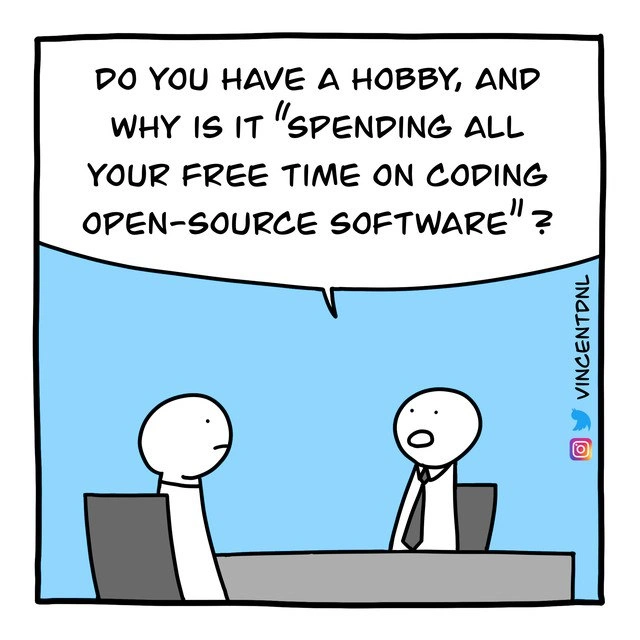
Imagine you go to school all day, and when you come home, you do more homework for fun instead of playing. Sounds a bit funny, right? Most people would think, “Don’t you want to play or do something else?” This meme is joking about a similar idea. The picture shows a job interviewer asking a programmer if they have a hobby, but he phrases it like he already knows the answer: that the person spends all their free time coding. It’s funny because a hobby is usually something different from your job – like drawing, or soccer, or video games – something you do to relax. But here, the person’s “relaxing hobby” is actually the same thing they do at work: writing code! It’s as if a painter painted houses all day at work, then went home and painted more for fun. The joke makes us smile because it’s a little silly and relatable: it shows how much this programmer must love coding (or maybe how they just can’t step away from it). It’s pointing out in a playful way that sometimes developers work so hard and are so passionate that their work and play become the same thing.

Level 2: Open Source 101

Let’s break down what’s going on for a newer developer or someone outside this scene. Open-source software (OSS) is software whose source code is publicly available for anyone to view, use, modify, and share. Think of popular projects like Linux, Firefox, or frameworks like React – their code is out in the open on platforms such as GitHub. When we talk about OpenSourceContribution, we mean contributing to these projects: writing code, fixing bugs, or adding features, usually as a volunteer. Many programmers engage in these open_source_side_projects during their free time. It’s coding as a hobby, often done out of genuine interest or the joy of learning.

Now, in a job interview, there’s a classic question: “What are your hobbies?” It’s usually meant to see a human side of you – maybe you play guitar, or you do photography, or you enjoy hiking. It’s a chance to show you have a life outside work. But in DeveloperCulture, a lot of folks answer: “I tinker with code/projects in my spare time.” This meme exaggerates that scenario. The interviewer in the cartoon isn’t even asking if the candidate codes as a hobby – they assume it! The speech bubble basically says: “Your hobby is spending all your free time coding open-source software – why do you do that?” It’s funny because it suggests the candidate has no other hobbies at all, just coding, coding, and more coding.

For a junior developer, it’s helpful to know why this resonates. Early in your career, you might indeed spend evenings building a small app or contributing to an open-source library to practice new skills. Maybe you’ve stayed up late debugging your personal project – that’s hobby_programming. Many of us have been that enthusiastic newbie who treats coding like a fun puzzle to solve after dinner. Doing so can improve your skills and yes, it can make your resume stand out (employers do appreciate seeing GitHub projects or OSS contributions; it shows initiative). This is part of the OpenSourceCulture – a community norm where coders around the world collaborate on projects just because they want to. It’s pretty common: for example, contributing a patch to fix a typo in documentation, or writing a plugin for an open-source tool you love, all in your off-hours.

However, the meme is also hinting: “Is this really a hobby or just more work?” The tag WorkLifeBalanceTips comes into play here. Work-life balance means having a healthy separation between your job (work) and your personal life. Ideally, you spend your free time on activities that relax or fulfill you in other ways – like sports, arts, reading, family time – basically things that aren’t work. In tech though, the joke is that many developers use that personal time to do free_time_coding. So their work and play blur together. It’s like if you’re a baker by profession and then you come home and bake cakes “for fun” every night. You must really love baking – or maybe you feel you have to keep baking to stay competitive. The interviewer’s question in the cartoon teases the candidate about this exact situation. It highlights a bit of absurdity: instead of saying “I play guitar to relax,” the candidate apparently relaxes by writing more code!

In simpler terms, this cartoon is a piece of TechHumor/DeveloperHumor that points out a trend: developers often have side projects (which are basically additional coding work) as their hobbies. It’s both proud (“look how passionate we are!”) and a little self-jabbing (“uh, maybe we should get out more”). If you’re new to the field, don’t worry – you don’t have to spend all your free time on coding to be a good developer. Many do it because they truly enjoy it, just like someone might enjoy solving puzzles. The meme just takes that to the extreme for a laugh, imagining an interview where it’s so expected that you code on the side that they jokingly frame it as an inevitable truth.

Level 3: Hobby or Hustle?

Why it's funny: This meme’s interviewer flips a standard question on its head, implying the answer before it’s given. In developer culture, it’s alarmingly common for programmers’ primary hobby to be more programming – specifically contributing to Open-Source Software (OSS) projects. The humor comes from the absurd honesty of the question: “Do you have a hobby, and why is it ‘spending all your free time coding open-source software’?” It satirizes how tech interviews often indirectly probe for passion. Instead of “What do you do for fun?” the interviewer basically says, “We already know you code in your free time – explain yourself!” This playful accusation strikes a chord with many developers who really do code all evening. It’s a blend of flattery and concern: flattery because being so dedicated to OpenSourceContribution is seen as passionate, concern because it hints at a shaky work-life balance.

Reality behind the joke: In the software industry, there’s an unspoken expectation that truly dedicated engineers keep coding after hours. Many seasoned devs smirk at this because they’ve lived it or seen it: the teammate who commits to GitHub every night, the coworker who treats maintaining an open-source library as their “relaxation.” This meme pokes at that reality. The interviewer’s exaggerated phrasing suggests that spending all your free time coding is so prevalent that it’s assumed to be the norm for candidates. It’s a bit like an inside joke among developers (InterviewHumor at its finest): everyone nods because either they’ve been that person or felt the pressure to become that person.

Industry context: Open-source culture celebrates passion projects and free_time_coding. Engineers often create or contribute to OSS libraries, frameworks, or tools on weekends, both for learning and reputation. In fact, hiring managers may scan a candidate’s GitHub profile for green commit squares – evidence of those late-night commits. So an interview might subtly check, “What do you do outside of work?” hoping to hear about hackathons, personal apps, or that you’re an active OSS maintainer. It’s reached the point where saying “I code in my spare time” isn’t surprising; it’s practically expected in some circles. The meme exaggerates this expectation to comic effect by treating it as a foregone conclusion.

The double-edged sword: For veteran developers, the question triggers both pride and a sigh. On one hand, contributing to open source is a badge of honor in DeveloperCulture – it shows initiative, curiosity, and gives back to the community. That’s why a lot of us treat open_source_side_projects as a labor of love. On the other hand, the meme hints at burnout and DeveloperLifestyle imbalance. If your only pastime is unpaid coding work, you might be edging into workaholic territory (the classic “all code and no play” scenario). The interviewer’s tongue-in-cheek tone could be read as “We admire your passion, but… do you ever unplug?” It reflects a growing awareness that expecting constant hustle (even in free time) is unhealthy. Yet, the fact that this comic exists means many of us recognize the truth in it – perhaps while rubbing those tired eyes from last night’s marathon coding session.

Underlying commentary: The humor also shines a light on how intertwined a developer’s identity can become with open source contributions. Side projects often blur into one’s professional identity – your GitHub is like a second resume. Companies benefit enormously from open-source (many big tech products are built on OSS foundations), and who maintains those foundations? Often, people volunteering their evenings and weekends. The meme winks at this irony: the industry asks “What are your hobbies?” but kind of hopes the answer is “coding more (for free) to sharpen my skills.” It’s a subtle critique of how tech culture can normalize turning a passion into an unpaid second job. Seasoned engineers chuckle (or groan) because they know the OpenSourceCulture hero narrative – “Look at Alice, she’s a rockstar who commits code on Sunday just for fun!” – but they also know the burnout stories hidden behind those heroic tales. In essence, the meme is funny-’cause-it’s-true: in tech, the line between work and play often vanishes beneath a mountain of code.

Description

A single-panel comic depicting a job interview scenario with two minimalist stick-figure characters sitting at a desk against a plain blue background. A large speech bubble from the interviewer dominates the top half, asking, "DO YOU HAVE A HOBBY, AND WHY IS IT 'SPENDING ALL YOUR FREE TIME ON CODING OPEN-SOURCE SOFTWARE'?". The candidate on the left looks nonplussed, while the interviewer on the right, wearing a tie, looks expectant. The artist's handle 'VINCENTDNL' is visible vertically on the right. This comic satirizes the pervasive and often unhealthy expectation in the tech industry that passionate developers must dedicate their personal time to coding, particularly on open-source projects, for it to be considered a valid hobby. The humor resonates with experienced engineers who recognize this trope from interviews, where 'passion' is often measured by the amount of unpaid work a candidate does, blurring the lines between work, hobby, and professional development, and contributing to burnout culture
Comments

7
Anonymous ★ Top Pick My hobby? Auditing dependency licenses for fun. It's like a corporate escape room where the prize is discovering you're not allowed to use 90% of your stack
  1. Anonymous ★ Top Pick

    My hobby? Auditing dependency licenses for fun. It's like a corporate escape room where the prize is discovering you're not allowed to use 90% of your stack

  2. Anonymous

    Open source is my “hobby” because it’s the only place I can rewrite a decade-old Java monolith in Rust microservices, skip the ROI slide deck, and still get strangers to hit “LGTM” before my manager even opens the JIRA

  3. Anonymous

    My therapist says I need healthier coping mechanisms, but maintaining a library with 10,000 GitHub stars IS my coping mechanism for maintaining enterprise software with 10,000 technical debt tickets

  4. Anonymous

    Ah yes, the classic interview trap: 'Tell me about your hobbies' where the only acceptable answer is 'I maintain 47 npm packages, contribute to the Linux kernel on weekends, and dream in TypeScript.' Because apparently, having a life outside of coding means you're not 'passionate enough' - as if burning out before your Series B is some kind of achievement unlock. The real kicker? The interviewer asking this probably hasn't pushed to their personal GitHub in 3 years, but they'll definitely judge your 6-month gap in green squares

  5. Anonymous

    Because OSS is the only hobby where 'forking' builds legacy instead of family drama

  6. Anonymous

    Open source as a hobby: you’re PM, SRE, and legal for a product with a global user base and a bus factor of 1 - paid in GitHub stars and Friday‑night “is this maintained?” issues

  7. Anonymous

    Open source is my hobby; it’s the only gig where my weekend PR fixes Monday’s sev‑1 and the compensation is a “LGTM” from a stranger

Use J and K for navigation