Legacy Stack Constraints vs. Modern Pet-Project Freedom
Why is this LegacySystems meme funny?
Level 1: Chores vs Playtime
Imagine you have to spend all day doing something boring with old tools, but then you get to go home and do something fun with new toys. For example, picture yourself at school forced to use a really old computer that is super slow and frustrating. Maybe it takes five minutes just to open a file, and it can only run very simple, outdated games. You feel kind of stuck and annoyed using it, right? That’s like the developer at work, stuck with the “legacy” (old) tech – it’s not fun, but they have to use it because that’s their job. Now picture that when you get home, you have a brand new laptop or game console waiting for you with all the latest games or apps. It’s fast, it’s exciting, and you can’t wait to play with it. You feel free and happy using the new technology because it lets you do so much more without the frustration.
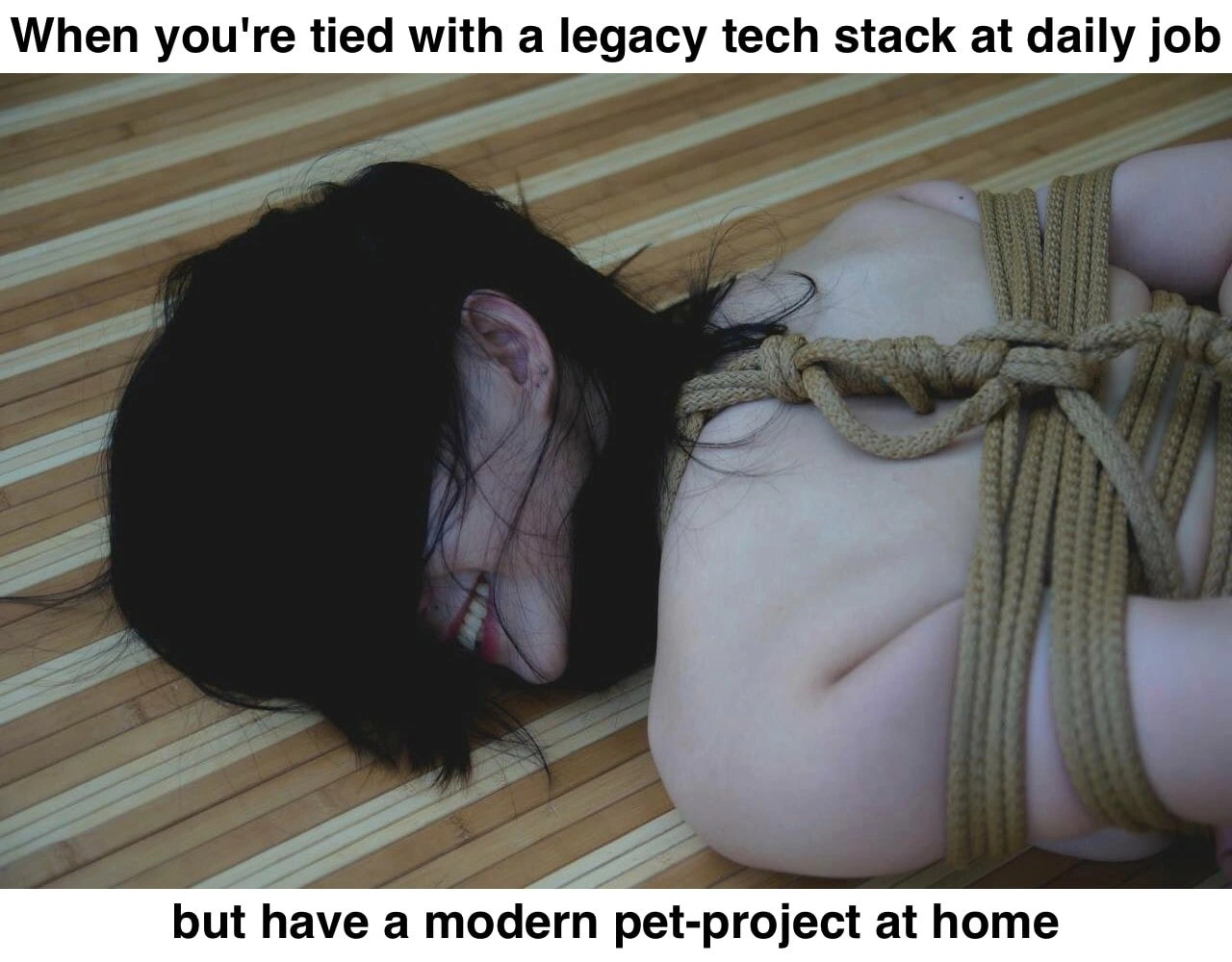
In the meme, being tied up with ropes is a dramatic way to show how the person feels at work: kind of trapped and unable to move freely (just like being stuck with old, limiting tools). But the person is smiling because they’re thinking about the fun thing they’ll do later – their side project with cool, modern tech, which is like their playtime. It’s like doing your homework with an old dull pencil all day (not fun), but knowing that afterwards you get to play your favorite video game (super fun!). That contrast – stuck vs free, boring vs fun – is why the picture is funny to developers. They often joke that at work they’re chained to old stuff, but at home they can code with new stuff and feel “liberated.” Even if you’re not a programmer, you can understand that feeling: the relief of finishing your chores and finally getting to do the activity you really enjoy. This meme simply shows that feeling in a humorous way: the worker is all tied up (doing what they have to do), but grinning because later they’ll be free to do what they want to do. That makes us smile, because we all love the idea of getting through the hard stuff and then enjoying the good stuff.
Level 2: Legacy Days, Modern Nights
Let’s break down what’s happening in this meme in simpler terms. It’s highlighting the difference between old technology at work and new technology at home, and why that’s both frustrating and funny for developers. When we say "legacy tech stack," we mean a collection of software and tools that are outdated or very old, but still in use. Legacy in tech refers to something like an old codebase or system that was built a long time ago (by tech standards) and hasn’t been updated to newer versions or methods. For example, imagine a company website built in 2005 using an old version of Java or PHP – that’s a legacy system. It might still run, but it’s probably harder to maintain and doesn’t use the conveniences of modern frameworks. Working with such a legacy stack can feel like being tied down because you have to do things the old way. There may be a lot of TechnicalDebt – which means the code has many quick-and-dirty solutions accumulated over time. (Think of technical debt like a messy room where things were shoved into closets instead of put away properly; eventually, someone has to deal with that mess, and it’s not fun.) Developers in a legacy project often face constraints: you can’t easily upgrade libraries or you have to support outdated browsers or hardware. Every change is risky, and that makes the work slow and cumbersome. This is the "tied up at daily job" part – you’re stuck using old tools and methods, not because you want to, but because that’s what the existing system is built on.
Now, the meme contrasts that with having "a modern pet-project at home." A pet project (or side project) is a small project a developer works on in their free time, usually for fun, learning, or personal satisfaction. Modern here implies it uses the latest technology. For instance, if at work you’re forced to write code in an old language like Visual Basic 6 or maintain a huge legacy Java app, at home you might choose to write a new app in Python, JavaScript or Go – languages and frameworks that are currently popular and enjoyable to use. In your side project, you’re free to experiment with cutting-edge tools: maybe a new JavaScript framework like React or Vue, or a new database like MongoDB in the cloud. There’s no boss or legacy users telling you “you must use X version because our whole system depends on it.” It’s freedom. The developer in the image is smiling despite being tied up, which humorously suggests that mentally they’re already thinking about their evening coding session with their modern setup 😄. It’s a feeling of “I may be stuck with this old stuff now, but later I get to play with something awesome.”
This contrast is very familiar in the software world. Many programmers experience a kind of dual life in terms of technology. At their day job, especially in older or larger companies, they might deal with LegacySystems that use older programming languages, older databases, and even older deployment processes (like manually copying files to a server). Then these same developers go home and do hobby projects with the latest tech just to keep themselves up-to-date and sane. It’s like if you were a race car driver who has to drive a rusty old truck at work because that’s the only vehicle available, but at home you have a brand new sports car in the garage. Of course you’d be excited to get home and drive the sporty car! The legacy truck gets the job done, but it’s slow and has quirks you have to work around. The modern sports car (your side project) is smooth, fast, and fun.
To put it in more concrete terms, let’s compare the two situations side by side:
| Aspect | Work (Legacy Stack) | Home (Modern Project) |
|---|---|---|
| Tech Stack | Old and tried-but-tired tech (e.g. maintaining a 15-year-old Java or COBOL system) | New and shiny tech (e.g. coding in Rust or building a Node.js app with the latest React frontend) |
| Infrastructure | On-site servers or dated hardware, manual deployments (maybe even copying files by hand) | Cloud-based services or modern hosting, automated deploys with CI/CD pipelines |
| Code Architecture | One big monolithic codebase with lots of entangled parts (spaghetti code!) that’s been patched over years | A fresh codebase, possibly using microservices or clean modular design, built from scratch your way |
| Update Frequency | Slooooow updates – infrequent releases because everyone is afraid to break the legacy system (maybe updates happen only a few times a year) | Rapid iteration – you can deploy updates whenever you want, sometimes daily. Breaking things is okay; you fix them quick since it’s just your project |
| Developer Mood | Often frustrated or bored: it’s tedious to work with old tools, and you’re always worrying about what could go wrong if you change something | Mostly excited and creative: you’re learning new things, building features freely, and if something breaks, it’s a fun challenge rather than a crisis |
In short, the meme shows Modern vs Legacy in a very visual way. Being tied up represents all the limitations and frustrations a developer faces with an old legacy stack at work. The smile (and the thought of the modern project at home) represents the joy and freedom they get when they work with up-to-date technology on their own terms. It’s common for developers, especially those who have been in the industry a while, to maintain side projects like this. Not only is it a creative outlet, it also helps them keep their skills current. After all, if your day job has you writing maybe SQL scripts for an old system all day, you might fear you’re falling behind. So you tinker with, say, a cloud app using AWS Lambda or a new mobile app in Flutter at home to stay sharp (and because it’s fun!).
For newer developers or junior engineers, this meme is a glimpse into a possible future scenario. You might start your career at a place that doesn’t use the latest tech – and that can be a bit of a shock if you learned on modern tools in school or bootcamp. One day you’re all excited about Kubernetes and React Hooks, and then your first job says, “Actually, we need you to add a feature to this old ASP.NET WebForms application from 2008.” 😅 It can feel like stepping back in time. The meme is relatable humor among developers because almost everyone eventually encounters some “old, messy system” they have to deal with. And almost everyone has dreamt of rewriting that system in a newer language or has gone home and actually started building something similar the right way as a personal experiment. That moment when you switch from the legacy project (frustration) to your pet project (elation) is pure relief. It’s like taking off tight shoes after a long day – ahh, freedom! – which in the image is symbolized by that grin despite the ropes.
So, in summary, this meme is pointing out a common developer experience: feeling tied to legacy systems at work but free to use modern tech on personal projects. It’s funny because it’s true – a lot of developers really do live in these two different worlds, and the difference is night and day. The meme uses an extreme visual metaphor (being tied up) to exaggerate that “stuck” feeling, and the punchline is that we secretly enjoy our freedom at home with newer stuff. It’s a mix of frustration and happiness that many find all too familiar.
Level 3: Shackled by Tech Debt
At first glance, this meme hits senior developers right in the feels. We see a person literally tied up with rope on the floor, smiling despite the predicament. It's an on-the-nose metaphor: being bound by a legacy tech stack in your daily job. Those intricate rope knots (reminiscent of shibari rope art) represent the tangle of decade-old code, ancient frameworks, and technical debt that holds a developer hostage at work. The top caption sets the scene: "When you're tied with a legacy tech stack at daily job". In real life, that means spending your 9-to-5 wrestling with an application built on outdated technology – think a monolithic Java app from 2006 or a COBOL program still running on a mainframe. Every component is fragile; one wrong move and you might bring the whole system down. The codebase is full of mysterious knots created by quick-fixes and TechDebt layered over years. You feel constrained by decisions made long before you joined: archaic coding patterns, an old database that nobody dares to replace, and build tools that belong in a museum. It's like being handcuffed to a rock – progress is slow and painful. 😩
Yet the person in the image is smiling. Why? The bottom caption gives it away: "but have a modern pet-project at home." By day you’re chained to that legacy system, but by night you’re liberated – free to hack away on a shiny new side project with all the modern bells and whistles. This is the dual life of a developer. Many senior engineers maintain a pet project after hours precisely to escape the boredom of their legacy-laden day job. Imagine spending all day fixing bugs in a crusty LegacySystem held together by duct tape deprecated APIs, then going home and spinning up a new app in Go or Node.js on a whim. The contrast is almost absurd. At work, deploying a small change might involve manual FTP uploads or a fragile Ant script; at home, you push to main and your CI/CD pipeline auto-deploys to a cloud in seconds. No wonder the bound engineer is grinning – mentally, they're already writing sleek new code in their personal repo while still tied to that old production beast.
This meme’s humor comes from that painfully relatable contrast. It captures the DeveloperExperience (DX) whiplash that many of us feel. By day, you're maintaining a behemoth with a thousand unexplainable quirks ("Why does this XML config need a blank line at the end to not crash?"). You navigate a minefield of TechnicalDebt: outdated libraries that can't be upgraded without breaking everything, code comments from 2008 saying "TODO: remove this hack," and a build process that takes 45 minutes. There's also the bureaucratic rope tying you up: maybe management is ultra-conservative, saying "If it ain't broke, don't fix it!" – classic words that often translate to "we're too scared to modernize." So you soldier on, bound to legacy tools and tech constraints that make you feel like it's still 2010 (or 2000…). The pain point is real: working in a legacy stack can feel like coding in slow motion, with heavyweight processes and ancient bugs that have outlived their creators.
But then after hours, it's a different world. You fire up your personal laptop and suddenly freedom. Your side project runs on a modern stack: perhaps a snappy React front-end talking to a serverless backend in AWS. You use containerization (Docker, Kubernetes) or shiny new frameworks that would make your legacy system quiver. It's cutting-edge, it’s fun, and you have full control. No 20-year-old constraints or inherited messes – you’re starting fresh with the latest tech that actually makes development enjoyable again. This kind of Modernization in your personal time feels like untying all those ropes one by one. Many developers keep these side projects not just for fun, but to learn new skills and retain sanity. It’s the classic Modern vs Legacy split: the stuff that pays the bills vs the stuff that feeds your passion. The meme nails this juxtaposition by visually showing freedom vs constraints: tied up at work, but smiling because you know you'll be playing with your cool project at home later.
From an industry perspective, this scenario is very real. Companies often run on older, LegacySystems that are stable (or just too critical to change easily). As a senior dev, you might spend years nurturing this aging beast, untangling one knot at a time. Proposing a sweeping rewrite or modernization can be a career risk ("Why are you trying to rock the boat?"). So instead, developers often innovate on the side. It's a bit ironic – the skills you use at home are more up-to-date than what you use at work. You end up with one foot in the past and one in the future. This can lead to a strange kind of cognitive dissonance: by day you might be debugging a SOAP XML issue or optimizing SQL on a 90s-era database, and by night you're messing with GraphQL or setting up a CI pipeline with the latest GitHub Actions. 🤖 The meme resonates because so many of us have lived this dual-life developer story. It's funny in the way that sharing war stories is funny – a mix of "ugh, I know right?" and "how do we even put up with this?". We laugh because otherwise we'd cry about being so tied down. And we smile, like the person in the picture, because at least we have that sweet modern side project to look forward to when the workday is done.
Description
A meme that contrasts the feeling of working with old technology versus new. The image features a person with black hair lying on a bamboo mat, intricately tied up with thick, tan-colored ropes in an artistic style resembling Japanese shibari. Despite being bound, the person has a subtle, knowing smile. The top text overlay reads, 'When you're tied with a legacy tech stack at daily job'. The bottom text provides the punchline: 'but have a modern pet-project at home'. The meme uses the visual metaphor of being physically constrained to represent the creative and technical limitations of working with legacy systems. The smile signifies the private satisfaction and creative outlet that a modern side project provides, a relatable feeling for developers stuck maintaining old codebases while passionate about contemporary technologies
Comments
10Comment deleted
My day job is a monolith held together with duct tape and hope. My pet project is a serverless, edge-computed, Rust-based marvel that serves a single, perfectly centered div. It's about balance
My 9-to-5 is shibari in Struts, JNI, and XML: exquisite knotwork, zero mobility; my 9-to-9-oh-wow is one git push to serverless Rust on the edge - finally, a safe word that’s just ‘deploy’
The real Stockholm Syndrome is when you start defending the legacy monolith's 'stability' while your Kubernetes cluster at home auto-scales better than your company's entire infrastructure budget meeting
The real tragedy isn't being bound to a legacy stack - it's that your side project uses the exact framework that will be considered 'legacy' by the time you convince management to modernize. At least the rope has better documentation than your production codebase
Corporate monolith at work: shibari-tight vendor lock-in. Home pet project: Kubernetes pods deploying with zero drama
Weekdays are tight coupling on a WebSphere monolith where a logging change needs a CAB; weekends are loose coupling - shipping a Rust/K8s microservice to the homelab before the coffee cools
что Comment deleted
А можно соус? Comment deleted
stoya Comment deleted
сидя Comment deleted