Skip to content
DevMeme
1463 of 7435
Philosophical Problems: From Falling Trees to Heisenbugs
Bugs Post #1638, on May 28, 2020 in TG

Philosophical Problems: From Falling Trees to Heisenbugs

Why is this Bugs meme funny?

Level 1: The Invisible Problem

Imagine you thought you saw a problem, but when you go back to check, everything looks fine. For example, pretend one day you flip a light switch and the bulb flickers strangely. You get worried and call a friend to show them, but now the light is shining steady without any issue. 🤔 Your friend never saw the flicker. So you both joke, “Huh, if no one else ever sees the light acting weird, was it ever really a problem?” This meme is laughing about that exact idea, but with computer bugs.

In the picture, an old-time thinker wonders: if a tree falls and nobody hears it, did it really make a sound? That’s a fancy way of asking “do things count if no one knows about them?” Now a modern-day coder asks a similar silly question: if a software bug happened but now nobody can make it happen again, did it really happen at all? It’s funny because they’re treating a simple tech glitch like a big mysterious riddle. The joke shows how people writing programs sometimes feel like they’re dealing with “invisible” problems – kind of like a prank that disappears as soon as you look for it. We find it humorous and relatable because it captures the feeling of chasing something that might not even be there. In simple terms: if you can’t see the trouble anymore, you start wondering if it was ever real, and that little bit of confusion makes everyone smile.

Level 2: Works on My Machine

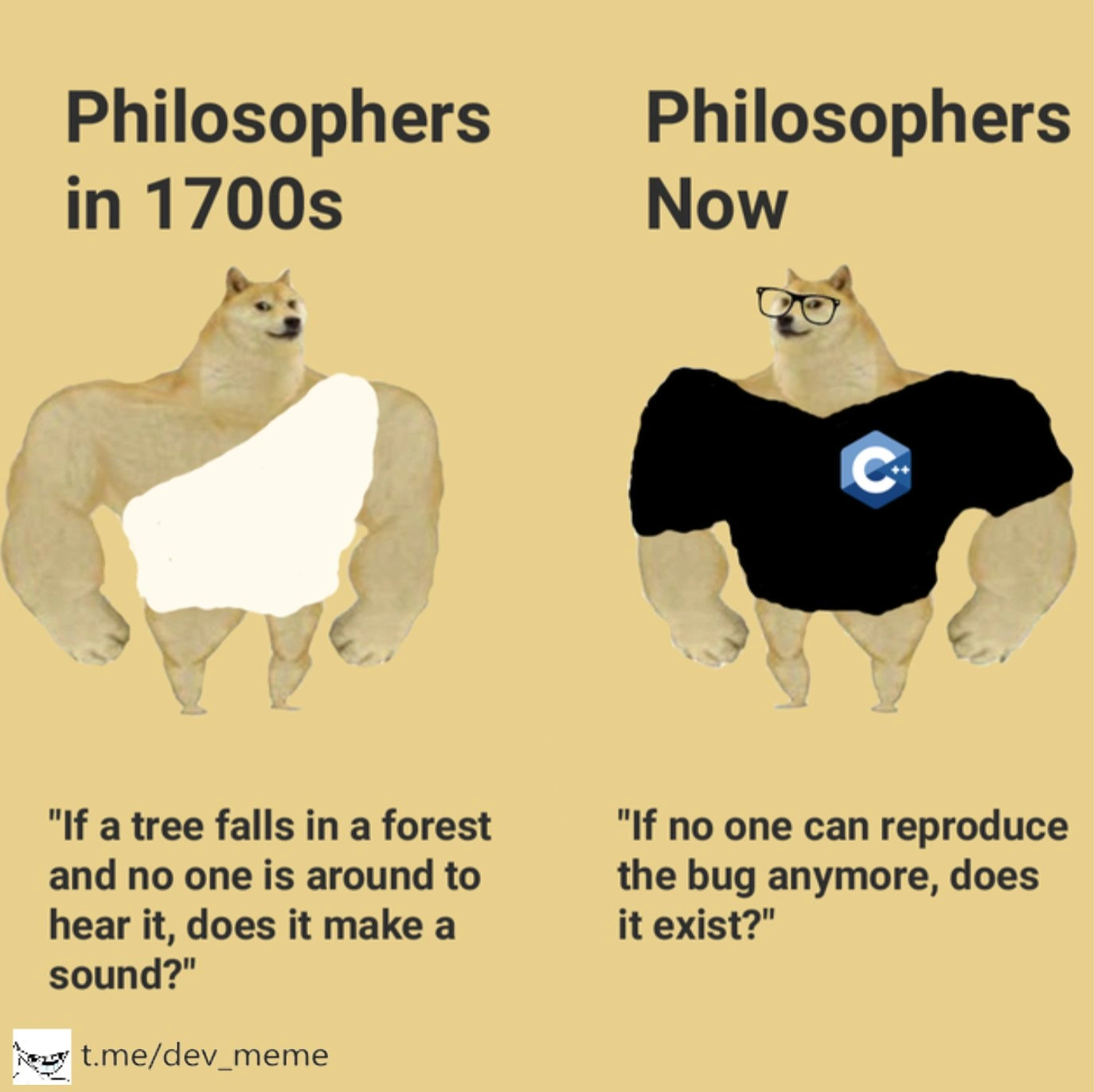
Let’s break down the meme’s two panels. On the left, we have Doge dressed like an 18th-century thinker (wearing a toga), labeled "Philosophers in 1700s". Below him is the famous question: “If a tree falls in a forest and no one is around to hear it, does it make a sound?” This old riddle asks whether an event has real effects if no one is there to experience it. In simple terms: if something happens but nobody notices, did it truly happen in a meaningful way? Philosophers have debated this to explore ideas about perception and reality.

Now on the right, we see a modern twist. Another buff Doge (this time sporting nerdy glasses and a black C++ T-shirt) is labeled "Philosophers Now". His quote reads: “If no one can reproduce the bug anymore, does it exist?” This is a direct analogy to the tree question, but applied to software bugs. A bug is a mistake or error in a program that causes it to behave in an unexpected or wrong way. When developers fix problems, they first try to reproduce the bug – that means running the software in a way that makes the bug happen again reliably. Reproducing it is crucial: if you can’t make the bug appear, it’s extremely hard to diagnose or fix it.

So the right side is essentially a programmer joking, “If a software error happened once but nobody can make it happen again, can we even say it exists (or is it a fluke)?”. Developers actually face this dilemma often. Imagine a tester or user finds a nasty error in an app – maybe it crashed or showed wrong data. They file a bug report. But when the developer tries the exact same steps on their own computer, everything works perfectly fine. This scenario is so common that there’s a tongue-in-cheek phrase for it: “works on my machine.” When a developer says “Hey, it works on my machine!” they’re half-joking and half-frustrated – implying that since it runs correctly in their setup, they can’t find or fix the problem. It’s a lighthearted way of saying, “I’m not seeing what you saw.”

The meme uses the buff Doge with glasses and a C++ logo to represent a present-day software engineer as a kind of philosopher. The C++ logo specifically signals “this is a programmer (probably one dealing with complex code).” C++ is a programming language known for its power and complexity; C++ programs manage memory directly and can have very tricky bugs (like memory leaks or undefined behavior) that sometimes appear randomly. Even if you’re not a C++ expert, you can appreciate that this developer is grappling with a profound question about an unreproducible bug. An unreproducible bug (or ghost bug) is an issue that was observed at least once but then refuses to show up again when you try to replicate it. It’s like a car that made a weird noise earlier, but when you take it to the mechanic, it runs just fine. Super frustrating, right? In software, this often leads to confusion: Was there actually a bug, or did something else cause a one-time glitch?

The humor here comes from equating a high-minded philosophical puzzle with a very practical software troubleshooting problem. In the 1700s example, the philosopher’s question is abstract and intellectual. In the modern example, the “philosopher” is a coder in a T-shirt joking about a concrete issue: closing a bug ticket because no one can trigger the error again. It’s funny because the developer is acting like a philosopher, treating a debugging problem as if it were a deep question about existence. It also playfully mocks how developers sometimes rationalize unresolved issues. If a bug mysteriously disappears, some might quip, “Oh well, maybe it wasn’t a bug after all!” or “The code fairy fixed it when we weren’t looking.” It’s a bit of debugging frustration mixed with humor. Every developer, even juniors, eventually encounters a scenario where a program misbehaved and then stubbornly refused to misbehave when you want to show someone. This meme nails that experience. We laugh because it’s a clever way to say: Modern engineers have their own version of ‘if a tree falls...’ — and it’s all about whether a software bug truly exists if nobody can see it again.

Level 3: Software Epistemology

In modern software teams, debugging can feel like a PhD in philosophy. This meme hilariously casts developers as present-day philosophers pondering an age-old question: when a problem leaves no trace, can we be sure it was real? The left panel quotes the classic thought experiment:

"If a tree falls in a forest and no one is around to hear it, does it make a sound?"

This is a centuries-old paradox about perception and reality. The right panel replaces the tree with a software bug, asking:

"If no one can reproduce the bug anymore, does it exist?"

Seasoned developers immediately grin at this comparison. It’s referencing those maddening bugs in software that appear for one user or under odd conditions, then vanish without a trace. In bug tracker lingo, it’s the dreaded “Cannot Reproduce” ticket outcome. One moment an error had everyone scrambling, the next moment it’s as if the incident never happened. The meme wittily equates that situation to a kind of Schrödinger’s bug – until we observe it again, the bug is both existent and non-existent.

Anyone who’s been through a midnight debugging session or an incident post-mortem will recognize the relatable dev experience here. A tester reports a crash, but when the developer runs the same steps, everything works perfectly. The frustrated tester might insist “It did happen!”, while the developer shrugs: “Works on my machine.” This phrase (half defensive, half perplexed) has practically become an industry meme of its own. It’s the developer’s way of saying, “I believe you saw a problem, but I can’t find it.” At this point, the whole team enters an almost philosophical debate about reality: Was the bug ever “real” if it leaves no evidence? Are we dealing with a ghost in the machine?

From a senior engineer’s perspective, the humor cuts deep: we’ve all wrestled with these phantom issues. Often they’re Heisenbugs – a term (inspired by Heisenberg’s uncertainty principle) for bugs that change behavior when you try to study them. For example, adding extra logging or running a program in a debugger might unintentionally hide the bug by altering timing or memory layout. It’s like the act of observing the bug causes it to disappear, just as measuring a quantum particle disturbs it. In other cases, these elusive bugs are caused by race conditions in multi-threaded code, undefined behavior in languages like C++, or environment differences that are hard to replicate exactly. The developer in the right panel is wearing a black T-shirt with the C++ logo, a playful nod to how low-level languages can produce especially tricky, non-deterministic issues (think wild pointers or memory corruption that strike at random). Seasoned C++ programmers carry plenty of scar stories about crashes that only happen on the production server or only when optimization is on – but never in the dev environment.

The juxtaposition is brilliant because it frames our everyday debugging drama as if it were a profound ontological question. It’s poking fun at how seriously we agonize over an unreproducible bug. In a sprint planning or an incident retrospective, you might literally hear exasperated engineers debate, “If nobody can see it now, was it ever a bug, or was it a user glitch or cosmic ray?” This can lead to a tongue-in-cheek conclusion: if we can’t reproduce it, maybe the code fixed itself or the report was mistaken. Of course, deep down experienced devs know that absence of evidence is not evidence of absence – just because we can’t see the error now doesn’t guarantee it won’t bite us later. But in the heat of the moment, closing a ticket as “Works for me” or “No Repro” can feel like a quick philosophical escape hatch. The meme captures that absurd relief (and lingering worry) perfectly. It’s funny because it’s true: modern software folks sometimes sound like philosophers, using logic and reasoning to argue whether a glitch “truly” occurred. In other words, debugging can be as much about belief and proof as it is about code. One could say our daily stand-ups occasionally drift into existential debugging. We chuckle at the meme, acknowledging both the humor and the pain behind it – after all, today’s “philosophers” aren’t pondering trees and sound, but logs and stack traces, seeking certainty in a world of unpredictable systems.

Description

A two-panel meme comparing philosophers of the past and present using the 'Swole Doge' character. On the left, under the heading 'Philosophers in 1700s', a muscular Doge in a classical white toga poses. Below him is the classic philosophical question: '"If a tree falls in a forest and no one is around to hear it, does it make a sound?"'. On the right, under 'Philosophers Now', the same muscular Doge character is wearing glasses and a black t-shirt with the C++ logo. The modern philosophical question posed is: '"If no one can reproduce the bug anymore, does it exist?"'. A watermark for 't.me/dev_meme' is at the bottom left. The meme humorously equates the abstract, existential questions of traditional philosophy with the frustrating, practical, and equally existential dilemmas faced by modern software developers, particularly the notorious 'Heisenbug' that disappears when observed

Comments

7
Anonymous ★ Top Pick The correct answer is to close the ticket as 'cannot reproduce'. The bug doesn't exist in the same way the sound doesn't exist: until it takes down production at 3 AM, at which point its existence becomes painfully self-evident
  1. Anonymous ★ Top Pick

    The correct answer is to close the ticket as 'cannot reproduce'. The bug doesn't exist in the same way the sound doesn't exist: until it takes down production at 3 AM, at which point its existence becomes painfully self-evident

  2. Anonymous

    Quantum debugging: instrument the Heisenbug and its waveform collapses to “works on my machine,” auto-closing two Jira tickets and opening one philosophical incident post-mortem

  3. Anonymous

    After 20 years in the industry, I've learned that Schrödinger's bug is real - it simultaneously exists in production and doesn't exist in your debugger, usually correlating directly with whether the CTO is watching over your shoulder during the demo

  4. Anonymous

    Ah yes, the Heisenbug - Schrödinger's bug's more annoying cousin. It exists in a quantum superposition of 'critical production issue' and 'works on my machine' until a senior engineer observes it, at which point it collapses into 'cannot reproduce.' The philosophical evolution is complete: we've gone from pondering the nature of unobserved reality to questioning whether that race condition that crashed the payment service at 3 AM actually happened if the logs got rotated and nobody can trigger it again in staging

  5. Anonymous

    Enterprise metaphysics: if CI, ASAN, and TSAN can't reproduce it, PMs mark the JIRA WONTFIX - until it resurfaces at 3am under -O3 on a slightly different kernel

  6. Anonymous

    Senior C++ koan: If a heisenbug vanishes after a printf, you didn’t fix it - you collapsed the UB wavefunction from “sometimes” to “only in prod.”

  7. Anonymous

    Heisenbugs: quantum debugging where observation collapses the bug from 'broken' to 'never happened' - no need for qubits, just a curious PM

Use J and K for navigation