Skip to content
DevMeme
1462 of 7435
The Duality of a JavaScript Developer
Languages Post #1637, on May 28, 2020 in TG

The Duality of a JavaScript Developer

Why is this Languages meme funny?

Level 1: Only We Can Say It

Imagine you have a little brother. You can tease your little brother and call him silly nicknames, because he’s your brother. But if some kid from another neighborhood comes over and says mean things about your brother, you’d be upset and defend him, right? You might tell that kid, “Hey, you don’t even know him – back off!” Then later at home, you and your brother joke and you say, “Yeah, you are kind of goofy,” and you both laugh. This meme is just like that, but with programmers and their favorite programming language. People who don’t use JavaScript are like the outsider kid calling it names. The JavaScript programmers get defensive and say, “You don’t understand it, go learn it!” But among themselves, those same JavaScript folks laugh and say, “Haha, yeah, our language is pretty silly sometimes.” It’s funny because it’s a little bit hypocritical – it’s okay when they say it, but not okay when someone else does. It’s like a family: you protect it from outsiders, even if you know its faults. And that mix of pride and honesty is what makes the joke feel so true (and so funny) to developers.

Level 2: JavaScript Oddities

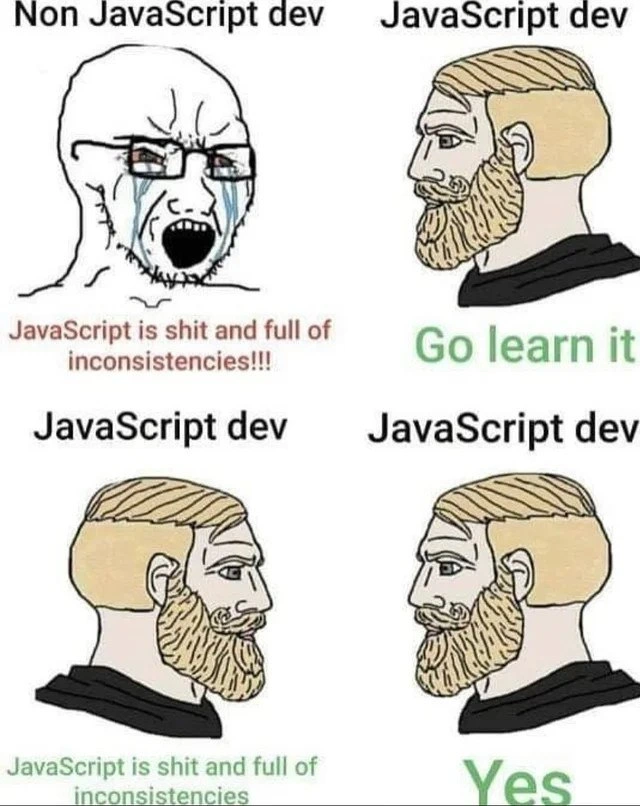
Let’s break down the meme in simpler terms. On the left, we have someone who doesn’t primarily write JavaScript – maybe a developer who works in another language like Python or Java. He’s depicted as a crying, shouting cartoon face (a popular meme character used to show someone upset or ranting). He yells: “JavaScript is shit and full of inconsistencies!!!” This basically means he thinks JavaScript is a bad language because it behaves in weird, unpredictable ways. Inconsistencies here refer to how JavaScript sometimes gives surprising results or doesn’t follow a clear logic in certain situations. For example, if you’re new to JS and you see something like 0 == '0' is true but 0 == [] is also true (since an empty array becomes 0 in comparison), you might say “What the heck, that’s inconsistent!” There are many little confusing things like that which other language users often make fun of.

On the top-right, the “JavaScript dev” is drawn as the Chad character – a meme figure with a confident demeanor (strong jawline, beard, looking composed). He replies calmly: “Go learn it”. In plain language, he’s telling the complainer: “Go actually learn JavaScript.” This response is a bit dismissive and defensive. It suggests that if the critic took time to learn the language properly, they would understand why those quirks exist or how to work with them. It’s like saying, “You only think it’s bad because you don’t know enough about it.” This is common in developer communities: fans of a technology often respond to criticism by implying the critic is just ignorant. It’s a quick way to defend their favorite language or tool. Here, the JavaScript developer feels attacked (JavaScript is his domain), so his instinct is to protect it: “JavaScript isn’t stupid, you just haven’t learned it well.”

Now look at the bottom row. Both characters on bottom-left and bottom-right are labeled “JavaScript dev” – so now two JavaScript developers are talking to each other. The one on the bottom-left (still the Chad image) repeats the exact same sentence the outsider said: “JavaScript is shit and full of inconsistencies”. And the other JS dev on bottom-right just answers “Yes.” in agreement. This is where the joke hits: the same criticism is happening, but now it’s coming from inside the JavaScript community. And suddenly, it’s totally acceptable – the second dev just nods and agrees calmly. No one is yelling “Go learn it” anymore, because both of them already know JavaScript well. They’re basically saying, “Yeah, we as experienced JavaScript devs know it’s full of bizarre things.” There’s no denial here; in fact, they’re kind of bonding over this shared understanding.

So what’s the humor? It’s the double standard or irony: if a non-JS person says “JavaScript is awful,” JS devs will defend their language fiercely. But among themselves, those same JS devs will openly joke about how awful or inconsistent JavaScript can be. It’s like an inside joke in the JavaScript community. They might roll their eyes at things like undefined versus null, the odd scoping rules before modern JS, or why typeof NaN returns "number". They love JavaScript (it’s everywhere in frontend development and beyond), but they also love to poke fun at its oddities because, well, they deal with them every day. It’s a relatable humor for anyone who writes JS code: you laugh to cope with the warts of the language.

Let’s clarify a few terms and concepts to make sure it all makes sense:

  • JavaScript: A very popular programming language, mainly used to make web pages interactive (running in browsers) and also used on servers (with Node.js). It’s known for being flexible and easy to start with, but it also has some strange behavior because of how it was designed and evolved.
  • Inconsistencies/Quirks: These refer to parts of JavaScript that behave in ways you might not expect if you’re used to other languages. For example, JavaScript doesn’t have strict type enforcement, which means it sometimes automatically converts values behind the scenes. A classic quirky example: '5' + 3 results in "53" (because it treats it like text and sticks them together), but '5' - 3 results in 2 (because it treats it like numbers when using the minus sign). That can feel inconsistent. Another one: == vs ===. In JavaScript, == tries to be flexible (so 0 == '0' is true, since it converts the string '0' to number 0), whereas === is a strict equality check (it would see that one is a number and one is a string and say they’re not equal). Newcomers often trip over these differences.
  • “Go learn it”: This is a short, snappy comeback. In developer circles, if someone says “XYZ is a terrible language,” fans of XYZ might respond with “learn the language” or “you’re using it wrong.” It’s a defensive mechanism. Here the JavaScript dev believes the non-JS dev doesn’t truly understand JavaScript. The phrase is basically telling them to go study JavaScript in depth before making such statements. It’s a bit of a snub – implying the complainer is just ignorant.
  • Wojak vs Chad meme: This meme uses a format with two recurring internet characters. The Wojak (sometimes specifically a “Soyjak” when depicted as overly emotional with tears) represents the person who is upset or complaining (often irrationally or loudly). The Chad is the opposite: drawn as a muscular, confident guy with a beard and a stoic expression. Chad represents someone who is unfazed, confident, or dismissive. In this meme, the non-JS dev is portrayed as Wojak to make him look whiny and maybe not taken seriously, whereas the JS devs are all Chad, implying they are confident and maybe a bit smug. This contrast enhances the comedic effect: one side is yelling and crying, the other side is cool and terse.
  • Self-deprecation in tech: Many developer groups poke fun at their own tools or languages. For instance, Python devs joke about the infamous whitespace sensitivity (“offside rule”), or C programmers joke about memory leaks and pointer nightmares. Here, JavaScript devs joke about how weird JavaScript can be. This self-deprecating humor is a bonding experience: it says “we all know this thing we use daily is kind of crazy, haha.” But if an outsider says the same thing without that shared camaraderie, it can come off as an attack.

So the bottom line is: JavaScript developers often defend JavaScript when someone else attacks it (especially if that person hasn’t proven they understand it). However, those same developers will freely admit JavaScript’s flaws when talking among themselves. It’s both funny and true, and that’s why this meme resonates in FrontendHumor circles. Anyone who’s spent time in JavaScript land has probably been on both sides of this exchange at some point – first as the frustrated newcomer confused by the language, later as the seasoned insider who says “Yeah, it’s a mess, but it’s our mess.”

Level 3: Chad’s Paradox

Seasoned JavaScript developers have a love-hate relationship with their language that outsiders often find baffling. This meme captures a classic LanguageWars dynamic: the in-group vs out-group double standard. In the top panels, a “Non-JavaScript dev” (drawn as the crying Wojak, a popular internet character for frustration) shouts that JavaScript is shit and full of inconsistencies!!! Meanwhile, the confident bearded Chad (labelled “JavaScript dev”) dismissively replies “Go learn it” in cool green text. Why such a response? Experienced JS devs often react defensively when someone from outside their DevCommunity criticizes the language. The unspoken retort is “If you actually learned how JavaScript works, you’d understand or avoid those quirks”. It’s a bit of gatekeeping mixed with pride: only those who have slogged through the frontend trenches get to complain about its inconsistencies.

Now, the punchline comes in the bottom panels: the same Chad-looking JavaScript dev repeats the exact same complaint (in the same angry red text) – “JavaScript is shit and full of inconsistencies” – and another Chad calmly answers “Yes.” Here the meme flips the script, showing two insiders casually agreeing that, indeed, JavaScript has ridiculous parts. This is the Chad’s paradox: JavaScript experts publicly defend the language but privately (or humorously among themselves) acknowledge its LanguageQuirks. It’s a form of language self-deprecation that’s incredibly common in tech communities: only we (the insiders) are allowed to call our baby ugly. They’ve earned the right through hard experience to joke about the javascript_inconsistencies that drive everyone crazy.

Technically, why do such inconsistencies exist? JavaScript was created in 10 days back in 1995, and its early design decisions and rushed development led to weird parts that stuck around. For example, the infamous type coercion rules can yield baffling results:

console.log('5' + 3);    // "53"  (string concatenation)
console.log('5' - 3);    // 2    (string converted to number for subtraction)
console.log([] + []);    // ""   (two arrays become two empty strings, then concatenated)
console.log(true + false); // 1  (true coerced to 1, false to 0)
console.log(typeof null); // "object"  (bug from 1990s, null isn’t actually an object)

These are not bugs in the code you write, but oddities in the language itself. Seasoned devs know which parts of JavaScript are safe and which are WAT-worthy. They use best practices (like always using === instead of == for equality, or employing linters and TypeScript for sanity) to navigate the minefield. So when an outsider yells “JS is trash!”, veteran JS folks smirk because yes, the language is full of gotchas, but they’ve tamed this wild beast. It’s a matter of tribal knowledge. The meme’s humor lies in this developer double standard: publicly, they’ll defend JavaScript’s honor (after all, their careers and identity are tied to it), but among friends, they roast it mercilessly. It’s very RelatableHumor to anyone who’s spent years in a tech stack: you become both the guardian and the chief critic of the tools you love.

Finally, note the Wojak meme format: the crying, angry Wojak (sometimes called Soyjak when depicted as overly emotional) versus the stoic Chad. This format exaggerates the contrast in reactions. The Non-JavaScript dev Wojak is portrayed as irrationally upset (red, bold, triple exclamation marks!!!), whereas the JavaScript dev Chad is ultra-confident and terse (“Go learn it.” one green line). In the bottom row, the meme brilliantly uses Chad vs Chad to show an internal dialogue within the JavaScript community itself. Both characters are now Chad (meaning it’s an in-group conversation of peers), and suddenly the harsh criticism is acceptable — even met with a deadpan “Yes.” It’s like watching someone argue with themselves: one moment defensive, next moment openly agreeing. This captures the tongue-in-cheek language_self_deprecation culture among JS developers. They know the LanguageQuirks better than anyone and aren’t blind to them. In fact, veteran JS devs often lead the chorus of jokes about undefined being a type or how NaN !== NaN (yes, Not-a-Number is so inconsistent it’s not equal to itself). But crucially, that chorus is by insiders for insiders. As soon as an outsider (say a C++ dev or a Java guru) pokes fun at JavaScript, the ranks close and the comeback is “Go learn it”, implying “You don’t get to mock our ecosystem until you’ve suffered through it yourself.” This camaraderie-through-suffering is the core of the humor.

Description

A four-panel 'Wojak vs. Chad' comic that contrasts opinions on JavaScript. In the top-left panel, a crying Wojak character labeled 'Non JavaScript dev' yells, 'JavaScript is shit and full of inconsistencies!!!'. To his right, a stoic, bearded 'Chad' character labeled 'JavaScript dev' calmly replies, 'Go learn it'. The bottom two panels feature two identical Chad 'JavaScript dev' characters talking to each other. The one on the left states, 'JavaScript is shit and full of inconsistencies', and the one on the right simply replies, 'Yes'. This meme captures the nuanced perspective of experienced JavaScript developers: they defend the language against outsiders but privately acknowledge and accept its well-known quirks and flaws among themselves
Comments

7
Anonymous ★ Top Pick Arguing with a senior JS dev about the language's flaws is pointless. We've already accepted that '[]' is truthy but not '== true', and we've shipped three frameworks that depend on it
  1. Anonymous ★ Top Pick

    Arguing with a senior JS dev about the language's flaws is pointless. We've already accepted that '[]' is truthy but not '== true', and we've shipped three frameworks that depend on it

  2. Anonymous

    JavaScript: the only language we brag about for its “flexibility” while secretly chaining TypeScript, ESLint, Prettier, and 400 KB of polyfills just to cosplay as something deterministic

  3. Anonymous

    We've spent 15 years building abstractions on top of JavaScript's quirks, and now the abstractions have quirks that need abstractions - it's turtles all the way down, but at least they're async turtles

  4. Anonymous

    This perfectly captures the JavaScript developer's arc: you start by screaming about `[] + {} !== {} + []`, spend three years debugging `this` binding in nested callbacks, finally understand why `0.1 + 0.2 !== 0.3`, and emerge as a battle-hardened veteran who can calmly explain to newcomers that yes, JavaScript's type coercion is objectively insane, and yes, you'll still ship production code in it tomorrow because you've learned that all languages are terrible in their own special ways - JavaScript just has the decency to be honest about it upfront

  5. Anonymous

    JavaScript is inconsistent? Yes. That’s why our stack is harm reduction: TypeScript, ESLint, Prettier, and a CI job that treats '==' like a CVE

  6. Anonymous

    20 YoE JS architect: 'Inconsistencies? Nah, just CAP theorem for types - welcome eventual coherence.'

  7. Anonymous

    If you can’t explain why [] + {} !== {} + [] and why typeof null is "object", you don’t get to complain about JavaScript - come back after '==' burns you in prod

Use J and K for navigation