Modern Infrastructure: It's Backdoors All the Way Down
Why is this Security meme funny?
Level 1: Secret Doors Everywhere
Imagine you built a big sandcastle with your friends. It has tall walls, towers, and looks really strong. You tell everyone, “This will keep the bad guys out!” But what if, in every single wall and tower, you accidentally left a small hidden door that any bad guy could just walk through? Oops! 😅 Suddenly, it doesn’t matter how big or fancy your castle is, because every brick has a secret door letting the sneaky goblins right inside. This cartoon is joking that our computer systems – the apps, websites, and networks we use – are a bit like that castle. We keep adding more rooms and towers (new features, new services), thinking we’re building something sturdy. But if each addition has a little hidden hole or door (a security flaw) that a bad person can sneak through, the whole thing becomes fragile and unsafe, like a wobbling Jenga tower. It’s funny in a way because it’s so silly: who would build a tower where every piece has a hole in it? But it’s also a tiny bit scary, because it feels like that’s how our technology is built sometimes. The meme makes us laugh and worry at the same time, picturing our high-tech world as a big tower of blocks that could tumble down because of all those secret doors.
Level 2: Backdoor Basics
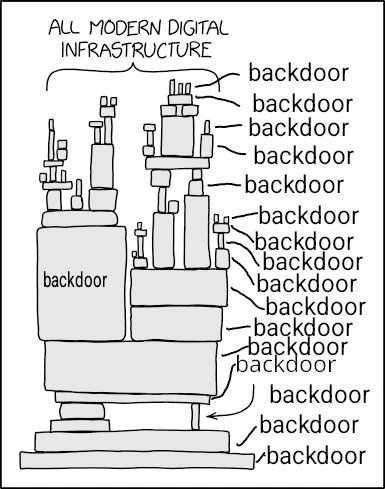
Let’s break down the joke in simpler terms. The meme shows a tall stack of tech components (imagine servers, software modules, pipes connecting them – a bit like a big factory made of LEGO blocks). All Modern Digital Infrastructure is written up top, meaning this stack represents all the stuff that keeps our apps and websites running. Now, every single piece in that stack has an arrow pointing to it labeled “backdoor.” In computer security, a backdoor is like a secret way to get into a system without permission. It could be an intentionally planted secret login, or more often an accidental security flaw that lets bad guys sneak in through a side entrance. The cartoon is saying: every layer of our technology, from the bottom to the top, has some backdoor or vulnerability in it.
Why would that be true? Well, modern software is built on many layers of dependencies. A dependency is any code or system your own code relies on. For example, if you create a simple website, you might use a library (pre-made code) for something like logging, or authentication, or you might run it on a cloud server with its own operating system. Each of those is a dependency. Dependency hell is a cheeky term developers use when they have to manage too many of these, especially when they conflict or need constant updates. Here, it’s not about version conflicts but about security vulnerabilities lurking in dependencies.
Think of it this way: you build a house (your application) using bricks, pipes, wires made by different manufacturers. If even one batch of bricks was faulty, your house could have a weakness. Now imagine you didn’t just buy bricks from one place; you got bricks, doors, windows from dozens of suppliers without fully inspecting them. That’s what we do in software! We pull in open-source packages from all over. Most of the time it’s fine, but occasionally we get a nasty surprise — like a door that was installed upside-down (bug) or even a door with a copy of the key hidden under the mat (backdoor).
There have been real examples that juniors might’ve heard of: Log4Shell was one where a widely used logging library called Log4j had a devastating flaw. People included this library in their applications to handle logs (records of events), not realizing it had a “secret door” that could let attackers run any code on your system by sending a specially crafted message. It was as if millions of applications worldwide suddenly discovered they’d built in a hidden zero-day (a vulnerability no one knew about until it was exploited) into their products. Everyone scrambled to lock that door by updating the library. Another example: the SolarWinds hack – a company that provided network management software was compromised by attackers, so when countless organizations (even government agencies) updated to the latest version, they were unknowingly installing a backdoor planted by hackers. It’s the stuff of cybersecurity nightmares (hence the tag supply_chain_nightmares). And for a lighter but illuminating example: the left-pad incident – a tiny npm package (just 11 lines of code) that many JavaScript projects depended on was removed by its author as a protest, and it broke tons of applications. That wasn’t a hack, but it showed that even a small building block, if yanked out or broken, can make the whole tower fall.
Key terms to know here: Infrastructure in tech means the foundational systems that everything runs on – servers, networks, cloud services, operating systems, etc. It’s like the roads and plumbing/electricity for the digital world. The meme suggests all of that is riddled with vulnerabilities (“precarious tower of backdoors”). Another is Software Supply Chain – this describes the chain of software components and tools that go into making another software. Just like a supply chain for a car includes steel, plastic, electronics from various suppliers, the supply chain for an application might include open-source libraries, third-party APIs, docker images, and build tools. A weakness or attack at any point in that chain (like a hacked library or a malicious update server) can insert a backdoor into the final product.
To combat this, the industry talks about Zero Trust and SBOM. Zero Trust is a security philosophy of “trust nothing by default.” In an old-school corporate network, once you were inside the network, everything kind of assumed you were friendly. Zero trust says: nope, assume every request could be malicious, even from inside, and verify credentials and intentions every step. It’s like in a building where even employees have to badge in through every door – because who knows if an intruder stole someone’s badge. This mindset fits the meme’s world where every module might be compromised: you operate as if an attacker could be anywhere, because they might already be. SBOM stands for Software Bill of Materials. Think of it like an ingredient list or a recipe for your software: it lists all the components and libraries in it. This is super helpful when, say, a new vulnerability is announced in “OpenSSL 1.1.1” – if you have an SBOM, you can quickly search, “Do we use that version anywhere?” Without it, you might be scrambling through code to find if that risky component is hiding in your stack. Generating SBOMs and tracking dependencies is now a big part of SoftwareSupplyChainSecurity best practices, especially after the big scares recently.
In summary, this meme is a cautionary illustration for developers: every shortcut or external component we introduce could hide a trap. It emphasizes the importance of keeping software up to date (patch those backdoors!), auditing what you bring into your project (know your dependencies), and designing systems with the expectation that any part could fail or be breached. It’s a bit paranoid, sure, but after experiencing a few SecurityVulnerabilities in critical systems, you learn that a healthy dose of paranoia in tech is justified. The meme just dramatizes that lesson by literally labeling everything “backdoor,” which is both funny and a little horrifying. It essentially says: “Our lovely modern tech stack? Yeah, it might just be a bunch of exploitable components tenuously bolted together. Sleep tight!”
Level 3: Dependency Jenga
For seasoned engineers, this cartoon hits like a bittersweet truth bomb. It depicts modern infrastructure as a wobbly Jenga tower of components, and every single block is labeled “backdoor.” Why is that funny (in a painful way)? Because it feels like every week we discover that some foundational piece of our tech stack has a security vulnerability or an accidental backdoor. If you’ve survived the past decade of tech, you probably have war stories from the great supply-chain fiascos: the infamous SolarWinds incident where hackers Trojan‐horsed a trusted network management tool, the zero-day Log4Shell vulnerability that lurked in a ubiquitous logging library and set the internet on fire, or even the silly-but-scary left-pad debacle where the removal of an 11-line npm package broke half the JavaScript world. Each of those felt like someone yanked a block from the bottom of a teetering tower of dependencies. Dependency hell isn’t just about version conflicts anymore – it’s about never knowing which tiny module or third-party service might betray you next.
The meme’s drawing looks like an architecture diagram where normally you’d label components “database,” “server,” “kernel,” etc., but here every label reads “backdoor.” That’s the joke: it suggests that every layer is basically an open door for attackers. Seasoned devs and ops folks chuckle (or groan) because it rings true. We’ve got Infrastructure as a Service, Platform as a Service, containers, orchestration, open-source packages – a veritable Rube Goldberg machine of tech. And experience shows each piece can fail spectacularly. The base of the tower might be your OS or hardware – remember when CPU bugs like Meltdown and Spectre revealed that even Intel/AMD chips, the very foundation of computing, had lurking flaws effectively acting like backdoors to sensitive data? The next layer up could be your hypervisor or container runtime – plenty of exploits have broken out of containers or VMs, proving those safety walls aren’t impermeable. Above that, the libraries and frameworks (hello, Log4j!) can hide nasty surprises for years. And at the top, your own application code might be pulling in dozens of npm/PyPI packages maintained by who-knows-who. It’s backdoor_everywhere, literally.
This resonates as satire of industry practices: we’ve built incredibly complex systems by continuously stacking others’ code on top of others’ code. It’s like building a skyscraper by scavenging parts from random old buildings – sure, it’s quicker than starting from scratch, but who knows if one of those beams is termite-infested? When a critical library vulnerability hits the news, senior engineers swap knowing looks that say, “Here we go again.” There’s an entire DevOps calendar of nightmares: Patch Tuesday scramble, zero-day firefights, late-night incident response calls because some “trusted” component turned out to be an open door for hackers. The phrase Software Supply Chain Security has become a hot topic precisely because of these collective scars. We now bandy about terms like SBOM (Software Bill of Materials) – basically an ingredient list of software components – because after surprises like SolarWinds and Log4Shell, everybody wants to know exactly what’s inside their applications and whether any of those ingredients are poison. The meme wryly implies that today’s SBOM might read: backdoor, backdoor, backdoor…
It also highlights the security tradeoffs we make. Using third-party dependencies and cloud services lets us build faster and avoid reinventing the wheel, but it requires blind faith that those components are safe. Often that faith is unwarranted. (We’ve all seen a npm install pull in 500 packages – how many of those do you really audit? Exactly.) Thus the industry is having a zero_trust_epiphany: assume no part of your system is safe, not even your internal network or base images. “Zero trust” architecture essentially means treating your infrastructure like it’s that sketchy tower of backdoors – verifying every action, requiring authentication everywhere, segmenting everything so one compromise doesn’t topple the whole stack. It’s a direct response to the kind of nightmare the cartoon illustrates.
Seasoned devs find this amusing because it’s an exaggerated diagram of what we deal with silently. It’s the dependency nightmare turned into art. We laugh so we don’t cry – because we’ve seen an AWS S3 bucket misconfiguration (backdoor on your data storage), an outdated Struts library bringing down an enterprise (hi, Equifax!), or an “secure” VPN appliance riddled with holes. The humor is in the blunt honesty: calling our beloved “infrastructure” just a tower of exploitable components. It’s like a doctor cartoon for engineers, reminding us that security is only as strong as the weakest link, and right now everything is looking pretty weak. Gallows humor, yes, but also a rallying cry: maybe it’s time to stop treating each breach as a one-off fluke and start realizing our whole approach to building systems needs a rethink. Until then, pull up a chair and watch the tower sway with each new CVE announcement.
Level 4: Backdoors All The Way Down
At the most fundamental level, this meme illustrates a trust paradox in computing: every layer we rely on can itself be compromised. In theoretical terms, modern systems suffer from an infinite regress of trust. You trust your application code, which trusts libraries, which trust the operating system, which trusts firmware, which trusts hardware… but if any of those contain a hidden vulnerability or backdoor, the entire stack’s security collapses. It’s like a recursive nightmare: who verifies the verifier? This was famously highlighted in Ken Thompson’s 1984 Turing Award lecture, “Reflections on Trusting Trust.” Thompson demonstrated that a compiler could be tampered with to insert backdoors into programs it builds – a hack so sneaky that even reading the source code won’t reveal it.
“No amount of source-level verification or scrutiny will protect you from using untrusted code.” — Ken Thompson, 1984
This quote nails the core issue: if the tools that create your software are compromised, you’re building on quicksand. In security theory, we talk about the Trusted Computing Base (TCB) – the components that must be secure for the system as a whole to be secure. The cartoon’s joke is that our TCB is enormous and every piece of it might be tainted. From a formal perspective, verifying that a complex system has no backdoors is akin to proving a negative across thousands of components – practically an undecidable problem. There’s even a resemblance here to Gödel’s incompleteness or the Halting Problem: a system can’t fully verify itself using itself. And as systems grow, the attack surface (places where a bad actor could insert a backdoor) grows combinatorially.
Modern security architecture tries to tackle this with concepts like zero trust (assume no part of the system is safe by default) and rigorous code signing chains. Cryptography can ensure that a piece of software hasn’t been altered since it was signed, but if the signer’s system was compromised (say, malicious code signed with a stolen certificate), all bets are off. We’ve seen real-world echoes of this deep insecurity: hardware implants and firmware backdoors that are almost impossible to detect without physical forensics. The meme’s “tower of backdoors” isn’t just hyperbole – it reflects the academic and practical realization that vulnerabilities exist at every layer. Only through approaches like formal verification (e.g., mathematically proving certain critical software can’t be subverted) and strictly minimal TCBs can we even hope to eliminate hidden flaws. But in practice, we don’t have a formally verified internet or fully secure supply chain; instead, we have a heaping pile of code and hardware where we cross our fingers that none of the lower layers are malicious. It’s backdoors all the way down, and that’s the dark, heady truth this meme brings to light for those steeped in software theory and security research.
Description
This is a single-panel cartoon, drawn in a simple black-and-white line-art style reminiscent of the webcomic XKCD. The drawing depicts a large, complex, and precarious-looking stack of various blocks and components. A large bracket at the top labels this entire structure 'ALL MODERN DIGITAL INFRASTRUCTURE'. The humor and commentary come from the labels applied throughout the stack. Numerous lines point to various components, from large foundational blocks to the smallest pieces at the very top, and nearly all of them are labeled 'backdoor'. The image serves as a cynical but accurate metaphor for the state of modern technology. It suggests that the complex systems we rely on - including hardware, firmware, operating systems, and software libraries - are fundamentally insecure and riddled with vulnerabilities, whether intentional or accidental. For experienced engineers, this cartoon is a powerful visual representation of supply chain security risks, the challenge of auditing dependencies, and the uncomfortable truth that our entire digital world is built on layers of potentially compromised components

Comments
11Comment deleted
The architecture review was a success. We confirmed every component has a clearly labeled, well-documented backdoor, which we're now calling the 'Express Lane API for Unscheduled Audits'
SBOMs these days read less like bill of materials and more like a list of known accomplices - our microservices aren’t loosely coupled, they’re jointly indicted
After 20 years in the industry, you realize the real architectural pattern isn't microservices or monoliths - it's the Universal Backdoor Pattern where every layer of abstraction adds exactly one new undocumented administrative interface, and your threat model is just a list of vendors you're contractually obligated to trust
This architectural diagram perfectly captures the modern approach to security: defense in depth, where 'depth' refers to how many layers deep the backdoors go. It's like we took 'assume breach' and made it a design principle - why wait for attackers to find vulnerabilities when you can build them in at every abstraction layer? The real innovation here is achieving O(n) backdoors where n is the number of components, proving that scalability isn't just for legitimate features
Leadership asked for “defense in depth”; procurement delivered “backdoor in depth” - transitively signed all the way down to the firmware
After CVE‑2024‑3094 our architecture doc basically became this picture; we added Sigstore, but the backdoor was already approved by the build pipeline
Zero-trust achieved: no front doors, just a symphony of backdoors for perfect blast radius scaling
Backdoor-driven development Comment deleted
chose the wrong door Comment deleted
Where's small explosives? Comment deleted
Where's the front door? Comment deleted