Skip to content
DevMeme
5717 of 7435
The Recurring Cycle of AI Job Displacement Anxiety in Programming
AI ML Post #6270, on Sep 25, 2024 in TG

The Recurring Cycle of AI Job Displacement Anxiety in Programming

Why is this AI ML meme funny?

Level 1: Bully vs Bodyguard

Imagine a school playground where a big boastful kid (AI) is going around saying, “Ha! I’m going to do ALL of your homework for you, and then no one will need you!” Understandably, all the other kids (representing different subjects or skills, like math, science, art – or in the meme’s case, different programming languages) get a bit worried and hide together. They’re thinking, “Oh no, will we become useless?”

But among these kids, there’s one small friend who’s usually pretty quiet and not as famous as some others – let’s call him Rust (and picture him with a little pet orange crab, because why not!). Rust steps forward and says to the bully, “Hold on, do you think you can handle my homework?” Now, Rust’s homework is notoriously the toughest of all – it’s like a super hard puzzle that Rust has spent a lot of time mastering. Maybe it’s a super advanced math puzzle or a really tricky game that requires following a bunch of strict rules. The bully wasn’t expecting this. He thought he could do anyone’s homework easily, but now he’s faced with Rust’s challenge and he freezes up, not sure how to solve it.

Rust gives a big confident thumbs-up, as if to say, “Didn’t think so!” The bully, suddenly not so cocky, doesn’t have a clever comeback. Meanwhile, all the other kids (the ones who were scared before) peek out from behind Rust, smiling and relieved. Their buddy Rust stood up for them! The bully’s claim that he could replace them at everything just got proven wrong – at least when it comes to Rust’s super-difficult task.

In simple terms, the bully in the story is like the hype about AI doing every coding job. The other kids are programmers using languages like Java, Go, C, and TypeScript who were worried about that. And Rust is the friend with a special superpower that even the bully can’t match. The whole scene is funny and heartwarming because it’s like saying, “Don’t worry, we’ve got someone on our team that the bragging robot can’t beat.” It’s a playful way to show that sometimes the newest, “smartest” tool (AI in this case) isn’t all-powerful – there are still hard problems out there that need our trusty human experts (with their tough tools like Rust) to handle. And seeing a tiny crab (Rust’s mascot) puff up into a big hero to save the day – well, that just makes the point with a big smile.

Level 2: Does It Compile?

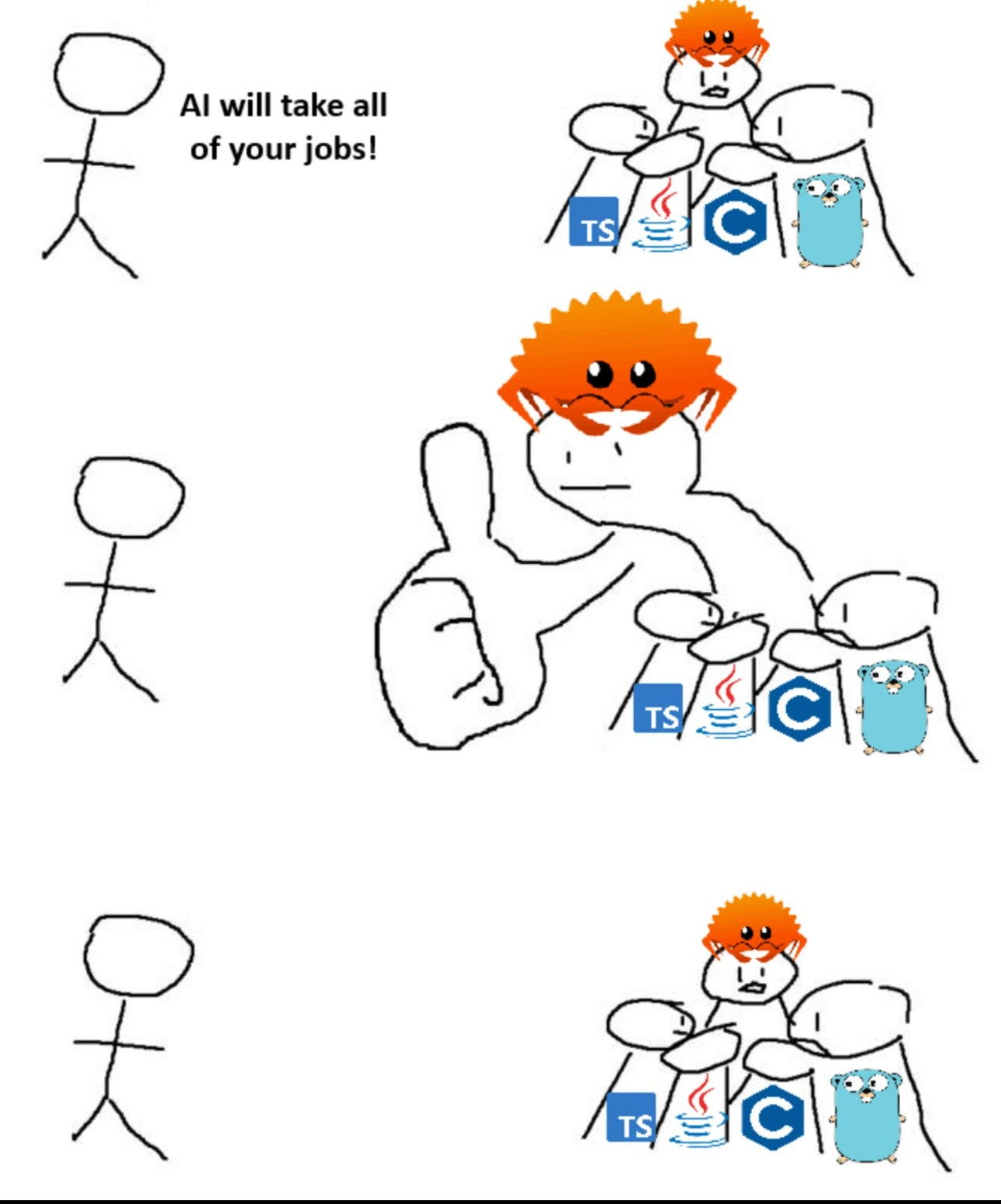
Let’s break this down in simpler terms. We have a bunch of programming languages on one side and an AI on the other. The AI is basically saying, “I’m going to take over all your programming jobs!” (This echoes a lot of recent hype where people claim AI can write code so well that human programmers won’t be needed). The languages – shown as cartoon stick figures with their logos – get nervous. These logos: TS for TypeScript, that steaming cup for Java, the blue hexagon “C”, and the cute gopher for Go (Golang). They represent some of the most popular programming languages used today.

Now, why do they shove Rust out in front as their champion? Rust is another programming language (its logo is an orange crab named Ferris). But Rust is different from those others in a key way: it’s known for being really strict and challenging to work with, especially if you’re new to it or if you’re not careful. Rust is a systems programming language like C or C++, meaning it gives you a lot of control over memory and performance. However, unlike C, Rust has this thing called the borrow checker which is part of Rust’s compiler. The borrow checker’s job is to enforce Rust’s rule of ownership: only one piece of code can “own” a piece of data at a time, and if others want to just read or borrow that data, there are tight rules on how long they can do so and whether the original data can be changed in the meantime.

Think of Rust’s ownership and borrow checker like a librarian who is very strict about lending books:

  • Only one person (one part of the program) can own a book at a time. If you want to lend it to a friend (pass a reference), you have to check it out properly.
  • If your friend borrows the book to read (an immutable borrow), you’re not allowed to rip out pages or scribble in the book until your friend returns it.
  • If you lend the book to someone who promises to add notes in it (a mutable borrow), the librarian won’t let anyone else even read it until that person gives it back.
  • And absolutely nobody can borrow the book once it’s been returned and shelved away (no using a reference to data that’s already been freed).

This is great for safety – it prevents a lot of common bugs like two people unknowingly editing the same data (data races) or someone reading a book after it was destroyed (use-after-free errors). But it means Rust won’t even run your program unless you follow these rules to the letter. The joke among developers is “if it compiles, it probably works,” because Rust’s compiler is so thorough at checking correctness upfront.

Now, imagine an AI coding assistant (like the ones built on GPT-4, often used in tools like GitHub Copilot) trying to write code in Rust. If the AI isn’t explicitly trained to obey all those borrowing rules, it might write code that a human might write on a first try – which, in Rust, often doesn’t pass the compiler’s rules initially. A human programmer can read the compiler’s error message and adjust the code (maybe by rethinking how data is passed around). But an AI producing code in one go might not realize it made a mistake until you try to compile it. With languages like JavaScript/TypeScript, Python, or even Java, the rules are more lenient or errors only show up when you actually run the program. Those languages either handle a lot of things for you (like memory management) or have simpler compile checks. This means an AI has a higher chance of getting code “right enough” in those languages on the first try.

For example:

  • TypeScript (TS): It has a compiler that checks types (making sure, say, you’re not mixing up strings and numbers), but it’s nowhere near as strict as Rust about memory. An AI trained on tons of TS code can usually produce something that satisfies the TS compiler, because the kinds of errors are easier to predict (and TS will compile to JavaScript even with some warnings sometimes).
  • Java: It’s statically typed and verbose, but it doesn’t have concepts like ownership/borrowing. An AI can piece together common Java patterns (like classes, loops, etc.) that will compile because Java’s rules are more about type matching and less about low-level memory safety. There are also decades of example code in Java for the AI to draw from.
  • C: This is a low-level language like Rust in terms of working close to the hardware, but C is unsafe by design – meaning the compiler will happily compile code that might crash or have security bugs. It doesn’t check for things like “are you accessing memory you shouldn’t?” at compile time. So an AI could generate C code that compiles easily (since the bar is just “does it follow the syntax and types?”). Whether that code would run without crashing is another story – but the C compiler won’t stop it. So ironically, it might be easier for an AI to write C that compiles than Rust, even though Rust was designed to avoid C’s common pitfalls.
  • Go: Go is a simpler language by design. It has garbage collection (so it manages memory for you at runtime) and a straightforward set of features. It’s not as lenient as C (it will catch some mistakes), but it’s nowhere near Rust’s strictness. An AI can churn out Go code using common idioms (like using Goroutines for concurrency) and usually it’ll run. Go’s errors are usually simpler (unused variable, mismatched types, etc.), which an AI has likely seen before.

Rust, however, is comparatively new (first stable release was in 2015) and has a unique mix of rules that other languages don’t. There are fewer Rust code examples in the world than, say, Java or C, simply because it hasn’t been around as long and is often used for specific, tougher problems. So an AI has less to learn from. More importantly, the Rust compiler’s error messages — while very helpful to a human developer — represent a level of feedback that the AI doesn’t get in real-time. The AI might produce what it thinks is correct Rust code, but without actually compiling and checking, it won’t know it broke a borrowing rule. This is why in the meme, Rust is portrayed as the first line of defense. The other languages are basically thinking, “If AI is going to replace one of us, Rust is the hardest one to replace — let’s put Rust up front!” It’s a humorous way of saying Rust programmers may have a bit more job security from AI automation, at least for now, because even AI struggles to get Rust code right on the first try.

And there’s another layer: Rust folks are proud of Rust’s strictness and the safety it provides. The community joke is that the Rust compiler is your strict but loving teacher – it won’t let you graduate (run the code) until you’ve done things correctly. Seeing Rust depicted as a small crab that suddenly grows gigantic to protect the others is funny because Rust is often seen as this humble, niche language that actually packs a huge punch. It’s like the quiet kid who’s secretly a black-belt in karate. When a bully (the AI in this case) comes along, the quiet kid steps up and the bully goes “uh oh”. Meanwhile, the big popular kids (Java, C, etc.) are peeking from behind, happy they didn’t have to get into that fight.

In simpler terms: the meme uses the stick figure format (simple drawings with labels) to tell a quick story. The threat “AI will take all your jobs” is a common fear these days. The response it shows is, “Well, AI, have you met Rust?” If AI were a student claiming they can ace every exam without studying, Rust is that insanely tough exam that humbles them. It’s programmer humor to remind us that not every part of coding is easily automatable – some languages (and the problems they solve) have a complexity that even cutting-edge AI finds challenging. So, for junior developers or anyone new: don’t panic! This meme says there’s more to programming than just writing any code – it’s writing correct code, and that’s an art and science where humans (with the help of strict tools like Rust’s compiler) still have an edge over AI, at least in certain domains.

Level 3: Crustacean Shield

In this meme’s comic panels, programming languages are personified as buff stick-figure buddies, and the hype of “AI will take all of your jobs!” is the scrawny heckler yelling from the left. The lineup on the right features some heavy hitters of the coding world – TypeScript, Java, C, and Go – all represented by their logos on muscular stick-figure chests. They look startled by the AI’s taunt. And peeking out from behind them is a tiny orange crab head: that’s the mascot of Rust, affectionately known as Ferris.

When the AI threat is announced, Rust suddenly volunteers as tribute to confront it. In panel 2, the cute crab character inflates into a giant, thrusting a huge thumbs-up (or perhaps a thumb-down to the AI’s plan) right in the heckler’s face. The other languages literally duck behind Rust’s massive form, letting the feisty crustacean take center stage. By panel 3, everything’s back to normal size, with Rust now a small crab on the shoulders of its pals – but the message has been sent: “Not so fast, AI.” This playful reversal portrays Rust as the bodyguard shielding its fellow languages from the sweeping claim that AI will replace programmers.

Why is this so funny to developers? It taps into an inside joke about Rust’s reputation: Rust is hard – even for machines. Rust is famously strict about memory safety and correctness. Its compiler acts like a no-nonsense senior engineer reviewing every line of code, often returning a litany of errors if you haven’t handled ownership and borrowing just right. Seasoned devs joke about the “borrow checker anxiety” they felt when first learning Rust – the compiler can make you fix even tiny potential issues before your code will run. It’s a bit of tough love: frustrating at first, but it leads you to write rock-solid code. Now apply that to an AI trying to generate Rust code. Many experienced programmers have noticed that while AI like ChatGPT or GitHub Copilot can autocomplete boilerplate in Python or even write working JavaScript, it tends to stumble with Rust. It might produce something that looks okay, but then you try to compile and… BOOM! – dozens of errors about lifetimes and mutable borrows pop up. Even an AI code wizard winds up scratching its head (metaphorically) at Rust’s demands.

So in the meme, the other languages are happy to let Rust step forward and say, “Alright, AI hotshot, deal with this!.” There’s a kernel of truth wrapped in humor: if there’s any language that could “hold the line” against AI automation right now, it’s the one that even top-tier devs struggle to master quickly. TypeScript and Go are relatively easier for AI to generate code for – their rules are more straightforward, and there’s a ton of training code out there. Java, being verbose and enterprise-stable, often follows consistent patterns that an AI can mimic. And C might be low-level, but it has less strict safety checks at compile time (meaning an AI can spit out C code that compiles, even if it’s an unsafe mess). But Rust – Rust will call out nonsense with an uncompromising roar of compiler errors. It’s like the friend in your group who’s a stickler for rules: you just know any bogus claim will be meticulously debunked by them. Here, an AI’s sweeping claim to take dev jobs is the bogus boast, and Rust is the stickler saying “Oh really? Can you pass my test?”.

To a senior developer, this scenario drips with “hype vs. reality” wisdom. We’ve seen waves of tech hype before. Remember when “wizard” IDEs in the 2000s were supposed to let you just draw flowcharts and auto-generate working programs? Or when no-code/low-code platforms were hyped to eliminate the need for traditional coding? Each time, reality struck – edge cases, performance, maintainability, or simply the limits of abstraction meant developers weren’t going anywhere. The current AI hype (“ChatGPT will replace programmers!”) is following a familiar pattern. The meme winks at that history: the stick-figure saying AI will take all your jobs echoes every over-eager futurist who ever underestimated the complexity of real-world software development. And the languages hiding behind Rust resemble those seasoned engineers who smirk because they’ve heard this one before. Sure, AI can write some code, but let’s see it maintain a large Rust codebase or tackle systems programming tasks where one wrong pointer can bring down a server.

There’s also a camaraderie element captured here. The languages are like a band of colleagues, and Rust – the relatively new but incredibly strong teammate – steps up when a threat appears. It reflects how many devs feel: we’re not really in competition with each other as languages, we’re collectively facing the next big tool or trend. In the “language wars” we might playfully argue Python vs. Java or C# vs. C++, but when someone shouts “AI will replace you all!”, suddenly Java, JavaScript/TypeScript, C, Go, and Rust developers are on the same side, nodding as Rust retorts, “Let’s see you handle ownership, AI.” It’s a unifying joke for developers across the spectrum, especially those who have grappled with Rust.

To drive the point home, consider a quick real-life style scenario: an AI code generator suggests a snippet in Rust to modify a data structure while iterating over it. A human Rustacean (Rust developer) immediately thinks, “That won’t compile – you can’t mutably alter a collection while holding an immutable reference to one of its items!” Sure enough, if you try it, Rust’s compiler stops you with an error. Here’s a bite-sized example:

fn main() {
    let mut numbers = vec![1, 2, 3];
    let first = numbers.first();    // Immutable borrow of the vector’s first element
    numbers.push(4);               // Attempt to mutate the vector while `first` exists
    println!("{:?}", first);
}

Running this would yield a compiler error like:

error[E0502]: cannot borrow `numbers` as mutable because it is also borrowed as immutable
  --> src/main.rs:3:5
   |
2  |     let first = numbers.first();
   |                 ---------------- immutable borrow occurs here
3  |     numbers.push(4);
   |     ^^^^^^^^^^^^^^^ mutable borrow occurs here
4  |     println!("{:?}", first);
   |                      ----- immutable borrow later used here

Even without knowing Rust, you can glean the issue: Rust caught that we still had a reference to numbers (first) when we tried to change numbers. This kind of safety net is exactly why Rust is both powerful and… well, a bit intimidating. It forces you to handle such cases, usually by restructuring your code (e.g., drop first before pushing, or avoid holding that reference). An AI not intimately familiar with these rules might merrily generate the code as above because in many languages (or in its training data) that pattern is fine. But Rust figuratively puts a big clawed foot down and says “Nope!” – and by extension, so does our giant Rust crab in the meme, putting a claw on the line to stop AI hype in its tracks.

In summary, the “Rust bodyguard” meme resonates with senior dev humor: it’s a lighthearted way of saying “Calm down with the AI-takes-our-jobs talk. Real-world coding has complexities your fancy AI hasn’t conquered yet – just look at Rust.” It’s both a tech insight and a bit of comfort. After all, when confronted with yet another “Your jobs are doomed!” claim, who wouldn’t want a burly orange crab friend giving a confident thumbs-up and telling the fearmonger, “You shall not pass!”?

Level 4: LLM vs Borrow Checker

At the most granular level, this meme spotlights a clash between statistical code generation and formal compile-time verification. Modern AI coding assistants (powered by LLMs, or Large Language Models) generate code by predicting likely sequences of tokens learned from vast datasets. They excel at producing syntactically correct code in familiar patterns. But here’s the rub: Rust’s compiler doesn’t care how plausible the code looks – it enforces strict ownership and borrowing rules that must be logically satisfied. Rust’s famed borrow checker acts like a theorem prover in your toolchain, constructing an internal model of which piece of memory is owned or borrowed where, and for how long, to ensure memory safety. If the AI’s output violates any of those constraints, the code simply won’t compile.

From a programming language theory perspective, Rust’s type system incorporates concepts from affine types and region-based memory management. Each value in Rust has a single owner, and any borrowed references to that value have a limited lifetime. The compiler checks that no reference outlives the data it points to, and that you never have two mutable references to the same data at once. These conditions can be thought of as a set of logical predicates that every valid Rust program must satisfy. In formula form, one invariant might be:

∀ data D: not (borrowed_mutably(D) AND borrowed_immutably(D) at the same time)

In less formal terms, you can’t have one part of the code changing something while another part is merely reading it – not without explicit coordination. Enforcing such rules at compile time is a complex analytical task, akin to solving a constraint satisfaction problem for each function’s borrow graph. Rust’s compiler (recently enhanced by the experimental Polonius borrow checker) effectively performs a kind of dataflow analysis and ownership proving that has its roots in academic research. It’s a bit like a built-in, specialized model checker or SAT solver that runs every time you hit cargo build.

Now consider the AI side: an LLM like GPT-4 doesn’t inherently perform symbolic reasoning or solve constraints – it generates the code token by token based on probability, without a global understanding of lifetime constraints. Unless explicitly guided, the AI might confidently emit Rust code that looks reasonable but violates these strict rules. For example, the AI could try to borrow a value and then modify it without relinquishing the borrow, triggering Rust’s compile error. Unlike a human, the model isn’t mentally simulating the borrow checker’s graph of references; it’s effectively guessing a valid program. There’s an impedance mismatch here: Rust demands algorithmic certainty about memory safety, while the AI provides statistical guesses learned from past code.

We’re observing a fundamental limitation of current AI code generation. Without incorporating a feedback loop (e.g., the AI attempting to compile and adjust code iteratively, or being trained with compiler error signals), an LLM is at a disadvantage with Rust. It’s relatively easy for an AI to crank out valid code for languages like Python or JavaScript – those run-time-managed or dynamically typed environments don’t enforce nearly as many a priori constraints. But in Rust, the space of “acceptable programs” is carved out by rigorous rules that even seasoned human developers must carefully reason about. In computational complexity terms, if we imagine the AI trying to satisfy Rust’s borrow rules by brute force token prediction, it’s facing a search problem that can blow up combinatorially with program size. The CAP theorem might govern distributed systems, but here we have a cheeky analog: you can’t maximize creativity, correctness, and completeness all at once with a naive LLM. Rust’s compiler will unflinchingly point out every little logical inconsistency.

In essence, the meme’s scenario of Rust bravely standing up to an AI highlights a deep truth: formal verification and strict static analysis present a wall that generative AI can’t easily punch through. At least not yet. It’s a beautiful irony – some of the very qualities that make Rust code safe and performant (rich type information, ownership semantics, fearless concurrency guarantees) also make it a tough nut for probabilistic models to crack. Until AI tooling explicitly incorporates Rust’s rules (or LLMs evolve to perform hybrid symbolic reasoning), Rust programmers have a fortress of determinism to fall back on, even as AI stormtroopers line up at the gate. The battle between autoregessive neural networks and a compile-time ownership model is on – and in this meme, the compiler’s logic wins the first round.

Description

A three-panel stick-figure comic illustrates the cyclical fear among developers about AI. In the first panel, a character declares, "AI will take all of your jobs!", causing a group of figures representing TypeScript, Java, C, and Go to huddle in fear, with the Rust mascot (Ferris the crab) on top looking worried. In the second panel, a large figure gives a confident thumbs-up, seemingly dismissing the threat. In the final panel, the group returns to their initial state of huddled fear, showing the anxiety is persistent. The meme humorously captures the tech industry's recurring waves of panic and temporary confidence regarding job security in the age of AI, suggesting that even developers of "safer" languages like Rust are not immune to the existential dread
Comments

16
Anonymous ★ Top Pick The three stages of AI adoption grief: 1. Panic. 2. A senior dev scoffs and gives a thumbs up after a single cherry-picked benchmark. 3. Back to panic when the AI starts suggesting code with unsafe blocks
  1. Anonymous ★ Top Pick

    The three stages of AI adoption grief: 1. Panic. 2. A senior dev scoffs and gives a thumbs up after a single cherry-picked benchmark. 3. Back to panic when the AI starts suggesting code with unsafe blocks

  2. Anonymous

    LLMs can spit out CRUD in 12 dialects, but ask them to placate Rust’s borrow-checker and they start hallucinating about garbage collection

  3. Anonymous

    After 15 years of hearing 'rewrite it in Rust,' we finally found the killer use case: Rust's borrow checker is so complex that even AGI gives up trying to understand lifetime annotations and moves on to easier targets

  4. Anonymous

    When someone suggests AI will replace developers, but you've spent the last six months fighting the borrow checker - you know no neural network has that kind of masochism built in. Rust developers aren't worried about AI taking their jobs; they're too busy explaining why their compile times are a feature, not a bug, and why memory safety without garbage collection is worth protecting at all costs. Besides, if AI could truly understand Rust's lifetime annotations, we'd have already achieved AGI

  5. Anonymous

    AI breezes through TS/Java/Go boilerplate; the moment lifetimes, Send/Sync, and a borrow-across-await appear, it hallucinates 'static' - so everyone pushes the Rust dev to the front

  6. Anonymous

    AI took TS, C#, Docker jobs - good luck explaining monolith-to-microservices migration without a 6-month outage

  7. Anonymous

    AI won’t take your job; Rust will claim ownership, Java will demand an interface, TypeScript will add types to the panic, C will wander into UB, and Go will spawn a goroutine to pretend it’s fine

  8. @azizhakberdiev 1y

    Recursive

  9. @gongchanM1 1y

    Can ai handle brainfuck or even whitespace? Probably no

    1. @captain_gaga 1y

      Can you?

      1. @gongchanM1 1y

        I can only complain at the legacy code I need to deal with. Thats my job

        1. @captain_gaga 1y

          That's one thing that neural models will never replace, so you're safe there

    2. dev_meme 1y

      Technically this is exactly the area where AI will excel much ahead of almost 100% of actual devs

  10. @noi01 1y

    Cant take a job if you dont have one - Rust bros

  11. @ZgGPuo8dZef58K6hxxGVj3Z2 1y

    Facts

  12. @AmindaEU 1y

    Are they emphatic too? How is Haskell itself, should I join? /S

Use J and K for navigation