The road less traveled: CS fundamentals vs. framework hype
Why is this CS Fundamentals meme funny?
Level 1: Candy vs Vegetables
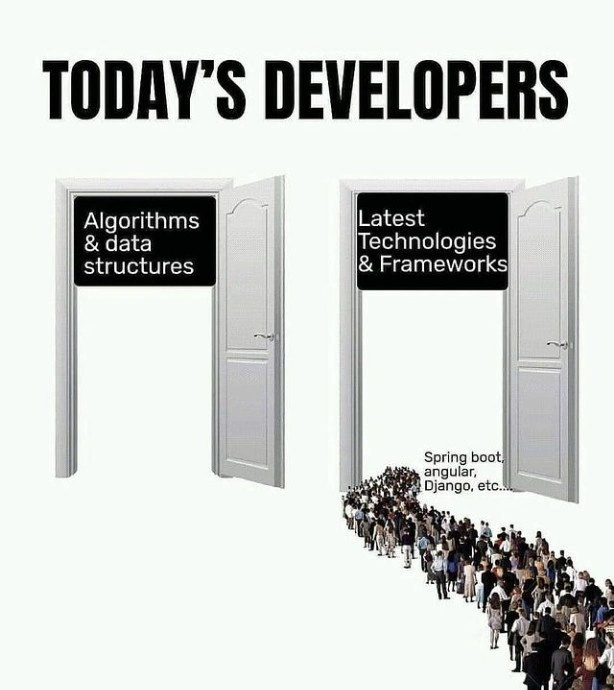
Think of it like a school cafeteria with two options: one table has candy and desserts, and another table has vegetables. Almost all the kids are lined up excitedly for the candy table, and no one is going to the vegetables table. The candy is sweet and gives you a quick burst of joy – just like learning a new flashy framework can be immediately fun and rewarding. The vegetables are healthy and important for growing strong – that’s like learning basic skills (algorithms and data structures) which make you a stronger developer in the long run. The picture is funny because everyone is rushing for the tasty treats (new tech) and ignoring the healthy greens (fundamentals), even though we all know we probably should have a bit of both to be healthy and happy.
Level 2: Shiny Frameworks vs Solid Foundations
Imagine two workshop rooms at a developer conference: one titled “Algorithms & Data Structures 101” and another titled “Build Apps with the Latest Frameworks!”. In the meme, the algorithms room is open with no attendees, and the frameworks room has a huge line out the door. This visual gag sums up how a lot of today’s developers prioritize their learning. Let’s break down the terms to see why this is amusing:
- Algorithms are like step-by-step recipes for solving problems. For example, an algorithm might tell you how to sort a list of numbers from smallest to largest, or how to find the shortest path in a maze. These are core CS fundamentals you’d learn in a computer science class.
- Data structures are ways to organize and store data so that algorithms can use them effectively. Common examples are things like lists, arrays, stacks, queues, or trees. Each has different strengths: imagine data structures as different-shaped containers for data (some allow fast lookup, some allow fast insertion, etc.). Knowing which container (data structure) to use can make your program much faster or use memory better.
Now, frameworks (and “latest technologies”) are the opposite end of the spectrum. A framework is a collection of pre-written code and guidelines that helps you build applications more easily. It’s like a ready-made toolset or a template. Instead of writing everything from scratch, you use the framework’s components and just fill in the specifics for your app. For instance:
- Spring Boot is a popular Java framework that sets up a lot of web application configuration for you. It’s part of the Spring ecosystem and lets developers create production-ready web services with minimal boilerplate. Instead of writing tons of setup code, you add a few annotations and Spring Boot handles the heavy lifting (like starting a web server, connecting to a database, etc.).
- Angular is a JavaScript/TypeScript framework for building front-end web applications (particularly single-page applications). It provides a structured way to build a dynamic website, with features like data binding (keeping the UI in sync with data), components, and services. Angular has lots of built-in solutions for common front-end tasks, so you don’t have to reinvent how to update the page when data changes.
- Django is a high-level Python web framework. Its tagline is “batteries included” because it comes with a lot of stuff built-in: an ORM (Object-Relational Mapper) for database access, an admin panel, and tools for handling login, sessions, etc. With Django, you can get a database-driven website up quickly by following its conventions and using its provided modules.
These frameworks (and others like Angular, React, Vue, Flask, etc.) are very popular because they let developers build real-world applications quickly. When a new tech or framework comes out, there’s excitement around it – lots of tutorials, YouTube videos, blog posts, and community buzz. For a newcomer or even an experienced developer looking to stay current, it’s tempting to spend time learning these latest technologies. Mastering a new framework can directly help you make a cool project or land a job where that framework is in demand. There’s also a bit of trendiness: using a hot new framework can feel like you’re on the cutting edge of the industry (IndustryTrends).
On the other hand, learning algorithms and data structures can feel more abstract at first. You might implement a sorting algorithm or a binary tree in a coding practice session, but it doesn’t immediately show up as a flashy app you can share. A lot of early-career developers encounter algorithms mainly in academic courses or coding interview prep. If you’ve ever prepared for a technical interview, you probably practiced things like reversing a linked list or calculating Big-O complexity. Those exercises build deep understanding, but they’re not as visibly glamorous as building a full website or a mobile app using a new framework.
So the joke in the meme is highlighting this common situation: when given the choice, most developers (especially newer ones) will queue up to learn a trendy framework like Angular or Spring Boot, rather than queue up to study, say, graph traversal algorithms or balanced binary trees. The meme even lists “Spring boot, angular, Django, etc…” next to the crowded door – calling out examples of exactly what draws the crowds. Meanwhile, the Algorithms & data structures door is empty, implying few takers for that subject in their free time.
This doesn’t mean frameworks are bad or that people don’t know any fundamentals at all. It’s more about preference and immediate payoff. Frameworks often have a shorter learning curve to get something visible working. For example, a junior developer can follow a tutorial and have a basic web app up in a day with Django or Angular. That’s exciting and feels productive! In contrast, spending a day learning about, say, different sorting algorithms might not result in anything you can show off, except maybe a console program that sorts numbers slightly faster. Early in your career, you might gravitate towards things that show quick results or are directly asked for by job postings. Modern developer education (like coding bootcamps or online courses) often emphasizes these practical tools and frameworks for exactly that reason – so you can build a portfolio project and get hired. Bootcamps might only lightly touch on data structures and algorithms, because their goal is to get you building apps fast.
However, as you grow in your career, you’ll likely find that those solid foundations become important. For instance, if your app becomes successful and you have to deal with a lot of users or data, knowing algorithms can help you optimize performance. Or when debugging an issue, understanding how a data structure works internally (like how a hash table stores and looks up values) can be crucial. Many developers eventually circle back to strengthen their fundamentals once they realize these basics help in any tech stack. But the meme playfully points out that, at least initially, there’s a big crowd around the fun, new stuff, and a much smaller crowd around the textbook stuff. It’s poking fun at our developer learning priorities in a lighthearted way.
Level 3: Hype-Driven Development
The meme’s two doors illustrate a classic developer culture dilemma. On the left, a door labeled “Algorithms & Data Structures” stands wide open but completely deserted. On the right, a door labeled “Latest Technologies & Frameworks” has a massive queue of people eagerly shoving through. This contrast is both funny and painfully true. In today’s industry, many developers instinctively flock to whatever new framework or tool is trending, while hardly anyone rushes to revisit fundamental computer science concepts. It’s capturing the phenomenon of hype-driven development – choosing tech because it’s hot and new, not necessarily because it’s needed.
For a senior engineer, this image triggers knowing chuckles (and maybe a facepalm). We’ve seen résumés where candidates list every hot framework – Spring Boot, Angular, Django, you name it – yet they struggle with a basic binary tree or an optimal sorting approach. The meme exaggerates that idea: everyone is lining up to learn the next shiny stack that promises quick results, while the room for core CS fundamentals is empty. It’s funny because it’s true in a lot of cases. There’s an irony that the crowd itself forms a literal queue – which is, humorously, a data structure taught in those empty algorithm classes! 🤯
From an experienced perspective, this trend reflects real industry trends and incentives. Modern development moves fast, and there’s constant framework churn – today’s hot JavaScript front-end framework might be passé next year. Many developers feel pressure to keep up with the latest technologies (hello, JavaScript fatigue!), leading to framework fatigue. We end up with a developer ecosystem where everyone chases the newest tool (whether it’s a new JS library, the latest cloud service, or a trendy backend framework) just to avoid feeling left behind. It's practically FOMO-Driven Development – fear of missing out on the cutting-edge. Meanwhile, foundational skills like choosing the right algorithm or understanding a data structure’s performance characteristics get deprioritized because they’re not as flashy or immediately rewarded on the job.
This meme also hints at the divide between theory and practice. In theory, knowing how to analyze an algorithm’s complexity (those big $O(n \log n)$ vs $O(n^2)$ distinctions) is crucial for writing efficient code. In practice, many devs rely on frameworks that abstract those details away – until they hit a performance wall and realize they used an $O(n^3)$ solution inadvertently. Seasoned developers have war stories of projects where misuse of a tool (maybe an ORM doing needless repetitive queries, or a fancy library used in the wrong way) caused slowness that only a deep dive into fundamentals could solve. The meme’s humor is that nobody’s lining up for that lesson ahead of time. Instead, they’re lining up for the next Spring Boot or Angular course.
Historically, this is a cycle we’ve seen before. In earlier eras, a developer might eagerly adopt, say, Ruby on Rails or jQuery when those were the hot new frameworks, while shrugging off things like algorithmic optimization or memory management. A decade later, the specific frameworks have changed (Angular/React/Vue in front-end, Django/Flask or Spring Boot/Micronaut in back-end), but the pattern remains: new generations of devs gravitate to tools that let them build cool stuff fast. The fundamentals door is lonely not because algorithms aren’t important, but because learning them requires deliberate effort and yields more subtle, long-term benefits. In contrast, learning a framework can feel immediately empowering – you can quickly create a web app or a fancy UI, and that’s highly rewarding. It’s the difference between eating your vegetables versus grabbing a tasty snack. Many companies inadvertently encourage this too. Job postings scream for framework experience (“Must know React and Spring”), and fewer ask “Do you understand algorithmic complexity and data structures?” (except in those notorious whiteboard interviews!). So developers, being pragmatic, line up for what employers and projects seem to demand – the latest frameworks.
The DeveloperHumor here has a slight wink: none of those folks in the long line could enjoy their fancy frameworks if not for the unsung heroes who implemented the underlying libraries and algorithms. All those slick technologies are built on CS fundamentals. It’s as if the meme is saying: “Look, we know everyone loves the new toys, but don’t forget the basics that make those toys possible!” Experienced devs often end up revisiting algorithms and data structures when debugging, optimizing, or designing something novel. There’s a shared understanding (with a bit of “kids these days…” sighing) that while frameworks come and go, fundamentals vs hype is an eternal tug-of-war. That empty left door might be quiet now, but any time a developer encounters a complex problem or performance bug, they eventually have to walk through the algorithms & data structures door for a solution. The humor (tinged with truth) in this meme resonates across the industry because we’ve all seen the imbalance it highlights. It’s a gentle critique of our developer preferences – a reminder that a balanced diet of skills might serve us better than chasing every new trend.
Description
The image presents a stark visual commentary under the heading 'TODAY'S DEVELOPERS'. It shows two white doors against a plain white background. The door on the left, labeled 'Algorithms & data structures,' stands open with no one in front of it, signifying neglect. In contrast, the door on the right, labeled 'Latest Technologies & Frameworks,' has a massive, long queue of people eagerly waiting to enter. Text next to the queue lists examples like 'Spring boot, angular, Django, etc...'. This meme criticizes the prevalent trend in modern software development where developers, particularly those early in their careers, prioritize learning trendy frameworks over mastering timeless computer science fundamentals. For experienced engineers, this illustrates the frustration of seeing a focus on superficial, resume-padding skills instead of the deep, problem-solving abilities that come from a strong understanding of algorithms and data structures

Comments
11Comment deleted
Frameworks are like cheat codes for problems you don't understand; CS fundamentals are like learning to mod the game engine itself
We spent three sprints migrating from Angular to React to keep the résumé queue happy - meanwhile the cache-friendly data structure that would’ve cut our AWS bill in half is still standing behind the empty door, checking its watch
After 15 years of watching junior devs build their 47th todo app with the framework-of-the-month while unable to implement a basic binary search, I've realized we're not building better software - we're just building the same bugs with fancier abstractions and more node_modules
The irony is that after 5 years of chasing the latest frameworks, these developers will finally circle back to studying algorithms and data structures - not for passion, but because they can't pass a FAANG interview. Meanwhile, the empty 'Algorithms' door quietly powers every framework they've ever used, patiently waiting like a disappointed parent who knew they'd eventually need to learn proper fundamentals when their O(n²) solution times out in production
Everyone queues for “Latest frameworks” until the flame graph and the AWS bill issue a 301 to “Algorithms & Data Structures”
Fundamentals build castles; frameworks erect sandcastles that wash away with the next tide
Resume-driven development: queue length ~ hype^2; meanwhile every Sev-1 gets fixed with a priority queue and Big-O, not a framework upgrade
> latest > Angular Comment deleted
old Comment deleted
>latest >spring boot Comment deleted
Why not? Comment deleted