The developer's daily sign-off to the codebase
Why is this Bugs meme funny?
Level 1: Sleep on It
Imagine you’re trying to solve a really hard puzzle or beat a tough level in a video game, and it’s almost bedtime. You’ve tried everything, but it’s just not working out. You’re super frustrated. Finally, you put down the puzzle or turn off the game and say, “Ugh, I’ve had enough! I’ll deal with this tomorrow.” Maybe you even stick your tongue out at it or mutter something not-so-nice under your breath. That’s exactly what’s happening in this meme, but with a programmer and their computer code. The programmer’s code has mistakes (we call those mistakes “bugs”), and it’s late in the day. He’s tired and annoyed that it’s not fixed yet. Instead of staying up all night getting more upset, he kind of jokingly says to the code, “Forget you, I’m done for today – see you tomorrow!” It’s like giving the problem a timeout. This is funny because we’ve all felt that way about a problem at some point. It shows that even grown-up programmers sometimes need to walk away and rest, just like you might take a break from homework or a tricky game. In simple terms: when you’re worn out and cranky, sometimes the best thing to do is stop, say “I’ll try again later,” and get some sleep. The next day, you’ll come back fresh and maybe solve that “puzzle” (or fix the code) right away. The meme makes us smile because it’s a very human moment – even the guy who writes the code gets fed up and calls it a night, with a little joke to make himself feel better.
Level 2: Delayed Debugging
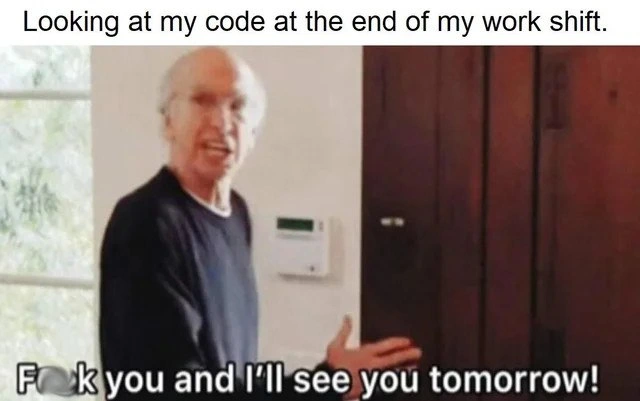
This meme portrays a classic end-of-day scenario that many programmers (even junior ones) quickly learn about. The top text sets the scene: “Looking at my code at the end of my work shift.” The bottom subtitle has the developer essentially telling their program, “Screw you, I’m done, see you tomorrow!” (using a partially censored expletive for comic effect). Let’s break down why this is funny and what it all means in simpler terms.
First, buggy code means code that has bugs – errors or flaws that make it behave in unintended ways. Maybe the program is crashing, giving wrong results, or just not working at all. By the end_of_shift (the end of the work day), our developer has been trying to fix these bugs for hours, and you can imagine their patience is running thin. DeveloperFrustration is at a high: the code still isn’t cooperating, and the clock is saying it’s time to stop. Every developer has had that “ugh, why won’t this just work?!” feeling. That’s the frustration this meme captures.
Now, instead of triumphantly solving the problem, the developer does something very human: they give up for now. The subtitle “F**k you and I’ll see you tomorrow!” is a humorous way to show the developer kind of yelling at their code as if it were a person. Of course, code can’t hear you, but in DeveloperHumor we often joke like this – blaming or talking to the code as if it has a mind of its own. It’s a form of developer self-deprecation too, because usually we wrote the code, so essentially we’re half jokingly cursing at our own work. The phrase “see you tomorrow” is key – it means the programmer is done for today but acknowledges that the problem isn’t solved. They’re literally telling the problem, “wait until tomorrow, I’ll deal with you later.” This is a WorkLifeBalanceTips moment: as much as programmers love to solve things, it’s generally a good idea not to let work consume your entire evening. Here the developer politely (well, not so politely actually) decides to stop working and resume the battle the next day. It’s a little bit of wisdom wrapped in a joke: sometimes it’s better to sleep on it than to keep banging your head against the wall when you’re tired.
Why not just keep working late and fix the bug now? A couple of reasons. DeveloperProductivity tends to drop sharply when you’re mentally exhausted. Think about when you study or do homework late at night – after a point, you stop absorbing information and start making silly mistakes. Same with coding: if you push yourself too long, you might actually write worse code or introduce even more bugs. CodeQuality suffers when the coder is running on empty. So, fixing it “tomorrow” isn’t just procrastination; it can be a smart choice to maintain quality. The meme is poking fun at this very situation: the code is a mess right now (CodebaseChaos might describe a chaotic or messy code situation) and the developer is basically saying, “I’m done trying to untangle this today.” There’s also an element of mental fatigue here – that tired feeling where your brain just isn’t firing on all cylinders after a long day. When you’re that drained, complicated debugging can feel impossible. Coming back with fresh eyes in the morning often makes a huge difference. Newer developers might feel guilty stepping away from a problem, but it’s actually a known productivity trick in programming: take a break, and you might suddenly see the solution when you return.
Let’s talk about the image itself. The guy in the doorway is Larry David, a comedian and actor known for the TV show “Curb Your Enthusiasm.” This show is famous for Larry’s grumpy, blunt humor in awkward everyday situations. The meme uses Larry David because he’s a perfect fit for expressing fed-up body language. In the picture, he’s blurred and mid-gesture, which gives the vibe that he’s literally walking out the door while talking. Using a larry_david_template from a well-known comedy makes the meme even funnier to those who recognize him. It’s like saying the developer is having a Larry David moment – being brutally honest and a bit dramatic while leaving. It’s a fun curb_your_enthusiasm_reference: on that show, if something isn’t going his way, Larry often gives a flippant remark and exits the scene, just like our dev leaving the office with a one-liner. Even if you don’t know Larry David, you can clearly see he’s an older man with a somewhat exasperated expression, hand out as if saying “I’m outta here.” That’s a universally understood gesture of “I’m done.”
The wording uses an expletive (the “F**k you”) which is obviously a curse word, partially censored with an asterisk to keep it light on social media. The fact that the developer says that to their code is what makes it CodingHumor – it’s an exaggeration. Most people don’t actually tell their code “F-you” out loud (well, some might mutter it under their breath!), but it feels like that sometimes. It’s a playful dramatization of a common DeveloperPainPoints: code not working and time running out. By phrasing it this way, the meme finds humor in what is otherwise a pretty frustrating daily experience. There’s also a nice irony: the meme’s title calls it “telling my buggy code to politely wait until tomorrow.” Of course, saying “F**k you” isn’t literally polite – it’s quite rude! But the joke is that by censoring it a bit and framing it as a humorous farewell, it becomes our tongue-in-cheek version of politeness. In other words, the developer is being “polite” by not completely losing their cool; instead, they’re jokingly acknowledging the problem and stepping away calmly (with a dash of attitude).
In summary, this meme is funny to developers because it captures a very real scenario in a lighthearted way. It’s DeveloperHumor about the struggle of dealing with buggy code, balanced with a healthy message: sometimes the best fix is to call it a day and return tomorrow. The image of a man basically walking out and saying “to heck with this, see you later!” is a perfect visual for that feeling. New programmers quickly learn that not every bug can be solved in one sitting, and that taking a break is often more productive than brute-forcing a solution when you’re exhausted. So the next time you’re staring at an error at 7 PM, remember this meme – it’s okay to tell your code “I’ll deal with you later” (maybe without the cursing if others are around 😇) and pick it up in the morning. That’s not giving up; that’s just smart work-life balance. After all, even coders need to clock out and recharge, and the code will still be there (unfortunately!) when you return.
Level 3: Curb Your Code
By the end_of_shift, every line of your buggy code starts to look like an unpredictable enemy. This meme shows a developer effectively throwing up their hands and calling a truce with the code: "F**k you and I’ll see you tomorrow!" 😅. It’s a scene dripping with DeveloperFrustration and weary sarcasm that any seasoned engineer recognizes. Why is it funny? Because it’s developer humor rooted in truth: we’ve all been there, staring at a mess of failing logic or a stubborn bug at 5:00 PM, brain drained, telling our code (and indirectly ourselves) to shove off until morning. It’s an expletive_signoff that perfectly encapsulates the mental fatigue of late-day debugging. Instead of a graceful solution, you give the code a polite profane send-off. This is basically the programmer’s version of “talk to the hand.” The top text "Looking at my code at the end of my work shift" sets the stage for this daily ritual in the trenches of software development. It’s a snapshot of that punchy moment in the DeveloperExperience (DX) when code quality ideals collapse under real-world exhaustion. You know the code is broken, you wrote the darn code, and yet you glare at it like it’s a longtime nemesis. This mix of developer self-deprecation (since cursing your own code is basically cursing yourself) and DeveloperPainPoints (nasty bugs + zero energy) hits home for any programmer who’s pulled their hair out at the eleventh hour.
On a deeper level, this meme hints at the unglamorous reality of CodeQuality and CodebaseChaos in crunch time. Experienced devs will nod at the subtext: continuing to hack on a complex problem when you’re running on fumes is a recipe for disaster. It often leads to poorer code quality (quick-and-dirty patches, anyone?) or even more bugs. So the darkly comedic wisdom here is “just walk away.” Even if it feels like surrender, it’s actually a tactical retreat. DeveloperProductivity isn’t a linear thing – past a certain hour, your productivity nosedives and every fix you attempt risks introducing another bug (or five). The meme’s humor plays on that common sense we tend to ignore until we’re completely cooked. It’s funny because it’s true: staring bleary-eyed at the screen, you eventually accept that nothing good will happen if you keep pounding the keyboard. So you slam your laptop shut in mock anger – real coding_escape hours – and mutter this exact sentiment. It’s a coping mechanism as much as a joke. In fact, veteran engineers consider it a WorkLifeBalanceTips pro move: set a boundary, leave the debugging for tomorrow when your mind is fresh (and your patience bar is refilled). The caption might be phrased as a brash one-liner, but it’s actually highlighting a healthy (if salty) habit of separating work from personal time. It’s a tiny moment of developer empowerment – telling the code “you don’t own me after 5 PM.”
Technically speaking, there’s also an undertone of delayed technical debt. By saying “see you tomorrow,” you’re knowingly deferring the fix. Every coder has done this dance: leave a // TODO: fix this later comment or stash your half-broken changes at day’s end, essentially kicking the can to Future You. It’s both a pragmatic decision and a running joke in software teams. You might even push a last commit named "WIP: temporary hack, fix tomorrow" before you clock out. We chuckle because we’ve seen those exact commit messages (and regrettably authored a few). The meme exaggerates it with an F-bomb, but it’s not far off from real stand-up meeting updates: “I was working on that feature, but it was a dumpster fire... I’ll finish it first thing tomorrow.” The subtext is, Yes, I left a mess, but I chose sanity over hopeless debugging at midnight. Seasoned devs know that feeling too well. We laugh in solidarity, remembering all the times we’ve done a dramatic swivel-chair exit, maybe not quite yelling obscenities at the screen... but definitely feeling that vibe internally.
Let’s also appreciate the pop culture layer: the image is Larry David, a king of comedic frustration from Curb Your Enthusiasm. Using Larry’s infamous exasperated expression as he’s literally halfway out the door is pure meme genius. It’s a curb_your_enthusiasm_reference that adds comedic weight for those in the know. Larry David’s character is famous for blunt honesty and throwing out an annoyed “pretty, pretty good... or not” vibe when situations go south. Here he’s essentially the developer avatar, giving the bug-riddled code a what-for. That larry_david_template amplifies the humor because Larry often ends scenes by walking away from absurd situations—exactly the energy a coder has leaving their desk after wrestling chaotic code. It’s like telling your program “I’m done with your nonsense” in peak Larry David style. Even the partial censorship (“F*k you”) is part of meme etiquette, but it also mirrors how devs think versus what they say in a professional setting. We can’t usually yell expletives in an office (at least, not loudly 😇), so the meme expresses outwardly what we internalize. In that sense, it’s cathartic.
To sum up the senior-perspective humor: this meme nails a DeveloperExperience_DX truth that spans startups to giant tech companies. When the day’s done and the code is still broken, sometimes the best deploy strategy is a strategic retreat. It’s funny because the developer’s polite goodbye is anything but polite – it’s raw honesty wrapped in a joke. And every engineer with a few battle scars has felt that mix of frustration and resignation, giving their screen the stink eye and essentially saying, “Alright you stupid code, you win today – but tomorrow we’re gonna dance again.” It’s a momentary defeat with a promise to return, which is weirdly motivating and comical all at once. The DeveloperPainPoints are real (hello, mental fatigue and unsolved bugs), but laughing about it is how we cope. After all, why fix today what you can cleverly procrastinate until tomorrow with a snarky one-liner?
if work_day.is_over() and code.is_buggy():
# end-of-shift truce with the unruly code
print("F**k you and I'll see you tomorrow!")
commit_changes(message="WIP: fix bug tomorrow") # postpone the fix
clock_out() # developer exits stage left
(Above: Pseudocode for the 5 PM developer exit strategy. Instead of forcing a late fix, we leave a friendly note for “Tomorrow Me” and head home. Future Me might not thank Present Me, but at least tonight I get some sleep!)
Description
This meme consists of a caption, 'Looking at my code at the end of my work shift,' placed above a reaction image. The image is a screenshot of Larry David from the show 'Curb Your Enthusiasm,' looking annoyed and gesturing dismissively as he says, 'F*ck you and I'll see you tomorrow!'. The meme captures the common love-hate relationship a developer has with their work. After a long day of battling complex logic, stubborn bugs, or confusing legacy systems, the code can feel like a personal adversary. The humor lies in the raw, exasperated farewell, acknowledging the frustration of the moment while also accepting the inevitability of returning to the same problems the next day. It's a deeply relatable sentiment for any experienced engineer familiar with the persistent, often infuriating, nature of software development
Comments
7Comment deleted
Signing off for the day is just telling your bugs, 'I'm not trapped in here with you, you're trapped in here with... me, tomorrow morning, after coffee'
At 5:59 PM I treat the whole codebase like a distributed transaction: mark every change ‘pending’, disconnect, and trust that tomorrow-morning-me will magically retry with a saner isolation level
After 15 years in the industry, you realize the real continuous integration is the daily cycle of hating your code at 6 PM and convincing yourself overnight that refactoring it tomorrow will somehow make it less of a distributed monolith with race conditions that only manifest in production
Every senior engineer knows this exact moment: you've shipped the feature, the tests are green (mostly), and you're about to `git push` before EOD. Then you glance at that 800-line service class with nested ternaries, the TODO comments from three sprints ago, and that one function you 'temporarily' made async. You know tomorrow-you will open that PR, see your own code, and wonder what past-you was thinking. But today-you? Today-you has a meeting-free evening and a deploy window that closes in 10 minutes. So you commit with the message 'refactor: improve code quality' and log off. The code doesn't care about your feelings, and your feelings don't care about the code. See you at standup
My EOD commit is "TODO: revisit lock ordering tomorrow" - temporal coupling to my least reliable dependency: Future Me
End-of-day protocol: git commit -m 'wip', flip the flag off, quarantine the flaky, and rely on eventual consistency between Present Me and Tomorrow Me
When your own commit haunts you like legacy COBOL, but with fresh timestamps