Skip to content
DevMeme
1283 of 7435
Generational Hobbies: Model Trains vs. Model Training
AI ML Post #1434, on Apr 29, 2020 in TG

Generational Hobbies: Model Trains vs. Model Training

Why is this AI ML meme funny?

Level 1: Round and Round We Go

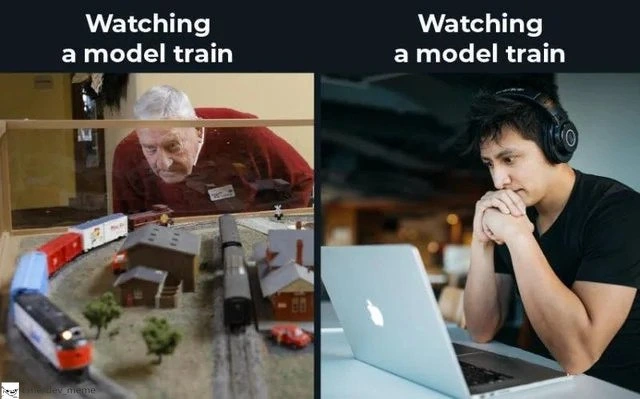
Imagine you’re watching a little toy train go around on a tiny track. Maybe it’s in a toy store or at your grandpa’s house. It’s kind of fun and calming to see it chug along, even though it’s doing the same loop over and over. Now imagine someone else is sitting in front of a computer, just watching a little loading bar or spinner on the screen as a program runs. It’s a bit like when you wait for a video game to load or a YouTube video to buffer – you end up just staring at that progress bar or circle, waiting for it to finish. In this meme, the funny thing is they used the exact same words, “Watching a model train,” to describe both situations at once.

For the older man on the left, watching a model train literally means he’s enjoying a model train set (a toy train). He’s super focused on it, probably because it’s his hobby and it makes him happy to see the little train go around the miniature world he set up. For the young guy on the right, watching a model train means something completely different: he’s watching a computer model training (basically his computer is learning something, and he’s waiting for it). He looks a bit bored or very patient, with his chin on his hands, just sticking with it until the computer is done.

It’s funny because normally if someone said “I’m watching a model train,” you’d think of the toy train scenario. You wouldn’t picture a person staring at a laptop. The meme plays with this confusion. Both people are doing almost the same kind of thing – sitting and watching something go round and round – but one is doing it for fun with a toy and the other is doing it as part of his work with technology. It shows a kind of unexpected similarity between a relaxing hobby and a high-tech job. In simple terms, it’s saying: whether it’s a tiny train or a big computer program learning, sometimes you just have to sit there and watch it go. And the fact that the caption fits both so perfectly is what makes you stop and chuckle. You realize, “Oh! That’s what they mean by model train in the second picture – not a toy train, but an AI thing training.” It’s a little play on words and a wink to how even in high-tech jobs, there are moments that look as simple as just watching a toy go in circles.

Level 2: Same Words, Different Worlds

Let’s break down why this meme is funny, in simpler terms. It all comes down to a play on words. The caption on both sides says “Watching a model train.” On the left, that means literally watching a model train set – you know, a small toy train running on little tracks. On the right, it means watching a machine learning model training. In the tech world, a "model" is like a smart program that can learn tasks, and "training" is the process of teaching it by feeding it lots of data. So, even though the text is exactly the same on both images, the meaning flips completely from one side to the other. That double meaning is what we call wordplay (using one phrase to refer to two things), and tech folks love this kind of pun because it bridges a common phrase with a highly specific geeky scenario.

Now, consider the two scenes. Left panel: An older gentleman is peering into a glass box at a miniature railway. This is a classic hobby: people build detailed dioramas with tiny trains (a model train set) and watch them go around and around. It’s something people do for fun and relaxation, often spending hours perfecting the tracks, the little houses and trees, and then simply enjoying the sight of a train looping through the miniature landscape. It’s hands-on, physical, and a bit nostalgic. The man’s posture – leaning in, eyes glued to the train – shows he’s totally absorbed in that little world.

Right panel: A young software engineer or data scientist sits in a modern office with headphones on, staring at his laptop screen in almost the same posture as the hobbyist. What’s he doing? He’s waiting for a machine learning model to train. In other words, he’s running a program that is currently teaching an AI model by showing it a lot of data. This process (model training) often takes a long time, and you can’t rush it much – the computer has to crunch a ton of numbers. So he’s literally just watching his screen, likely looking at some kind of progress indicator. Many ML engineers will have a console message or a progress bar saying something like “Epoch 3/50 – 20% complete” or a graph updating to show the model getting better. He has his hands clasped and chin resting on them, which is the universal body language for “Alright, I’m stuck waiting now.” The headphones suggest maybe he’s listening to music or trying to pass the time while the computer works. This scene is something people in programming or AI know well: sometimes you run your code and then your job is just to watch or check on it periodically.

So why is this funny and not just random? Because it’s comparing two very different activities that end up looking surprisingly similar. The left side is a leisurely pastime from possibly an older generation; the right side is a high-tech work process from the current generation. But both involve a person doing the exact same thing: patiently watching something go in loops. In one case it’s a toy train going in literal circles on a track. In the other, it’s a progress bar (or some on-screen output) looping through training epochs over and over. The meme highlights that parallel visually and with the single caption applied to both. It’s the kind of joke you appreciate if you know the context on the right: if you’re into machine learning, you immediately get that “model train” isn’t about a choo-choo train at all, but about an AI model. And if you’ve ever actually trained an AI model, you probably chuckle because you’ve been that person waiting and watching as the computer churns away. There’s a shared understanding in the developer community that training models can be both exciting and dull at the same time – exciting when you think of the result, but dull because in the moment you’re often just staring at a loading bar or log messages.

Let’s break down a few terms to make sure everything’s clear:

  • Machine Learning (ML): This is a field of computer science (and a part of AI) where instead of explicitly programming everything, we create models that learn from data. For example, rather than programming rules for how to recognize a cat in a photo, we have a model learn from many example cat photos.
  • Model: In ML, a model is basically the equation or network that is learning to do the task. Think of it like a student or a blank brain that gets trained. It has a bunch of adjustable parts (parameters) that get tuned during training.
  • Training: This is the process of teaching that model. You feed the model a lot of examples (data), check how well it’s doing, and adjust it to do a bit better – repeat this many, many times. Training is usually computationally heavy, meaning it takes a lot of calculations. This is often when you see a progress bar, because the program might say “I’ve done X out of Y steps” to give you a sense of progress.
  • Progress Bar: A visual (or textual) indicator of progress. For long tasks, developers will include a progress bar or at least print out messages like “Processing... 60% done” so you know the program hasn’t frozen. In ML training, you might see one updating for each iteration or each percent of the dataset processed. The engineer in the meme is likely watching something like this creep toward 100%, much like the hobbyist watches the train complete each circuit of the track.
  • GPU: This stands for Graphics Processing Unit. It’s a specialized chip originally for rendering graphics (like in video games) but it turns out they are very good at doing the kind of math used in ML (lots of multiplications/additions in parallel). So ML engineers often use GPUs to speed up training. Even so, big models can still take a long time to train, which is why patience is needed.
  • Epoch: This word might appear if you ever see ML training logs. An epoch means one full round through the entire training dataset. Often you’ll train for many epochs (like 10, 50, 100 epochs) to give the model multiple passes to improve. Each epoch might take several minutes or more, so if someone says “I’m waiting for 100 epochs to finish,” they mean they have to wait a while. The context tag waiting_for_training_epochs literally describes what the right-side guy is doing.

So putting it all together: The left image (hobbyist with the model railroad) and the right image (engineer with the training model) are two worlds apart, but the meme humorously connects them with one caption. It’s saying, in effect, "Whether it's a tiny train or a training algorithm, here’s what life can look like: just watching and waiting." If you’re new to programming or ML, don’t worry – watching a progress bar isn't all we do! It’s just a funny part of the process that everyone eventually experiences. And if you’ve ever waited for a long download or a game to load, you know the feeling. In the developer community, we just have specific instances (like model training) where this waiting is notorious. That’s why this meme is tagged DeveloperHumor/TechHumor: it pokes fun at a slice of our work life that is oddly mundane and universally understood among us. We laugh because we've all been that person, chin in hand, waiting for the computer to finish its thing.

Level 3: Progress Bar Purgatory

For seasoned developers and data scientists, this meme hits close to home. The right-hand image – the young engineer with headphones, hands clasped in a mix of boredom and concentration – is an all-too-familiar sight. It screams: "I’ve started a long-running job, and now I can only wait." In software development generally, that scenario might come from waiting for a huge codebase to compile or an extensive test suite to pass. In the AI/ML realm, it’s invariably waiting for a machine learning model to train. The meme’s humor comes from pairing this modern digital waiting game with the identical phrasing used for an old-school leisurely pastime. It’s a classic bit of developer humor: taking a mundane phrase and flipping its meaning in a tech context. Everyone in the ML community immediately reads “Watching a model train” on the right as “watching a model (neural network) train (learn)”, not a toy locomotive — and that moment of realization sparks the laugh. It’s a prime example of AI humor through wordplay.

Beyond the clever caption, the side-by-side images highlight a truth about the developer experience. Long waits and idle monitoring are practically a ritual in our field. Notice the body language of the two watchers: the older gentleman is leaning in with genuine fascination, and the younger guy is in the exact same pose. That parallel posture is funny because it suggests that, despite the generational and technological differences, both people are equally absorbed in what would look to an outsider like “nothing much happening.” The old man’s model train just goes round and round in a small circle; the engineer’s progress bar or training metrics slowly tick forward, maybe a fraction of a percent at a time. Both scenes require patience, and perhaps a touch of obsession, to find enjoyable.

Every experienced ML engineer has lived through what the right panel shows. You kick off a training run — perhaps it’s 12 hours for a deep network on a big dataset — and then enters the progress bar purgatory. During this period, you’re technically free to do something else, but you often end up mesmerized by the training output. It’s that peculiar state of limbo where your brainchild model is off learning on its own, and you, the proud parent (or anxious caretaker), can’t resist checking in constantly. You watch one epoch finish, see the new accuracy score come in, maybe breathe a sigh of relief that it’s improving. It’s akin to watching a pot of water on the stove: you know it won’t boil faster if stared at, but you peek anyway. In fact, many developers joke that a watched build never finishes and a watched model never converges – a tongue-in-cheek twist on the old saying about watched pots. Still, we watch!

Why do we do this? Partly because of habit and hope. In the first few minutes of a long training job, experienced folks babysit the process to catch errors early. If something’s wrong (like your data is messed up or the model is diverging), it's better to know at epoch 1 than at epoch 100. So we watch those initial loops intently. But even after things look stable, it’s hard to completely step away. There’s a weirdly satisfying element to seeing that progress bar advance or the loss metric go down. It’s like a slow-motion victory – each tiny improvement is feedback, a reward for our setup. Some engineers even admit it can become hypnotic. The term “progress bar gazing” captures it well: you almost enter a trance, watching the console scroll like staring at a campfire. It might be unproductive downtime, but it’s also a moment of contemplation (or frankly, zoning out with some music on, as the headphones suggest).

The meme also pokes fun at how tedious this aspect of ML can be. Training a state-of-the-art model can feel like watching paint dry. Unlike writing code where you get rapid feedback (or at least something interactive), deep learning often involves these heavy off-line computations. It’s a known pain point in ML development: waiting for training epochs is the bottleneck in the iteration cycle of improving a model. Sure, one could use more GPUs, or a cloud cluster to speed it up, but that’s not always available (or cheap!). So, much like a model train enthusiast who has invested in a fancy new engine but still must watch it go around at scale speed, an ML engineer might invest in a cutting-edge GPU only to still spend hours monitoring the training process. It’s a trade-off we accept for higher model accuracy. In a sense, patience becomes part of the job description.

To highlight the parallel, consider the two scenarios side by side:

Hobbyist with a Model Train 🚂 ML Engineer Training a Model 🤖
Builds a tiny train set with tracks, scenery. Builds an ML model (neural network) and dataset.
Watches the model train circle the track, enjoying each loop. Watches the training loop run each epoch, monitoring metrics.
Adjusts switches, dials, or the train’s speed by hand if needed. Tunes hyperparameters (learning rate, etc.) if training misbehaves.
Worries about derailments on curves or the train stalling. Worries about overfitting, crashes, or the loss metric stalling.
Finds the looping journey relaxing and rewarding (it's a labor of love). Finds the training process stressful yet exciting when it converges well (also a labor of love!).
Might proudly show off the functioning train set to friends. Might proudly share the finished model’s accuracy or a cool demo once training is done.

(Both involve meticulous setup and that oddly satisfying feeling of watching a system run on its own.)

The table above draws out how the pastime versus profession each has parallels: both require setup, both have a “run” phase, and both can give a certain satisfaction when everything goes smoothly. The meme’s title even labels it as “hobbyist pastime versus ML engineer ritual,” underlining that for developers, waiting on training is more than just idle time — it’s almost ceremonial. We queue up our code, say a little prayer to the GPU gods, and then perform the ritual of observation. Some developers will even joke that they have time to grab a coffee, catch up on emails, or do some push-ups while the model trains, yet here we see one just sitting and staring. It’s funny because it’s true: sometimes you just watch, either from fascination or from the faint hope that by observing you’re somehow keeping it on track.

The shared experience this meme taps into is broad. You don’t have to be an ML engineer either; even regular software devs have sat through a slow install or a deployment and felt that same chin-on-hands stare. But the context of AI humor makes it extra relevant to those in the machine learning field. In an age where we talk about super-intelligent algorithms and cutting-edge AI, it’s humbling and humorous to remember that a lot of our time is spent waiting for progress bars, just like anyone else using a computer. And when someone external walks by and asks “What are you doing?”, trying to explain “I’m watching my model train” will definitely earn you some puzzled looks – which is exactly why this meme brings on the chuckles for those in the know.

Level 4: Epochs on Track

At first glance, this meme hinges on a clever lexical illusion: the phrase "watching a model train" carries two entirely different meanings in parallel. In one context, model train is a noun (a scale replica locomotive); in the other, model is the noun and train is the verb (an AI model in the process of training). This double entendre is delightfully nerdy because it compresses a complex computing process into an everyday phrase. But let's pull back the glass casing and look under the hood of that computing process: machine learning model training.

In machine learning (ML), training a model is an iterative optimization ritual. The code is tuning a mathematical model (like a neural network) by feeding it tons of data and slowly adjusting internal parameters to minimize error. This typically involves algorithms like stochastic gradient descent (SGD) performing repeated passes (called epochs) over the dataset. Each epoch is like one loop around a track for the algorithm, making incremental improvements. There’s no straightforward formula to jump to a perfect solution; instead the model gradually converges toward better performance, much like a train inching its way around bends and up hills toward a destination. The reason it's slow is fundamental: finding the best parameters of a complex model is a hard problem, often with a loss surface full of twists and turns (local minima and saddles). The only practical way is to traverse it step by step, data batch by data batch. Underneath that friendly progress bar, billions of matrix multiplications and vector updates are happening. The engineer’s code is literally recalculating and tweaking thousands or millions of weights over and over — an exhausting number-crunching marathon for the computer.

Modern ML engineers harness powerful hardware (like GPUs or TPUs) to speed this up. GPUs excel at linear algebra and can perform many operations in parallel (think of dozens of little train engines all pushing the model forward at once). Even so, training a large deep learning model (say on a dataset like ImageNet or training a complex transformer network) can take hours, days, or even weeks. It’s as if the “track” that the model must traverse is extremely long and winding. During this time, the engineer is often monitoring the process through logs and charts. Typically, you'll see something like a progress bar or epoch counter in the terminal:

Epoch 1/5: loss=1.732, val_loss=1.945 - ETA: 02:00:00   # Model is untrained, high error
Epoch 2/5: loss=1.103, val_loss=1.256 - ETA: 01:30:00   # Learning, error decreasing
... 
Epoch 5/5: loss=0.321, val_loss=0.345 - ETA: 00:05:00   # Nearly done, converging nicely

Each line here is like a status update from the training loop. Loss (the error rate) is dropping with each epoch, indicating the model is learning (improving) with each pass. The ETA (estimated time remaining) shrinks as the model chugs along. An ML engineer stares at these readouts the way a hobbyist watches the train complete each circuit: with quiet anticipation. There’s a genuine technical drama in those numbers – Will the loss plateau? Will it keep improving? – analogous to wondering if a toy train will make it up a steep miniature hill or if it might derail on a curve. If the training goes awry (say the loss suddenly explodes due to a bad hyperparameter causing divergence), the engineer might stop the “train” and adjust the tracks (tweak the model or training settings) before setting it off again. This hands-on vigilance is why the meme’s right panel is so accurate: progress-bar gazing is practically a job requirement in AI labs.

What makes the meme especially satisfying is how it bridges two intricate worlds with one phrase. On the left, we have a meticulous mechanical system – tiny locomotives, rails, switches – all governed by physics and careful craftsmanship. On the right, a meticulous computational system – layers of neurons, weight matrices, gradients – governed by math and code. Both require patience to see through. The hobbyist’s train set might evoke principles of control systems or feedback loops (don’t speed too fast on curves!), while the ML training invokes optimization theory and convergence criteria (learning rate schedules, avoiding overfitting). In a way, the ML engineer’s screen is a diorama of a different kind: instead of miniature houses and trees, he’s looking at a landscape of data and algorithms in motion. The phrase "watching a model train" becomes a nerdy poetic intersection of these analog and digital mini-worlds. It’s a wink to those of us who appreciate that beneath a simple joke lies the deep truth that whether it's locomotives or algorithms, getting a complex system to run (or learn) smoothly is a labor of love and a test of endurance.

Description

A two-panel meme comparing two different activities under the same name. Both panels have the identical caption 'Watching a model train'. The left panel shows an elderly man in a red sweater, looking with intense focus and fascination at a physical model train set running on a track through a miniature landscape. The right panel shows a young man, presumably a developer, wearing headphones and staring with the same intense concentration at his laptop screen. The humor is derived from a clever pun on the phrase 'model train'. For the older generation, it's a literal, physical model train. For the developer, 'watching a model train' refers to the process of training a machine learning model, which often involves passively watching logs, metrics, and progress bars for hours on end to see if the algorithm is learning correctly. It's a niche tech joke that equates the developer's highly technical task with a classic, quiet hobby
Comments

7
Anonymous ★ Top Pick One is watching for derailments on a tiny track. The other is watching for loss divergence in a tensor graph. Same zen-like state of helplessness
  1. Anonymous ★ Top Pick

    One is watching for derailments on a tiny track. The other is watching for loss divergence in a tensor graph. Same zen-like state of helplessness

  2. Anonymous

    Miniature locomotive: 6-second loop. Transformer on eight A100s: 6-hour epoch and a real-time “budget anomaly” Slack alert - same glazed stare, vastly different burn rate

  3. Anonymous

    Both hobbies involve watching something go in circles for hours, but only one of them has a chance of actually arriving somewhere useful

  4. Anonymous

    The fundamental difference between these two experiences: one involves watching something follow predictable physics on a fixed track, the other involves watching your loss curve inexplicably spike at epoch 47 after 6 hours of training, questioning every hyperparameter choice you've made, and wondering if you should've just added more dropout layers. At least with the physical train, you know it won't suddenly NaN out and waste your entire weekend

  5. Anonymous

    Two kinds of “model train”: one needs track alignment, the other a learning‑rate schedule; both go in circles and occasionally derail - only the ML one does it at 300W and leaves NaNs in the yard

  6. Anonymous

    Toy train laps reliably; your model promises convergence after 'just one more epoch' since 2019

  7. Anonymous

    Whether HO scale or H100 scale, watching a model train is just staring at a loop and praying early stopping fires before finance notices the burn rate

Use J and K for navigation