Skip to content
DevMeme
1284 of 7435
The 'Full-Stack' General Contractor
Career HR Post #1433, on Apr 29, 2020 in TG

The 'Full-Stack' General Contractor

Why is this Career HR meme funny?

Level 1: Too Many Chores

Imagine your parents ask you to do all the chores in the house in one day: clean your room, wash all the dishes, mow the lawn, fix a broken lamp, and even paint the entire living room. And they want it all done by tonight. That sounds crazy, right? You’d probably laugh and know it’s impossible for one person to do so many different things at once. This meme is funny for the same reason. It shows a single stick-figure person being asked to fix the roof, do plumbing, paint the house, repair the electricity, and lay tiles all by themselves, as if one person could do the work of an entire construction team in a snap. It’s a silly way to show how one developer (like one helper) is being told to do way too much. We laugh because it’s obviously too many jobs for one person, and anyone can see that the expectation is ridiculous. The feeling you get is the same as when a kid is given an impossibly long list of chores — first you’re shocked, then you just have to smile at how unrealistic it is.

Level 2: Full-Stack Handyman

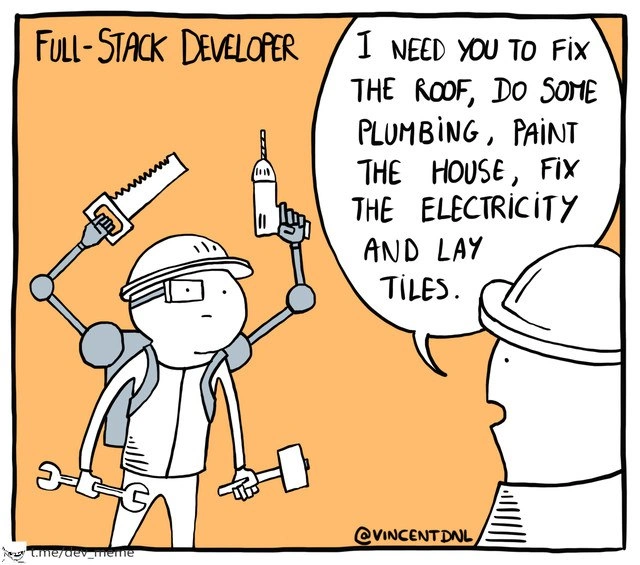
This comic cleverly compares a full-stack developer to a do-it-all handyman in construction. In technology, a full-stack developer is someone who works on every layer of an application: they build the front-end (what you see and click on), the back-end (the server, database, and logic behind the scenes), and everything in between. Here, the developer is drawn with multiple arms holding a saw, drill, paint roller, and wrench — just like a handyman responsible for an entire house. Each tool represents a different kind of task a developer might do:

  • Saw (Fix the roof) – This suggests high-level structural work. In software terms, that could mean fixing the overall architecture of the project or redesigning the main user interface. It’s like repairing the “roof” of the app to ensure the whole thing doesn’t collapse.
  • Wrench (Plumbing) – Plumbing is about pipelines and connections. A developer might need to fix the “plumbing” of the code by connecting different software components or services together, and making sure data flows correctly between them (for example, hooking up the database to the application logic).
  • Paint roller (Paint the house) – Painting is making things look nice. This corresponds to working on the visual design and front-end styling (like CSS, layouts, and user experience improvements) to make the application look polished and user-friendly.
  • Drill (Fix the electricity) – Electricity in a house is like the power and infrastructure in software. This could stand for fixing server issues, configuring cloud services, or solving other infrastructure and DevOps tasks that keep the application running reliably (the “power” behind the app).
  • (No tool shown) Lay tiles – Laying tiles is one of the finishing steps in construction. In a software project, this could be adding final features, fixing remaining bugs, or writing tests — the detail work that comes towards the end to finish the project nicely.

In the speech bubble, the manager character rattles off all those tasks at once: “fix the roof, do some plumbing, paint the house, fix the electricity and lay tiles.” This is an example of scope creep, which means the list of things to do keeps growing larger than originally planned. The manager’s request isn’t focused on just one area; it covers practically everything. Stakeholder expectations like this can be very misaligned with reality. The stakeholder (a client or project manager) might think, “Hey, you’re a full-stack dev, so you can handle it all, right?” They imagine that one person labeled “full-stack” can multitask every skill from graphic design to database tuning. They might believe this will be efficient or cost-saving, but in practice it can overwhelm a developer.

To a junior developer or someone new to the industry, it might sound cool to be a “master of all trades.” But as you gain experience, you learn why teams usually have specialists: front-end developers, back-end developers, database admins, designers, etc. Sure, a full-stack developer has knowledge across the stack and can work in different areas — and that’s a valuable skill set. However, even a skilled generalist has limits. Each part of the “stack” (front-end, back-end, infrastructure, etc.) can be complex enough to be a full job on its own. When one person is asked to do everything in one sprint (a sprint is a short development cycle, typically 1 or 2 weeks in Agile methodology), it often leads to stress and lower quality work. The developer has to constantly switch contexts — like changing hats every hour. One minute you’re debugging JavaScript in the UI, the next you’re writing SQL queries, and after lunch you’re wrestling with cloud deployment scripts. Switching between so many different tasks is mentally exhausting.

The cartoon amplifies this reality in a humorous way. It shows how ridiculous it would look if we treated a developer truly like a one-man construction crew. The FullStackDevelopment label in the comic is drawn to look like “Full-STACK Developer,” emphasizing the “stack” of technologies this person is supposed to handle. The multiple arms are basically saying: “Look, our developer isn’t an octopus, but we’re working them like one.” It’s funny because it’s an exaggeration of a real workplace issue. Many developers share stories of job postings that want one person to be developer, designer, DevOps engineer, and QA tester all in one. This meme resonates with those experiences. It uses a simple construction analogy so even someone outside software can understand: it’s like expecting one worker to build an entire house alone, which in reality would require a team of different experts. The humor has a bit of a “truth-telling” edge to it: it’s poking fun at how non-technical managers or clients sometimes just don’t get how much work is involved in each part of a project. For a junior dev, it’s a glimpse at why your senior colleagues chuckle (or groan) when they hear the term “full-stack” thrown around so lightly. Essentially, the meme is a lighthearted warning: beware of being the handyman who’s asked to do it all, because you might end up with way more than you bargained for in that sprint.

Level 3: One Sprint, One-Man Crew

In this meme, a single full-stack developer is being treated like an entire construction crew, and every senior dev can feel the pain. The stick-figure engineer with four mechanical arms represents the mythical one-person army that management dreams of: a coder who can handle front-end, back-end, DevOps, UI design, and maybe brew coffee all at once. The manager figure’s speech bubble — "I need you to fix the roof, do some plumbing, paint the house, fix the electricity and lay tiles" — reads like a scope creep shopping list. It’s a caricature of stakeholder expectations in many companies: they hear “Full-Stack Developer” and assume that means “expert in everything”. By the time the manager finishes rattling off tasks, you can almost hear every experienced dev groaning, “all in one sprint? Seriously?”.

To decode the construction analogy: each requested house repair maps to a different layer of a software project, all dumped on one person. It’s a clever (and painful) parallel:

Construction Task Software Task (Full-Stack)
Fix the roof Overhaul the app’s architecture or UI (top layer)
Do some plumbing Connect back-end services & database (data flow)
Paint the house Polish the UI/UX design (front-end styling)
Fix the electricity Repair server infrastructure (DevOps & hosting)
Lay tiles Add final features and bug fixes (finishing touches)

Normally, each of these jobs is a specialty of its own. In real construction you’d hire a roofer, a plumber, an electrician, a painter… not one poor soul with four arms and a deadline. But in software, companies often treat a FullStackDevelopment role as a catch-all: one developer expected to wear all the hats simultaneously. The meme exaggerates it with a Dr. Octopus-like engineer wielding a saw, drill, paint roller, and wrench — a darkly funny visual for what being “full-stack” sometimes feels like.

The misaligned expectations here are all too real. A sprint (an Agile development cycle usually 1-2 weeks long) is supposed to contain a reasonable amount of work for a team. Yet the manager in the comic is effectively asking for an entire house renovation in one go. Seasoned developers recognize this scenario: a boss or client starts tacking on “just one more thing” over and over. The result? A two-week sprint turns into an overstuffed marathon of tasks spanning the entire tech stack. You’re switching from JavaScript UI tweaks to database indexing to AWS configuration in the same day, juggling more contexts than a web browser with 100 tabs open. DeveloperProductivity plummets due to constant context-switching, and the quality of each task suffers. It’s a classic “Jack of all trades, master of none” situation — or as the cynical joke goes, *“Jack of all trades, Jacked up by deadlines.”*

The humor here has a bite of truth: it highlights how some managers view developers as interchangeable handymen. They might call you a “rockstar full-stack ninja” in the job ad, but what that often means is “we’re only willing to pay one person to do five people’s jobs.” The meme is funny (in a laugh-cry kind of way) because so many in tech have been there. We’ve all had that project where suddenly you’re the one-man IT department expected to “just fix everything”. The cartoon captures that absurdity: the stakeholder cheerfully piling on tasks, and the overextended dev holding every tool under the sun. It’s a snapshot of ManagementHumor and WorkplaceHumor in software development — one that makes you smirk if you’ve ever survived an unrealistic sprint like this.

Description

A single-panel comic titled 'FULL-STACK DEVELOPER'. The illustration features a cartoon character wearing a hard hat, a backpack, and a futuristic eyepiece. This character has four robotic arms, each holding a different construction tool: a saw, a drill, a wrench, and a hammer. Another character, also in a hard hat (presumably a manager or client), is speaking to the developer. A large speech bubble contains the request: 'I NEED YOU TO FIX THE ROOF, DO SOME PLUMBING, PAINT THE HOUSE, FIX THE ELECTRICITY AND LAY TILES.' The comic, by artist @VINCENTDNL, uses a construction metaphor to satirize the unrealistic and overly broad expectations often placed on full-stack developers. The joke is that the 'full-stack' title is often interpreted by management as a single person who can perform the duties of multiple specialized roles (frontend, backend, DevOps, database admin, etc.), much like asking a single construction worker to be a roofer, plumber, painter, electrician, and tiler all at once. It highlights the problem of role dilution and the immense pressure on developers to be a 'jack of all trades'
Comments

7
Anonymous ★ Top Pick The recruiter said 'full-stack,' but the job description looks like they want one person to build and maintain the entire Death Star, including the plumbing in the stormtrooper barracks
  1. Anonymous ★ Top Pick

    The recruiter said 'full-stack,' but the job description looks like they want one person to build and maintain the entire Death Star, including the plumbing in the stormtrooper barracks

  2. Anonymous

    PM: “Just a quick 3-pointer - patch the React roof, reroute the Kafka plumbing, repaint the Figma façade, and rewire the Terraform electrics.” Full-stack dev: “Sure, an end-to-end blue-green deployment of the entire house. Anything else before stand-up?”

  3. Anonymous

    "Full-stack" means I can debug both the React hooks causing infinite re-renders AND the Kubernetes cluster that's mysteriously eating all our AWS credits, not that I know why the office printer only works on Tuesdays

  4. Anonymous

    The comic brilliantly captures the modern full-stack developer's reality: you're expected to architect microservices, optimize database queries, craft pixel-perfect UIs, configure CI/CD pipelines, manage cloud infrastructure, handle DevOps, understand security, and somehow still have time to mentor juniors - all while stakeholders wonder why the 'simple' feature isn't done yet. It's the tech equivalent of being asked to build a house when you signed up to write JavaScript, except now you're also the electrician, plumber, roofer, and apparently the tile guy too. At least in construction, when someone asks you to do everything, they acknowledge you need different tools; in tech, they just expect you to 'Google it' and add it to your LinkedIn skills section

  5. Anonymous

    Full-stack: the architectural pattern where one engineer owns the monolith, the pipeline, and the 3AM prod roof leak

  6. Anonymous

    Full‑stack: the role where you’re the general contractor, electrician, and building inspector - estimated by PM as a two‑point UI tweak

  7. Anonymous

    Full‑stack: a deployment model where the single point of failure carries the pager

Use J and K for navigation