Skip to content
DevMeme
1282 of 7435
The Ultimate Troubleshooting Tool: The Hard Reset
Hardware Post #1439, on Apr 29, 2020 in TG

The Ultimate Troubleshooting Tool: The Hard Reset

Why is this Hardware meme funny?

Level 1: When All Else Fails, Hit It

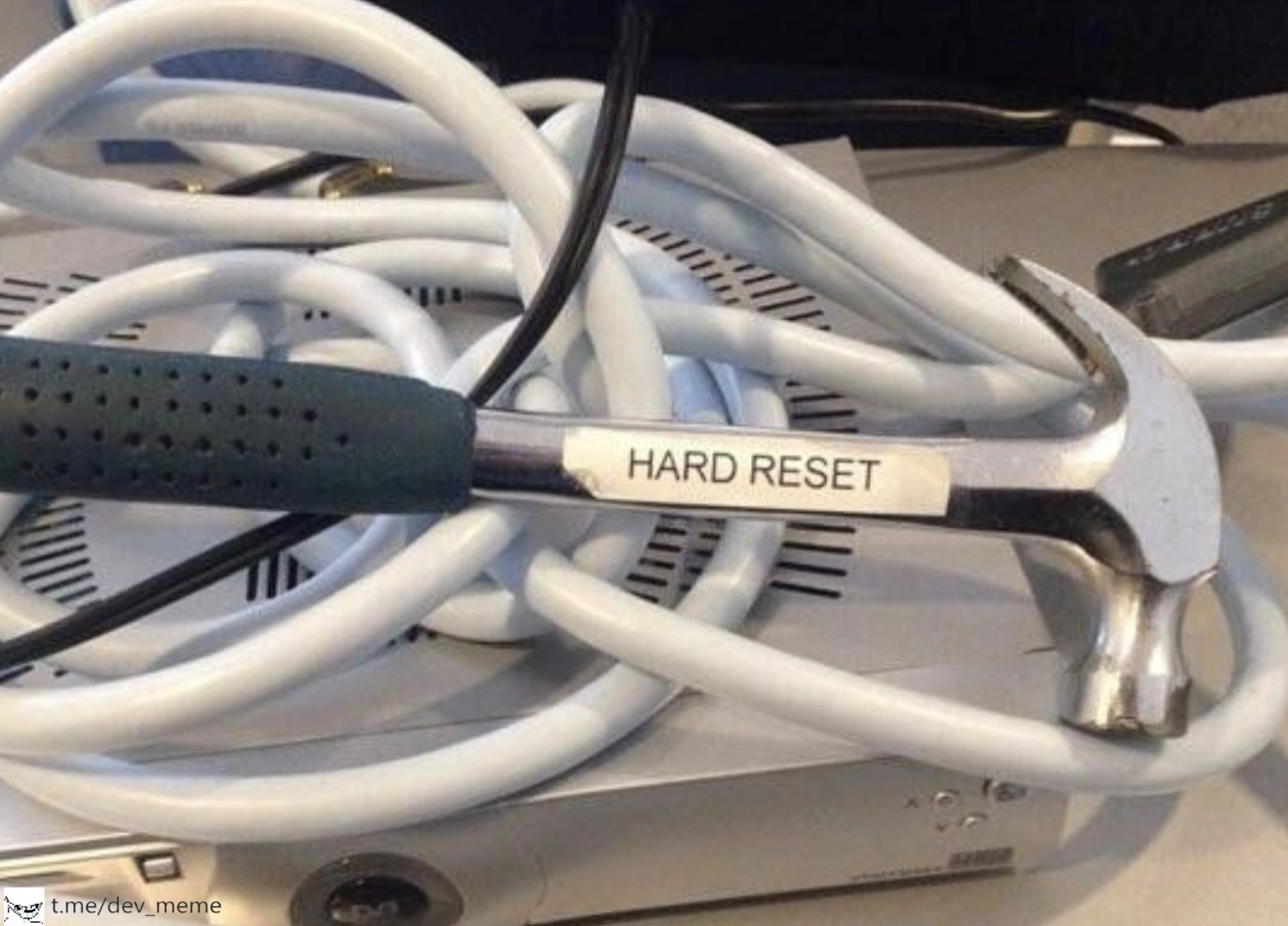
Imagine you have a toy or gadget that suddenly stops working. You’ve pressed all the buttons and even turned the power off and on, but it’s still stuck. In frustration, you give it a good whack on the side – and surprise – it starts working again (even if only for a moment). This meme is funny for the same reason: it shows IT people joking about doing that to a stalled computer. When a computer or device is completely frozen and nothing fixes it, the silly idea is to hit it with a hammer to “reset” it. Of course, that’s not a real solution in the tech world, but the picture makes us laugh because it captures that feeling of last-resort desperation. It’s like when your TV freezes and you slap it in annoyance – sometimes you’re just so frustrated you try anything! The hammer labeled "HARD RESET" is a playful way to say, “I’ve tried everything else, now I’m just going to smack some sense into this thing!” It’s a joke that shows the emotional side of working with stubborn machines: sometimes you feel like the only fix left is to literally knock it back into shape.

Level 2: The "Hard" in Hard Reset

Let’s break down the elements for those newer to on-call life or hardware quirks. The photo shows an ordinary hammer with a dark teal grip, but it’s been humorously labeled “HARD RESET” along its metal handle. In IT terms, a hard reset means forcibly restarting a machine – typically by cutting power or pushing a physical reset button – as opposed to a graceful reboot through the operating system (a soft reset). In a healthy server, you’d rarely do this except as a last resort, because it’s like yanking the battery out of a laptop; it doesn’t give software any time to shut down properly. Now, the joke takes “hard reset” one step further: using hard force from a hammer to reset a device literally.

The device under the hammer looks like some network appliance or set-top box, and those thick white cables coiled around it suggest a super messy server rack or network cabinet. Tangled cables are a hallmark of rushed setups or legacy hardware closets – a real tangled_cabinet_cables scenario. For a junior developer or IT support engineer, encountering a spaghetti mess of Ethernet cables can be overwhelming. Imagine trying to follow one cable through that tangle to figure out which port it’s connected to, especially while an outage is happening. It’s a Debugging Headache, for sure. The presence of the hammer on top of this mess exaggerates the frustration: when you can’t even find the right cable to pull, maybe you feel like just smashing through the knot instead!

Now, consider the term percussive_maintenance – this is real slang in engineering and electronics. It means hitting or tapping a device to jar it into working again. It sounds goofy, but historically it sometimes worked on old TVs or radios; a loose connection or stuck part might briefly fix itself after a whack. In modern IT, we don’t list “percussive maintenance” as a recommended troubleshooting step, but the concept is widely joked about. If you’ve ever had a frozen laptop and smacked the side of the screen in exasperation, or slapped the top of a misbehaving printer, you’ve attempted percussive maintenance. Here the meme is showing an extreme form – a hammer is obviously over-the-top, like using a sledgehammer when a gentle tap would do. That’s intentional hyperbole to make it funny.

OnCall humor is another layer here. On-call means it’s your turn to be available 24/7 for any urgent issues in the systems you manage. If a critical server goes down at 2 AM, the on-call engineer’s phone rings, and they might have to jump out of bed and fix the issue ASAP (often remotely, but sometimes by rushing to the office or data center). It’s high pressure and can be very stressful – this is what we call ProductionFirefighting, because you’re essentially putting out digital fires in production systems. In these situations, you try a series of troubleshooting steps: checking logs, restarting services, swapping cables, rebooting the machine. When nothing works, frustration mounts. The meme’s hammer labeled "Hard Reset" is a physical representation of that frustration – the engineer is basically saying, “I’ve done everything reasonable, and the system is still frozen. I’m about ready to force it back to life with brute force!” It’s the same energy as shouting at your computer or kicking a stuck server rack door, just personified in a tool.

We should note the humor also relies on contrast: A hammer is a tool from basic construction or carpentry, definitely not part of any standard IT toolkit for electronics. In fact, using a hammer on computers is absolutely a ToolMisuse – you’d typically use delicate tools, like screwdrivers or maybe a can of compressed air to fix hardware, not a blunt instrument. The visual of a precise, high-tech environment (network device, cables) being subjected to a brute force solution (hammer) makes an engineer or developer laugh because it’s a ridiculous mismatch. It’s like using a chainsaw for brain surgery – way over the top for the problem at hand. But in those maddening moments when a piece of gear just will not respond, the fantasy of whacking it starts to feel oddly satisfying.

Finally, the little watermark "t.me/dev_meme" tells us this image came from a developer meme channel, meaning it’s a joke shared among IT professionals. So don’t worry – no one is actually advocating hammer violence on real servers (we hope!). It’s a form of EngineeringHumor that lets stressed developers and ops folks smile about the nightmare scenarios they face. The next time you’re debugging a hardware issue and someone quips “have you tried the hard reset hammer?”, you’ll know they’re referencing this classic idea: when all else fails, sometimes you just want to hit it.

Level 3: Percussive Maintenance

At the highest level, this meme skewers the desperate debugging tactics of veteran sysadmins. Picture a production server or network appliance that’s completely unresponsive – no amount of ssh sessions, remote reboots, or console commands will bring it back from the dead. In traditionally polite IT terms, you'd perform a hard reset by power cycling the machine or pressing a recessed reset button. But here we see the next-level escalation: a full-on percussive maintenance approach. The image shows a regular claw hammer repurposed as an “emergency reset device,” complete with a label maker tag reading "HARD RESET". It’s a darkly humorous nod to the unwritten sysadmin proverb: “if it jams, force it; if it breaks, it needed replacing anyway.”

The Debugging_Troubleshooting vibe is strong – the meme highlights that knotted mess of thick white cables coiled atop a presumably frozen piece of hardware. Those tangled cables scream “server rack spaghetti”, an OnCall nightmare where tracing a single connection or finding the right reset switch at 3 AM is nearly impossible. Anyone who’s pulled on the wrong network cable in a panic, only to knock out a different system, can relate. The hammer labeled "Hard Reset" implies we don’t have time for careful cable tracing or graceful shutdowns. This is ProductionFirefighting in its rawest form: you’ve tried everything logical, and now you’re down to primal engineering instincts. It’s a tongue-in-cheek take on HardwareHacks and ToolMisuse – we know a hammer is not a real IT fix, but the joke lands because every seasoned engineer has felt that visceral urge to just whack the malfunctioning box that’s jeopardizing your uptime SLA.

On a more technical note, this gag hints at the physical_layer_debugging that hardware folks do. Under normal circumstances, physical-layer troubleshooting means checking power cables, reseating network connections, observing link lights – basically methodically ensuring Layer 1 of the OSI model is sound. But here “physical layer debugging” is hilariously literal: physically impacting the device with kinetic force. The hard_reset_hammer becomes the mythical Layer 0 tool – beyond firmware resets, beyond kernel panic triage – a final resort when software logic fails to revive a frozen system. It’s the IT equivalent of a defibrillator paddle jolt: not in any official manual, but when a critical router is down and the NOC is breathing down your neck, the thought crosses your mind in half-jest: "Should I just hit it?"

There’s rich irony in labeling the hammer as HARD RESET. Normally, hard reset means a forced restart (as opposed to a graceful soft reset where the OS shuts down properly). A hard reset is already a dramatic measure – cutting power abruptly can corrupt disks or trip circuits – but here we escalate hard reset to really hard reset. The humor taps into shared sysadmin trauma: those all-nighters where nothing works, documentation has failed, and you’re left with a single cathartic option. Seasoned ops folks might recall the old BOFH jokes, where the Bastard Operator From Hell keeps a “LART” (Luser Attitude Readjustment Tool – often a big stick or hammer) for situations when users or machines won’t behave. This meme is a direct descendant of that gallows humor. We laugh because we’ve been there – locked in a freezing data center at absurd o’clock, surrounded by the hum of machines, armed with coffee, a sense of defeat, and a half-serious notion that a blunt instrument might succeed where logic did not.

In short, the meme works on multiple levels of tech inside-jokery. It satirizes the OnCall_ProductionIssues crisis mode where conventional DebuggingHeadaches give way to outlandish ideas. It also pokes fun at HardwareHumor – the fact that while software engineers talk about elegant algorithms, hardware folks sometimes resort to percussive solutions. The EngineeringHumor here lies in the contrast between how we’re supposed to fix things (firmware patches, controlled reboots, careful cable management) versus how we feel like fixing things when the pressure is on. The label on that hammer is basically a battle-scarred engineer’s sly commentary: “We tried turning it off and on again. Next step: hit it with this.”

Description

The image displays a silver claw hammer with a black and gray textured handle. A white, printed label is affixed to the metal part of the handle, bearing the words 'HARD RESET' in all-caps. The hammer is lying on top of a silver electronic device, possibly a DVD player or a receiver, which is entangled in a mess of thick, coiled white cables and a thinner black one. The setting appears to be a typical office or server room environment where hardware issues are common. The humor is a literal and physical pun on the technical term 'hard reset,' which normally refers to forcibly restarting a piece of hardware. This meme humorously suggests that when all else fails, the final, most cathartic troubleshooting step is 'percussive maintenance' - hitting the problematic device with a hammer. It's a deeply relatable joke for any developer, sysadmin, or IT professional who has ever felt extreme frustration with unresponsive technology

Comments

7
Anonymous ★ Top Pick The five stages of debugging are: denial, bargaining, anger, depression, and finally, acceptance that the problem requires a tool from the hardware store, not another software patch
  1. Anonymous ★ Top Pick

    The five stages of debugging are: denial, bargaining, anger, depression, and finally, acceptance that the problem requires a tool from the hardware store, not another software patch

  2. Anonymous

    SRE escalation: systemctl reboot → IPMI power cycle → switch to the Layer-0 management plane - “HARD RESET” hammer. Idempotent by design; nothing survives a second run

  3. Anonymous

    When you've tried graceful shutdown, SIGTERM, SIGKILL, pulled the power cord, and now you're implementing the final fallback in your disaster recovery runbook that nobody talks about in the post-mortem

  4. Anonymous

    Ah yes, the time-honored 'percussive maintenance' protocol - when your disaster recovery plan involves a wrench and the phrase 'have you tried hitting it?' This is what happens when your runbook's rollback strategy is literally 'apply physical force until LED patterns change.' Bonus points if this is labeled as the official DR procedure in your infrastructure-as-code repo

  5. Anonymous

    Percussive maintenance: the only algorithm guaranteeing O(1) resolution to hardware Heisenbugs

  6. Anonymous

    Distributed state stuck? Apply the only cross‑platform idempotent op: HARD RESET with a hammer - eventual consistency by physics

  7. Anonymous

    Fallback SRE runbook: when SSH, IPMI, and the BMC all wedge, escalate to percussive consensus - fantastic MTTR, catastrophic CAPEX

Use J and K for navigation