Gamified AI class dangles gift card and intern interview carrot
Why is this Career HR meme funny?
Level 1: Big Effort, Small Prize
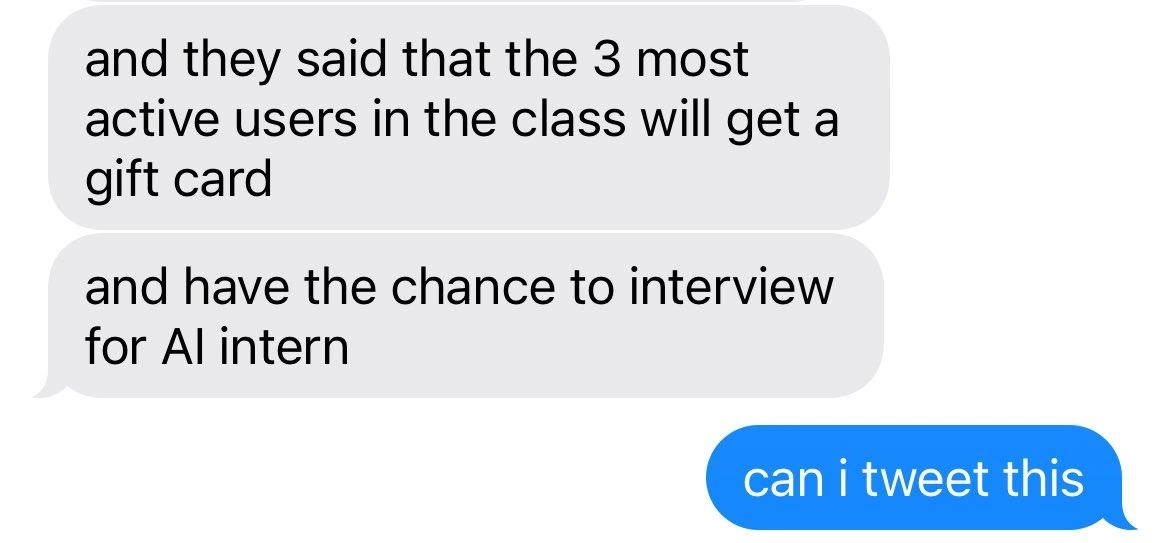
Imagine you’re in a classroom and your teacher says, “Whoever talks the most and asks the most questions this week will get a small candy bar, and maybe even get to be the teacher’s helper for a day.” The teacher is basically trying to make everyone super active by offering a little treat and a special chance. It sounds kind of exciting at first – you might think, “Oh, I want that candy and to be helper!” So some kids start talking a whole lot, even if they don’t have much to say, just to be the busiest student. But it also feels a little silly, right? They’re doing a lot of work for a very small prize. It’s like doing all your chores at home and only getting one cookie as a reward. In the chat from the meme, one friend hears about this kind of deal (with a gift card and an interview instead of a cookie and helper role) and finds it so absurd that they ask, “Can I tell everyone about this?” They want to share it because it’s both funny and a bit unbelievable. The whole situation is amusing because the reward doesn’t quite match the effort people would have to put in – it’s a tiny carrot dangled in front of a big job. Even a kid can sense the hmm, that’s odd vibe – doing a lot just to maybe get something small – and that’s why it’s laughable enough to tell all your friends about.
Level 2: Gamified Hustle
Let’s break it down in plain terms. In this chat screenshot, someone is describing how their AI class is offering prizes to encourage participation. They say “the 3 most active users in the class will get a gift card and have the chance to interview for [an] AI intern [position].” This means the class has been gamified – turned into a sort of game or contest. The students who participate the most (likely by posting in class forums, answering questions, or otherwise being active users) will be rewarded. And what are the rewards? First, a gift card – probably a small amount of money to spend at a store or online (a common little incentive, like a $25 Amazon or coffee shop card). Second, those top participants also get a chance to interview for an AI intern role. An intern is basically a beginner position, often for students or new grads, where you get to work at a company (sometimes unpaid or for low pay) to learn and get experience. So they’re not directly giving a job, just an interview opportunity – you’d still have to impress in the interview to actually land the internship. It’s like saying, “Work really hard in our class game, and you might get to apply for a cool-sounding job.”
This setup is a classic example of gamified class participation. Gamification means adding game-like elements (points, rankings, prizes) to something that isn’t a game, in order to motivate people. Here, the “points” are essentially your activity level in the class (how many posts or contributions you make), and the “prize” is the gift card + interview perk for the top three participants. The folks running the class want people to engage a lot – ask questions, answer others, share ideas – so the class feels lively and students learn from each other. It’s similar to how some online forums or learning websites give you badges or leaderboards for being active. They’re using a gift_card_incentive to make it fun or competitive.
However, there’s a bit of tech industry irony in the air, and even newcomers can sense it. Usually, you’d hope students participate because they want to learn, not just to win a prize. By emphasizing “most active users,” the class might accidentally encourage quantity over quality – for example, someone might spam trivial posts just to climb the ranks. It reflects a bigger issue of chasing engagement metrics over value. Engagement metrics are numbers that show involvement, like number of posts, time spent online, etc. Increasing those numbers looks good on paper (or to whoever is measuring the class success), but they don’t always mean real value is being created. In a learning context, 100 shallow posts aren’t as valuable as 10 thoughtful ones. As a junior developer or student, you might have seen this on platforms like Stack Overflow or Discord communities, where people who talk a lot show up on “Top Contributor” lists. It’s exciting to be on top, but being most active doesn’t necessarily mean you’re the most knowledgeable – sometimes it just means you have a lot of free time or enthusiasm to chatter.
Now, about that AI intern interview part – this taps into the current AI/ML craze. AI (Artificial Intelligence) is a hot field, so an internship in AI sounds very desirable for someone trying to start a tech career. The class organizers know this, so they’re using it as a carrot to entice students. It’s almost like saying, “If you win our participation game, we’ll put in a good word for you to maybe get your foot in the door of an AI job.” Early career folks can find this super motivating because breaking into the AI/ML industry can be tough – any extra chance to interview at a company working on AI is valuable. It’s a bit of AI hype leveraged for motivation: people hype up AI roles as if they’re magical, so even a slim chance at one feels special. But notice, it’s still just a chance to interview. You’ll have to go through the regular interview process, which can be challenging (technical tests, coding problems, tough questions about machine learning, etc.). There’s no guarantee you’ll actually land the internship – you’re basically winning a lottery ticket for an interview. Depending on your perspective, that’s either a great opportunity or a pretty flimsy reward for being the top student.
Finally, the punchline: the blue text bubble that asks, “can i tweet this”. This is a modern, tongue-in-cheek reaction. When someone says “can I tweet this,” it usually means “This is so amusing or absurd, I want to share it with everyone on Twitter.” Twitter is a popular place where developers and students share quick thoughts or anecdotes. By asking to tweet it, the person is signaling that this situation is funny, ironic, or noteworthy enough that others in the tech community would appreciate it. It’s relatable dev experience fodder – many people in tech have seen similar over-the-top incentive schemes, so it would get a laugh or knowing groan on social media. As a junior, you might feel a bit conflicted: part of you thinks, “Hey, I wouldn’t mind a gift card and an interview shot!” while another part of you can’t help but smirk at how extra this all is. The desire to tweet it means the absurdity is winning out – it’s basically saying, “Wow, they’re really doing that... I have to tell people, this is one for the books.”
In short, this meme shines a light on a real trend: turning learning and career advancement into a game. For someone early in their journey, it’s a glimpse of how tech culture sometimes works. Companies or classes will offer small perks (like swag, gift cards, or a fast-track interview) to get you to engage more. It can be motivating, but it also can feel a bit cheap or manipulative. And when it goes a little too far into the realm of silliness (like making an interview a prize), even newbies can tell it’s something to chuckle about. After all, the main goal should be to learn and grow, not just to win a popularity contest – and this chat is pointing out that awkward imbalance in a humorous way.
Level 3: Paid in Exposure
In this scenario, an AI/ML course turns into a competitive circus of engagement. The instructor dangles trivial rewards – a measly gift card and a “chance to interview for [an] AI intern” position – as carrots to get students hustling. Seasoned developers see the classic tech industry irony here: gaming the system to boost engagement metrics at the expense of actual learning or value. We have a gamified class environment where posting feverishly on forums or chat can somehow earn you Career_HR prizes. It’s a perfect storm of AI hype vs. reality: the hype is an “AI intern” opportunity held up like it’s Willy Wonka’s golden ticket, while the reality is likely an unpaid grind or a résumé footnote. The whole thing screams CareerHumor and InterviewHumor – making an interview itself (normally a stressful gating process) into a door prize.
Let’s unpack why engineers are smirking. Gamified class participation schemes like this are a textbook example of chasing engagement_metrics_over_value. Instead of rewarding insight or learning, they reward sheer activity volume. Imagine a course turning into a mini social network, where the 3 most active users (probably the ones spamming threads with lukewarm takes) get a prize. Quantity over quality, engagement over understanding. A veteran dev has seen this pattern in company forums, internal trainings, even open-source communities: “Top contributor of the month gets a $50 Amazon card!” It’s a cheap way to incentivize free labor and enthusiasm. In an educational context, it might mean students flooding the discussion board with low-value comments just to rack up points. One can almost hear the collective eyeroll: this learning curve isn’t about mastering algorithms; it’s about mastering the art of being loud.
And then there’s the AI intern interview carrot. In today’s AI talent scramble, even an internship is treated like some mythical prize. The meme pokes fun at AI_ML hype: everyone wants that shiny “AI intern” line on their résumé, so much that a chance to interview for it is supposed to make people jump through hoops. A senior developer chuckles because they know an interview is no guarantee of anything – it’s basically a lottery ticket. Plus, an AI intern role might sound cutting-edge, but often it’s 90% cleaning data or tweaking models under supervision (i.e. grunt work with a fancy title). The AIHypeVsReality tag fits perfectly: the reality of an intern gig (maybe unpaid, definitely temporary) is far from the glamorous breakthrough in AI that naïve participants might envision. Offering an interview instead of a job is like saying “we won’t pay you, but if you work really hard, we’ll let you try to convince us to let you work (maybe still unpaid).” It’s internship hustle culture distilled into a one-liner. No wonder the friend in the blue bubble responds with “can i tweet this” – they immediately recognize this as a tweetable anecdote, a bit of absurd tech-world humor begging to be broadcast. In developer circles, when something this cringey or relatable happens, the instinct is to share it on Twitter for collective sighs and laughs. It’s practically a community service: “Look at this folks, they’ve turned class participation into a Black Mirror episode of engagement farming.”
From an insider perspective, this meme is a wink and a nudge about how both learning and career advancement are being reduced to a points game. It satirizes that relatable dev experience of being prodded to do more for disproportionately small rewards. Old-timers recall similar gimmicks – from Stack Overflow reputation races to hackathons paying in exposure and pizza – and they cringe and laugh in equal measure. This kind of developer humor lands because it’s rooted in truth: the system often under-values real expertise (no gift card can compensate genuine skill), yet over-values meaningless engagement (being “most active” ≠ being most competent). A cynical veteran might dryly comment, “Great, they’ve finally turned interviews into raffle prizes. What’s next, on-call shifts awarded to the loudest cheerleader?” The code below, dripping with sarcasm, illustrates how this engagement lottery works under the hood:
# Pseudocode for the class engagement competition
for user in class.forum.users():
score = user.post_count # because quantity matters more than quality, apparently
# Select the top 3 "most active" users based on post count
winners = sorted(class.members, key=lambda u: u.post_count, reverse=True)[:3]
for winner in winners:
give_reward(winner, GiftCard(value=50)) # a small token for your effort
give_reward(winner, InterviewOpportunity(role="AI Intern")) # not a job, just a chance at one
As shown above, it’s all about boosting that post_count. The humor (especially to a senior dev) is that this gamified hustle completely misses the point of learning. Real learning isn’t a competition for goodies, and real career moves aren’t won by who can post the most emojis in a class chat. By broadcasting “can I tweet this,” the meme’s author effectively does tweet it – holding up a mirror to our industry’s habit of turning everything into a game for engagement’s sake. It’s a gentle roast of the modern developer ecosystem, where even education and hiring can feel like a clout-chasing game show.
Description
Screenshot of an iMessage-style chat: two grey bubbles say, “and they said that the 3 most active users in the class will get a gift card” and “and have the chance to interview for AI intern”. A blue reply bubble beneath simply asks, “can i tweet this”. The visual is minimalist - rounded iOS chat bubbles on a plain white background - but it captures the all-too-familiar tech hustle culture: gamifying course participation with trinket rewards and an ‘AI intern’ interview that likely pays in résumé lines rather than cash. Seasoned engineers will recognise the tongue-in-cheek request to broadcast the absurd incentive structure, a riff on how everything from community forums to MOOCs optimises for “engagement” metrics while under-valuing real expertise
Comments
6Comment deleted
Sure, nothing says “cutting-edge AI research lab” like choosing talent via reply-count leaderboards and a $25 Amazon voucher
Nothing says 'we value diverse perspectives in AI development' quite like turning education into a hunger games where the prize is the chance to compete again for an unpaid internship. At least in production, when we gamify metrics, we pretend it's about user engagement, not human resources
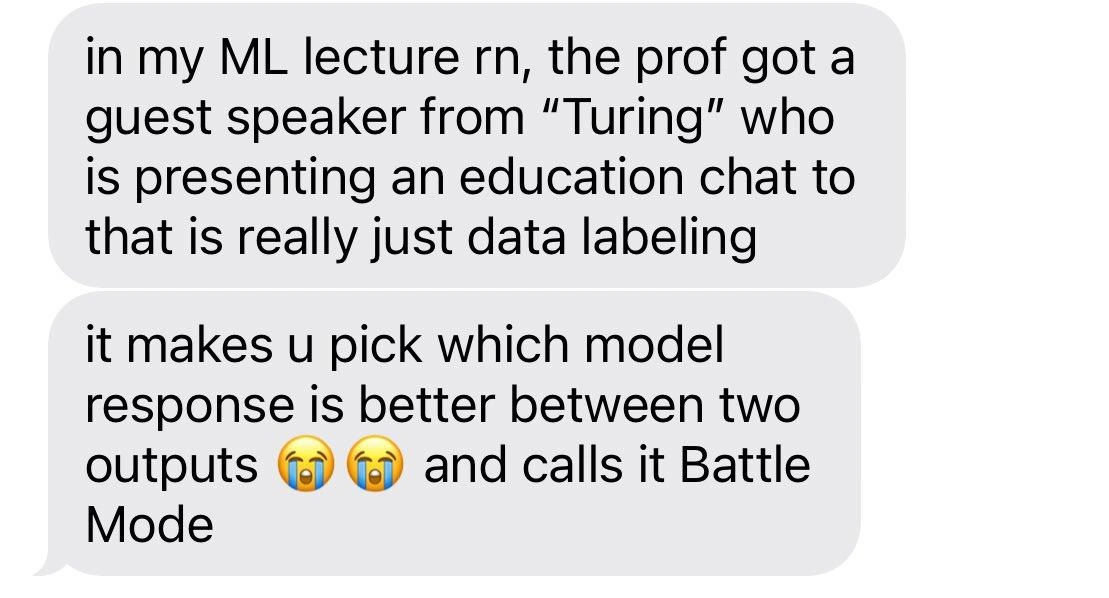
Nothing says 'we understand AI ethics' quite like turning your ML course into a Battle Royale where students compete for the privilege of an unpaid internship. At least they're honest about optimizing for engagement metrics over learning outcomes - very on-brand for 2024 AI companies. The real machine learning here is teaching students that their value is measured in 'activity' rather than understanding, which perfectly prepares them for a career of gaming OKRs and sprint velocity metrics
Selecting AI interns by “most active users” is pure growth-hacking osmosis: optimize for DAU, hire for tweets - expect the onsite to be a leaderboard
AI hiring hack: Optimize for message throughput before tackling gradient descent
Goodhart’s Law in action: optimize for 'most active user' and your AI intern pipeline devolves into p99 emoji spam, not signal