Skip to content
DevMeme
1122 of 7435
The Silent Scream of the Call Stack
CS Fundamentals Post #1259, on Apr 4, 2020 in TG

The Silent Scream of the Call Stack

Why is this CS Fundamentals meme funny?

Level 1: Stop Copying Me!

Imagine two kids in a room playing a silly game of copycat. One kid shouts, “Stop copying me!” and the other immediately shouts back, “Stop copying me!” Of course, the first kid then repeats it again, “Stop copying me!” and it goes back and forth over and over. They get stuck saying the exact same thing, and nothing new ever happens. At first it might be kind of funny, but pretty soon both kids just look at each other with blank, confused faces because the game never ends on its own. Eventually an adult might step in and make them stop, because otherwise they'd be caught in that loop forever.

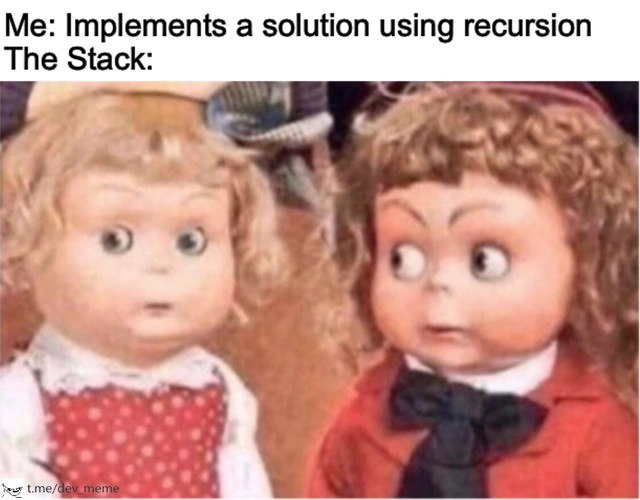
This is just like what can happen inside a computer program. If the program keeps telling itself to do the same task again and again with no signal to stop, it ends up in an endless loop – sort of like those two kids yelling “Stop copying me!” on repeat. The meme shows two identical dolls staring at each other with that bewildered expression, which perfectly captures the uh-oh, we’re stuck feeling. It’s funny because you don’t need to know anything about computers to see that two look-alike dolls caught copying each other is a ridiculous, never-ending situation. The joke is basically saying, “Look, my code got stuck copying itself forever,” and anyone who’s seen two kids do the copycat routine can instantly get the idea and have a laugh at how silly (and frustrating) that situation is.

Level 2: Infinite Mirror Maze

Recursion in programming means a function calls itself in order to solve a problem. It’s like two mirrors facing each other: the function’s output feeds into another call of the same function, creating a repeated reflection. In code, a recursive function usually has two crucial parts: a base case (a condition where the function stops calling itself) and a recursive step (where the function calls itself with a smaller or simpler input). For example, to compute factorial of a number n recursively, you can define factorial(n) = n * factorial(n-1), and you set a base case that factorial(1) = 1. The base case acts like a stopping point – it prevents infinite recursion by telling the function when to return instead of recursing further. Without a base case, the function would just keep calling itself forever (or until the computer runs out of resources).

When a function calls another function (or itself), the computer uses a call stack to keep track of all the active function calls. Think of the call stack as a stack of plates: each function call puts a new plate on the stack, and each function return removes one. Each plate (or stack frame) holds the information about that function’s execution (its local variables, where to continue after it finishes, etc.). In recursion, you keep adding more plates because the function keeps calling itself without finishing the previous calls until a base case is reached. If there’s no base case or it takes too long to reach one, this stack of calls grows and grows. Eventually, you hit a limit: either the program uses up all the memory reserved for the stack or the language runtime decides the recursion has gone too deep. That’s when you encounter a stack overflow error – a type of runtime crash where the stack is literally overflowing with too many nested calls. Many languages put a safety brake on this. For instance, Python will raise a RecursionError (with a message about "maximum recursion depth exceeded") after about 1,000 recursive calls. This is basically the interpreter saying, "I think you forgot to stop – I’m halting this before I crash for real."

Let’s look at a tiny example of bad recursion that would cause such a crash:

def infinite_recursion():
    # No base case! This function will call itself forever.
    infinite_recursion()

# infinite_recursion()  # 🚫 WARNING: If you run this, it will keep calling itself until the program stops with an error.

In this snippet, infinite_recursion() has no condition to ever stop. If you were to call infinite_recursion(), it would immediately call itself again, then again, and so on. Nothing new gets done in each call; it’s the exact same action repeating. Eventually, the program will either freeze or throw a runtime error because it ran out of stack space (memory) to keep track of all those nested calls. The meme’s image of two look-alike dolls facing each other is a perfect metaphor: the function call is essentially staring at itself repeatedly without end. The dolls even have that slightly spooked, blank look, much like a program would if it could express confusion. For a new programmer, seeing a program crash this way can be mystifying at first: the code just kind of… stopped. But once you learn about recursion and the call stack, it makes sense: the program was stuck in a loop of calling itself. The humor of the meme comes from recognizing this scenario. It’s turning a tough lesson (remember to include your base case!) into a visual gag – the stack would be just as dumbfounded as those dolls when confronted with a never-ending mirror image of calls. Once you’ve learned what recursion is and why an infinite recursive loop is bad, the picture of two identical, dazed dolls is a funny way to say, “Oops, my code is just calling itself over and over with that same empty stare.”

Level 3: The Abyss Stares Back

Recursion is one of those elegant yet treacherous CS fundamentals that every developer both loves and fears. This meme nails it: “Me: implements a solution using recursion – The Stack: [blank stare].” The image of two identical dolls facing each other perfectly visualizes a function calling itself: each doll is like a new invocation on the call stack, staring at a clone of the same function. The humor here taps into that moment when you realize your clever recursive algorithm has no base case or termination condition – the function just keeps spawning copies of itself, and the system’s stack is like, “Wait... we’re doing this again? 😳” (Cue the classic joke definition: “Recursion: see recursion.”)

Seasoned engineers chuckle (and cringe) because they've been there. A runaway recursive call is a classic bug that often leads to the dreaded stack overflow error. (Not the helpful Q&A site we all rely on, but the actual program-frying fault!) In a real debugging session, you might see an error like a StackOverflowError in Java or Python’s infamous RecursionError: maximum recursion depth exceeded. The call stack ends up containing dozens or even thousands of identical frames, essentially the function staring back at its own clone over and over. It’s as if the program got stuck in a hall of mirrors reflecting infinitely until the glass (memory) shatters. The dolls’ vacant, alarmed look is exactly how a developer feels upon seeing a never-ending list of the same function in a stack trace – a moment of pure debugging frustration that is painfully familiar.

On a deeper level, this meme pokes fun at algorithm humor and the perils of recursion. Recursion is powerful: you solve a problem by solving a smaller instance of the same problem, like those Russian matryoshka dolls (dolls within dolls). But here the dolls just duplicate each other with no end – a sure sign something’s wrong. Experienced devs learn that every recursive approach must have a well-defined stopping point. Without it, the logic becomes an infinite recursion, and the poor call stack will keep growing until it collapses. In system terms, each recursive call consumes a chunk of the stack (a new stack frame holding that function’s local variables and return address). If you never return (because you keep calling yourself), you eventually exhaust the stack memory. Unless your language or compiler does some magic like tail-call optimization (reusing a stack frame for certain recursive calls), the frames just pile up. It’s both a logical paradox and a physical limitation – you’ve created an unwinnable "call stack staring contest" with itself. And just like in a staring contest, the stack eventually loses (crashes) if you don’t blink (i.e. hit a base case and return).

From a senior developer’s perspective, this scenario is almost a rite of passage. We’ve all written that naïve recursive function that seemed elegant until it spiraled out of control. Perhaps you thought a recursive tree traversal or math function would be neat, but you forgot the exit condition. Boom! – the program blows up, and you’re left scrolling through a log filled with repeated function calls. The meme exaggerates that moment by anthropomorphizing the failure: the call stack essentially becomes self-aware of the absurd situation. It’s comedic because it paints a runtime error as a goofy staring match. The stack isn’t literally conscious, of course, but it feels like the system is looking back at you and saying, “Umm... I’ve called myself one time too many, now what?” That blend of fundamental CS knowledge and absurd self-referential failure is both painful and hilarious in hindsight. Every experienced coder remembers the first time they crashed a program with recursion gone wild. The blank, slightly panicked faces on those two mirror-image dolls perfectly capture how we felt in that moment: stunned, confused, and thinking “this code is literally calling itself to death.” And that shared experience is exactly why this meme hits home and makes us laugh-while-we-wince.

Description

A reaction meme about the dangers of recursion. The top text reads, 'Me: Implements a solution using recursion', followed by 'The Stack:'. The image below features two creepy-looking vintage dolls with wide eyes. One doll stares forward with a neutral, slightly surprised expression, while the doll on the right gives an intense, angry, and stressed side-eye, its eyebrows furrowed. The technical joke is that every recursive function call adds a new frame to the system's call stack. If the recursion is too deep or lacks a proper base case, it will exhaust the stack's memory, causing a 'stack overflow' error. The angry doll humorously personifies the call stack being pushed to its absolute limit, silently screaming under the pressure of too many function calls. It's a classic computer science joke that resonates with developers who have experienced the sudden and catastrophic failure of an elegant but flawed recursive algorithm

Comments

7
Anonymous ★ Top Pick Recursion is the epitome of 'trust the process' until you run out of memory. The stack, however, does not trust the process
  1. Anonymous ★ Top Pick

    Recursion is the epitome of 'trust the process' until you run out of memory. The stack, however, does not trust the process

  2. Anonymous

    Ship a recursion without a base case and the stack frames duplicate like these dolls - blankly wondering why the JVM still treats tail-call optimisation as an elective course

  3. Anonymous

    After 20 years in this industry, I've learned that recursion is just a fancy way of making the same mistake over and over again until either you find the answer or production crashes at 3 AM

  4. Anonymous

    When you confidently implement that elegant recursive solution without a depth limit, the call stack gives you the same look your senior architect gives when reviewing your 'clever' code - equal parts horror and resignation, knowing it's about to experience a very bad time in production

  5. Anonymous

    I wrote a recursive DFS; the stack replied, “Neat - does your JVM do tail-call optimization or should I ping PagerDuty now?”

  6. Anonymous

    Nothing humbles a clean recursive solution like user input and a missing tail-call optimization

  7. Anonymous

    Unbounded recursion: where the call stack's existential dread rivals your last monolith-to-microservices migration

Use J and K for navigation