PyTorch Precision vs. Keras Chaos
Why is this AI ML meme funny?
Level 1: When Messy Wins
Imagine you and your friend are in a contest to circle all the people in a big group photo. You take a marker and carefully circle just the actual people you see – maybe you circle 5 people total, nice and neat. Now your friend goes wild and scribbles circles everywhere on the picture. They circle every person, of course, but they also circle the chairs, the plants, the clock on the wall, even random shadows – there are so many circles that you can barely see the picture anymore!
When the teacher comes to judge the contest, she notices that your friend didn’t miss a single person (since your friend basically circled everything, every person ended up circled). Sure, your friend also circled a bunch of things that aren’t people, making the picture a messy rainbow scribble, but the teacher says, “Well, at least you found all the people.” So your friend actually gets a higher score for catching everyone, even though they made a huge mess on the picture. You, on the other hand, did a tidy job and were mostly right, but you missed a couple of people in the back. You end up with a lower score because you left those people un-circled.
It feels unfair, right? You were neat and mostly correct, while your friend was super messy and drew circles around things that weren’t even part of the task. But because of how the scoring worked – rewarding finding every single person – your friend’s chaotic approach wins. It’s a funny situation: the person who overdid it and made a mess actually comes out on top. That’s exactly what this meme is joking about: sometimes in silly competitions (or with quirky scoring rules), the over-the-top, “circle everything” strategy can beat the careful, sensible strategy. We laugh at it because it’s like saying being messier won the day, which is the opposite of what you’d normally expect!
Level 2: More Boxes, More Score
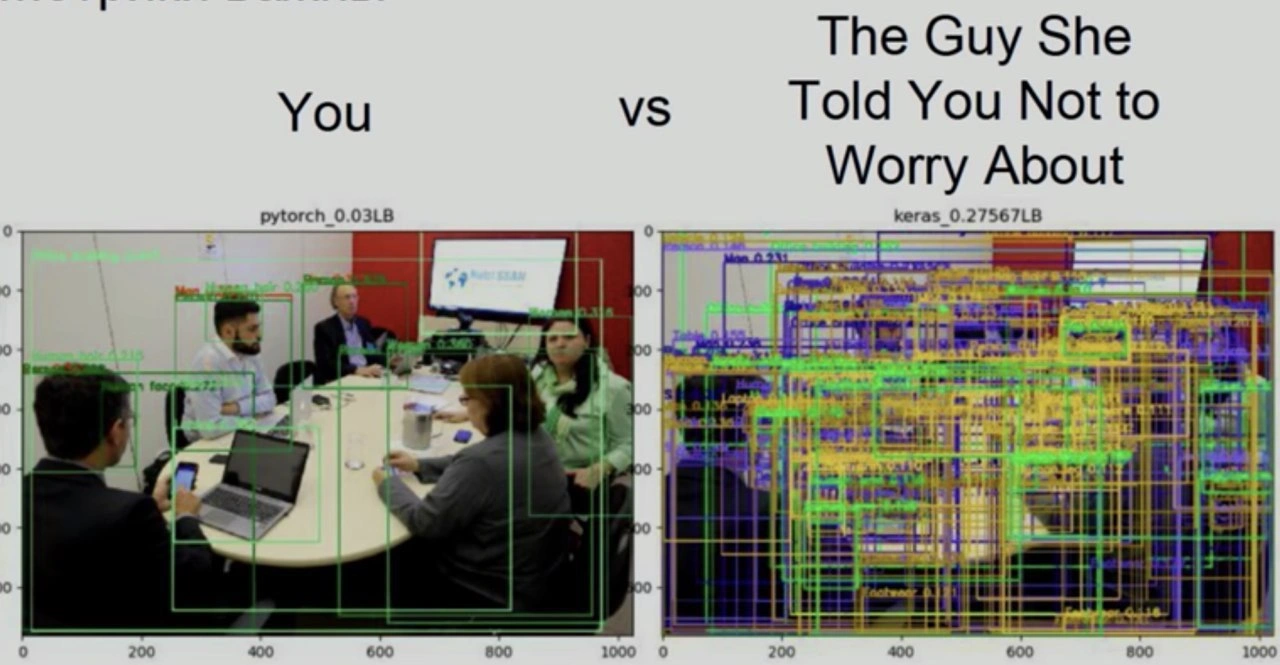
This meme is a side-by-side comparison of two computer vision models trying to identify objects in the same image. It uses the familiar meme caption format “You vs The Guy She Told You Not to Worry About” – basically meaning the second model is far superior (or at least more extreme) in a humorous way. In each panel, the model’s predictions are shown by drawing colored bounding boxes around detected objects in a meeting room photo. Each box has a label like “person” or “laptop” with a number (that number is the model’s confidence – e.g. person 0.83 means the model is 83% sure there’s a person in that box).
On the left side, labeled “You,” we see the output of a model (noted as pytorch_0.03LB at the top). There are only a few green boxes neatly outlining the actual people sitting around the table and maybe a couple of laptops. The image is mostly clear; the model didn’t tag anything that it wasn’t pretty sure about. On the right side, labeled “The Guy She Told You Not to Worry About,” we have the output of another model (noted as keras_0.27567LB). This one went overboard – the photo is almost completely covered by a crazy jumble of green, blue, and yellow rectangles. It looks as if this model thought everywhere in the image might contain something. The result is that it found all the people and objects alright, but it also marked a ton of things that aren’t actually meaningful. It’s the difference between a model that’s conservative (left side) vs one that’s extremely aggressive (right side) in detecting objects.
Let’s clarify the labels “pytorch” and “keras” here. PyTorch and Keras are two popular frameworks (software libraries) for building deep learning models. Deep learning is a type of machine learning often used for tasks like image recognition. PyTorch is loved by many researchers and developers for its flexibility and control – you write Python code to define your neural network and how it operates. Keras, on the other hand, is known for being user-friendly and high-level – it lets you stack layers of neurons with simple commands (often running on top of TensorFlow). In this meme, the implication is that “You” built a model using PyTorch, and “the guy not to worry about” built one using Keras. The joke isn’t really that Keras is better than PyTorch generally (both are powerful), but it sets the scene as if two people used two different tools and got very different outcomes.
Now, what do the numbers 0.03LB vs 0.27567LB mean? LB stands for leaderboard. This tells us we’re dealing with a competition scenario, likely on Kaggle (a popular online platform for data science and machine learning competitions). In a Kaggle competition, many teams try to build the best model for a given task, and they’re ranked on a leaderboard by some score. For an object detection task, the score might be something like an average precision or some accuracy measure – usually, higher is better. So a score of 0.27567 is much higher (better) than 0.03. The left model only got 0.03, which is really low, whereas the right model’s 0.27567 is significantly higher. These oddly specific numbers (up to five decimal places) are typical in Kaggle contests, where even a difference of 0.001 can separate ranks. So, the meme is basically saying: “Your PyTorch model scored 0.03 on the leaderboard, but the Keras model (the one you dismissed) scored 0.27567 – wow!” It immediately sets up the comedy: the model you thought was fine is embarrassingly outperformed by the one you thought was no threat.
Why did the Keras model score so much higher despite its output looking like a hot mess? This comes down to how object_detection performance is measured and the concept of precision vs recall (though the meme doesn’t say those words, it’s the idea under the hood). The left model (PyTorch) was very selective. It probably had a high confidence threshold, meaning it only drew a box if it was very sure something was there. That’s why we see just a few boxes: it found maybe 2 people and 1 laptop and ignored everything else it was unsure about. The downside: it likely missed a bunch of objects (e.g. maybe there were 5 people total, but it detected only 2). In evaluation, missing real objects hurts your score a lot. It’s like leaving answers blank on a test – you lose points for each miss.
The right model (Keras) was the opposite. It had a very low bar for what it would count as an object. It probably drew a box even for the slightest hint of something. This is why there are dozens of boxes layered everywhere – it was extremely liberal in calling things “objects.” The upside: it didn’t miss much. Every actual person in that image is surely under a box (probably under multiple boxes!) somewhere in that colorful mess. It likely caught all the laptops and any other items too. The downside: it also flagged a ton of things that weren’t real targets (false alarms). In a scoring sense, this model has high recall (found all the true positives) but low precision (a lot of its predictions are wrong). Depending on the competition’s scoring rule, a model like this can actually end up with a higher score. Many object detection metrics reward finding all the objects and aren’t too harsh if you also have some extra false detections, as long as you don’t go completely overboard. It’s a bit counter-intuitive, but think of it like this: if the scoring metric gives partial credit for each correct detection you make, you want to make sure you detect every possible object to get all the credit. The Keras model did that (it cast a very wide net). It got all the points for finding those people and laptops. It may have lost some points for the false detections, but apparently not enough to outweigh the gains. The PyTorch model, by contrast, missed many objects, so it never got those points in the first place.
This leads to the idea of overfitting_models in competitions. Overfitting means your model isn’t truly smarter in general; it has just learned the test or training data too specifically. The Keras model’s behavior hints that it might be overfit to this particular competition. Perhaps it learned that in the competition dataset, it’s better to err on the side of putting a box everywhere. Maybe the person who built it noticed that the evaluation metric on Kaggle favored more detections, so they tweaked the model to exploit that. In a real-world scenario (like deploying that model to real security cameras or something), it would be awful – it would constantly be seeing things that aren’t there. But on the KaggleCompetitions leaderboard, it shines because it was optimized purely to get a higher score on that given test set. This is something newcomers might find surprising: the best competition model isn’t always the one that looks best qualitatively or makes the most sense; it’s the one that scores best according to the metric. And competitors sometimes achieve that by pushing the model into a weird, overly specialized regime.
So, in simpler terms: The left image is a normal, careful model output. The right image is an exaggerated, “detect everything!” model output. The second one scored higher because it didn’t miss any of the required objects (even though it went kind of crazy finding things that weren’t there). It’s a bit like two students taking a test: one answered only the questions they were sure about (and left some blank), the other tried to answer every question (even if it meant writing some nonsense for some answers). If the teacher’s grading gives you points for correct answers but doesn’t heavily punish wrong ones, the student who attempted everything might score higher by sheer volume of attempts.
The meme is funny to people in AI/ML because it exaggerates this phenomenon. It’s common on Kaggle to chase the leaderboard_score, and sometimes that leads to creative but overly complex solutions. The phrase “the guy she told you not to worry about” is used humorously here: you thought the Keras model wasn’t a threat, but look at it now – it totally outperformed you, albeit in a ridiculous way. It’s AI humor highlighting the gap between a clean solution and a hacky high-scoring solution. And it’s a gentle reminder: more complex or flashy isn’t always better in reality, but it sure can rack up points in a competition scenario!
Level 3: Overfitting Olympics
For seasoned machine learning engineers, this meme captures the essence of AI competition culture in one hilarious snapshot. It parodies the classic “You vs The Guy She Told You Not to Worry About” format, but instead of human rivals, the competition is between two object detection models – one built with PyTorch, and the other with Keras. On the left panel (“You”), the PyTorch model provides a clean, minimal output: just a few neat green bounding boxes around actual people and laptops in a conference room. On the right panel (“The Guy She Told You Not to Worry About”), the Keras model floods the same image with a chaotic rainbow of overlapping boxes, as if it suspiciously found something in every nook and cranny of the room. The kicker is the text at the top: pytorch_0.03LB vs keras_0.27567LB – these look like Kaggle leaderboard scores, and indeed the messy Keras model somehow scores nine times higher than the restrained PyTorch model (0.27567 vs 0.03). Seasoned Kagglers are nodding (and laughing) because they’ve seen this scenario play out on leaderboards: an overfitted Frankenstein model achieving a deceptively good metric, leaving a well-behaved baseline model in the dust.
Why exactly is this funny (and painfully relatable)? It’s highlighting a well-known quirk in model evaluation and Kaggle competitions: sometimes the model that does all the wrong things (like labeling everything under the sun) can game the metric and win on the leaderboard. In object detection tasks, your score often depends on a balance of detecting all the true objects without too many false alarms. The PyTorch model likely played it safe – maybe it had a high detection threshold or a sensible post-processing step like non-maximum suppression, resulting in only a handful of high-confidence boxes (“person 0.83”, “laptop 0.92”, etc.). It’s precise but misses a lot, yielding a low score (imagine a student who only answers questions they’re 100% sure about). The Keras model, on the other hand, went all-in: it apparently marked almost everything as an object. The result is a tangle of colored boxes covering nearly the entire image (the visual equivalent of a spray and pray strategy). This model likely has extremely high recall (it finds every person, laptop, maybe even imaginary ones!) but terrible precision (many of those boxes are false positives). Due to a quirk in the evaluation metric, this shotgun approach can actually score higher – perhaps the competition scoring (like mean Average Precision with generous settings or a recall-weighted metric) gave partial credit for finding more true objects, even if it meant tolerating more noise. It’s the computer-vision version of brute force.
To an experienced eye, the right panel looks absurd – all those overlapping rectangles are like a neon highlighter party gone wrong. It’s as if the Keras model didn’t use proper non_max_suppression() or set its confidence threshold to 0, effectively shouting “There’s something here!” everywhere. Here’s a tongue-in-cheek pseudo-code contrast to illustrate the difference:
# PyTorch model: only high-confidence detections (few, precise boxes)
preds = pytorch_model.predict(image, threshold=0.8)
# Keras model: keep even the lowest-confidence predictions (tons of boxes!)
preds_overkill = keras_model.predict(image, threshold=0.0)
In real life, you’d never literally use a 0 threshold, but this exaggeration helps explain why the Keras output is drowning in boxes. The experienced dev or data scientist reading this can practically smell the overfitting. They’ve seen contestants on Kaggle (the popular data science competition platform) do wild things like ensemble 10 models, use heavy augmentation, or hand-tweak thresholds per class – all to squeeze out a higher score. It’s both impressive and a bit ridiculous. This meme gets to the heart of that: the neat PyTorch model represents a straightforward, principled approach, whereas the wild Keras model represents the tunings and hacks people use to climb the leaderboard.
To put it in perspective, here’s how the two approaches stack up:
| PyTorch Model (“You”) | Keras Model (“Guy Not to Worry About”) |
|---|---|
| Framework: PyTorch (low-level, code-centric control) | Framework: Keras (high-level, user-friendly API) |
| Leaderboard Score: 0.03 (very low, bottom-tier) | Leaderboard Score: 0.27567 (much higher ranking) |
| Output: Few boxes on obvious objects (clean and tidy) | Output: Dozens of boxes on almost everything (chaotic) |
| Precision: High (mostly correct detections, few false alarms) | Precision: Low (lots of false positives, boxes on random stuff) |
| Recall: Low (misses many actual objects, very selective) | Recall: High (finds all the real objects... and then some) |
| Style: Conservative (only marks what it’s sure about) | Style: Aggressive (marks everything, just in case) |
| Likely real-world performance: Stable and generalizable | Likely real-world performance: Overfitted, brittle |
The humor lands because anyone who’s competed in a Kaggle competition or tuned a complex model knows this temptation: crank up the sensitivity, throw in every trick, and hope the metric smiles upon you. The meme’s caption, “You vs the Keras model she said not to worry about,” perfectly captures the feeling. Initially, you (the PyTorch user) felt confident – your model was clean and reasonable. People might even have told you, “Don’t worry, those other over-complicated models won’t necessarily do better.” Then the leaderboard updates and bam! – that flashy, over-the-top Keras model is suddenly ruling the chart, making your approach look humble by comparison. It’s the coding equivalent of being upstaged by a show-off who somehow impresses the judges.
Experienced developers chuckle (with a hint of PTSD) because they’ve been there. They know that a model like that Keras contraption is not sustainable in production (imagine all the false alarms it would trigger in a real app!), but it might win when only the metric matters. It’s a commentary on the gap between leaderboard performance and real-world performance. The meme is essentially a lighthearted roast of those overfitting models that look ridiculous under the hood, yet manage to beat everyone out – the ones we were told “not to worry about” until they stole the show.
Description
This is a 'You vs. The Guy She Told You Not to Worry About' meme, comparing two machine learning frameworks. On the left, under the label 'You', an image of a conference room has several clean, green bounding boxes drawn by an object detection model labeled 'pytorch_0.03LB'. The boxes accurately identify people and objects. On the right, under 'The Guy She Told You Not to Worry About', the same image is completely obscured by a chaotic mess of overlapping green, yellow, and blue bounding boxes from a model labeled 'keras_0.27567LB'. This meme humorously contrasts the perceived performance of two popular deep learning frameworks, PyTorch and Keras. It portrays PyTorch as producing a clean, precise, and useful result, while Keras generates a noisy, over-sensitive, and unusable output. For experienced developers, the joke resonates with the frustrations of model tuning, where a poorly configured model can produce an overwhelming number of false positives, rendering it useless despite its complexity

Comments
7Comment deleted
The Keras model isn't broken, it's just aggressively pursuing a 100% recall strategy by identifying every possible subatomic particle in the room
My PyTorch detector quietly nails five boxes in 20 ms; her Keras fever dream floods the frame with 500, times out half the GPUs, and still tops the leaderboard - because nothing overfits harder than a metric
Your model fits in a Lambda function and actually ships to production. His model requires a Kubernetes cluster just to load the weights and will never make it past the research paper
When your PyTorch model is a clean 0.03LB of elegant tensor operations, but Keras shows up with 0.27567LB of abstraction layers so deeply nested that even the computational graph looks like it's been through seven rounds of enterprise architecture review. It's not bloat, it's 'high-level API convenience' - which is exactly what she told you not to worry about
PyTorch in prod: tuned thresholds and NMS; Keras on the leaderboard: NMS=False, TTA×32, and a rectangle for every pixel - +0.25 LB, +1 pager
Your model boxes 'person'; his infers 'VP mid-layoff pitch with 0.95 mAP'
He “won the demo” by setting conf_threshold=0 and NMS=False; I kept precision, he shipped bounding-box spaghetti - guess whose screenshot made the quarterly deck