Skip to content
DevMeme
520 of 7435
Fibonacci indentation: the golden ratio of unreadable code
CodeQuality Post #598, on Aug 20, 2019 in TG

Fibonacci indentation: the golden ratio of unreadable code

Why is this CodeQuality meme funny?

Level 1: Indenting Off the Page

Imagine you and your friend are writing a story together. You argue a bit about how far to indent (move in from the left margin) the first line of each paragraph. One of you likes a small indent, the other a bigger indent. Now a silly third friend jumps in and says: “Hey, I have a crazy idea – let’s start the first paragraph indented by one thumb-width, the next by one thumb-width again, then the next by two thumb-widths, then three, then five, and keep increasing like that!” Very soon, your paragraphs would start so far to the right that you’d run off the page!

This meme is just like that, but with computer code. Programmers usually indent code to make it easy to see who is inside what (like which statements are inside a loop or an if-condition). Normally, they always indent by the same amount. The joke here is someone saying to indent by a growing amount each time using a famous number pattern (1, 1, 2, 3, 5, 8,...). It’s funny because it’s an over-the-top solution – way too complicated for something very simple. It’s like using a huge hammer to crack a tiny nut. The code ends up zig-zagging to the right crazily, making it hard to read (just like a story that starts halfway across the page would be hard to read!).

People laugh at this because it pokes fun at how we sometimes argue over tiny details. It reminds us not to take everything so seriously. In the end, code (or a story) should be easy to read, and doing something wild like this just to win an argument is silly. The humor comes from seeing a normally simple thing (spacing out code) being done in the silliest, most unnecessary way possible. It’s a lighthearted way for developers to chuckle at themselves and say, “Okay, maybe we shouldn’t over-complicate stuff that doesn’t need it.”

Level 2: Indentation Overkill

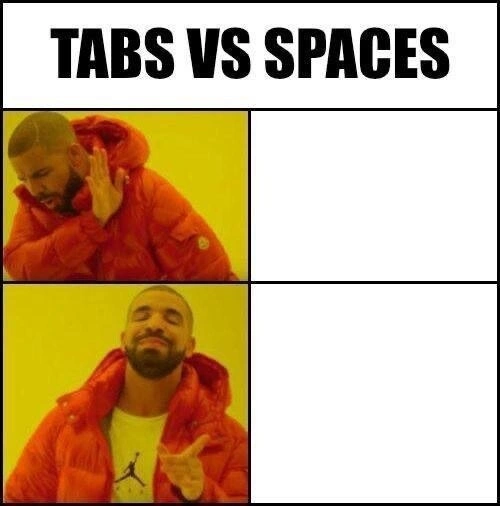
For newer developers, let’s break down what’s happening. The meme revolves around indentation – that is, the spaces or tabs at the beginning of a code line that show how deeply nested in a block of code you are. In most programming languages, especially C-style ones (C, C++, Java, JavaScript, etc.), you indent code inside curly braces { } to make the structure clear. For example, inside an if statement or a function, you usually move the code right by a fixed amount so it's visually clear that code is inside that block. This improves readability by showing hierarchy. The big debate is how to indent: with a tab character or with a certain number of space characters. This is the famous Tabs vs Spaces debate. It’s such a common argument that it’s practically a running gag in programming culture (they even joked about it on HBO’s Silicon Valley show).

  • Tabs (\t): a special single character which many editors display as some fixed width of space, often 4 or 8 columns. Using tabs means one press of the key moves the code to the next tab stop.
  • Spaces: literally using the spacebar multiple times (usually 2 or 4 spaces per indent level) to align code.

Teams often choose one convention to avoid mixture (mixing tabs and spaces can cause messy alignment, and in Python it even causes errors because Python uses indentation to define code blocks). Style guides (like PEP8 for Python or the Linux kernel’s style for C) will specify something like “use 4 spaces per indent” or “use tabs, size 8” so that everyone formats code the same way.

Now, what does the meme suggest instead? Fibonacci indentation. The Fibonacci sequence is a famous sequence of numbers where each number is the sum of the two preceding ones. It goes 1, 1, 2, 3, 5, 8, 13, 21, ... and so on, growing larger each step. It appears in nature (spirals of shells, sunflower seeds arrangement) and is a common example in programming classes (like writing a function to compute Fibonacci numbers). In the tweet, the joke is to use these Fibonacci numbers as the number of spaces for each successive indent level. So, level 1 indent = 1 space, level 2 indent = 1 space (again), level 3 indent = 2 spaces, level 4 indent = 3 spaces, level 5 indent = 5 spaces, etc. This means the deeper you nest, the wider the indent becomes compared to the previous level.

Let’s illustrate the pattern of spaces per level:

Indent Level Spaces for that level (Fibonacci)
Level 1 1 space
Level 2 1 space
Level 3 2 spaces
Level 4 3 spaces
Level 5 5 spaces
Level 6 8 spaces
Level 7 13 spaces (you see it skyrocketing)

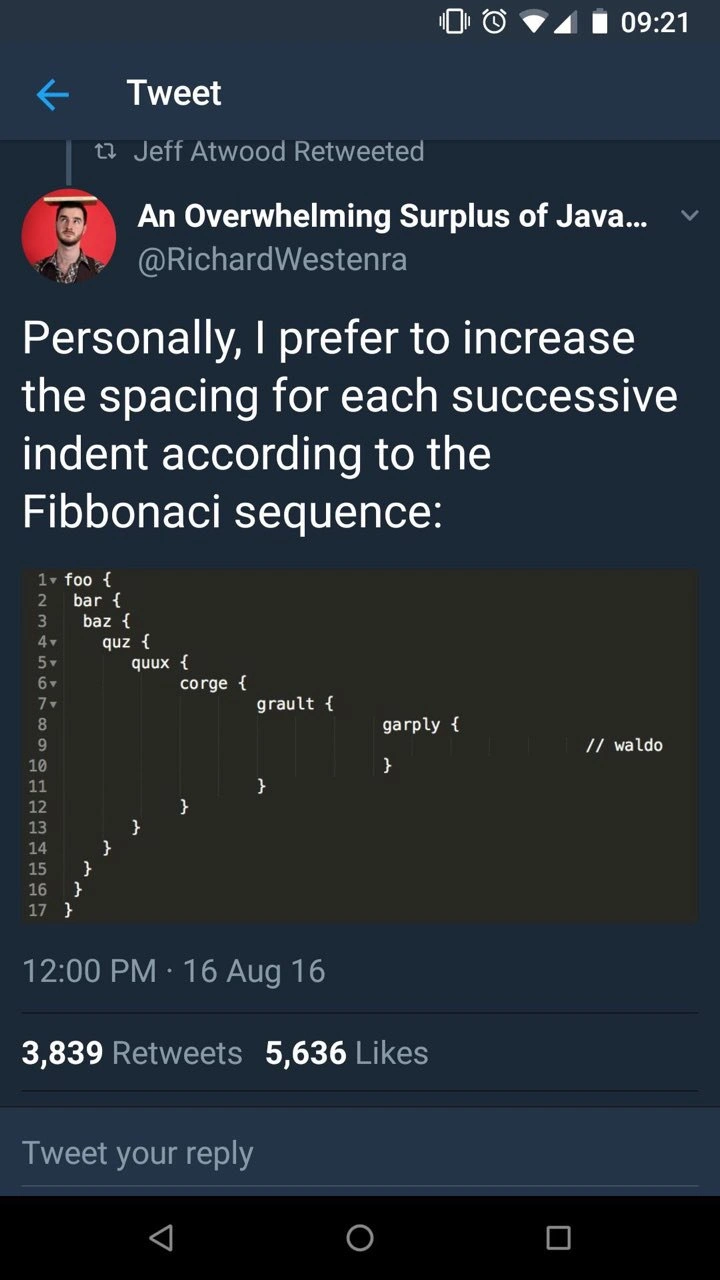
Normally, indentations are constant (say always 4 spaces). But here it “grows” with each level. The code snippet in the meme isn’t doing anything meaningful; it’s just a series of nested brackets with placeholder names (foo, bar, baz, etc.) to demonstrate how the indentation increases. By the time it gets to garply { ... } and the comment // waldo, the indent is huge compared to where it started. The comment // waldo is an extra joke: it references the “Where’s Waldo?” puzzle because Waldo is hard to find, just like that little comment is hard to spot way off to the right in an overly indented code block!

So why is this funny to developers? Because it’s indentation_humor highlighting an overkill solution to a silly argument. The TabsVsSpacesDebate has been a lighthearted point of contention among programmers for ages. Some insist spaces are better for alignment and always look the same, others insist tabs are more flexible and each person can view them with their preferred width. It’s a minor stylistic choice, but people can get surprisingly passionate (there are jokes like “tabs people vs spaces people will never get along”). Many companies and open-source projects have CodeStyleGuides and use linters/auto-formatters (like Prettier, ESLint for JavaScript, or gofmt for Go) to automatically enforce one style, precisely so that developers stop arguing about it and focus on real problems.

Now, the tweet jokingly throws a wrench into this debate: what if someone said, “you’re both wrong – let’s do something completely different: Fibonacci indentation!” This is funny because it’s such an over-engineered idea. It’s as if to solve a tiny disagreement (“2 spaces or 4 spaces?”), someone proposes a super complex rule (“how about 1,1,2,3,5... spaces!”) that nobody asked for. It’s a mockery of when engineers use a complicated formula or system for something that should be simple — that’s what we call overengineering. Here, the CleanCodePrinciples of keeping things simple and readable are being ironically ignored. Instead of improving CodeQuality, such a rule would make the code much harder to read and maintain. Imagine trying to count out 13 spaces for the 7th indent level without messing up! It would be a nightmare to type and to review. Every developer’s editor would probably misalign it or flag it as wrong.

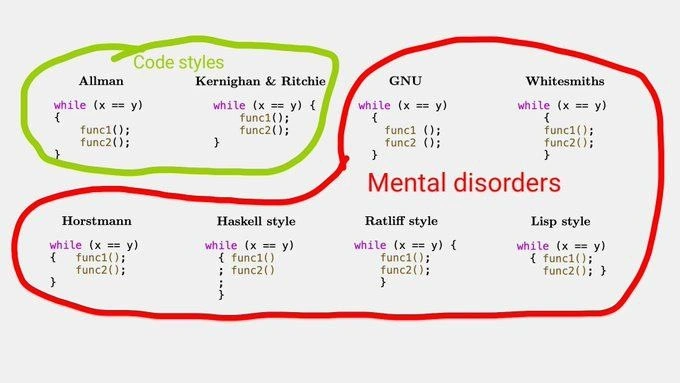
We also see brace_alignment taken to a comedic extreme. In the code screenshot, each closing brace } is not aligned under the opening { of its block as usual, but staggered far to the right at varying columns. This is because each deeper block started further right than the last. Visually, it forms a diagonal line of braces, which is not a normal sight in code. Usually, clean code keeps braces neatly vertically aligned (or consistently indented) so you can match them easily. If you actually tried this Fibonacci style, finding which brace matches which would be like solving a puzzle.

Another point: the tweet being a twitter_screenshot with thousands of retweets means it resonated widely. Even if you’re a junior dev or just learning, you can appreciate that this is a DeveloperHumor scene making fun of our own tendencies. It’s saying, “we programmers sometimes argue over dumb things like how to format code. Look how crazy it would get if we took those arguments way too seriously!” The term DeveloperExperience (DX) might pop up here: part of good DX is having consistent, easy-to-read code. An indentation scheme that changes with every level would make the developer experience worse. It would be very confusing for someone reading or trying to contribute to the code — they'd spend more time counting spaces than understanding logic.

In summary, the meme uses the idea of fibonacci_indentation as a joke. It’s not advocating this as a real practice (thank goodness!). Instead, it’s poking fun at formatting_extremism and showing newbies just how absurd things can sound when a simple idea (indentation) is taken to ridiculous lengths. It teaches an implicit lesson: keep your formatting rules simple and consistent; don’t be an overzealous pedant about them, or you’ll end up with something unmanageable (and everyone will laugh, as they did here).

Level 3: Tabs vs Spaces vs Fibonacci

At first glance, this meme escalates the classic tabs vs spaces debate into absurdity by introducing a Fibonacci sequence for code indentation. The tweet (amusingly retweeted by Jeff Atwood of Stack Overflow fame) proposes:

“Personally, I prefer to increase the spacing for each successive indent according to the Fibonacci sequence.”

In the code block screenshot, each nested block is indented by a growing number of spaces: 1, 1, 2, 3, 5, 8… and so on. This nested_curly_braces pattern leads to brace_alignment that drifts further right with each level, eventually creating a staggered staircase of closing braces. The deepest line even has a // waldo comment far off to the right, a wink that the code’s structure is as hidden as Where’s Waldo. This extreme formatting is a parody of formatting_extremism in which a programmer takes a simple style rule and over-engineers it. It lampoons how some developers treat code formatting and CodeStyleGuides with near-religious zeal.

From a seasoned developer’s perspective, the humor has several layers. First, there’s the sheer overengineering: using a famous mathematical sequence (often associated with recursive algorithms and the golden ratio) to determine indent width. It’s a ridiculous OverEngineering solution to an already trivial problem – reminiscent of solving a pocket calculator issue with a quantum computer. It satirically comments on how debates over CodeFormatting (like whether to use tabs or spaces, and how many spaces) can become overblown. In real projects, teams pick an indent style (2 spaces, 4 spaces, or a tab) and stick to it for consistency. Here, consistency is thrown out the window in favor of an ever-increasing indent size. The result? An unreadable mess that no sane style guide would ever allow.

This resonates with experienced devs because many have endured Formatting Zealotry in code reviews or fought in the “TabsVsSpacesDebate.” We’ve seen trivial issues like indentation width or brace placement consume inordinate amounts of time and energy. The meme exaggerates this by positing “Fibonacci indentation” as if someone so obsessed with CleanCodePrinciples and readability might unironically claim this mathematical approach makes code clearer. (Spoiler: it doesn’t — by the time you’re 8 levels deep, you’re scrolling horizontally to find code that’s way off to the right.) It mockingly highlights how pursuing an ideal of readability without regard to practicality leads to less readable code. The supposed benefit of indicating deeper nesting with larger indents is overshadowed by the DeveloperExperience_DX nightmare of handling code that keeps pushing off the screen.

There’s also a bit of insider fun with the variable names: foo, bar, baz, quux, corge, grault, garply… and the comment “// waldo”. These are all infamous nonsense placeholders from programming lore (the metasyntactic variables often used in examples). Seeing them nested is a signal that this code is just a pedagogical jest. Any actual function or logic is irrelevant – the CodeQuality here is deliberately sacrificed for the joke. In practice, deeply nested code is itself a red flag for poor design, often called “arrow code” or the “staircase of doom.” Real clean-code advice encourages flattening such nesting. By cranking indentation to insane levels, the meme doubles down on what not to do, for comedic effect.

Finally, consider the community context: This tweet garnered thousands of retweets and likes, showing how DeveloperHumor about something as mundane as whitespace struck a chord. It’s a gentle roast of our industry’s tendency to argue over pedantic details. Many of us have sat through heated meetings or long comment threads about bracket placement or whether to use 2 vs 4 spaces. Seeing someone propose a Fibonacci-based CodeFormatting rule is hilarious because it’s plausible as satire – it feels like the next logical step when one’s tired of the old arguments. It’s the ultimate tongue-in-cheek solution that underscores the absurdity of the TabsVsSpacesDebate. In short, the meme is saying: “We’ve taken this far enough – look how ridiculous it would be if we went even further!”

Description

A screenshot of a tweet from user Richard Westenra, retweeted by Jeff Atwood. The tweet sarcastically suggests an absurd code indentation style. The text reads: 'Personally, I prefer to increase the spacing for each successive indent according to the Fibbonaci sequence:'. Below is a code snippet with deeply nested curly braces, where each level of indentation gets progressively wider, visually demonstrating the Fibonacci sequence (1, 1, 2, 3, 5, 8...). The indentation grows so large that the code becomes extremely difficult to read. This meme is a satirical commentary on the endless and often pedantic debates within the developer community about code style, such as 'tabs vs. spaces,' by proposing a ridiculously impractical alternative

Comments

7
Anonymous ★ Top Pick My auto-formatter just saw this, submitted its resignation, and is now working as a YAML parser to feel better about its life choices
  1. Anonymous ★ Top Pick

    My auto-formatter just saw this, submitted its resignation, and is now working as a YAML parser to feel better about its life choices

  2. Anonymous

    Adopted Fibonacci indentation to end the tabs-vs-spaces war; CI passes, but Git history is 90 % whitespace diffs and ‘git blame’ now looks like abstract art

  3. Anonymous

    Finally, a coding standard that naturally enforces the architectural principle of "if you need more than 5 levels of nesting, you've already lost" - by level 8 your code is literally off the screen and your coworkers are off the project

  4. Anonymous

    When your tech lead says 'make the code more elegant with mathematical principles' and you take it literally by implementing Fibonacci indentation - because nothing says 'maintainable codebase' like needing a telescope to find your closing braces. At least when someone asks 'Where's Waldo?' in code review, you can confidently point to line 9, approximately three monitors to the right

  5. Anonymous

    Fibonacci indentation turns scope nesting into O(phi^n) rightward drift - perfect if your real goal is forcing a formatter policy at the next postmortem

  6. Anonymous

    Fibonacci indentation: when cyclomatic complexity isn’t scary enough, so you crank the space complexity to O(phi^n) and watch Prettier rage-quit

  7. Anonymous

    Because Java's pyramid of doom wasn't unmaintainable enough without golden ratio whitespace

Use J and K for navigation