Skip to content
DevMeme
518 of 7435
When Your AI Model Fails the Turing Test Spectacularly
AI ML Post #596, on Aug 19, 2019 in TG

When Your AI Model Fails the Turing Test Spectacularly

Why is this AI ML meme funny?

Level 1: Stubborn Pet

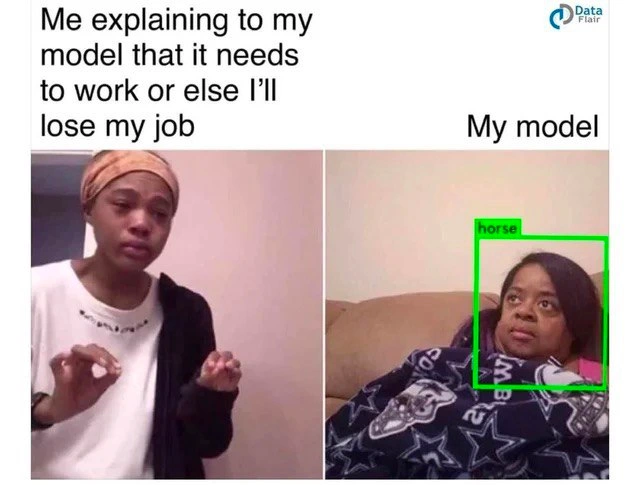
Imagine you’re working on a school project with a friend who has to help you label pictures correctly. You hold up a photo of a person wrapped in a blanket and you tell your friend, “Please, you have to get this right or we’ll both get in trouble!” You’re really nervous about it, like your grade (or job) depends on this. But your friend looks at the picture and with total confidence says, “That’s a horse.” 🤦‍♂️ Now, that’s obviously a silly mistake – anyone can see it’s not a horse – and you feel frustrated and scared because no matter how much you beg, your friend just doesn’t see the mistake. In this meme, the “friend” is a computer program that’s supposed to identify things in a picture. The joke is that the person is so desperate they’re talking to the computer model like it’s a person, saying “Work properly or I’m finished!” But the computer is like a stubborn pet that just tilts its head and does the wrong trick anyway. It’s funny in the same way it’s funny when someone earnestly explains something to their dog, but the dog just barks back or rolls over cluelessly. The human is stressed out and pleading, and the “smart” computer acts totally dumb – calling a blanket a horse – which is such a goofy, unexpected error that you can’t help but laugh.

Level 2: Object Detection Fail

Let’s break down what’s happening in simpler terms. We have an image and an AI machine learning model whose job is to look at the image and tell us what it sees. Specifically, this model is doing object detection – that means it doesn’t just say “I see a horse,” it also draws a box around where it thinks the horse is in the picture. In the meme’s right panel (labeled "My model"), the model looked at a photo of a person lounging on a couch under a navy blue blanket, and it decided that the person’s head (sticking out of the blanket) was actually a horse. It even put a bright green rectangle around the poor woman’s head and tagged it “horse” – that green box is a visual way these algorithms show what region of the image they think the object (horse) is in. This is a blatant classification error: the model is classifying one thing (a human under a blanket) as another thing entirely (a horse). It’s a pretty hilarious and extreme example of an object_detection_fail, because even a small child could tell you that’s not a horse. But the computer? It’s confidently wrong.

Now, the left panel text – "Me explaining to my model that it needs to work or else I’ll lose my job" – is joking that the developer (the person who built or is using the AI model) is so desperate to fix this error that they’re talking to the model as if it were a person. Obviously, in reality you can’t bargain or reason with a piece of software. The model doesn’t have feelings or intentions – it’s just a program. But this exaggeration conveys the stress and anxiety the developer feels. The phrase “or else I’ll lose my job” shows they’re under pressure: maybe their boss is expecting the project demo to go well, or a client needs the model to perform accurately. In the world of AI startups and tech projects, there’s often a timeline and career pressure: make the tech work, prove that this AI delivers, or our jobs/funding are on the line. So the meme taps into that career_anxiety in a comical way. The developer is basically giving a pep talk to the AI: “Come on model, you can do it! Please don’t embarrass me by calling people horses!”

Let’s clarify some terms that appear in the tags and context:

  • Machine Learning Model: This is a program that has learned to perform a task from data. In this case, the task is recognizing objects in images. It’s not explicitly programmed with rules like “if it has a blanket, it’s a human” – instead, it learned from many example images what a horse looks like, what a human looks like, etc. or at least it’s supposed to have learned that.
  • Object Detection: A specific kind of machine learning task where the model finds and labels objects in pictures. It outputs both a label (like “horse”) and coordinates for a box around the object. It’s like a supercharged version of image classification. Instead of just one overall label for the image, it can find multiple objects and say what each one is. In the meme image, the model found one “object” (in reality, the woman’s head) and labeled it. It chose the wrong label (“horse”), which is the fail.
  • Misclassification: This just means labeling something as the wrong category. The model misclassified a human as a horse. That’s a pretty big mistake! In machine learning, especially with images, misclassifications can happen if the things look somewhat similar to the computer or if the model is just not trained well for those cases.
  • Overfitting: This is a jargon term often mentioned (one of the tags is OverfittingModels). Overfitting happens when a model performs too well on its training data (the examples it saw during learning) but then performs poorly on new data. It’s like if you studied only the exact questions for a test – you’d ace those exact questions, but if the teacher changes them slightly, you’re confused. An overfitted model has basically memorized specific training images of horses and might be so tuned to those that it thinks anything remotely close to those patterns is a horse. Maybe it saw a horse with a similarly colored background in training, so now it’s like “blue background + roundish shape = horse” even when it shouldn’t.
  • AI Humor / Developer Humor: This meme is funny to developers and AI folks because it exaggerates a real issue in a way we can all laugh at. It’s filed under AI humor and developer humor. If you’re new to this field: yes, we actually do share memes about frustrated programmers talking to their code or models. It’s a way to vent and bond over the quirks of our work.
  • Bugs: Normally a “bug” means a mistake in a program’s code that makes it do the wrong thing. Here, the “bug” isn’t a simple coding error; it’s more about the model’s behavior being wrong. We sometimes call these model bugs or just issues with the AI. They’re much harder to fix than a normal bug, because you can’t pinpoint one line of faulty code – the “knowledge” is spread across many parameters inside the model. So you often have to go gather more data or change the training process to address it. The meme’s joke is essentially treating this misclassification like a bug so bad that it could cost someone’s job.
  • Data Flair Watermark: If you noticed, in the top-right corner of the meme image there’s a little logo that says “Data Flair.” DataFlair is actually an educational site that provides tutorials on data science and machine learning. The presence of that watermark suggests the images used in this meme might have come from a tutorial or demo they created. Perhaps they had an example of object detection and this was one of the results (and obviously it turned out unintentionally funny). It’s a small detail, but to an insider it’s an extra wink – like, “hey, even tutorial examples can go horribly wrong!”

In everyday terms: this meme highlights that AI can make goofy mistakes. The developer in the meme is explaining and almost pleading because, in reality, you can’t directly tell an AI off. But we often talk to our computers or code anyway when frustrated (“Why won’t you just work?!”). The humor comes from picturing that scenario literally: a person in a hallway passionately gesturing and scolding this intangible “model,” and then the model’s “response” is just some oblivious incorrect output (the horse label) as if it’s lazily saying, “Whatever, I think it’s a horse.” It’s a mismatch in communication – the human is emotional, the machine is… well, a machine doing something dumb with zero awareness.

For someone new to machine learning, it’s also a quick lesson: AI isn’t perfect. It can be super smart in some ways (it learned from data, it can recognize lots of things correctly), but it can also fail in ridiculous ways that a human never would. And when those failures happen, the poor AI engineer has to figure out how to fix it, often feeling like they’re trying to coach an unruly student or debug a possessed black box. This meme encapsulates that feeling in a fun, exaggerated way.

Level 3: Ultimatum to an Algorithm

On the practical side, every machine learning engineer or data scientist who sees this meme is probably half laughing, half cringing. The left panel – “Me explaining to my model that it needs to work or else I’ll lose my job” – is a tongue-in-cheek dramatization of real career anxiety in AI/ML projects. In a traditional software bug, you could stay late debugging code logic. But when your AI model is misbehaving (say, labeling people as horses), you can’t just yell at it or quickly patch a line of code to fix the bug. The meme humorously suggests the desperate pep-talk approach: pleading with the model as if it were a stubborn employee or a hard-headed friend. It’s funny because anyone who’s worked with unpredictable models has felt this helplessness. You’ve tried tweaking hyperparameters, added more training data, fine-tuned for the 10th time… and it’s still giving absurd outputs. At 3 AM, with a presentation to the boss looming, you personify the neural network as this obstinate creature that just won’t listen to reason. Yes, it’s essentially a pep talk to AI, a comical projection of human interaction onto an algorithm.

This highlights a core tension in the AI_ML world: MachineLearningHumor often comes from the gap between how we expect smart systems to behave and what they actually do. Here the expectation is, “Surely the model knows a blanket-covered person is not a horse, right? It’s obvious!” – yet the reality is a big green object_detection_fail box saying “horse” with absolute conviction. The absurdity is golden. It’s the kind of developer humor that mixes technical absurdity with a hint of horror: we laugh, but also think “oh no, I’ve been that person begging my code to work.” The threat “or else I’ll lose my job” is an exaggeration (hopefully!), but it underscores real pressure. In fast-paced tech environments, especially during a demo or a crunch deadline, a model that won’t cooperate can feel like it’s jeopardizing your employment. The meme exaggerates it to the point of the developer having a one-sided shouting match in a hallway, which gives it that over-the-top comedic effect.

Look at the right panel image labeled “My model.” The model is personified as a completely unbothered individual chilling under a cozy blanket with stars, lazily mislabeling things while the developer is in panic mode. The facial expression on “the model” is priceless – wide-eyed and clueless, as if saying “Huh? Horse, right?” It’s basically the embodiment of a stubborn bug. The model doesn’t care about your job; it’s going to do whatever its training and algorithm tell it to, however wrong. There’s a hint of bugs category humor here: it’s a bug you can’t easily fix. In normal code, a bug might be a missing semicolon or logic error. Here the “bug” is emergent behavior from a complex system – much trickier. It resonates with experienced developers because it’s a scenario where all the fancy math and big promises of AI boil down to a silly mistake, and you’re left doing a facepalm. Everyone in tech has had that “you had one job!” feeling toward a program, and here that job was “don’t call people horses.”

The unspoken industry truth is that AI limitations like this are more common than outsiders think. We’ve all seen the polished demos where the model detects objects flawlessly, but behind the scenes, the engineer knows that if the lighting were a bit dimmer or the blanket a bit more patterned, the whole thing might go off the rails. There’s a saying, “All AI demos are hand-picked.” This meme is the other side – the blooper reel where the model is doing something dumb. The inclusion of the little Data Flair watermark in the image is even a mini-joke of its own: DataFlair is known for tutorials and ML content. Possibly, this meme’s right image came from an actual object detection exercise gone wrong. It’s like the model’s failure was so meme-worthy that it escaped a tutorial and made it into our humor feeds. (Imagine writing a tutorial on object detection and your example output labels a person as a horse – oops, instant meme material!)

For seasoned developers, there’s also a nod to the challenge of debugging these issues. The meme text implies trying to reason with the model. In reality, you might respond by checking your training set (maybe all your human images in training were standing, not under blankets – so the model never learned “person lying down” and is misidentifying the unfamiliar scenario). Or you’d examine the misclassification and say, “Is this an overfitting model issue? Do I need to augment my data? Change my architecture?” It’s a painstaking process – far less straightforward than telling the model in plain English to shape up. The image of “me explaining to my model” captures that frustration: you wish you could just directly impart the knowledge (“listen, network, that’s clearly a human, fix that weight matrix now!”), but you can’t. Instead, you’re stuck retraining and hoping the dice land better this time.

To put it in code-ish terms, the dynamic feels like:

# Developer's desperate pseudo-fix for the mislabeling bug:
result = model.detect(image)
if result.label == "horse" and there_is_clearly_no_horse(image):
    print("Not a horse, try again!")  # futile protest - model can't hear this
    result = model.reconsider(image)   # imaginary function; we wish this existed

Of course, no real model.reconsider() function exists in our frameworks (if only!). You can’t just if blanket then label = human either – that defeats the purpose of Machine Learning. So, the dev is stuck giving an ultimatum to an algorithm that has zero grasp of human stakes like “losing a job.” It’s this intersection of human fear and machine indifference that makes the meme so relatable and so funny to folks in the field. We see a reflection of those nights we stared at a training loss that wouldn’t go down and jokingly whispered to our code, “Please... I need you to work.”

Level 4: Convolutional Confusion

At the deepest technical layer, this meme spotlights how an object detection model (likely a deep CNN, or Convolutional Neural Network) can hallucinate a result that defies common sense. In object detection, the algorithm scans an image for learned features and outputs a bounding box with a label when it finds a pattern match. Here it’s drawing a bright green box around a woman’s head and confidently labeling it “horse.” How on Earth could a state-of-the-art model see a cozy human under a blanket and declare horse? The answer lies in the way neural networks do pattern matching without true understanding. A CNN is trained on countless images and tuned to recognize statistical features of objects – edges, textures, shapes – but it doesn’t actually know what a horse or a human is in any semantic way. It just knows that certain pixel patterns usually correlate with the label “horse” because in training data those patterns appeared on horse images. If some combination of the blanket’s starry texture, the shape of the person’s head, or even the color contrast accidentally resembles features the network learned for horses, the network’s neurons fire in a familiar pattern and voila – a false positive horse detection pops out. This is a classic case of the model being confidently wrong.

From a research perspective, it’s a beautiful failure: the model is likely overfitting to spurious cues. Perhaps in the training dataset, horses often appeared against dark backgrounds or with certain saddle blankets, and the model latched onto those correlations. Now it’s seeing a dark navy blanket with patterns and extrapolating wildly. There’s also the issue of context omission: most object detection architectures (like the popular YOLO or Faster R-CNN algorithms) analyze regions in isolation. They don’t have a global context understanding. So our model doesn’t think, “Hmmm, we’re in a living room with a sofa – horses don’t belong here.” It just zooms in on the face+blanket region and compares it to its learned horse-ish features. If enough low-level features line up, the neural network reports “horse” with high confidence. In essence, the poor AI is making a blanket statement — literally treating a blanket and human face pattern as a horse — because it lacks contextual common sense.

This ties into deeper theoretical concepts in machine learning. One is the idea of a model’s generalization ability versus memorization. Our misbehaving model might have memorized peculiar details of horses from training (like a particular coat pattern or silhouette) and is now mis-generalizing those to new scenarios. It illustrates the AI limitations tag perfectly: even advanced algorithms have fundamental constraints. The No Free Lunch theorem reminds us that a model that performs great on one distribution of data will inevitably stumble on out-of-distribution examples – such as, say, a person under a starry blanket (something it never saw during training). Without explicit programming, the model has no concept of “blanket” or “human” unless those were classes in its training data. And since it’s likely only trained on a fixed set of labels (horse, person, cat, etc.), when it sees something unfamiliar, it tries to force it into one of its known categories. The result? Hilariously wrong labels like calling a person-in-blanket a horse.

To AI researchers, this kind of misclassification isn’t just a joke – it’s a well-known phenomenon prompting serious work in improving model robustness. Techniques like hard negative mining (explicitly training the model on tricky non-horse images that it might mistake for horses) or adding context modules are ways to battle these false positives. It’s a reminder that despite all the hype, today’s AI is still basically a pattern-matching machine. It can be borderline magical on data it’s seen, but it can also make absurd mistakes when it encounters something even slightly outside its expectations. In academic terms, this meme is a crash course in the pitfalls of computer vision: from overfitting models that learn the wrong features, to the lack of explainability (we can only guess why the model thought “horse” – we can’t ask it directly), and the challenge of embedding common sense into algorithms. And yet, here we are, with a bright green rectangle around a baffled human face labeled as an equine. It’s a convolutional confusion, a moment where the tech that’s supposed to be smart reveals a very human-like flaw: seeing things that aren’t there.

Description

A two-panel meme format. The left panel is titled 'Me explaining to my model that it needs to work or else I'll lose my job' and shows a person with a pleading, anxious expression. The right panel, titled 'My model', shows a woman looking back with a detached, slightly confused expression. An object detection bounding box is drawn around her face with the incorrect label 'horse'. A watermark for 'Data Flair' is visible in the top right corner. The meme humorously illustrates the frustration and high stakes involved in machine learning development when a model fails spectacularly and absurdly. It highlights the disconnect between the pressure on developers and the unpredictable, sometimes nonsensical, outputs of their AI models. For experienced engineers, it’s a relatable depiction of a model being confidently wrong, a common and stressful scenario in deploying complex AI systems
Comments

7
Anonymous ★ Top Pick The model passed all the unit tests for identifying four-legged animals, it just seems to have overgeneralized on the 'long face' feature
  1. Anonymous ★ Top Pick

    The model passed all the unit tests for identifying four-legged animals, it just seems to have overgeneralized on the 'long face' feature

  2. Anonymous

    Our object detector just boxed the blanket-wrapped intern and confidently labeled it “horse” - proof that the toughest part of ML isn’t the model, it’s explaining to finance how ‘domain drift’ can cost actual headcount

  3. Anonymous

    After 6 months of transfer learning from ImageNet, my model achieved 99.8% accuracy on the test set and 12% in production because apparently real-world humans don't come pre-cropped, centered, and labeled by mechanical turk workers

  4. Anonymous

    When your YOLO model achieves 99.9% confidence that you're a horse, you realize the 'You Only Look Once' philosophy applies equally to your employment prospects. The real loss function here isn't cross-entropy - it's your career trajectory plotted against catastrophically mislabeled validation sets presented to stakeholders

  5. Anonymous

    Turns out “I’ll lose my job” isn’t a loss function - after COCO pretraining and a domain shift to people-under-blankets, the detector confidently optimizes for horse while I optimize for severance

  6. Anonymous

    When your detector swaps ImageNet priors for equine hallucinations - careers end up in the glue factory

  7. Anonymous

    Detector labels a head “horse” at 0.95 - classic domain shift meets cheap labels: accuracy sells the deck, calibration keeps the job

Use J and K for navigation