Agile or Fragile Development?
Why is this Agile meme funny?
Level 1: Safety Last
Imagine you’re baking cookies for your friends. Agile baking would mean you try baking a small batch first, taste them, get feedback (“too salty, not enough chocolate chips?”), then adjust your recipe for the next round. You still follow basic steps like preheating the oven and measuring ingredients (that’s like testing your recipe). Now picture someone who skips all the prep: they don’t measure anything, dump ingredients randomly, and shove the cookies in the oven without checking the temperature. Five minutes later, they pull out burnt blobs and say, “I was just being flexible and fast, this is a new style of baking!” 🙃. Calling that chaos “agile” is silly, right? The joke in the meme is the same idea. It’s funny (and a bit ridiculous) because someone is mixing up doing things carelessly with doing things the smart way. Real agility is about adapting and improving while still making sure your cookies (or code) turn out good. Skipping the “make sure it’s good” part isn’t being agile – it’s just a recipe for a mess!
Level 2: Testing? What Testing?
Let’s break down the terms and scenario for a newer developer. The meme caption “Is this agile?” is referencing Agile development – a popular approach to making software. Agile means working in small steps, delivering updates frequently, and adjusting plans as you go, rather than one big release after a long time (the old Waterfall method). The key point: Agile still cares a ton about quality. Teams use practices like Continuous Integration (CI) (automatically building and testing code with each change) and Continuous Deployment (CD) (frequently deploying updates, but only when they pass tests) to ensure each small change is safe. They also do things like code reviews, automated tests, and staged rollouts. In true agile, you might hear buzzwords like “CI/CD pipeline,” TDD (Test-Driven Development), and “iteration” – all aimed at quality-focused delivery with speed.
Now, what are “untested prod changes”? This phrase describes code changes that go straight into production (the live system users interact with) without being tested. Normally, a change should go through a testing environment or at least pass a suite of automated tests in CI before hitting production. That’s what we mean by CI/CD gates – checks that prevent bad code from deploying. An untested prod change skips all that. It’s like doing surgery without any diagnostic tests or sterilization – pretty reckless! In software, this often happens when someone is “cowboy coding” or doing a cowboy_deploy. Cowboy coding is a slang term for making changes on the fly in production, without process or review, much like a cowboy who rides without following the rules. It might be a developer directly editing code on a server, or bypassing the normal deployment pipeline. It’s high risk: one mistake can crash the app or introduce nasty bugs for users. 🤕
The meme’s character (labeled "Me") is essentially a naive developer or manager pointing at “Untested prod changes” (the butterfly) and calling it “agile.” Why is that wrong? Because Agile doesn’t mean “no testing” or “no discipline.” Agile actually encourages testing at every step! For example, ContinuousIntegration means every code change triggers tests to catch issues early. Agile teams often say “quality is everyone’s responsibility.” Pushing untested code to production is the opposite of that – it’s potentially creating ProductionIssues that everyone will have to fix later. There’s even a tongue-in-cheek phrase, “testing in production,” which means you didn’t test your code until it was live and users found the bugs for you. That’s usually said as a joke (or a painful admission), not a serious best practice. Real continuous delivery might deploy often, but only after checks pass. If you deploy often without checks, that’s not ContinuousDeployment, it’s just continuous danger.
Let’s clarify a few more terms from the meme context:
- CI/CD: Stands for Continuous Integration / Continuous Deployment. It’s the pipeline that builds, tests, and deploys code. Skipping the “CI” part (the tests/integration) and doing just “CD” (deployment) means you’re flying blind.
- ReleaseAnxiety: This is the nervous feeling before a deployment. Good practices (tests, gradual rollouts, etc.) reduce this anxiety. But if someone is deploying untested changes, everyone on the team gets anxious because you never know what might break.
- AgilePainPoints: In practice, adopting agile can reveal pain points – like flaky tests or poor communication. Here the pain point is misunderstanding agile so badly that basic testing is ignored.
- DeploymentPainPoints: These are the common troubles during releases. A big one is deployments failing or causing outages because something wasn’t tested. That’s exactly what happens with untested prod changes – you often end up scrambling to fix a hot issue that proper testing would have caught.
- ProductionIssues: Bugs or outages in production (live site/app problems). Untested changes are a prime source of these. If you’ve ever heard a junior dev say, “It worked on my machine!” after the website crashes, you know the pain. Without tests, they only find out about the bug when users start complaining.
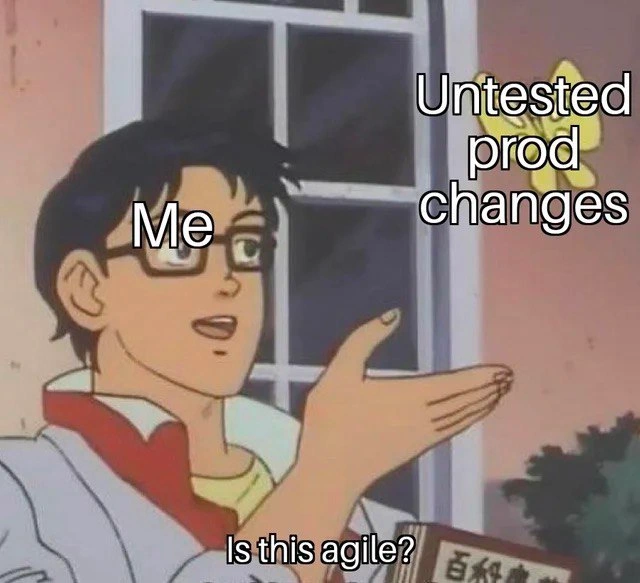
The anime image itself is a known internet meme format from the show “The Brave Fighter of Sun Fighbird”. In the original scene, the character mistakes a butterfly for a pigeon – a completely silly misidentification. Tech folks love this format to joke about any concept being mistaken for another. Here, “untested prod changes” (which are a bad practice) are being mistaken for “agile” (supposedly a good practice). It’s an ironic comparison. Everyone familiar with proper software process immediately recognizes the mix-up: No, my friend, deploying untested code isn’t agile at all! It’s more like “Fragile” development, because you’re likely to break things. The meme is a lighthearted way to poke fun at that confusion. If you’re a junior dev, take this as a cautionary chuckle: Agile ≠ chaos. Real agile teams move fast and don’t break things – because they test, monitor, and improve continuously, not skip all the safety steps.
Level 3: Cowboy Scrum
In this classic “Is this a pigeon?” meme remix, a hapless developer (the anime guy labeled “Me”) is pointing at a butterfly labeled “Untested prod changes” and earnestly asking, “Is this agile?”. It’s a tech AgileHumor moment that makes every experienced engineer smirk (or cringe). The humor comes from misunderstood agile practices – a scenario all too familiar in real software teams. Agile is supposed to mean rapid, incremental delivery with continuous feedback and quality, but here it’s being confused with reckless cowboy-style deployments. The meme satirizes a painful AgilePainPoints reality: some teams bypass tests and continuous integration, then mistake chaos for agility.
Let’s unpack why this is funny (and horrifying) to a senior developer. In true Agile methodology (like Scrum or Kanban), you still write tests, use CI/CD pipelines, and do careful incremental releases. Quality and adaptability go hand-in-hand. But some folks interpret “move fast and break things” much too literally – skipping QA, not writing unit tests, merging straight to main on Friday at 5 PM, and calling it “iteration”. This is the epitome of cowboy_deploy culture (a.k.a. cowboy coding): pushing code directly to production with zero safety nets. The meme’s joke is that the developer has embraced a dangerous anti-pattern and thinks it’s an Agile best practice. It’s like they read one blog about “individuals and interactions over processes and tools” and decided to throw out automated testing and code review altogether. 😅
Why do experienced devs nod knowingly? Because we’ve all been on that project from hell where a higher-up proudly declares, “We’re agile – no time for tests, we deploy on the fly!” That’s a DeploymentPainPoints red flag. Proper agile ContinuousDeployment doesn’t mean “deploy untested code continuously” – it means deploy small, well-tested increments continuously. Agile’s emphasis on “quick feedback” assumes you have mechanisms like automated tests and monitoring to get that feedback safely. Without tests or CI, you’re not doing Continuous Integration, you’re doing Continuous Intoxication – getting drunk on speed and neglecting quality until the bugs sober you up in production. When those ProductionIssues inevitably pop up (hello, 3 AM pager alert because the site is down), the same folks will scramble and say, “Don’t worry, we’re being agile – we’ll fix it right in prod!” 🙄. It’s a vicious cycle of ReleaseAnxiety masked as progress.
To highlight the contrast, here’s Agile vs. “Agile” at a glance:
| True Agile Practices 🏅 | Misguided "Agile" 💣 |
|---|---|
| Write tests early (TDD) and often. 📋✅ | “Tests? We’ll test in prod.” 🚫🐛 |
| Continuous Integration (CI) builds with quality gates. 🤖🔒 | Continuous bypass of CI – merge straight to prod. 🤦 |
| Small incremental releases with code review. 🔍✨ | Chaotic nightly deploys of unreviewed untested changes. 💥 |
| Monitoring & quick rollbacks for safety. 📈⚡ | No monitoring, just pray and hotfix on the fly. 🙏🔥 |
| Blameless post-mortems, learn and adapt. 📚🤝 | No retrospectives – repeat the same fire drill in the name of “speed”. 🔄🔥 |
The table above contrasts true Agile (left) with the cowboy deploy anti-pattern (right). The meme is poking fun at the right-hand side scenario. It’s an AgilePainPoints caricature: a team thinks they’re doing cutting-edge ContinuousDeployment by shipping features directly to prod at warp speed, but in reality they’re just one deploy away from a meltdown. The text “Is this agile?” at the bottom of the image underscores the irony: No, this isn’t agile at all! It’s misunderstood_agile at best – what seasoned devs sometimes call “Fragile” instead of Agile. The guy in the meme has the same energy as a dev lead who cancels the testing budget and then enthusiastically claims to be following the Agile Manifesto.
From a senior perspective, this meme nails a common source of AgileHumor (and horror): agile theatre. That’s when teams adopt the form of agile (like frequent releases) without the substance (like quality and feedback loops). The result? A codebase full of landmines and an on-call rotation that nobody wants. It’s funny because it’s true – we laugh, having learned these lessons the hard way, perhaps after one too many 3 a.m. outages caused by that untested prod change someone merged in a rush. This shared PTSD among developers turns into dark humor. As any cynical veteran will tell you, “Sure, go ahead and deploy straight to prod… if you love waking up to emergency calls!”. The meme resonates because, deep down, every experienced dev knows Agile doesn’t mean “no process” – and confusing the two leads to exactly the kind of ProductionIssues and ReleaseAnxiety that real agile practices are supposed to prevent.
Description
This meme uses the popular 'Is this a pigeon?' format from the anime series 'The Brave Fighter of Sun Fighbird'. The image features a human character with glasses, labeled 'Me', looking naively at a yellow butterfly, which is labeled 'Untested prod changes'. The subtitle at the bottom, posed as a question from the character, reads, 'Is this agile?'. The scene is set indoors, with a window in the background. This meme satirizes a common and dangerous misinterpretation of Agile methodologies. It mocks the idea that 'moving fast' - a tenet of Agile - means skipping critical steps like testing and quality assurance. For experienced developers, the humor lies in the painful accuracy of this scenario, where either inexperienced team members or misguided management equate reckless deployment with efficiency. It highlights the crucial difference between genuine agility, which aims for sustainable and rapid delivery of value, and 'cowboy coding', which introduces significant risk and inevitably leads to production incidents and technical debt
Comments
8Comment deleted
Some call it 'Agile,' others call it 'Continuous Delivery.' Senior engineers call it 'job security for the on-call team.'
Nothing says “agile” like A/B-testing reality: ship every unreviewed commit to prod and let PagerDuty curate the retrospectives
Twenty years in, and I've finally figured out that 'Agile' is just Latin for 'the PM stopped coming to standups six months ago and we're all too afraid to check if production monitoring is still working.'
We don't skip testing - we just moved the QA environment to production and renamed users 'testers'. Velocity has never been higher; so is the incident count
Ah yes, the 'Continuous Deployment' interpretation where 'continuous' means bypassing CI/CD pipelines entirely and 'deployment' means hoping the staging environment and production are close enough. This is the senior engineer's nightmare: watching a team confuse 'moving fast' with 'moving recklessly' while invoking agile as a shield against process. The real agility here is how quickly you'll be rolling back at 2 AM when monitoring alerts start firing. At least with waterfall, you knew exactly which phase you were skipping
Agile velocity: sprinting untested changes to prod, then retro'ing why your MTTR just became your new MVP
If your ‘agile’ ceremony is ssh prod && git pull, your Definition of Done is a PagerDuty escalation
Untested prod changes: CI/CD redefined as Commit Immediately, Call Devs - great MTTR practice, brutal change failure rate