Skip to content
DevMeme
229 of 7435
The Open Source Adoption Therapy Session
OpenSource Post #280, on Mar 29, 2019 in TG

The Open Source Adoption Therapy Session

Why is this OpenSource meme funny?

Level 1: Don’t Cage the Penguin

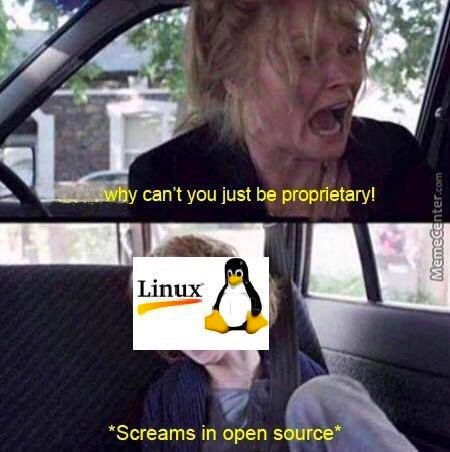
Imagine a parent telling a child who loves sharing their toys that from now on, they must keep all their toys to themselves and never let anyone else play. How would the child react? Probably with a loud, wild tantrum! This meme is like that. Linux is the child (represented by a cute penguin), and it loves sharing its “toys” (its code) with everyone. The parent is yelling, “Why can’t you just keep your toys to yourself?!” (which means “be proprietary and stop sharing!”). And Linux responds by basically screaming its head off. It’s funny because Linux acting like a screaming kid shows just how strongly it refuses to be caged or locked up. In simple terms: Linux is a free penguin that doesn’t want to live in a cage. If you try to trap it and take away its freedom, it’s going to squawk and flail until you give up. The humor comes from seeing something as geeky as open-source software turned into a goofy car-seat tantrum – it’s a silly, relatable way to say, “Linux will always be free, no matter how much someone demands otherwise.”

Level 2: Proprietary vs Penguin

Let’s break down the scene and terms for newer developers. Linux is an open-source operating system (an OS is the fundamental software that runs on a computer, like Windows or macOS). Open-source means Linux’s source code – the human-readable instructions that make it work – is freely available for anyone to see, modify, and share. This is the opposite of proprietary software, where a company keeps the source code secret and restricts how you can use or distribute the software. For example, Microsoft Windows is proprietary: you can’t just copy it freely or peek at its code; you have to accept a license and often pay for it. Linux, on the other hand, can be downloaded, run, and modified without paying a company, and if you improve it, you’re encouraged (and in fact, under the GPL license, required) to share those improvements openly.

In the meme’s image, the mother yelling “why can’t you just be proprietary!” represents someone from the proprietary world – it could be a clueless manager, a closed-source vendor, or generally the frustration of businesses who don’t like how freely Linux is given away. The child is labeled with the Linux logo (you see the word Linux and the famous Tux penguin mascot covering the kid’s face), showing that the child symbolizes Linux itself or the open-source community. The child’s response, shown as “Screams in open source” in the caption, is a humorous way to say “Linux reacts by loudly refusing to be closed-source.” It’s referencing a popular meme template (from the horror movie Babadook, where a mom yells “Why can’t you just be normal?” and the kid screams insanely). Here, it’s “Why can’t you just be proprietary?” and Linux/the kid unleashes an open-source scream instead of a normal one. That’s a funny way to imply Linux only knows how to behave as an open-source entity – anything else is unthinkable (hence the screaming tantrum).

Now, why is this funny to developers? It helps to know about open-source culture versus the proprietary software approach. Open-source folks pride themselves on transparency, collaboration, and freedom from control. In practical terms, open-source software avoids vendor lock-in – that’s when you’re dependent on a single company’s proprietary system, so switching away becomes really hard (think of being stuck with a tool or platform because no one else’s stuff can replace or interoperate with it). Linux and other open-source projects give users escape routes from that scenario, because anyone can maintain or fork the code if needed. Many developers have experienced frustration with proprietary systems that limit what they can do – maybe a library that costs money and you can’t fix bugs in it yourself, or a platform that suddenly changes pricing. Linux is often seen as the antidote to that: no single company owns it, and its license (GPL) ensures it stays free for all. So the mother’s demand “be proprietary” goes against everything Linux stands for. It’s like telling a free-spirited kid to conform to a strict uniform code – not going to end quietly! The meme exaggerates this conflict in a jokey way: the open-source scream is basically Linux saying “NO! I won’t give up my freedom!” in the loudest, most dramatic fashion. Developers who are new to this area can think of it this way: imagine one of your tools or favorite apps suddenly being taken over by a company that makes it closed-source and paid-only – you’d probably want to scream too, right? That’s essentially the emotion this meme conveys, using Linux and its penguin logo as the poster-child for loving open code. And indeed, the penguin (Tux) thrashing in the car seat is a perfect visual metaphor for Linux’s playful, stubborn refusal to be tamed by corporate rules.

Level 3: The GPL Strikes Back

At its core, this meme dramatizes the clash between open-source ideals and proprietary demands in the software world. The frustrated “mother” in the car represents the voice of a proprietary software mindset – the kind that insists on closed code, strict licensing, and vendor lock-in for profit or control. She’s basically shouting, “why can’t you just be proprietary!” at Linux, as if telling a wild penguin to wear a corporate suit. The “child” strapped in the car seat has the Linux logo (Tux the penguin) covering its face, thrashing and howling because being proprietary goes against Linux’s very DNA. Linux was born under the GNU General Public License (GPL), a legal framework that forces any derivative work to remain open-source. So asking Linux to “just be proprietary” is like asking it to violate its own genomic code – not happening. The meme’s punchline caption, “Screams in open source,” parodies a popular meme format (people screaming in a certain “language” or ethos) and perfectly encapsulates Linux’s reaction: an emphatic, primal rejection of closed-source constraints.

For seasoned developers, this image hits home because it satirizes decades of operating system licensing wars and culture clashes. Think back to the 90s and 2000s: big proprietary OS vendors (like Microsoft with Windows, or the many commercial Unixes) were essentially the angry parent, baffled and annoyed that Linux wouldn’t play by proprietary rules. There were real attempts to make Linux more “normal” (from a corporate perspective) or to co-opt its success into something closed. Each time, the open-source community fought back ferociously. A famous example: hardware vendors often tried to keep their drivers binary-only (closed source) for Linux, and the Linux community would collectively scream until either open-source drivers emerged or pressure mounted on the vendor. Linus Torvalds (the creator of Linux) himself once very bluntly expressed his disapproval to a company (NVIDIA) for refusing to open their drivers – essentially a professional “NO!” screamed in open source. This meme humorously captures that spirit of rebellion. It’s the FOSS (Free and Open-Source Software) ethos personified: rather than quietly complying with proprietary demands, Linux kicks and screams, refusing to be locked down. Developers who have been through license debates or faced vendor lock-in anxiety laugh at this because they’ve seen how absurd (and futile) it is to tell a project like Linux to adopt a closed model. The humor is equal parts tech culture reference and catharsis: we’ve all dealt with proprietary systems that made us want to scream, so seeing Linux literally do it in a meme is both funny and vindicating.

Description

A two-panel meme based on a scene from the movie 'The Babadook', depicting a tense car ride. In the top panel, a frantic-looking woman, representing a frustrated user or manager, is yelling, with the yellow caption reading, 'why can't you just be proprietary!'. In the bottom panel, a child in the back seat, whose face is covered by the official Linux logo featuring Tux the penguin, appears to be screaming back. The caption below them reads, '*Screams in open source*'. A watermark for 'MemeCenter.com' is visible on the right edge. The meme humorously personifies the culture clash and user experience differences between proprietary and open-source software. It captures the moment of peak frustration when a user, accustomed to the curated, single-vendor support of proprietary systems like Windows or macOS, hits a wall with Linux. The joke is that Linux's core identity - its open-source nature, which provides unparalleled freedom and customizability - is the very source of the user's anguish, as it often requires a more hands-on, self-sufficient approach to configuration and troubleshooting
Comments

8
Anonymous ★ Top Pick The real horror story is the support ticket: 'Problem: My OS is open source. Steps to reproduce: 1. Exist. Desired resolution: Please become a monolithic, closed-source entity with a multi-million dollar enterprise license agreement.'
  1. Anonymous ★ Top Pick

    The real horror story is the support ticket: 'Problem: My OS is open source. Steps to reproduce: 1. Exist. Desired resolution: Please become a monolithic, closed-source entity with a multi-million dollar enterprise license agreement.'

  2. Anonymous

    Exec: “Let’s just make our Linux fork proprietary.” Architect: “Great idea - once you’ve retroactively negotiated 30 million lines of GPL code with 20,000 contributors and one famously opinionated Finnish penguin.”

  3. Anonymous

    When you've spent 20 years explaining to executives why your GPL-licensed dependency means their "proprietary secret sauce" is now legally required to be published on GitHub, and they still ask if we can just "make an exception this one time."

  4. Anonymous

    Linux did eventually go corporate - it just made every Fortune 500 run on it for free while they paid Red Hat for the privilege of reading the docs

  5. Anonymous

    The eternal struggle: management wants vendor support contracts and enterprise licensing, while your infrastructure team has already recompiled the kernel three times this week and maintains a 47-page internal wiki on why systemd is both the best and worst thing to happen to init systems. Somewhere, Richard Stallman felt a disturbance in the Force and began drafting another GPL clarification

  6. Anonymous

    Proprietary: One vendor owns your pain. Open source: The whole internet shares it - with you doing the debugging

  7. Anonymous

    Procurement wants a single throat to choke; Linux replies with 10,000 maintainers and the GPL - good luck updating your RACI

  8. Anonymous

    Execs: “Why can’t you just be proprietary?” Linux: “Because at 3 a.m., a patch beats a purchase order.”

Use J and K for navigation