Skip to content
DevMeme
227 of 7435
Computational Apiology: The Bee-nary System
CS Fundamentals Post #278, on Mar 28, 2019 in TG

Computational Apiology: The Bee-nary System

Why is this CS Fundamentals meme funny?

Level 1: Busy Little Bees

Imagine you have a super hard math problem to solve, something that would take you all day. Now pretend you have a million tiny helper bees who love doing math. 🐝✨ Each little bee takes a teeny-tiny part of the big problem and works on it really fast. One bee adds two small numbers, another bee remembers a result, yet another bee checks a step – they all have their own little jobs. While you relax, these busy little bees buzz around, each doing a small piece of the work. Because there are so many of them helping, they finish the entire huge problem in just a moment!

That’s a lot like what a computer does for you. Instead of you doing every calculation slowly by yourself, the computer has lots of tiny parts all working together on the calculations so you get your answer almost instantly. The meme makes this into a funny picture by saying there are actual bees inside the computer doing the work. Of course, that’s just pretend – real computers use electricity, not insects – but it’s a silly way to show that a computer saves you from doing tons of hard work by hand. It’s funny because we know bees usually make honey, not solve math problems! Thinking of them flying around inside a computer is such a goofy idea that it makes us smile. The main idea is: computers have a lot of little things inside working on math, so you don’t have to do it all yourself, and that’s pretty amazing (and pretty funny) when you picture it as a tiny bee team helping you out.

Level 2: Bees and Bits

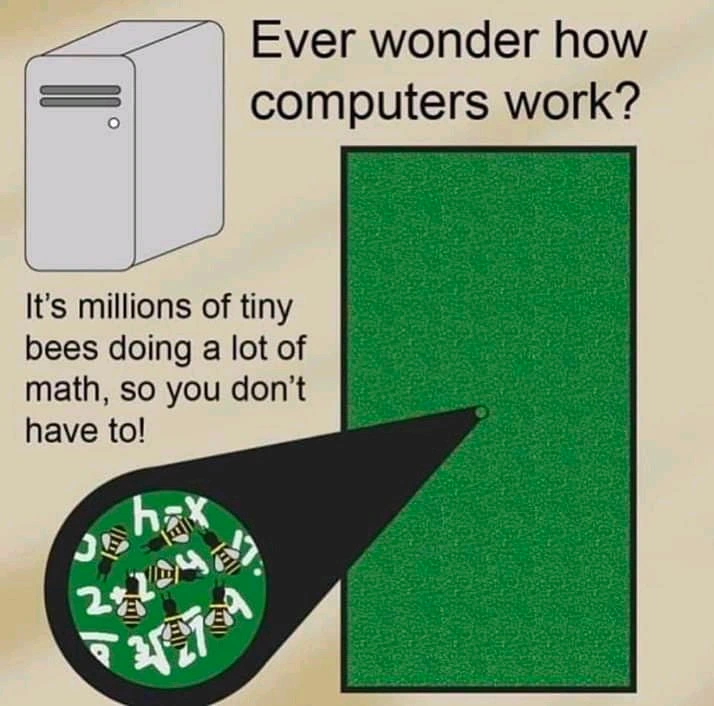
In this meme, a complex idea about computers is being explained in a very cartoonish and friendly way. On the left side, you see a simple drawing of a grey computer tower (the kind that sits under a desk or in a server room). The big text asks, “Ever wonder how computers work?” Then, on the right side, there's a tall green rectangle meant to represent the inside of that computer. A black magnifying-glass graphic zooms into the green area to reveal the funny surprise: a bunch of little bees flying around amid numbers and letters. Beneath the image, the caption answers the question: “It’s millions of tiny bees doing a lot of math, so you don’t have to!”

Let’s break down what all this means. In reality, computers do not have any bees inside 😄. This is a joke – a very imaginative way to describe what’s happening when a computer runs. The meme is suggesting a playful metaphor: that inside the computer, there are countless small workers (bees) busily calculating things. Those white numbers and algebraic letters drawn around the bees (like 2, 7, x, y) represent the math and data being worked on. So the picture is saying, "Hey, maybe the computer works by having a ton of tiny bees in there solving equations!" It’s a silly explanation meant to make you smile, because it’s obviously not true, but it hints at something real: a computer performs millions of calculations behind the scenes to get things done for you.

Now, what’s actually inside that green rectangle (inside a real computer) if not bees? It’s filled with hardware components like circuits, chips, and wires. The key part doing the “math” is a chip called the CPU, which stands for Central Processing Unit. Think of the CPU as the “brain” of the computer. Instead of bees, the CPU contains millions (often billions) of tiny electronic switches called transistors. Each transistor can be either OFF or ON, kind of like a light switch. OFF usually represents the number 0, and ON represents the number 1. This system of 0s and 1s is called binary (notice how “binary” sounds a bit like “bee-nary” – that’s the pun in the meme’s caption). Binary is a fundamental concept in computer science: it’s the simplest way to represent data, using only two states. All the numbers, letters, images, and videos in a computer are ultimately encoded in binary – long sequences of 0s and 1s – so that the machine can store and manipulate them.

When you use a computer to do any task (like adding two numbers in a calculator app or running a game), the CPU is constantly turning transistors on and off in specific patterns to carry out the instructions. It does this incredibly fast. For perspective, a modern CPU can switch those 0/1 states billions of times every second! That would be like a swarm of a billion “math bees” each doing a little task every second. Of course, they aren't real bees, but rather electrical signals moving through silicon. The reason the meme uses bees is to give a friendly, easy image for this concept: lots of little helpers doing work in parallel. It’s much more fun to imagine bees with tiny calculators than to imagine electrons and logic gates, right?

The phrase “so you don’t have to” is emphasizing that the computer is handling the hard work of calculation for you. In everyday life, we experience this whenever we use any software – the computer adds, multiplies, compares, and moves data around all on its own, so that we get results immediately without doing any of that math ourselves. For example, if you press "=" in a spreadsheet or ask Google a question, your computer might be performing millions of low-level operations to get the answer, but you don’t see any of that. To you, it just looks like it magically knew the answer. The meme jokingly says it's because a bunch of bees did all the math behind the curtain. This highlights the idea of abstraction: we don’t see the complexity, we only see the simple result. The technical term hardware abstraction means users and even programmers can use the machine without knowing the electronic nitty-gritty. In a way, the meme is a cute abstraction_explanation – it hides the complexity of transistors and machine code behind a simple story of bees solving math problems.

Notice the little word “Bee-nary” that was posted along with the image. This is a play on words. It merges “bee” (the insect) with “binary” (the 0-1 number system). Why binary? Because real computers actually work using binary math. Each of those tiny transistor switches in the CPU handles a binary digit, which we also call a bit. A bit is just a single 0 or 1. The computer groups bits into larger chunks (like bytes, which are 8 bits) to represent more complex information. But at the core, everything is bits. So when the meme says “millions of tiny bees doing math,” you can think of it like “millions of tiny bits being flipped.” The bees make that sound fanciful and humorous. It’s referencing that core CS_Fundamentals concept in a goofy way to make people laugh and maybe remember it better.

To a new developer or someone learning computer science, this meme is both funny and actually a decent analogy at a high level. It’s emphasizing that a lot goes on inside the computer to do even simple things. Those bees represent all the little operations and components working together. In truth, if you opened up a computer, you'd see green circuit boards (kind of like the green rectangle in the cartoon) with chips and tiny components soldered onto them. No moving parts like bees are flying around in there (thank goodness!), but electrically, things are indeed very busy and buzzing – the term “computer humming” isn’t far off, since you can often hear fans and disks whir as byproducts of all that activity. The meme just personifies that activity in a fun way. Anthropomorphizing (giving human or animal traits to non-human things) is a common way to explain tech to beginners or make jokes. Here, by turning transistors into a bee colony, the meme makers created a memorable image: a tiny_bee_cpu where each bee might be like a little calculator or switch.

In summary, the meme uses a HumorInTech approach to answer a big question ("How do computers work?") with a simple, funny visual answer. It's saying: imagine inside your computer there’s a whole bunch of busy bees doing mathematics lightning-fast. Of course, we know it’s really electrons in circuits, but thinking of it as a “bee team” is a playful mental model. It highlights the fact that computers handle tons of simple operations so that you get quick, easy results. The reason this is humorous is because it’s such an absurd simplification – mixing something as organic as bees with something as technological as computer hardware. It's a little bit like saying, "Inside your smartphone, there are tiny elves running around making things work." You laugh because you know it’s not true, yet it kind of acknowledges that there is an almost magical amount of work happening in that little box. In the end, the meme gives a warm, geeky chuckle and maybe helps you remember that binary (or shall we say "bee-nary" 😜) math is at the heart of it all. And don’t worry: no real bees are needed to run your laptop, so you won’t have honey leaking out of your USB ports anytime soon!

Level 3: Bees Under the Hood

For experienced developers, this meme hits a sweet spot between absurdity and truth. We all know there aren't actually insects inside our machines (if there are, you've got a serious case of hardware bugs – and not the programming kind!). Yet the image of “millions of tiny bees doing math” comically echoes how it often feels when we think about low-level computation. After all, modern computers perform insane amounts of calculation behind the scenes. The joke here is basically, "Ever wonder what's really happening under the hood? Some magic little workers take care of it!" It's poking fun at the fact that most people (even many developers, day-to-day) don’t see or think about the enormous hustle going on inside the CPU.

The meme sets up a deliberately naive explanation – the kind of tall tale you might tell a curious kid or a total non-techie: "Well, you see, inside the computer there’s a big green board where a million bees buzz around solving equations for you." It's an anthropomorphic_computation gag, attributing human or animal characteristics to a machine process. This resonates with geeks because it's both silly and oddly insightful. We’ve all had that moment of awe realizing that our high-level code is ultimately just ones and zeros being flipped at lightning speed by hardware. Describing those flips as busy little bees is a lighthearted metaphor for the hardware abstraction we rely on. It's a hardware_abstraction_layer_joke: from our lofty view in a high-level language, the CPU’s inner workings are invisible, so they might as well be bee-powered as far as everyday experience goes.

What makes this especially funny to an engineering crowd is the contrast between the cuteness of the imagery and the brutal efficiency of real hardware. A developer knows that inside that unassuming grey server tower (like the icon shown) there's a humming maze of silicon, copper, and fans – not a petting zoo of math-savvy bees. But the bees are a metaphor for all those tiny elements doing their jobs in unison. It highlights the scale: millions of something operating to get results. In reality it’s electrons moving through transistors, but expressing it as literal workers dramatizes the unseen effort. It's a wink to the sheer parallelism and speed computers achieve. An experienced dev might chuckle, thinking, "Heh, if only debugging was as simple as calming a hive of bees!" The truth is, when we optimize code or debug at the assembly level, we are trying to cooperate with those millions of tiny operations – aligning with the "bees" so they work efficiently without bumping into each other (cache misses, anyone?).

The phrase "so you don’t have to [do the math]" speaks to a shared appreciation: one huge reason we love computers is that they automate tedious calculations. Seasoned programmers remember times before high-level libraries did everything, perhaps even writing assembly or bit-twiddling algorithms by hand. We’re grateful that these days the compute hardware handles billions of operations so we can focus on logic and features. The meme exaggerates this gratitude with a fanciful scenario: thank goodness the bees are doing all that math, otherwise we’d be stuck doing it ourselves! It's the same gratitude one might express as, "My computer is crunching numbers like crazy so I don't have to break out the calculator and slide rule." Developers find humor in that relief, packaged as a silly visual.

There's also an inside-joke element with the word “Bee-nary.” This pun in the post title is a nod to binary, the fundamental language of computers. An experienced reader instantly recognizes that reference: all data and programs ultimately boil down to binary digits (bits). By spelling it with "bee", the meme creator ties it back to our insect friends. It’s the kind of groan-worthy pun that tech folks secretly love. It succinctly encapsulates the joke: computers speak binary; here we imagine they speak “bee-nary.” It’s reminiscent of other dev puns and wordplay that circulate in engineering humor, where terms like C++ bees or java sparrows might get tossed around for a laugh (okay, maybe not java sparrows… but now I’m picturing a JVM nest!). In essence, the caption “Bee-nary” tells those in the know: Yes, we’re joking about the core binary math inside CPUs, by pretending it’s done by bees.

What truly sells this meme in developer circles is how it juxtaposes a childlike explanation with a wink and a nod to technical reality. It's as if someone combined a grade-school science poster with a deep systems concept. Engineers often deal with abstraction layers – from high-level code down to firmware – and this joke is saying somewhere down there, tiny workers handle it. We laugh because we spend our days trusting that black box, sometimes peering into it when performance issues arise, but mostly treating it as a given. The bees caricature how mysterious that black box can seem. Plus, it's a nice reversal of the typical insect-and-computer trope: usually, a "bug" in the system is a bad thing to be eliminated, but here a whole swarm of insects is a feature! 🐝 In other words, the meme turns the idea of bugs on its head – these bees aren’t bugs causing errors; they’re diligently executing our instructions. (If only real software bugs were so helpful...).

Historically, whimsical explanations like this have always floated around tech culture. Old-timers might recall jokes about gremlins in the machine or the famed "magic smoke theory" (i.e., computers run on smoke – if you ever see smoke escape from a chip, the device stops working because the smoke was the magic ingredient!). The bees are in the same spirit of humor. They’re a fun narrative to make the esoteric inner workings more relatable. It’s the kind of joke you’d find on a DeveloperHumor forum or as a nerdy t-shirt graphic, where complex engineering is boiled down into an absurdly simple cartoon. And beyond the chuckles, there’s a kernel of pride and wonder: we laugh because we know the truth is even more amazing. Real CPUs, with their billions of nano-scale transistors switching billions of times per second, are mind-blowing – but that’s hard to visualize. So we joke that it’s bees, because ironically that’s easier to imagine and almost as incredible in concept. The humor lives in that contrast between literal truth and fantastical explanation.

So when a seasoned dev sees this meme, they get a bunch of pleasurable triggers at once: a clever pun ("Bee-nary math"), an absurd mental image (a data center full of buzzing hives where sysadmins are beekeepers – talk about cloud computing, or should we say “cloud of bees”?), and a subtle nod to the marvels of computing hardware (all those tiny parts working in harmony). It's a lighthearted reminder of why abstraction is powerful: we don’t have to worry about the zillion operations occurring under the covers – whether by transistor or by bee, it just works. And it’s precisely this kind of tongue-in-cheek ComputerScienceHumor that brings geeks together, shaking our heads with a smile, thinking, "Yeah, sometimes it does seem like there's magic (or bees) in that box, and thank goodness it's handling all that math for us."

Level 4: Hive Mind Architecture

At the deepest hardware level, a computer really is a hive of countless tiny workers coordinating at blinding speed. Of course, they aren't actual bees – they're microscopic transistors etched onto silicon chips – but the parallel is strangely apt. Each transistor acts as a tiny switch that can be either on or off, corresponding to the two binary states (1 or 0). This simple on/off behavior is the basis of Boolean logic, the algebra of true/false values that underpins all digital circuits. In essence, modern CPUs contain billions of transistors (imagine a swarm orders of magnitude larger than any bee colony!) all switching in concert to perform computations.

When you run a program, those transistors form vast networks of logic gates (like AND, OR, NOT) that implement everything from addition and multiplication to moving data around. An Arithmetic Logic Unit (ALU) – the part of a processor that does math – can be envisioned as an army of tiny adders working side by side. For example, adding two 64-bit numbers involves 64 little one-bit adders linked together, each handling a pair of bits and passing a carry to the next. It's as if 64 diligent bees each add a tiny portion of the numbers simultaneously and share the results – a parallel bit-wise effort. This is how hardware achieves in one step what would otherwise be 64 sequential single-bit additions. The control unit of the CPU acts like a queen bee or master coordinator, fetching instructions (the next "math problem") and telling the ALU’s worker-bee circuits what operation to perform on which data.

Despite the cutesy imagery, the analogy speaks to real architectural concepts. A modern processor core can be seen as a hive mind: pipelines, ALUs, registers, and caches all buzzing together under a unified clock signal. At a 3 GHz clock speed, the "hive" performs three billion cycles per second – far faster than any biological bee could ever flap its wings! Technologies like pipelining and out-of-order execution let different parts of the processor work on multiple instructions at once, much like a well-organized colony where tasks (fetching, decoding, executing, storing) overlap in time. The end result is astounding computational throughput, achieved by breaking complex tasks into millions of primitive operations distributed across these tiny electronic workers.

From a theoretical standpoint, this gets at a core CS fundamental: any high-level operation (like calculating a spreadsheet or rendering graphics) boils down to a vast number of simple binary operations. In the 1940s, pioneers like John von Neumann and Claude Shannon formalized how circuits of switches (relays or vacuum tubes back then) could do arithmetic and logic – essentially harnessing many simple agents to solve complex problems. Today’s transistors are the evolution of that idea: smaller, faster, more numerous. We’ve gone from room-sized computers with thousands of switches to microprocessors with billions of switches. That's like evolving from a small bee hive to a mega-hive spanning entire cities – and it explains why your smartphone can crunch numbers that old supercomputers struggled with. Each generation packed more "bees" onto the chip (thanks to Moore’s Law), enabling greater performance and more complex abilities.

What this meme humorously highlights is the principle of abstraction in computing. High-level software developers don’t explicitly think about individual transistor states (just as a beekeeper doesn't track every single bee). Instead, we use abstractions: we think in terms of bytes, variables, objects, or API calls, and trust that down in the hardware, electrons will shuffle correctly through gates to make it happen. The meme cuts through these layers by personifying the lowest level – it’s saying, imagine if inside the hardware abstraction layer there were literal bees doing all that work! This anthropomorphic twist is funny, but it’s also a reminder of the incredible hidden complexity inside every computer. Each time you press “Enter” on a keyboard or tap your phone, millions of operations fire off under the hood, unseen. Describing it as “tiny bees doing math” is a whimsical way to acknowledge those countless operations without diving into quantum physics or electrical engineering in everyday conversation.

There’s even a wink to actual computing concepts in the wordplay. The meme’s subtitle “Bee-nary” is a clever nod to binary – the base-2 number system of 1s and 0s that all these transistors speak. In a truly bee-centric computer, maybe those bits would be stored as honeycombs filled or empty, who knows? 🐝 In reality, binary states are just voltages (high or low), but calling it bee-nary personifies the idea that a swarm of simple yes/no units can encode complex information. In academic terms, one could jokingly refer to this imagined system as a "Bee Processing Unit" (BPU) instead of a CPU. It’s a fun thought experiment that still maps to real principles: large-scale coordination of tiny independent actors. Interestingly, computer scientists do study swarm intelligence algorithms (inspired by bees and ants) for problem-solving, but ironically those algorithms run on conventional silicon hardware. We haven’t actually replaced silicon chips with insect hives – that remains firmly in the realm of comedy!

In summary, the meme’s absurd suggestion of a tiny_bee_cpu underscores a beautiful truth: modern computing power comes from myriad simple elements working in unison. There may be no literal wings and honey, but the hardware really is buzzing with activity at the microscopic level. The hive analogy captures both the massive parallelism and the coordinated harmony of a CPU’s architecture. It’s a lighthearted spin on one of computer science’s deepest realities – that complex, almost magical results emerge from armies of simple operations – and it wraps that concept in a charming, memorable metaphor.

Description

An infographic-style meme that humorously explains the inner workings of a computer. The image displays a generic computer tower in the top left. The main text asks, 'Ever wonder how computers work?'. Below it, the explanation reads, 'It's millions of tiny bees doing a lot of math, so you don't have to!'. To the right, a large green rectangle represents a circuit board. A circular magnified view zooms in on a section of the board, revealing a swarm of cartoon bees actively working amidst numbers and mathematical symbols. One bee is even labeled with the word 'hax'. The post caption 'Bee-nary' adds a clever pun to the visual joke. The humor stems from creating a whimsical and absurd abstraction for the highly complex reality of semiconductor physics and boolean logic that power computation. For seasoned engineers, it's a playful nod to how much complexity is hidden from the end-user, and how explaining the real mechanics can sometimes feel as fantastical as describing magical math bees


Comments

8
Anonymous ★ Top Pick The original computer bug was a moth, but with modern multithreading, we've upgraded to a full beehive. It's not a bug, it's a buzz
  1. Anonymous ★ Top Pick

    The original computer bug was a moth, but with modern multithreading, we've upgraded to a full beehive. It's not a bug, it's a buzz

  2. Anonymous

    My CPU’s basically a beehive - hyper-threading is the workers faking extra legs, cache misses are sudden pollen shortages, and every full GC is the queen declaring a stop-the-world honey cleanup

  3. Anonymous

    After 20 years in tech, I've finally accepted that explaining distributed systems to executives is just replacing 'millions of tiny bees' with 'microservices' and watching them nod knowingly while the colony collapse disorder happens in production

  4. Anonymous

    Honestly more accurate than most onboarding docs - and the bees at least have a deterministic instruction set, unlike our microservices

  5. Anonymous

    This meme perfectly captures what every senior engineer tells junior developers about abstraction: 'You don't need to understand how the bees work, just trust the API.' Of course, at 3 AM when production is down, you'll wish you'd studied those bees more carefully - because suddenly you're debugging at the transistor level, realizing the 'millions of tiny bees' are actually race conditions in your concurrent hash map implementation

  6. Anonymous

    No wonder scaling to exaFLOPS is tough - coordinating that bee quorum without CAP theorem drama is the real von Neumann bottleneck

  7. Anonymous

    Cute model, but in production the waggle protocol kills throughput - Amdahl’s Law turns a million bees into one very busy mutex

  8. Anonymous

    Computers are just millions of math bees - no wonder thread pools buzz, GC gets sticky, and Kubernetes keeps scaling the hive until the honey (cloud budget) is gone

Use J and K for navigation