HumanOS Patch Deployment Successful
Why is this Security meme funny?
Level 1: A Flu Shot for Computers
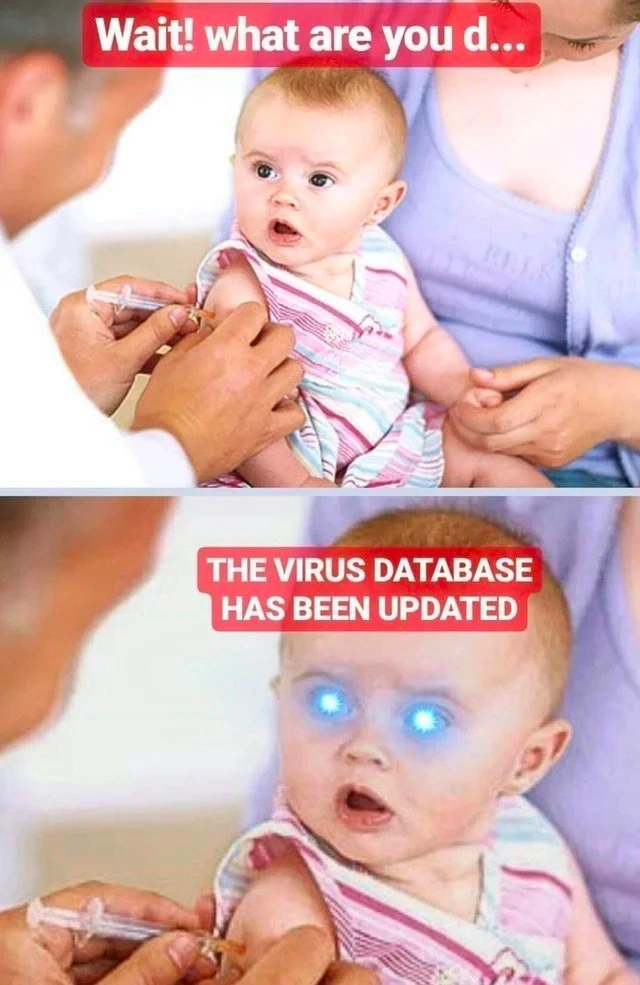
Think of your computer like a little kid getting a flu shot. We give kids shots to protect them from getting sick. In this meme, the baby represents a computer, and the shot represents an antivirus update. When the doctor (the antivirus program) says “The virus database has been updated,” it’s like telling the computer “Okay, you’re all set with your new vaccine!” The baby’s surprised face is funny because it’s like the computer going “Ouch, what was that?!” for something that is actually good for it. In simple terms, the picture jokes that updating your computer’s antivirus is like giving it a vaccination. It might be a quick sting or surprise (like when that loud voice suddenly speaks out!), but it helps keep the computer safe from catching a “cold” from bad germs — except in a computer’s case, the “germs” are bad programs called viruses. The glowing eyes on the baby in the second picture make it extra silly, as if the computer got superpowers from its security shot. The core idea is easy: just as we laugh at a cute baby’s dramatic reaction to a helpful vaccine, we laugh at how our trusty PC might “react” when we give it an important security update. It’s a fun way to remember that those little updates keep our computers healthy and happy, just like shots help keep us healthy.
Level 2: PC Immune System
Antivirus software is like a doctor for your computer. Just as a baby gets vaccines to learn about new diseases, an antivirus gets updates to learn about new computer viruses and malware. The “virus database” is a stored list of known bad programs (virus signatures) that the antivirus can recognize. When you hear “the virus database has been updated,” it means the antivirus just got a fresh batch of knowledge about recent threats, much like a flu shot gives your body info on the latest flu strain. In the meme’s first panel, the baby is about to get a vaccination (a shot that teaches their immune system about viruses). The partially visible caption “Wait! what are you d…” suggests the baby (or by analogy, the user’s PC) is caught off guard by what’s coming. In the second panel, the red caption bar completes the well-known Avast phrase in big bold letters, and the baby’s eyes glow blue – a funny exaggeration showing shock and maybe newfound “power.” This references the classic sound prompt from Avast: back in the day, Avast Antivirus would audibly announce “Virus database has been updated” in a monotone voice every time it downloaded new virus definitions. For many, it was a mix of reassuring and startling (security update success, but also a jump scare if your speakers were loud!). The meme tags like antivirus_update_notification and vaccination_analogy really sum it up: it’s comparing protecting a computer to protecting a child. Newcomers to tech might not recall that specific Avast voice, but they can understand the analogy: updating antivirus is essentially giving your computer a tiny vaccine so it can recognize and fight off new “germs” in the digital world. Keeping those updates regular is important in Security – it’s basic security awareness. And seeing the baby’s stunned face humorously captures how even routine safety measures can feel surprising. After all, the baby represents a user or a system getting its necessary but not-so-fun dose of protection.
To break it down, here’s how the meme’s analogy maps out:
| Real Life Vaccine Shot 🩹 | Antivirus Update 💻🔒 |
|---|---|
| Baby gets a needle with a vaccine (disabled virus or info about a virus) into their arm. | Computer gets a virus definition update (new data about malware signatures) into its antivirus program. |
| The doctor administers a shot to protect the child from future disease. | The antivirus software applies the update to protect the system from new malware. |
| Baby might cry or react (it stings, but it’s over quickly). | PC might ping or speak (“virus database updated!” – startling the user briefly). |
| Afterwards, the child’s immune system is stronger against real viruses. | Afterwards, the computer’s defenses are stronger against real computer viruses. |
This table shows why the meme is funny: it treats an antivirus update just like a pediatrician’s visit. For a junior dev or anyone new to cybersecurity, the takeaway is that updating your antivirus definitions is as crucial for your PC’s health as vaccines are for your body. And just like a kid might be startled by a shot, a user can be startled by that sudden update announcement. It’s a perfect mix of TechHumor and a touch of education: keep your “PC immune system” up-to-date, even if the process gives you a little scare!
Level 3: Digital Inoculation Reaction
This meme cleverly mashes up cybersecurity maintenance with a literal medical moment. In the top panel, a baby is about to get a shot and looks startled – just like a developer jolted by the classic Avast Antivirus voice prompt. Older devs instantly recognize the iconic phrase “THE VIRUS DATABASE HAS BEEN UPDATED” blaring unexpectedly from their speakers. It’s a nostalgic nod to a time when antivirus software spoke aloud, often catching us off-guard (imagine coding at 2 AM and suddenly hearing that!). The humor here lies in equating a routine antivirus update notification to a real vaccination jab: both are preventative measures against viruses (digital malware vs. biological germs), and both can feel like a surprise “attack” even though they’re for our own good. The baby’s wide-eyed, glowing-eye reaction in the second panel exaggerates how dramatic that update can feel – as if the computer (or the user) just got an adrenaline shot of security. Seasoned developers chuckle because they’ve lived through the era of loud antivirus alerts and know that keeping security up-to-date is as necessary (and occasionally startling) as getting a vaccine. It’s a bit of classic tech humor bridging software and life: updating a virus database is essentially arming your PC’s immune system with the latest defenses. This meme playfully promotes security awareness by showing that an inoculation – whether via a needle or via a download – might sting or startle for a second, but it boosts your immunity against nasty bugs (or malware). And admit it, that baby’s face is basically all of us the first time we heard our computer proudly announce a security update out loud!
Description
A two-panel meme that humorously equates vaccination with a software update. In the top panel, a baby with a wide-eyed, concerned expression is receiving a shot in the arm from a doctor. A red text box above reads, 'Wait! what are you d...'. The second panel shows the same scene, but the baby's expression has changed to a calm, almost robotic stare, with its eyes glowing a bright, cybernetic blue. The corresponding red text box now declares, 'THE VIRUS DATABASE HAS BEEN UPDATED'. This meme draws a direct and funny parallel between the biological process of immunization and the common technical process of updating antivirus software definitions. For a technical audience, the joke lies in personifying the human body as a computer system that requires regular security patches to defend against new threats ('viruses'). The glowing eyes signify the successful installation of the 'update' and the system's enhanced defensive capabilities
Comments
8Comment deleted
I wish my legacy systems could be patched this easily. Usually, updating a dependency involves three days of compiling, a sacrificial goat, and breaking half of the existing integrations
Whenever the AV blurts “THE VIRUS DATABASE HAS BEEN UPDATED,” I get the same chills as live-patching libc on the prod cluster - technically a vaccine, but my inner SRE baby still wants to scream
Your antivirus just downloaded 500MB of signatures to detect malware that was patched out of existence three years ago, while your zero-day sits there running as SYSTEM because it's signed with a valid certificate from 2019
Finally, a signature-based defense rollout with herd-level redundancy - unlike your corporate AV, this one doesn't peg the CPU at 100% every Monday at 9am
When your antivirus finally pulls the latest CVE definitions at 3 AM and suddenly understands why that sketchy npm package from 2019 was flagged in the morning standup. The glowing eyes perfectly capture that moment when your IDS correlates six months of logs and realizes the call was coming from inside the container all along
Like injecting a hotfix into prod: immediate glow-up, but the rollback involves hours of wailing downtime
Finally, a patch cycle even the CAB approves: one shot per endpoint, “virus database has been updated” as the audit log, and rollback is a lollipop
Patch Tuesday, biological edition: inject the hotfix, SecOps announces “the virus database has been updated,” and prod screams because nobody wrote a rollback plan