Microsoft's Kernel Access Changes Threaten PC Gaming Anti-Cheat
Why is this Security meme funny?
Level 1: Locking the Cookie Jar
Imagine you have a big house (that’s your computer), and inside it there’s a special room where only the parents (the operating system) are normally allowed to go. This room is like the control center of the whole house – it’s where the main electrical panel, the security system controls, all the important stuff is kept. Now, there are also some security guards (think of anti-cheat programs) that the parents hired to keep the house safe from troublemakers (cheaters or viruses). These guards are very effective because they used to have a master key that let them into every room in the house, even that special control center room, so they could chase a burglar anywhere. Sounds great for catching bad guys, right?
But here’s the problem: giving out the master key is risky. What if one of those guards makes a mistake or turns out not to be so trustworthy? They could mess up the control room, maybe flip the wrong switch or leave a door open for bad guys. In the past, some guards actually did cause accidents – imagine a guard tripping the security alarm by accident and shutting down the whole house in the middle of the night. Not fun! So the parents (in this case, Microsoft) are planning to change the locks on that control room. From now on, no guards, no outsiders – not even the “good” guards – can get in there. Only the parents themselves can access it, because they want to be absolutely sure the control center is safe and sound.
Now the guards who used to have the master key are in a panic. They’re worried: “If we can’t get into that room, how do we catch the sneaky burglars who hide there?” They’ve always been allowed to go anywhere in the house to do their job, and suddenly they might be stuck waiting outside the most important room. It’s a bit ironic – the very people hired to keep things safe are now upset that a safety rule is stopping them. It’s like a hall monitor at school complaining that the principal locked the office doors, because now the hall monitor can’t go in to look for cheaters hiding in the office! The whole situation is kind of funny because everyone’s trying to do the right thing (keep the house safe, keep the game fair), but they’re stepping on each other’s toes. The parents just don’t want anyone messing up the heart of the house, and the guards are worried they can’t guard as well from outside. In simple terms, Microsoft is tightening security on Windows, and the game anti-cheat folks are frantically saying, “Hey, wait, that might stop us from catching the bad guys!” It’s a tug-of-war between keeping the whole house safe and letting the guards chase the bad guys wherever they go.
Level 2: No More Ring-0 Playground
Let’s break down what’s happening in simpler terms. The kernel of an operating system (like Microsoft Windows) is the core part that has complete control over everything on the computer. Think of it as the master control program. Because it’s so powerful, the kernel is usually off-limits to most software. Programs we run every day (web browsers, games, etc.) operate in a safer, restricted area called user mode. They can’t directly mess with the entire system – if they need something done (like writing a file or using the network), they ask the kernel to do it via system calls. This separation is fundamental in OperatingSystems design for stability and security: a bug in a user-mode app might crash that app, but a bug in kernel mode could crash the entire OS.
Now, when the tweet says Microsoft plans to “remove kernel access for security solutions,” it’s talking about blocking certain programs from using a trick: currently, some special software (like certain antivirus or anti-cheat programs for games) actually install their own kernel-mode drivers. A driver is a low-level program that usually controls hardware (like your printer or graphics card), but drivers can also be used by security software to get deep access to the system. These anti-cheat tools – such as Riot’s Vanguard (used in Valorant), BattleEye (used in games like ARMA, DayZ, PUBG, etc.), or FACEIT Anti-Cheat (used for competitive CS:GO/CS2) – have components that run in the kernel. That means when you start your computer or launch the game, the anti-cheat driver is loaded with the highest privileges. It can inspect memory, watch the operating system’s behavior, and generally look for any signs of cheat programs hiding where normal programs wouldn’t see them. Essentially, the anti-cheat is playing at the same level as the operating system to outsmart the cheaters.
Microsoft’s rumored plan to lock down the kernel means those third-party drivers would no longer be allowed to run. The OS would say, “Sorry, this isn’t approved – no loading this driver.” Microsoft has been moving in this direction for a while: modern Windows already requires that drivers be digitally signed by Microsoft or a trusted authority (driver signing) before they’ll load, which was a way to prevent malware from sneaking in rogue drivers. (If you’ve ever tried to install an old unsigned driver on Windows 10/11, you’ve probably run into it refusing with an error – that’s driver signing enforcement in action.) Anti-cheat companies have dealt with those headaches by getting their drivers signed properly. Now, however, Microsoft might be saying, “Even if it’s signed, if it’s not part of our approved security system, it can’t run in the kernel.” This could be through new policies like only allowing Microsoft’s own security components or very tightly controlled ones in the kernel, possibly related to features like VBS (Virtualization-Based Security) or other protections. VBS, by the way, creates a mini virtual environment to keep sensitive parts of the system extra safe – sort of like putting the kernel’s most precious secrets in a vault that even a kernel driver can’t touch without permission. It’s another layer meant to stop malicious code.
For a junior developer or someone new to system internals, an example might help: imagine you’re playing a multiplayer game on Windows. To prevent cheating, the game asks you to install an anti-cheat program. You might notice during installation it asks for admin rights or even a reboot. That’s because it’s installing a driver that works at the lowest level of Windows. If you open Task Manager or similar tools, you might see a service or driver from that anti-cheat always running. Now, why go to such lengths? Because sophisticated cheats could, for instance, alter game memory or use low-level system calls to give players unfair advantages (like seeing through walls, aimbots, etc.). Some cheats even use their own drivers to hide from detection. So, the anti-cheat also goes low-level to sniff them out — like hiring a security guard with a master key to the building.
However, giving out a master key is risky. What if that security guard is clumsy or untrustworthy? In computer terms: if the anti-cheat driver has a bug, it might accidentally cause a system crash (some players indeed experienced blue screen errors due to anti-cheat software). Worse, if hackers figure out a vulnerability in the anti-cheat driver, they could exploit it to gain control of the system (the very nightmare scenario the anti-cheat was supposed to prevent!). Microsoft, as the OS maker, is like the building manager who’s increasingly uncomfortable with all these extra master keys floating around. They have been tightening the rules gradually (PatchGuard was one measure: it’s a system that watches the watchers, making sure no one – not even a well-meaning tool – tampers with the core kernel code). With this new plan, Microsoft might be effectively saying: only the OS (and perhaps official Microsoft-blessed code) gets to be in ring 0, period. No more exceptions for third-party “good guys.”
This directly impacts the gaming world because if kernel-level anti-cheats are banned, game developers and anti-cheat companies will have to find new ways to detect cheating. They might have to rely on user-mode detections, heuristic monitoring, or work with Microsoft to use some new secure APIs. It’s worth noting that other operating systems have already gone down this path: for example, macOS no longer allows traditional kernel extensions for things like antivirus; developers had to switch to safer user-mode frameworks. Windows might introduce something similar for anti-cheat, but transitioning will be a challenge. In the short term, those vendors are worried. The phrase “sparks security panic” in the title is apt – the people who make anti-cheat software are likely anxious that their current products will stop working or become ineffective under the new Windows policy.
Let’s clarify a few terms from the meme description to ensure everything’s clear:
- Kernel Access / Ring 0: This means running with the highest privileges on the system. If something has kernel access, it can do almost anything (read/write any memory, talk to hardware, etc.). Microsoft wants to revoke this level of access from third-party tools, meaning they’d be pushed up to less privileged levels (ring 3, where normal apps run).
- Anti-Cheat Drivers (Vanguard, BattleEye, FACEIT): These are the pieces of software that games use to detect cheating. Vanguard (by Riot Games for Valorant) famously runs at boot and has a kernel driver. BattleEye and FACEIT are used in many games and also operate at a deep system level. They are essentially like specialized antivirus programs, but for game cheats.
- PatchGuard: A Windows feature that guards the patching of the kernel. It’s like a security system that checks if the kernel’s code or critical data have been altered. If it finds an unauthorized change, it doesn’t care if it was a virus or your friendly neighborhood anti-cheat – it will trigger a system crash to stop it. This forces developers to avoid doing any naughty low-level hacks that PatchGuard would catch.
- VBS (Virtualization-Based Security): Imagine a security bunker within Windows. VBS uses hardware virtualization (the same tech that lets you run virtual machines) to isolate certain sensitive operations from the normal kernel. This means even if someone has kernel access, they can’t necessarily reach into the bunker. It’s great for protecting against malware, but it also means anti-cheat tools might not be able to peek at everything like they used to.
- Driver Signing: This is the process of getting a driver approved. Since Windows 10, Microsoft says “I won’t run just any driver; it needs to be signed by a valid certificate.” For most developers, that means you have to get your driver digitally signed by Microsoft’s developer program or a trusted CA. This ensures the code comes from a known source and hasn’t been tampered with. For anti-cheat devs, it’s an extra hoop to jump through. In the meme context, even a signed driver might not be allowed if Microsoft’s policy changes – they might restrict what kinds of drivers or which certificates are acceptable for these security-related drivers.
In summary, Level 2 take: Microsoft is strengthening Windows by saying “no outsiders in the most sensitive part of the system.” That’s colliding with the current way anti-cheat programs work, which rely on being those very “outsiders” with special access. It’s a classic security vs. functionality squabble. For a newer developer, it’s also a peek into how SecurityTradeoffs are made at the OS level: the more open you are (letting programs do anything, for flexibility and power), the more risk you carry; the more locked-down you are (for safety and stability), the less freedom external software has. This meme is pointing out that tightrope walk, and it resonates with developers because we know neither side can get everything they want without someone complaining. In this case, the complainers are the anti-cheat makers who might soon have to play by much stricter rules on Windows.
Level 3: PatchGuard PTSD
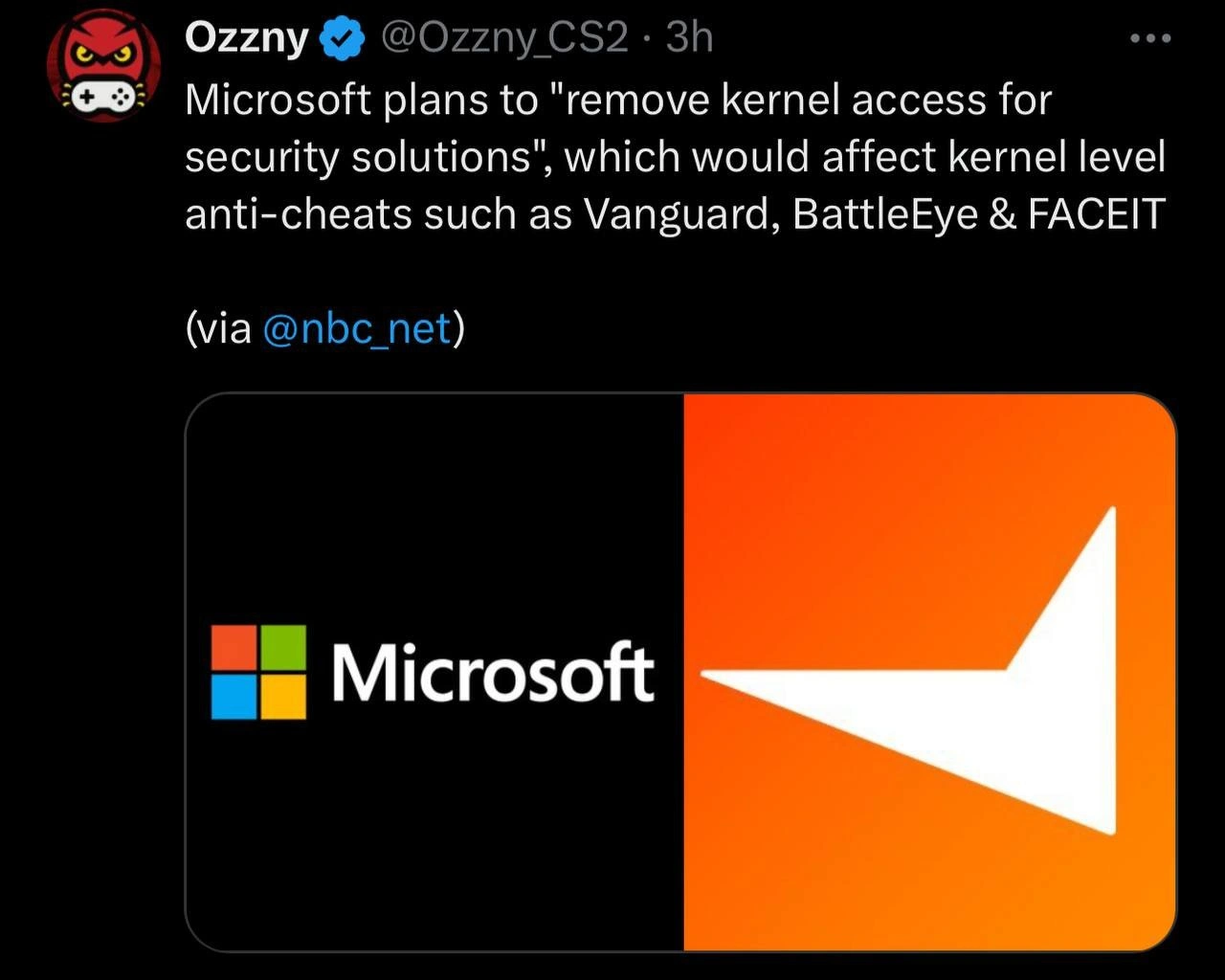
On the seasoned engineer level, this meme hits a nerve by referencing a very real clash between Microsoft’s operating system security policies and the needs of third-party anti-cheat vendors. The tweet by @Ozzny_CS2 announces Microsoft’s plan to “remove kernel access for security solutions.” That phrase immediately sets off alarm bells for anyone who’s been around Windows development or system security for a while. Why? Because it echoes the long history of Microsoft slowly tightening Windows’ kernel to be off-limits to outside interference. In other words, the days of sneaking custom drivers into ring 0 might be numbered.
Think of anti-cheat systems like Riot’s Vanguard, BattlEye, or FACEIT Anti-Cheat: these are essentially specialized drivers running with system-level privileges on your machine to catch cheaters red-handed. They operate at ring 0, the same level as the Windows kernel, which means they can inspect and manipulate practically anything in the system. That’s how they detect cheats that try to hide themselves or manipulate game memory. The dark joke among developers is that these anti-cheats behave a lot like the very malware or cheats they’re defending against — they hook low-level functions, scan memory, and often load at startup to be in place before any potential cheats can load. From a Security perspective, it’s a bit of the fox guarding the henhouse. We users and engineers tolerate that fox only because it’s our fox catching even worse foxes (cheaters). But now Microsoft, the farm owner in this analogy, is basically saying, “No more foxes in the henhouse, not even the ‘good’ ones.”
This creates a security tradeoff conundrum that industry folks have seen before. Back in the mid-2000s, when Microsoft introduced PatchGuard in 64-bit Windows, traditional antivirus vendors (like Symantec and McAfee) went into a minor panic. Their products at the time often relied on hooking the Windows kernel (for example, to monitor system calls or modify the OS’s behavior to trap viruses). PatchGuard was a watchdog that would literally crash the system if it detected unofficial tinkering in the kernel – a nightmare scenario for any AV solution doing exactly that. The vendors complained loudly; some even accused Microsoft of being anti-competitive (since PatchGuard didn’t hinder Microsoft’s own security software, just third parties). Driver signing requirements got stricter too – you couldn’t just load an arbitrary driver anymore; it had to be signed by Microsoft’s approved process. Many of us recall those driver_signing_headaches when trying to install custom or old hardware drivers on new versions of Windows. Ultimately, antivirus companies had to adapt, using documented APIs and user-mode components to do their job (like the newer Windows Defender model). Fast forward to today: the meme implies a similar upheaval, but now it’s the anti-cheat makers in the hot seat. You can almost feel the PTSD for any developer who lived through the PatchGuard era, thinking, “Here we go again – another lockdown; time to rewrite our software or become obsolete.”
From the Microsoft OperatingSystems standpoint, the motivation is straightforward: protect the integrity of the system. Over the years, Windows has been adding features like VBS (Virtualization-Based Security), which leverages the hypervisor to create secure enclaves, and tightening the rules on what drivers can do. There’s also the move toward isolating drivers and eliminating old kernel hooks by providing safer alternatives (for instance, replacing random kernel patching with official callback mechanisms or user-mode services). Microsoft doesn’t want any code running in the kernel that isn’t absolutely necessary and verified, because every additional kernel module is a potential source of vulnerabilities. And indeed, there have been embarrassing instances where anti-cheat or even antivirus drivers themselves had security flaws. If a bad actor exploits a vulnerability in a widely distributed anti-cheat driver, they essentially gain kernel-level access to millions of systems — a perfect recipe for a serious SecurityFlaws headline. Microsoft clearly loses patience with that risk over time. One could say this policy is Microsoft channeling a bit of Apple’s philosophy: (recall that Apple’s macOS in recent years deprecated kernel extensions in favor of “system extensions” that run in user space – causing similar panic for Mac security tool vendors). The meme’s scenario isn’t far-fetched: Windows might be heading down that road, telling developers, “No more mucking about in ring 0; find another way.”
Now, consider this from the gaming and development perspective. Competitive online games are an arms race: cheat developers find new ways to hack or exploit a game, and anti-cheat developers respond by digging even deeper into the system to catch them. That’s why we ended up with gamers having to install these intrusive anti-cheat drivers. If you’ve played Valorant, for example, you might remember that Vanguard starts up with your PC (it even has a system tray icon) and runs at the highest privilege to continuously watch for cheats. Some players felt uneasy, joking that Vanguard was basically a rootkit given how deep it hooks into Windows. BattleEye and FACEIT AC serve similar roles for other games, sometimes even requiring a PC reboot upon installation because they nestle into the OS so fundamentally. So, imagine you’re an engineer at one of these companies and you see this tweet. It’s essentially saying: the core method your software uses to ensure fair play might soon be illegal in Windows-land. No wonder it’s described as causing “panic”. These dev teams are likely scrambling for answers: “Can we achieve the same cheat detection purely in user mode? Do we rely on Windows to provide some new anti-cheat API? Or are we going to catch less cheaters now?” It’s a tough spot. They built their tech assuming a certain level of access, and Microsoft is about to yank that out from under them.
The meme’s humor has a bit of schadenfreude and irony. Anti-cheat vendors are supposed to be the guardians of game integrity, the “good guys” in the fight against cheaters. Yet here they are, portrayed as almost crying foul that a security measure (Microsoft tightening the OS) is going to hurt them. It’s ironic: security software complaining that the system is becoming too secure for their product to function. Developers who have dealt with corporate security policies or locked-down production environments might chuckle at this: it’s a classic case of “the tool I use to enforce rules is now breaking the rules!” There’s also a long-running Games vs. Platform tension highlighted here. Gamers want cheat-free experiences and they want their PCs to be secure and stable. Microsoft, as the platform, prioritizes overall system health, while game companies prioritize the competitive integrity of their game. When those priorities clash, things get spicy. We’ve seen gamers angry at both sides: angry at game companies for installing what they view as invasive system software, and angry at platform holders if cheaters run rampant. So, any experienced dev can see the powder keg: if Microsoft proceeds with this kernel lockdown, either games find a new solution (maybe Microsoft will offer a dedicated anti-cheat framework or improved system calls that detect suspicious behavior in user mode), or cheat detection might suffer in the interim. And if cheat detection falters, the players will definitely make noise. It’s a delicate balance.
To sum up the senior-engineer view: this meme captures a “too real” scenario of SecurityTradeoffs. It’s a lose-lose or win-win, depending on perspective. Either you weaken system security to let anti-cheats do their job (risky), or you strengthen security and possibly give cheaters an edge (also risky for the gaming experience). The shared laugh here comes from recognition of that absurd catch-22. It also carries an undertone of “we’ve been down this road before” – veterans recall the PatchGuard fights, the driver signing woes, the kernel-mode vs user-mode debates. It’s a nod to the ongoing evolution of OS policy: every time Windows (or any OS) raises the drawbridge, someone who used to sail freely into kernel harbor gets left out in the moat complaining. 🏰🐊 In this case, those left outside are ironically some of the people who claimed to be defending the castle. And that’s equal parts funny, frustrating, and fascinating to folks in the field.
Here’s a quick snapshot of the competing interests at play:
| Anti-Cheat Vendors | Microsoft | Gamers |
|---|---|---|
| “We need full ring-0 access to catch cheaters at all costs!” 🔐 | “We need a secure OS – no unauthorized code in kernel, period.” 🛡️ | “We want fair play and a stable, safe PC (no rootkits)!” 🎮💻 |
Each column is basically tugging in a different direction, and the meme sits right at the center of that tug-of-war, pointing at it and laughing in recognition.
Level 4: Ring-0 Rumble
At the deepest technical level, this meme highlights a kernel-level showdown in operating system design. In CPU architecture (like x86/x64), we have hierarchical privilege rings: user applications run in ring 3 (least privileged), while the operating system kernel and drivers operate in ring 0 (most privileged). When Microsoft talks about removing kernel access for third-party “security solutions,” it’s essentially saying: no more letting outside code run in ring 0. This is a radical OS hardening move. From a theoretical standpoint, it aligns with the Principle of Least Privilege and a more microkernel-like philosophy—only the OS’s own trusted code should wield absolute power. The humor (and panic) arises because those third-party tools (like anti-cheat drivers) currently live in that privileged space. They’ve been effectively granted the keys to the kingdom (or rather the keys to the kernel). Microsoft now appears ready to change the locks.
Why would Microsoft do this? It comes down to the integrity of the Operating System’s core. Any code executing in ring 0 becomes part of the Trusted Computing Base – if it’s malicious or just buggy, it can undermine the whole system. Historically, Windows has been tightening this inner sanctum for years. PatchGuard (Kernel Patch Protection) was introduced in 64-bit Windows to prevent any unauthorized modification of the kernel. If PatchGuard detects tampering (say, a driver hooking a system call table or modifying a kernel structure), it will deliberately crash the system (a blue screen of death) rather than let the violation continue. This was Microsoft’s academic-security-community-approved answer to rampant rootkits in the early 2000s. Of course, legitimate vendors (especially some antivirus companies) screamed in frustration back then, because their old techniques of hooking into Windows internals were suddenly forbidden. They had to redesign around official APIs and kernel mini-filter drivers. We’re seeing a similar drama now, but with game anti-cheat software cast in the role of those upset security vendors. The meme is funny to kernel developers because it’s like déjà vu: another generation of ring-0 “good guys” being told no touching the kernel!
On a systems-theoretical level, this is the classic dilemma of security vs. functionality. Anti-cheat and antivirus tools operate much like rootkits (ironically, the very thing they’re fighting) – they dig into the system at the lowest level to monitor and manipulate behaviors that would be impossible to see from user space. It’s a cat-and-mouse game: cheaters hide in kernel space, so anti-cheats followed them there. But from Microsoft’s kernel design perspective, any unauthorized presence in ring 0 is a hole in the OS defenses. Advances in hardware-based security like VBS (Virtualization-Based Security) and hypervisor techniques (often called ring -1, a privilege level even above the OS kernel) have given OS vendors new ways to enforce boundaries. For instance, with VBS, Windows can run sensitive security code in an isolated mini-VM that even kernel drivers can’t touch, and enforce features like HVCI (Hypervisor-Enforced Code Integrity) to block unsigned or unapproved code. This all means the OS is becoming less tolerant of ring-0 stowaways. The tweet signals that Microsoft might go so far as to explicitly prohibit what they call "kernel access for security solutions". In practice, that could mean no more loading custom drivers even if they are code-signed, or at least no more special exceptions for anti-cheat or antivirus tools to hook the OS. It’s as if the operating system is wearing chainmail — strengthening its core so nothing (not even well-meaning code) can easily pierce it.
From a computer science standpoint, we can appreciate the elegant intransigence of such an approach: less code in the kernel = smaller attack surface, better stability, stronger security guarantees. Academic research in OS security often points out that fully mediating trust at the lowest level is crucial — you don’t want random drivers acting as unofficial operating systems under yours. Microsoft likely has decades of hard lessons (blue screens, malware exploiting driver flaws, etc.) informing this stance. Nonetheless, it’s a bold move because it pits fundamental security architecture against the practical needs of certain applications (like competitive games). The meme is essentially shining a light on this ring-0 rumble: the immovable object (Windows kernel lockdown) meeting the unstoppable force (anti-cheat vendors’ demand for deep system access). To an experienced KernelDevelopment engineer or a security researcher, it’s both amusing and intriguing: amusing because we’ve seen this tug-of-war before (and maybe enjoy the irony of security tools being treated like security threats), and intriguing because it raises the question of how the industry will innovate around this constraint. The battle for the kernel’s “throne” has begun — and it’s a SecurityTradeoff royale at the lowest level of the system.
Description
A screenshot of a tweet from the user Ozzny (@Ozzny_CS2). The tweet reports on a significant policy change from Microsoft: 'Microsoft plans to "remove kernel access for security solutions", which would affect kernel level anti-cheats such as Vanguard, BattlEye & FACEIT'. Below the text is a composite image showing the Microsoft logo on the left and what appears to be the logo for a security or anti-cheat company on the right (a white stylized checkmark/arrow inside an orange square). This news is highly relevant to both the cybersecurity and PC gaming communities, as kernel-level access is how many of the most effective anti-cheat systems function. The change represents a major platform shift by Microsoft, prioritizing OS security and stability, potentially at the cost of making it much harder for game developers to combat cheating effectively
Comments
7Comment deleted
Microsoft is removing kernel access for 'security solutions.' Finally, the Blue Screen of Death will be reserved for legitimate driver errors, not just when I try to launch Valorant
When PatchGuard tells the anti-cheat devs they can’t sit at ring-0 anymore, everyone suddenly remembers user-mode telemetry is just “security by hoping the cheaters are polite.”
Microsoft finally discovered the security principle we've all known for decades: the best way to prevent kernel exploits is to not let anyone touch the kernel. Next up: preventing SQL injection by removing database access entirely
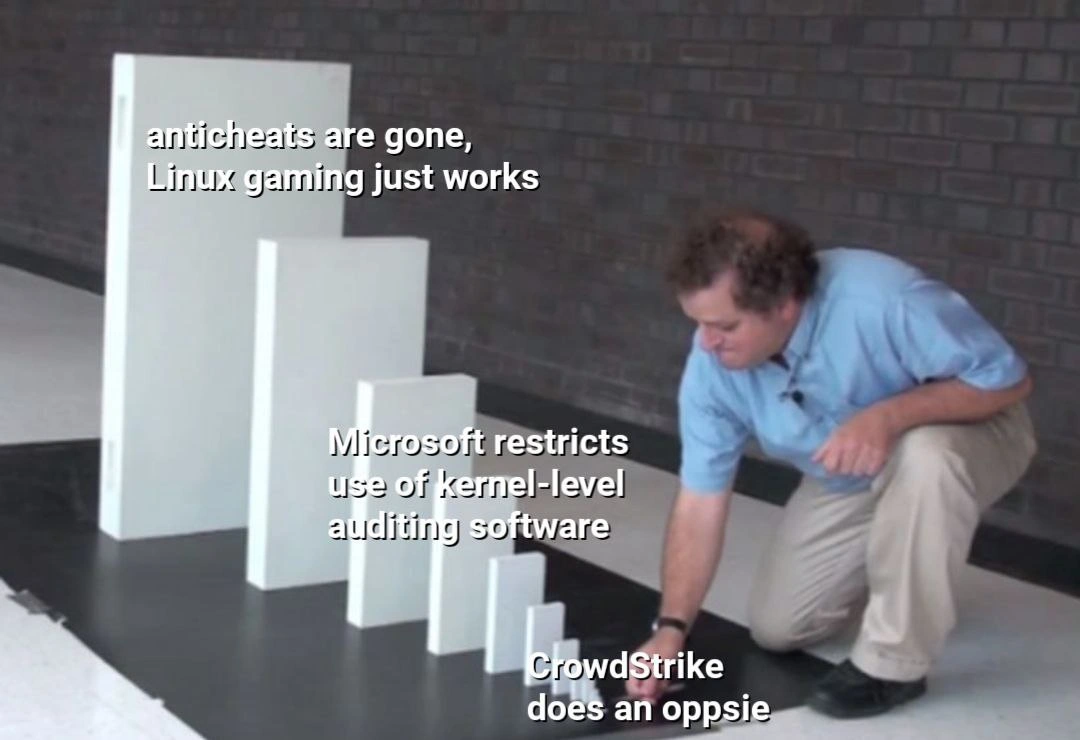
Microsoft finally realized that letting every anti-cheat vendor write kernel drivers is basically crowdsourcing blue screens. After CrowdStrike's global outage demo'd what happens when Ring 0 goes wrong, they're pulling the 'kernel access for everyone' card - which means competitive gamers will soon discover that the real cheat was kernel privileges all along. The irony? The same industry that spent decades teaching us 'never trust user input' has been letting game anti-cheat run at the highest privilege level possible
Applying least privilege at ring 0 is great - until your anti‑cheat driver gets demoted to ring 3 and your support queue achieves eventual consistency
Microsoft's kernel lockdown: Because userland anti-cheat totally won't just bluescreen everyone's rig instead
When Windows revokes Ring‑0 hall passes, half the anti‑cheat ecosystem realizes their “security solution” was just a signed rootkit with better PR