One bad kernel patch and Linux gaming magically works: domino meme edition
Why is this Security meme funny?
Level 1: Little Oops, Big Win
Think of it like a chain reaction from a tiny accident to a huge happy surprise. Imagine a bakery where one day a chef accidentally mixed a wrong ingredient into a batch of cookies – a real little oops. Because of that mistake, the bakery’s owner decides, “That ingredient is causing trouble, we’re not going to use it anymore in any of our shops.” That ingredient happened to be something like peanuts, which were also causing allergy problems for some kids. Now that all the peanuts are gone (due to the new rule from the owner), suddenly kids who were allergic to peanuts can eat any cookie in the bakery without worry. So, a small goof-up in the kitchen ended up leading to a big positive change for a bunch of customers who couldn’t enjoy the treats before. The meme is telling a similar kind of story with computers: one company made a tiny mistake in their deep system software (the small domino), which pushed a big company (Microsoft) to change the rules (the medium domino), and in the end a whole bunch of gamers on Linux (people who previously had trouble playing some games) got a big win – now their games run without a hitch (the huge domino falling). It’s funny and satisfying because nobody expected a little error to end up helping a totally different group of people in such a big way. It’s like tipping over a tiny domino and watching it knock down bigger and bigger dominoes, until the last one causes a happy ending for someone who was watching from the sidelines.
Level 2: Small Bug, Big Impact
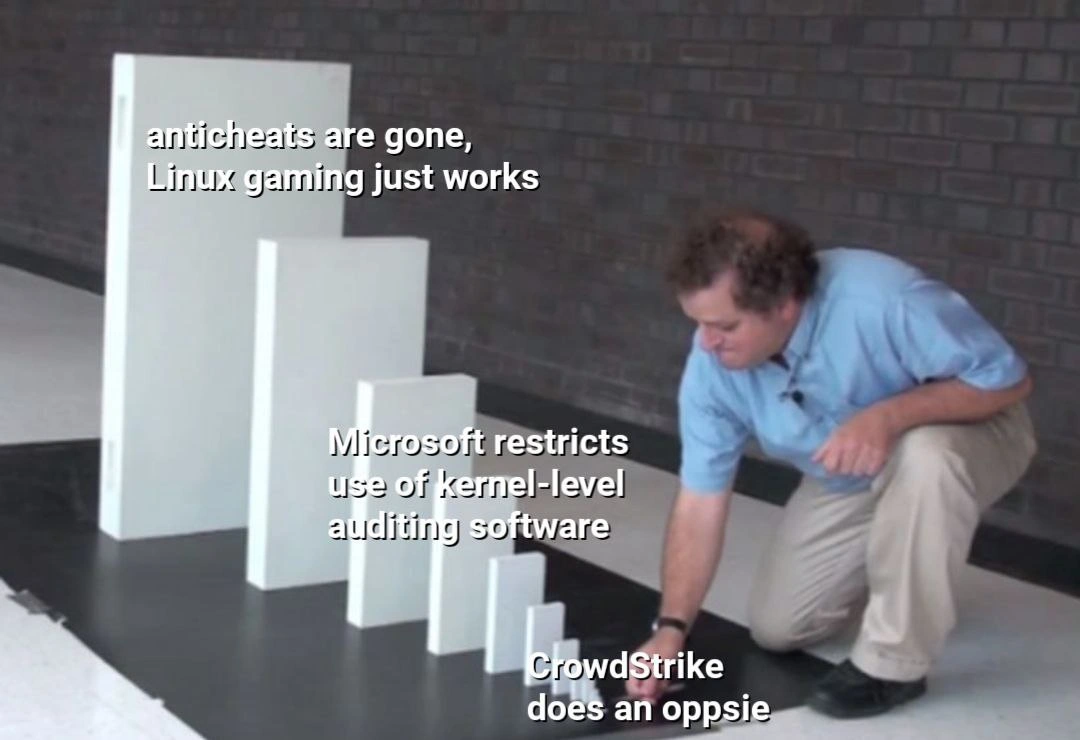
Okay, let’s break down what’s happening in this domino meme, step by step. It starts with CrowdStrike – that’s a company which provides security software to protect computers from hackers and malware. Think of CrowdStrike’s tool as a super-powered antivirus that large companies use. It operates at the kernel level of the operating system, meaning it has very deep access to Windows’ core (the kernel is like the heart of the OS where all critical decisions are made). Now, "CrowdStrike does an oopsie" implies that CrowdStrike released a bad update or patch to their software. In simpler terms, a software bug slipped through and caused a serious problem. Since this software runs in the kernel (the most sensitive part of Windows), a bug there can crash the whole system. This likely led to a bunch of Windows computers suddenly showing the Blue Screen of Death (that scary all-blue error screen, often just called a BSOD, which appears when Windows encounters a fatal error). If you’ve ever seen a BSOD, you know it’s no fun — it usually means the computer has to reboot and you might lose your work. A kernel bug can do that because there’s no safety net: it’s like an error in the operating system’s brain. So that’s our first tiny domino: a bug in CrowdStrike’s kernel driver caused a lot of headaches.
Now the next domino: Microsoft restricts use of kernel-level auditing software. In response to that kind of big mishap, Microsoft (who makes Windows) apparently decided to tighten the rules for programs that burrow into the kernel. Kernel-level auditing software refers to tools that monitor or inspect the system at a low level (CrowdStrike’s agent is one example, but there are others like certain diagnostic tools or security monitors). Microsoft has the power to update Windows to say “Hey, only certain trusted or properly designed programs can run in the kernel, others will be blocked or limited.” They do this to protect the operating system. Imagine if one partner’s software caused a ton of crashes — Microsoft wouldn’t want a repeat with some other software, because it makes Windows look bad and unsafe. So, by restricting kernel-level tools, Microsoft is basically drawing a line: fewer programs can operate in that super-sensitive area. Windows has features like driver signing (requiring kernel programs to be approved and signed by Microsoft) and other security mechanisms (like memory isolation) to control what runs down there. After the CrowdStrike incident, it’s likely Microsoft reinforced those mechanisms or added new policies. In essence, Microsoft is saying “We’re going to allow less freedom in the kernel to third-party software.” Good for stability and security, but this affects a lot of software out there that used to have more free rein.
Now, consider game anti-cheat software. If you play online games, you might know about programs like Easy Anti-Cheat (EAC) or BattlEye. These are tools that game companies include to stop cheaters. Unfortunately, cheaters can be very sneaky, sometimes even messing with the game or system at low levels to hide their cheating. So, anti-cheat software also went low-level to catch them – some even run as kernel drivers on Windows. That’s right, a game you install might also install a kernel driver purely to watch for cheating programs! These anti-cheat drivers are also a kind of kernel-level auditing software: they audit (monitor) the system for suspicious activity that could be cheats. Now connect the dots: Microsoft’s new restrictions on kernel software wouldn’t just apply to CrowdStrike – it would apply to all similar programs, including game anti-cheat drivers. If Microsoft says “only very well-behaved or approved drivers can run,” some anti-cheat systems might not meet the new requirements or might be outright blocked. The meme phrase “anticheats are gone” is a bit dramatic, but it captures the idea that game developers might have to remove or disable their kernel anti-cheat drivers because of Microsoft’s rules. They might be forced to move those anti-cheat functions to less privileged levels (like user-mode) or find alternative methods. In any case, let’s say anti-cheat programs in their current invasive form become much less common.
Finally, the biggest domino: “Linux gaming just works.” This is cheerfully referring to a longstanding issue in gaming. Many PC games are made for Windows and don’t natively run on Linux. However, projects like Wine and Proton (Proton is a compatibility layer by Valve/Steam that builds on Wine) allow Linux users to run Windows games by translating Windows calls into Linux ones. It works great for many games – but not so great for games with those anti-cheat drivers. Because anti-cheat drivers are built for Windows’ kernel, they simply cannot run on Linux (Linux has its own completely different kernel). So a game that requires a Windows-only driver just fails or refuses to start on Linux with Proton. This has been a big roadblock: a lot of multiplayer games wouldn’t work on Linux due to anti-cheat. If, thanks to Microsoft’s changes, game studios drop those kernel anti-cheats, then suddenly those same games have one less barrier to working on Linux. Basically, if the game no longer needs that Windows-only driver, Proton can handle the rest of the game’s logic in software. So the meme is saying that as an unintended result of Microsoft’s crackdown, now those games run fine on Linux – “it just works!” It’s a bit of an exaggeration (there are still other reasons some games don’t work on Linux), but it hits a real point: anti-cheat has been one of the trickiest blockers for Linux gaming compatibility.
So, in summary, each part of the meme is a cause-and-effect step: A bug in a security program leads Microsoft to change Operating System policy, which in turn forces removal of certain security/anti-cheat measures in games, and the happy side-effect is better compatibility for Linux gamers. It’s highlighting a domino effect where a small mistake leads to a big, somewhat surprising positive outcome for a completely different community. This relates to Security because it’s about security software and policies, Operating Systems because it’s about what runs in the kernel of Windows vs Linux, and Bugs because it all starts from a software bug. For a junior dev or someone new to these concepts: it’s a lesson that sometimes fixing a problem in one area (like tightening security) can impact other areas in unexpected ways. And it’s also a little tech joke about how Linux vs Windows has these constant back-and-forth moments – here Linux kind of “wins” a round thanks to a Windows security blunder!
Level 3: The Domino Patch Effect
This meme lands so well with seasoned engineers because it encapsulates a chain reaction of consequences that is all too familiar in the tech industry. We start with CrowdStrike doing an “oopsie” – in plainer terms, a bungled update to CrowdStrike’s kernel driver caused trouble. CrowdStrike Falcon is a popular enterprise EDR tool (think next-gen antivirus on steroids) that burrows deep into the Windows kernel to watch for malware. Sometime around a notorious “Blue Screen Friday”, an update to that agent apparently went awry. The result? BSODs spreading through corporate laptops like a flash mob of crashes. Seasoned sysadmins often quip, “It’s always the antivirus (when your system mysteriously crashes).” Here it was an EDR agent, but close enough – a security tool with kernel hooks caused system instability. Imagine walking into the office and finding dozens of PCs displaying the dreaded Blue Screen of Death. If you peeked at the stop code, it likely fingered the CrowdStrike driver (CrowdStrikeSensor.sys or similar) as the culprit.
*** STOP: 0x0000007E (SYSTEM_THREAD_EXCEPTION_NOT_HANDLED)
Failed Driver: CrowdStrikeFalcon.sys
Hypothetical BSOD error blaming an EDR driver — the nightmare of every IT admin.
Now, why is this domino so small in the meme? Because such an internal bug at a vendor is usually a contained, albeit painful, issue. It’s the kind of bug in software that gets quickly patched and quietly added to the “remember that Friday” list in IT war stories. But here the meme humorously amplifies the outcome: the small tile tips a bigger one – “Microsoft restricts use of kernel-level auditing software.” In real life, after an incident like that, Microsoft undoubtedly had some serious conversations. Windows is Microsoft’s baby, and nothing makes them jumpy like third-party drivers causing mass Kernel Panic-equivalents (BSODs) on their platform. It’s embarrassing and it undercuts Windows stability and security reputation. So as the meme suggests, Microsoft responded by tightening the rules for kernel-level auditing software. This means any software that digs into Windows internals (like EDRs, antivirus, low-level monitoring tools) would face new restrictions or oversight. In practice, this could be things like requiring stricter code signing, using Microsoft’s own kernel interfaces (instead of hacky hooks), or even blocking certain techniques outright. Microsoft essentially said, “Enough – if your code lives in our kernel, play by our rules or not at all.” This is a classic security vs. functionality trade-off. The corporate Security teams might cheer that move: fewer shady or sloppy drivers in kernel means fewer supply-chain dangers and support calls. But there’s collateral damage: the next domino involves game anticheat technologies.
This is where the meme gets delightfully tongue-in-cheek. Anti-cheat programs for games (like Easy Anti-Cheat, BattleEye, etc.) often operate akin to mini-EDRs or even rootkits. They hook deep into the OS to detect aimbots or wallhacks, watching for any tampering with game memory or system calls. Many anti-cheats even run as kernel drivers to stay a step ahead of cheat programs. For example, they might intercept system calls or perform kernel-level integrity checks on the game process. It’s very effective against cheats, but it’s also very invasive — and, notably, very Windows-specific. If Microsoft cracks down on kernel-level auditing software broadly, guess who else gets caught in that net? Those anti-cheat drivers. Game studios don’t get a free pass just because their kernel module is for “game security” rather than “endpoint security.” They might find their methods no longer allowed or their drivers needing special approval. Faced with that, some publishers might drop or substantially alter their anti-cheat approach (especially if rewriting to user-mode or getting Microsoft’s sign-off is too much hassle). In the meme, this is dramatized as “anticheats are gone.” That’s an exaggeration – not all anti-cheat would vanish overnight – but it pokes fun at the idea that Microsoft’s policy pivot could force the game industry’s hand. We’ve already seen some moves in this direction: for instance, certain games enabling user-space only anti-cheat modes to be compatible with the Steam Deck (which runs Linux). The meme simply imagines a cathartic scenario where devs just give up on invasive kernel anti-cheats entirely.
Finally, the largest domino falls: “Linux gaming just works.” To any Linux vs Windows veteran, those words are both humorous and heart-warming. For years, one of the biggest hurdles for running Windows games on Linux (via Wine or Proton) has been anti-cheat systems. Proton, developed by Valve, translates Windows system calls to Linux, letting you run Windows games seamlessly on a Linux box… until an anti-cheat driver shows up. You can’t easily translate a Windows kernel driver into Linux – that’s like trying to fit a square peg in a round hole, technically speaking. Anti-cheat drivers would either flat-out refuse to run on Linux or detect Wine as “not a real Windows” and shut the game down to prevent “cheating.” So lots of online games just wouldn’t work on Linux, much to the frustration of dual-booters and open-source aficionados. Now imagine a world where those kernel anti-cheats are no more – it would remove one of the final roadblocks to Linux gaming compatibility. Games would be way more likely to run under Proton because there’s no hidden driver saying “Nope, I don’t like this environment.” In essence, by Microsoft cleaning house in the Windows kernel, it indirectly does Linux a solid favor. That’s the delicious irony making every sysadmin-turned-gamer smirk: Windows tightening its security belts ends up boosting Linux’s gaming cred.
This domino effect meme brilliantly ties together a sequence of unintended consequences. Each step makes sense: a security fiasco leads to corporate policy change; that policy change hobbles a controversial practice (kernel anti-cheats) in another field; that hobbling removes a thorn in Linux’s side. It’s a tech karma story. Seasoned engineers love this because it’s too real: we’ve seen small bugs escalate into massive industry shifts before. It also slyly comments on how over-privileged software (whether it’s an EDR or an anti-cheat) can backfire. The humor has an undercurrent of “I told you so”—those of us who’ve been wary of invasive kernel drivers nod along. It’s as if the meme is saying: Had we practiced least-privilege and not let every app and its dog into the kernel, this domino scenario wouldn’t even be possible. But since we did, one way or another the piper gets paid — and in this tale the Linux gamers get an unexpected reward.
Level 4: Supply-Chain Reaction
At the deepest level, this meme riffs on kernel-space trust and privilege — essentially a cascade triggered by a breach in the software supply chain. In modern OS design, the kernel (ring-0) is sacred ground: code running here can do anything on the system. Ideally, only the OS’s own well-tested components run in kernel-space, but reality invites third-party kernel modules like antivirus and anti-cheat drivers. Allowing these into the kernel expands the Trusted Computing Base (TCB), meaning we’re inherently trusting external code with the keys to the kingdom. This is a classic supply-chain risk: if a widely-deployed, privileged component (say, a CrowdStrike security agent) has a flaw or gets compromised, that vulnerability ripples through thousands of systems that trust it. Here, one bad kernel patch from a security vendor is the first domino, illustrating how a single supply-chain “oops” at ring-0 can set off a chain reaction across the entire ecosystem.
From an academic perspective, this is about unintended consequences in a complex system. We have a highly privileged EDR (Endpoint Detection & Response) driver that likely violated the OS’s stability guarantees – either through a bug causing memory corruption or by being exploited. In kernel-space, there’s no safety net: a small pointer error or unchecked buffer in an EDR driver can trigger a system-wide failure (the infamous Blue Screen of Death, essentially Windows’ version of a kernel panic). The OS, in response, must reassert control to maintain security and stability. Microsoft’s reaction – restricting kernel-level auditing tools – is a systemic correction to re-balance trust boundaries. It’s akin to an immune response in operating systems theory: isolate or expel a component that misbehaves at the core. There’s precedent for this in OS history: Windows x64 introduced PatchGuard years ago to stop even legitimate programs from patching the kernel, precisely because rootkits (malicious or even “commercial” ones like some anticheat or antivirus drivers) were too dangerous to allow free rein. These kernel protection mechanisms are essentially implementing the principle of least privilege at a structural level, saying “no third-party should mess with critical internals” – because once you’re in ring-0, even a minor misstep can crash or compromise the whole machine.
By curtailing kernel-level auditing software, Microsoft is effectively shrinking the attack surface and the TCB. But such policies have side effects: any software class that relied on those deep hooks is suddenly locked out. This is where the domino effect carries through to gaming: anti-cheat drivers, which often behave much like EDR or even malware (scanning memory, intercepting system calls, hiding their presence), also lose their unchecked kernel privileges. The meme’s grand punchline – “anticheats are gone, Linux gaming just works” – highlights the extreme outcome of that policy shift. In theory, if games drop invasive kernel anti-cheat measures (because they can’t run or aren’t allowed), running those games under Wine/Proton on Linux becomes dramatically easier. Proton is essentially a user-space reimplementation of Windows APIs; it can’t easily accommodate a Windows kernel driver that some anti-cheats required. Remove that driver requirement, and suddenly the compatibility barrier vanishes. We end up with a delightful systemic irony: a security patch intended to harden Windows inadvertently ameliorates a long-standing compatibility issue for Linux. It’s a high-level reminder of how tightly interwoven our software ecosystem is – a change in OS security policy can cascade out to influence cross-platform compatibility and user experience in surprising ways. The domino meme format is a perfect visual metaphor for this academic concept of a cascade failure and correction: a small perturbation in a complex, interconnected system can lead to a large, emergent outcome, not unlike a chaotic system finding a new equilibrium. Here, the emergent outcome is positive (for Linux gamers at least), which adds to the humor – it’s a supply-chain reaction that solved an unrelated problem.
Description
The image uses the classic “domino effect” format: five white domino blocks increasing in size sit on a black floor against a dark brick wall, with a kneeling man in a light-blue shirt about to tip the tiniest tile. Visible captions (smallest to largest) read: “CrowdStrike does an oppsie,” “Microsoft restricts use of kernel-level auditing software,” and, on the tallest tile, “anticheats are gone, Linux gaming just works.” The visual joke implies that a single botched CrowdStrike kernel driver update (the small domino) cascades into Microsoft tightening kernel-mode restrictions, which then forces game publishers to drop invasive anticheat drivers, ultimately making Proton/Wine gaming seamless on Linux. Seasoned engineers will catch the deeper nod to supply-chain risk, over-privileged EDR agents, and the unintended consequences of kernel-space policies rippling through the entire software ecosystem
Comments
6Comment deleted
Apparently the shortest CI pipeline to Proton compatibility is triggering a planet-wide BSOD with one unsigned EDR driver
Twenty years of arguing that kernel modules are a security nightmare, and it took one bad regex in a Windows driver to finally prove our point - now we just need Valve to accidentally push Steam Deck sales numbers during the next earnings call
The beautiful irony here is that Microsoft's attempt to lock down kernel access for security reasons - partially motivated by improving Linux gaming compatibility removing the need for invasive anticheats - inadvertently created the perfect conditions for a kernel-level security tool to take down millions of Windows machines globally. It's the enterprise security equivalent of 'we've investigated ourselves and found we're the problem,' except CrowdStrike did it with a faulty channel file update that bypassed all the careful architectural decisions. Sometimes the real vulnerability isn't in the attack surface - it's in the 'trusted' code running at ring 0 with a direct line to production systems worldwide
Kernel-level auditing: Linux audits permissions first, Windows lets CrowdStrike audit the outage logs - from recovery mode
One global EDR hotfix later, ring-0 went from “must-have anti-cheat” to “audit finding,” and suddenly Proton is the most reliable ABI in the stack
One faulty ring‑0 sensor update and every CISO suddenly loves user‑mode EDR - meanwhile Proton quietly ships the real SLA: does the game launch?