Skip to content
DevMeme
933 of 7435
The Futility of Mobile Antivirus Software
Security Post #1054, on Feb 25, 2020 in TG

The Futility of Mobile Antivirus Software

Why is this Security meme funny?

Level 1: Guarding an Unbreakable Castle

Imagine you have a super secure castle 🏰 that bad guys can’t get into because it has unbreakable walls. Now suppose someone hires a security guard to patrol inside that castle, even though nothing bad can really get in past the walls. Kinda silly, right? The guard isn’t useless exactly – maybe he’ll shoo away a mouse or dust off a window – but he’s not going to face any real burglars because the castle was super safe to begin with. This meme is joking about that kind of situation. Apple’s iPhone is like the castle with really high, strong walls. Putting “Windows Defender” on the iPhone is like adding that extra guard inside – it might make a few people feel safer, but the castle was already mostly safe. So if you ever feel like what you’re doing isn’t important, remember some people had to do a job that’s a bit like guarding an unbreakable castle. It’s a funny way to say: “hey, it could be worse, your work does matter!”

Level 2: Antivirus vs Sandbox

So what’s the big joke? Let’s break it down in simpler terms. Microsoft Defender is an antivirus program. “Antivirus” means it scans your device looking for malware (bad programs like viruses or spyware). On Windows computers, this is super important – historically, Windows was open enough that if you downloaded an infected file or clicked a sketchy link, a virus could slip onto your system, spread, and cause havoc (steal data, show endless pop-ups, or worse). Windows Defender (now part of Microsoft’s security suite) was built to protect PCs by constantly watching for these threats. It checks files and apps against known bad patterns, and it runs in the background to catch viruses trying to do sneaky things. That’s normal on a PC.

Now, on modern smartphones like those running iOS (iPhones) or Android, things work differently. These systems use something called a sandbox for apps. Think of each app on your phone as being stuck in its own sandbox play area – it can play with its own toys (its own files, data, etc.), but it can’t run over and mess up another app’s sandbox. On an iPhone, apps are really isolated: an app generally can’t see what other apps are doing or touch the system in a deep way. Also, you typically can only install apps through the official App Store (on non-jailbroken iPhones), where Apple vets apps for malicious behavior beforehand. This means classic viruses (which jump from program to program, or insert themselves into your system without permission) have a hard time on iOS. It’s like each app is in a locked room – even if one somehow turned evil, it’s stuck in there and can’t rampage through your house. Android is a bit more open than iOS – you can install apps from outside the Google Play Store if you change settings, and Android allows some more background access – so Android has seen more malware apps in the wild. But even Android uses sandboxes and asks you for permissions (like when an app wants access to your camera or contacts, you have to say “Allow”). This greatly limits what a rogue app can do by default. Plus, Google built Play Protect, which is like a built-in mini-antivirus that automatically checks apps you install from the official store.

Given that context, the meme points out the silliness of bringing Windows Defender to iOS/Android. On an iPhone, an antivirus app can’t really scan much beyond its own little area, because iOS won’t let it roam through the entire device poking at other apps’ stuff. In fact, Apple doesn’t even allow true antivirus apps on the App Store that try to scan other apps or the iOS filesystem – it’s against their rules (because it’s not needed and could even be a security risk itself). So what does “Microsoft Defender” do on iOS? Good question! Mostly, it might do things like scan email attachments you open, or check websites you visit for phishing scams, or integrate with corporate security policies. But it can’t perform the classic full device virus scan that it does on Windows – the operating system won’t permit that level of access. On Android, Defender can do a bit more, like scanning files you download or warning about known malicious apps, but it’s still limited compared to on a PC. In both cases, the need for an antivirus on mobile is much lower. iOS, especially, is designed so that even if you never run an antivirus, you’re generally safe as long as you stick to the App Store and practice common-sense (like not clicking weird links).

So the meme is basically saying: “Feeling unimportant? Well, don’t worry – somebody out there had the job of porting an antivirus to a phone, a job that arguably didn’t need to be done!” It’s a bit of developer humor poking fun at how sometimes engineers are tasked with projects that make you scratch your head. Mobile development is full of challenges – dealing with different screen sizes, battery life, app store restrictions – and here, someone’s challenge was to squeeze a Microsoft security app into iOS/Android where it’s arguably redundant. If you’re new to this, imagine being asked to develop an app you suspect people don’t really need. It might feel a bit demotivating, right? That’s why other developers find this funny. It’s a mix of sympathy for the folks who built it and relief for everyone else that, hey, at least our current project has a purpose. This meme floats around in DeveloperHumor circles as a lighthearted reminder that no matter how pointless you think your work is, it could be worse – you could be reinventing a wheel that the platform already squared away.

Level 3: Better Safe than Redundant

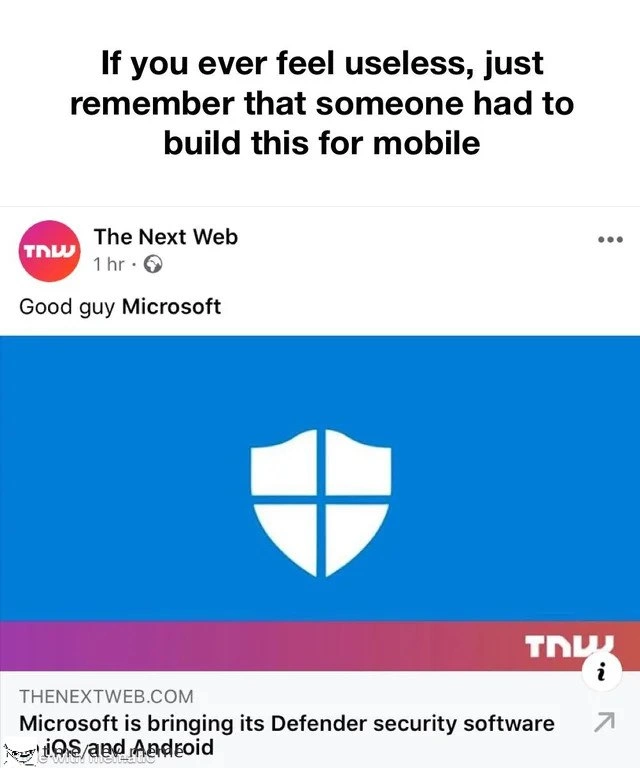
For seasoned developers, this meme elicits a knowing smirk at corporate decision-making and needless engineering hustle. The text up top nails the setup: “If you ever feel useless, just remember that someone had to build this for mobile.” It’s the ultimate tongue-in-cheek pep talk for a dev feeling pointless: “Cheer up, your job matters – after all, some poor team was tasked with porting Windows Defender to iOS and Android!” The humor comes from the absurdity and useless feature trope. In the software industry, we’ve all seen managers insist on building something that makes engineers mutter, “...why are we doing this again?” This is a prime example of feature overkill driven by checkbox mentality. Microsoft’s security division likely wanted to say, “We have Defender everywhere – Windows, Linux, and now your phone!” Even if on mobile it’s a guard dog guarding nothing, it checks the marketing box. Veteran devs recognize this pattern: a big company feels compelled to offer a flagship Microsoft product on every platform for completeness, even when the platform itself doesn’t need it. It’s like watching someone install windshield wipers on a submarine – technically impressive, but fundamentally unnecessary.

The meme’s screenshot (a social media post by The Next Web) labels Microsoft as “Good guy Microsoft” for bringing Defender to iOS/Android. That phrase drips with irony for those in the know. Good guy doing a pointless favor. Mobile development teams at Microsoft actually spent time designing, coding, and debugging an app that seasoned security folks suspect will rarely, if ever, catch a real virus. The experienced engineers reading this imagine the internal conversations:

  • Product Manager: “We need platform parity. Our security suite must include mobile clients because
 strategy!”
  • Engineer: “But iOS apps can’t even scan the system
 There’s practically nothing to defend against
”
  • Product Manager: “Make it work somehow. We promised a mobile Defender in the quarterly roadmap.”
  • Engineer: Sigh "Yes, boss."

The result? A dedicated team writing tens of thousands of lines of code to develop a mobile antivirus mostly to justify its own existence. It’s a classic case of security theater: providing the appearance of security rather than a significant actual benefit, much like those overly elaborate airport screenings that make us feel safer more than they actually catch bad guys. Developers who’ve been around the block have encountered similar wild-goose chases — be it implementing a full-blown plugin system for an app that would only ever have one plugin, or spending weeks on an overly generic “framework” no one ends up reusing. It’s extra painful when the effort is in the security domain, which people take very seriously, but the context makes it almost comical.

Another layer to the joke is the contrast between desktop security fears and mobile reality. In the 90s and 2000s, Windows users desperately needed antivirus protection – many of us have PTSD from cleaning actual viruses and malware off our desktops. Microsoft Defender (formerly known as Windows Defender) was a hero on Windows, guarding the gates of an inherently vulnerable castle. Fast-forward to modern smartphones: Apple and Google built castles with walls so high that the classic viruses can’t even get in. Yet here comes Microsoft, dutifully marching its knight (the Defender shield) into a fortress that’s practically empty of enemies. It’s overkill, and every senior dev immediately recognizes the humor in solving a “problem” that was solved at the OS level long ago. It’s reminiscent of other over-engineering war stories: like allocating a team to optimize an algorithm that isn’t even in the hot path, or writing unit tests for an API that’s about to be deprecated. The meme strikes a chord because it’s “too real” – we’ve all been that engineer building something we suspect is a glorified placebo.

In short, experienced developers laugh (perhaps with a twinge of empathy) because the meme spotlights a universal industry quirk: sometimes brilliant engineers at top companies toil away on redundant projects due to business trade-offs or marketing pressures. It’s not that the engineers are clueless – often they know it’s absurd – but hey, it pays the bills. If nothing else, at least it gives the rest of us a morale boost: no matter how meaningless your day’s Jira ticket feels, you can think, “Well, at least I’m not writing an antivirus for an iPhone.” 😏

Level 4: Shield in a Sandbox

At the deepest technical level, this meme highlights a fundamental OS architecture mismatch. Microsoft Defender (Windows Defender) is traditional antivirus software originally designed for Windows’ open ecosystem, where programs can freely interact with files, memory, and even each other’s code. On a desktop OS like Windows, Defender hooks into low-level system calls, monitors file system changes, and scans executables for known malware signatures. It operates close to the kernel, inspecting anything that moves — because on Windows, anything can move. In contrast, iOS (and to a slightly lesser extent Android) uses a strict sandboxing model and mandatory code signing. Each app on iOS runs in its own isolated sandbox, meaning it cannot poke its nose into other apps’ data or system files. The entire platform is a walled garden by design. There’s no concept of a roaming .exe file or a self-replicating virus on iOS – apps can’t normally download new executable code or tamper with one another. Apple’s security philosophy is prevention: keep the bad stuff out in the first place through a locked-down App Store, rather than letting it in and then trying to detect and remove it.

From an OS internals perspective, porting an antivirus to iOS is like installing a smoke detector in a submarine – the environment is engineered to avoid the kind of “fires” (malware outbreaks) an antivirus looks for. Any serious iOS malware would require exploiting a deep system vulnerability (essentially jailbreaking the device without permission). If such a rare exploit occurs, a third-party app like Defender is powerless: it can’t get the elevated privileges needed to detect or stop a kernel-level compromise. By the time an iOS app perceives something’s wrong, the battle is already lost to the OS bug. On Android, which is more open, a mobile antivirus has a bit more room to operate (scanning downloads, checking for known bad apps), but even Android relies heavily on Google Play Protect and user sandboxing to curb malware. The security tradeoffs on mobile favor preventative walls over reactive scanners. In essence, Microsoft’s engineers had to water down Defender’s capabilities to fit within Apple’s rules – no real-time scanning of other apps, no deep system hooks. The result is mostly an app that might scan downloads or warn about phishing links, a far cry from its Windows version that digs through the entire file system. It’s a “shield” forced to stay inside a tiny sandbox. The meme’s punchline is rooted in this paradox: the very raison d’ĂȘtre of Defender – hunting viruses – is largely moot on platforms architected to be virus-proof.

Description

This meme comments on the perceived uselessness of certain software projects. The top text reads, 'If you ever feel useless, just remember that someone had to build this for mobile'. Below is a screenshot of a news post from 'The Next Web'. The post, captioned 'Good guy Microsoft', features a large blue image with the white Microsoft Defender shield logo. The article headline at the bottom reads, 'Microsoft is bringing its Defender security software to iOS and Android'. The humor stems from the technical reality that traditional antivirus software, like Microsoft Defender, is largely redundant on modern, sandboxed mobile operating systems. Both iOS and Android have robust security architectures that limit the effectiveness and necessity of third-party security suites. The meme playfully pities the engineers assigned to this project, implying their work was pointless, a common sentiment among developers who have worked on features or products dictated by marketing or corporate strategy rather than genuine user need or technical merit
Comments

7
Anonymous ★ Top Pick That team's daily stand-up must have been grim. 'Yesterday I implemented a feature that the OS already does better. Today, I'll work on the battery drain component. No blockers.'
  1. Anonymous ★ Top Pick

    That team's daily stand-up must have been grim. 'Yesterday I implemented a feature that the OS already does better. Today, I'll work on the battery drain component. No blockers.'

  2. Anonymous

    Some architect just spent two sprints hacking around iOS entitlements so Windows Defender can “scan” a read-only sandbox - proving once again that enterprise compliance requirements are the only virus mobile really needs protection from

  3. Anonymous

    Somewhere a team of engineers spent six months architecting a sophisticated threat detection system for platforms where the biggest security vulnerability is users clicking "Allow" on every permission dialog without reading it

  4. Anonymous

    Ah yes, Microsoft Defender for mobile - because nothing says 'we understand platform security models' quite like porting a signature-based antivirus to sandboxed operating systems where apps literally can't access each other's memory space. I'm sure the engineering team had a blast explaining to management why iOS's permission model makes traditional AV about as useful as a firewall on a submarine. But hey, at least it checks the 'enterprise security compliance' box on some VP's quarterly OKRs, and that's what really matters, right?

  5. Anonymous

    Microsoft Defender on iOS/Android: sandboxing forbids real AV, background scans get murdered, so you ship a Network Extension and a green shield - phone unchanged, CISO dashboard finally “Protected.”

  6. Anonymous

    Mobile Defender: because iOS sandboxing needed an extra layer of Azure telemetry to truly enterprise-ify your battery drain

  7. Anonymous

    Defender on iOS: the art of ticking RFP checkbox 7.3 without kernel hooks - just an MDM profile, a VPN, and a slide that says “mobile coverage achieved.”

Use J and K for navigation