Skip to content
DevMeme
934 of 7435
When Your Code Is Woven
TechHistory Post #1055, on Feb 26, 2020 in TG

When Your Code Is Woven

Why is this TechHistory meme funny?

Level 1: Instructions Made of Holes

This is like writing instructions for a machine by punching holes in paper instead of typing on a keyboard. The funny part is pretending those old cards are a modern program, so a weaving problem becomes the same kind of mistake as broken code.

Level 2: Holes as Instructions

Punched cards are cards with holes placed in specific positions. Machines can read those holes as instructions or data. In a loom, the pattern of holes can help decide which threads move, creating a repeated design in cloth.

Code is a set of instructions for a machine. Today, code is usually stored in files and written in languages like Python, JavaScript, C, or Java. In this image, the "code" is physical: rows of holes on linked cards. The machine reads the cards as they move through the loom.

Compiling usually means translating human-written programming language into a form a computer can run. The caption jokes that the loom's card pattern has a compile error, as if a textile machine were a modern programming environment. For a newer developer, the key idea is that programming did not begin with laptops. The history of computing includes older machines that were programmable through physical media.

Level 3: Textile Build Failure

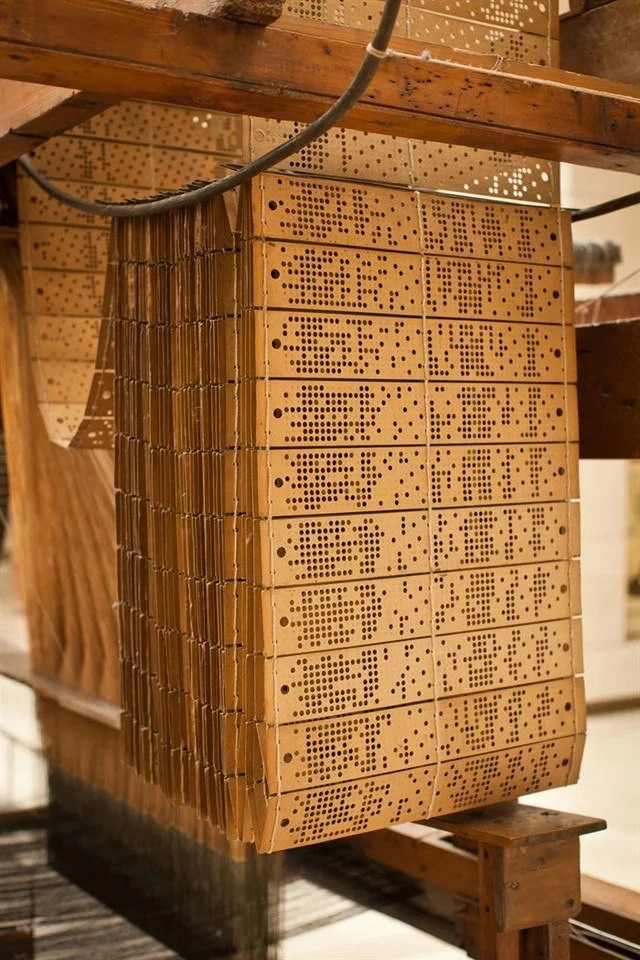
The image shows a chain of tan perforated cards feeding through a wooden mechanical loom setup, with cords and loom parts visible around it. There is no text inside the image itself, so the caption does the punchline: Can someone tell me why my code won't compile? The joke is that this is not modern source code on a screen. It is a physical program, encoded as holes in cards, being treated like a failed software build.

The senior-level delight here is that the analogy is not random. Jacquard-style looms used punched cards to control weaving patterns: a hole or no hole determined which threads were lifted, which controlled the final textile design. That is recognizably program-like. There is an input medium, an instruction sequence, a machine that interprets those instructions, and an output artifact. Replace yarn with bytes and the family resemblance becomes painfully obvious.

The caption's won't compile wording is funny because a loom does not compile in the modern sense. A compiler translates source code from one representation into another, usually from a programming language into machine code or some intermediate form. The punched-card loom is closer to a machine directly executing a physical instruction stream. But developers use "won't compile" as shorthand for "the machine rejected my intentions," and that emotional meaning fits perfectly. Somewhere in those holes is a typo, except the typo is made of cardboard and the error message is probably ugly fabric.

This is also SoftwareHistory compressed into one image. Long before most people thought about software as text files, people were already encoding repeatable procedures into external media. Punched cards became important in later computing because they offered a way to store instructions and data outside the machine itself. The visible cards make that abstraction concrete: code is not inherently glowing text in an editor. Code is any sufficiently precise set of instructions that a machine can follow. Sometimes it is main.c; sometimes it is a lace pattern with a bad merge conflict.

The historical irony is that modern developers complain about opaque build errors, but at least our compilers usually tell us a line number. With physical cards, debugging means inspecting holes, sequence, alignment, damaged cards, and mechanical state. Congratulations: your CI pipeline is made of wood.

Description

The image shows a close-up of a historical punched-card mechanism: rows of tan perforated cards or slats hang in a linked chain beside wooden loom components and cables. There is no visible text in the image itself, but the metadata caption says "Can someone tell me why my code won't compile?". The technical context is the Jacquard-style loom, where punched cards encoded weaving instructions and became an important precursor to later programmable machines and computer punch cards. The meme treats a mechanical textile pattern as source code, making a compiler-error joke out of early programmability.

Comments

1
Anonymous ★ Top Pick Compiler error at card 184: expected warp, got weft, and the build log is now upholstery.
  1. Anonymous ★ Top Pick

    Compiler error at card 184: expected warp, got weft, and the build log is now upholstery.

Use J and K for navigation