Skip to content
DevMeme
932 of 7435
The Loneliness of the Optimized Coder
Performance Post #1053, on Feb 25, 2020 in TG

The Loneliness of the Optimized Coder

Why is this Performance meme funny?

Level 1: Too Fast to See

Imagine you’re doing a magic trick for your friends. You’ve practiced it to be super fast – you can make a coin disappear in the blink of an eye. You do the trick so quickly that none of your friends actually see what happened. One moment the coin is there, the next it’s gone, and you’re already holding it in your other hand. Instead of clapping and cheering, everyone just looks puzzled because they missed the whole trick. You feel a bit sad because you did something awesome really fast, but no one understood it or even realized how you did it. In other words, you went too fast for anyone to follow, and now you’re left alone with your cool trick that nobody else appreciated. It’s like running way ahead of your friends in a race – you finish first, but you’re alone at the finish line because they haven’t caught up or seen how you got there. The funny picture with the kid in the blue costume shows that feeling: he’s super speedy like a character from a video game, but since he’s faster than everyone else, he’s standing there by himself, a bit in the dark, because no one else is with him to say “Wow, great job!”

Level 2: Speed vs Clarity

Let’s break down the technical joke in simpler terms. First, what does it mean to write “optimized code”? It means the developer has tweaked or written the program in a very efficient way to make it run faster or use fewer resources. Performance optimization often involves using advanced algorithms or low-level programming tricks to squeeze out more speed. However, these tricks can make the code more complicated. Imagine a piece of software that calculates something really fast, but it uses a method so clever or unusual that it almost looks like a secret code language. That’s basically what’s happening here: the code is super fast, but it’s also super hard to read.

Now, when people talk about CodeReadability or CodeMaintainability, they’re talking about how easy it is for humans to understand and work with the code. Readable code is written in a clear, straightforward way, using sensible variable names, simple logic, and maybe some comments to explain what’s going on. Maintainable code means future developers (or you, a few months later) can modify or fix the code without going crazy trying to figure it out. In a team setting, these qualities are extremely important. If the code is written in a confusing way that only the original author understands, it becomes a problem for everyone else. It’s like having assembly instructions for furniture that are written in a foreign language – only one person on the team can interpret them, and everyone else is left guessing.

Why would making code run faster end up causing confusion? Often, to speed things up, developers use shortcuts or advanced techniques that aren’t obvious at first glance. For example, check out this simple snippet (in Python-like pseudocode) that determines if a number is even:

# A clear, simple way to check if a number is even:
if n % 2 == 0:
    print("even")

# A more 'optimized' trick using a bitwise operation:
if (n & 1) == 0:
    print("even")  # This uses a binary trick: it checks the last bit of n.

Both pieces of code do the same thing: they print “even” if the number n is even. The first method n % 2 == 0 is very straightforward – if dividing n by 2 leaves a remainder of 0, then n is even. The second method (n & 1) == 0 uses a bitwise AND operation. It’s a known micro-optimization in low-level programming: checking the least significant bit of the binary representation of n is a quick way to test for evenness. But if you’ve never seen that trick, the second line looks puzzling – it’s less immediately clear why it works. You’d have to know that in binary, even numbers always end in 0 (so n & 1 masks out all but that last bit and compares it to 0). This is a classic case of an obscure optimisation: it might save a tiny bit of processing time, but it’s harder for a human to understand quickly.

In modern programming, especially in high-level languages, we often prefer the clear version because the performance difference is negligible in most situations, and clarity helps everyone on the team. Compilers and interpreters are pretty smart nowadays; they often perform their own optimizations under the hood. That means writing straightforward code is usually best, and the machine will handle a lot of the low-level tweaks. When we do need to optimize for Performance, we try to do it in a way that doesn’t sacrifice too much readability. We also choose our battles: we focus on optimizing the parts of the code that really need it (say, a function that gets called millions of times or a piece of code that is slowing the whole program down), not every single line. There’s a saying, “Make it work, make it right, then make it fast.” In other words, first ensure the code is correct and clear (“make it right”), then optimize only if necessary (“make it fast”). This helps avoid the trap of over-engineering a solution that becomes too complex for its own good.

You might have heard experienced developers joke about not being “too clever” or say things like “keep it simple” during code reviews. If you ever write code that uses a very convoluted one-liner or an exotic language feature, a senior engineer might ask you to rewrite it in a simpler way. It’s not that being clever is bad – it’s that code needs to be understood by others. There’s even a famous saying: “Any fool can write code that a computer can understand. Good programmers write code that humans can understand.” The point is, code is a communication tool, not just for instructing the computer but for collaborating with your team. DeveloperExperience suffers when someone on the team can’t figure out what a piece of code is doing.

So in this meme’s story, the developer wrote something incredibly efficient. Maybe they implemented a complex algorithm or did some crazy trick to handle data faster than anyone thought possible. Technically, that’s impressive! But when they show it to the team, nobody says “Wow, amazing!” because nobody fully understands what the code is doing or why it’s so fast without a long explanation. The author ends up feeling unappreciated – their work is “in darkness” as far as the team’s appreciation goes. The team, on the other hand, feels a bit in the dark in a different sense: they’re literally left confused (in the dark) about how this code works, and maybe a little worried about having to fix it someday.

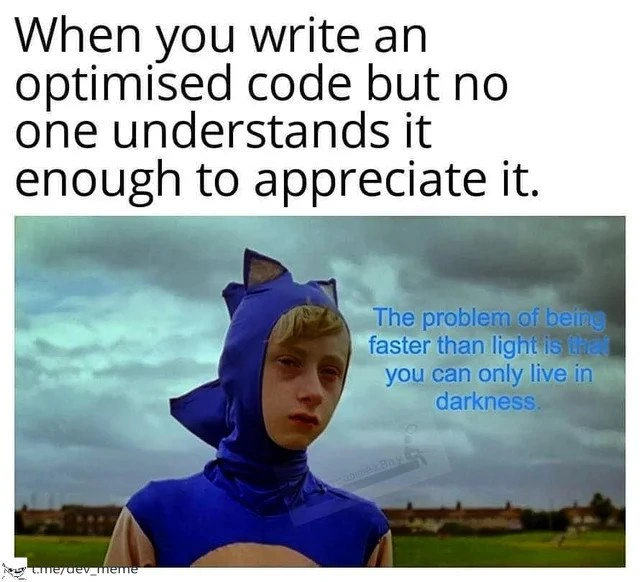
The meme’s image makes this scenario easy to visualize. The top text basically sums up the problem: “I wrote a super optimized piece of code, but nobody gets it enough to appreciate it.” The bottom part with the sad blue hedgehog costume and the quote about “living in darkness” drives the metaphor home. The blue hedgehog is referencing Sonic the Hedgehog, a video game character famous for being extremely fast. Here, someone dressed as Sonic looks lonely and disappointed. It’s as if the developer became Sonic – they went fast – but now they’re all alone and no one is clapping for them. The phrase “the problem of being faster than light is that you can only live in darkness” is a poetic way to say “if you go so fast that nobody can see what you did, you end up alone, with nobody understanding you.” In programming terms: if your solution is too quick and complex for others to follow, its brilliance won’t be recognized, and you’ll kind of be on your own with it.

For a newer developer, the takeaway is to balance cleverness with clarity. Yes, an elegant, efficient solution is cool, but not if it leaves your teammates completely baffled. In a real work environment (and even in school projects), it’s often better to write code that is clear and maybe a tad less optimized, rather than code that is super optimized but impenetrable. You want your fellow developers to say “Good job, I see what you did there,” not “Umm… can you explain what this does?” The humor in this meme comes from exaggerating that situation to an extreme: being so fast (like faster than light) that you metaphorically outpace everyone’s understanding, leaving you alone in the dark. It’s funny, and it also carries a grain of truth about teamwork in coding.

Level 3: Too Fast, Too Obscure

When code performance goes to infinity and beyond, the clarity often plummets. This meme humorously captures a scenario familiar to seasoned developers: a programmer writes blazingly fast code using every trick and micro-optimization known to humankind. The code’s runtime is phenomenal; maybe it processes data like Sonic the Hedgehog racing through Green Hill Zone. But there’s a catch – no one else on the team understands how it works. The top caption sets the stage:

“When you write an optimised code but no one understands it enough to appreciate it.”

The punchline that follows, “The problem of being faster than light is that you can only live in darkness,” is both figurative and literal. Figuratively, it means if your code is faster than light – i.e. so advanced or optimized beyond normal comprehension – your peers are “left in the dark,” scratching their heads. Literally, it riffs on physics: if you actually moved faster than light, you’d outrun all illumination and end up invisible in darkness. In a development context, outpacing your team’s ability to understand your code leaves you isolated. You’ve achieved performance bragging rights (you went faster than anyone), but now you’re alone in the dark with your obscure optimisations, with nobody to truly appreciate or maintain them. For the original developer, it feels like a triumphant high score in PerformanceOptimization; but for everyone else, it’s a mystifying headache. The result is a solution that runs fast for the machine, and leaves teammates furious trying to decipher it – a comedic Fast & Furious scenario unfolding in the codebase.

This meme nails an inside joke about OptimizationTradeoffs in software engineering. Sure, that ultra-clever function might execute in 0.001 seconds, but if it looks like dark magic, it’s a Pyrrhic victory. Experienced devs have learned (often the hard way) that Performance gains can come at the expense of CodeQuality and CodeReadability. There’s a famous mantra in programming: “Premature optimization is the root of all evil.” Coined by Donald Knuth (a legendary computer scientist), this saying warns that obsessing over making code absolutely fast or memory-efficient too early or unnecessarily can lead to over-engineered, convoluted code. In other words, if you optimize something before you truly need to, you might introduce complexity that’s not worth the payoff. This meme’s situation is a textbook case: the code is optimized (maybe even prematurely), and the result is software that’s extremely fast… but also extremely hard to grasp. The irony is rich: the author solved a performance problem that perhaps nobody else was worried about, and in doing so created a maintainability problem that everyone will worry about.

From a senior perspective, it’s funny and painfully relatable because we’ve seen it happen. Perhaps the “hero” developer went full throttle and wrote a super-tight algorithm with bit-level hacks or a cleverly abstracted one-liner that executes in constant time. It might use an exotic language feature or an obscure mathematical trick from an academic paper. The code reviewer opens that file and feels like they’re reading alien hieroglyphs. The rest of the team lives in darkness, i.e. confusion, whenever they look at this module. They might mutter, “It works fast, but how on earth does it work at all?” There’s DeveloperFrustration on both sides: the code’s author is annoyed nobody recognizes their genius, and the teammates are frustrated the code isn’t written in a straightforward way. This kind of scenario often leads to comments in code reviews like, “Clever... but please add comments or simplify — we need to be able to maintain this!”.

CodeMaintainability is the real victim of such over-optimization. The meme highlights a common industry truth: code isn’t just written for machines, it’s written for humans (the other developers, including “future you,” who will read it later). If only one person (the original author) can understand the optimized_code() function, then that person becomes a single point of failure. It’s great that the function runs in a millisecond, but if it produces a bug or needs a change, who’s going to dare touch it? The code lives in a black box – in darkness – from the perspective of the team. This is how technical debt accumulates: a piece of code might be high-performance now, but its opacity means future modifications are risky or time-consuming. The humor has a bit of dark truth: the author effectively ensured job security (since only they can maintain it) but also ensured they’ll get panicked calls at 3 AM because no one else wants to venture into that part of the codebase.

The imagery in the meme reinforces this joke brilliantly. The person in the goofy, makeshift blue hedgehog costume is a parody of Sonic, the iconic “gotta go fast” video game character. But unlike the real Sonic, who’s celebrated for speed, this poor soul looks dejected and out of place. It’s a visual metaphor for the lonely speedster coder: they tried to be the hero by going “faster than light,” but now they’re standing alone. The costume is cheaply made and the background is dreary (cloudy sky and a distant horizon) – reflecting how our “performance hero” might feel a bit silly and isolated when their teammates don’t shower them with praise. The light-blue text of the quote floating next to him – about being faster than light and living in darkness – almost feels like his thought bubble, a melancholy realization. It’s the developer experience (DX) equivalent of being too far ahead of the pack: you end up with no one beside you. In a collaborative codebase, being a team player often matters more than being a lone speed champion. There’s an industry saying that “code is read far more often than it’s written.” A super-optimized fragment that saves a few milliseconds might seem cool, but if it’s read 100 times by confused developers trying to fix a bug, it wastes more collective time than it ever saved at runtime. That’s the bittersweet humor here: the author’s effort actually reduces overall team efficiency because now everyone else is slowed down trying to understand or modify that inscrutable code. It’s a tongue-in-cheek reminder that pushing a system to be “faster, faster, faster!” without regard for others’ understanding is like running so fast you lap your teammates. Sure, you finished first, but now you’re alone at the finish line wondering why nobody is cheering.

In the end, this meme hits on a truth every experienced developer learns: being clever with code can be a double-edged sword. The dark side of speed is that if you take it to extremes, you might sacrifice clarity and end up in the dark – figuratively alone, with an unapproachable piece of code. It’s a funny, slightly tragicomic take on developer hubris: striving for that next level of performance and then realizing you’ve left your team (and perhaps common sense) behind. Everyone who’s been through painful code reviews or legacy-code maintenance can nod and chuckle: yep, been there – the code was a rocket, but none of us could pilot it.

Description

This meme captures the bittersweet feeling of writing highly optimized code that colleagues cannot fully appreciate. The top text reads, 'When you write an optimised code but no one understands it enough to appreciate it.' Below is an image of a person in a slightly sad, low-quality Sonic the Hedgehog costume, looking melancholically into the distance under a cloudy sky. Overlaid on the image is a quote in light blue text: 'The problem of being faster than light is that you can only live in darkness.' The humor comes from the dramatic, philosophical quote being applied to a niche programming scenario. It equates the genius of a hyper-efficient programmer with a lonely, misunderstood superhero, a feeling many senior engineers experience when their clever performance optimizations go unnoticed during code reviews or are seen as overly complex by the rest of the team. The low-budget Sonic costume adds a layer of self-deprecating humor. A small 't.me/dev_meme' watermark is in the bottom left

Comments

7
Anonymous ★ Top Pick The PR comment is just 'LGTM,' but you know they didn't understand the bit-shifting trick that made it 200ms faster. It's the loneliest feeling in engineering
  1. Anonymous ★ Top Pick

    The PR comment is just 'LGTM,' but you know they didn't understand the bit-shifting trick that made it 200ms faster. It's the loneliest feeling in engineering

  2. Anonymous

    I cut p99 latency from 40 ms to 4 ms with hand-rolled AVX and a sprinkle of UB - now the slowest part of the system is onboarding someone who can read the diff

  3. Anonymous

    The guy who wrote our payment service in hand-rolled assembly for "performance reasons" just quit, and now we're hiring a team of archaeologists to decipher what he meant by "optimized bit-twiddling magic in the hot path."

  4. Anonymous

    Ah yes, the classic dilemma: you've just shaved 50ms off a critical path using SIMD intrinsics, manual loop unrolling, and cache-line alignment - but now your pull request sits in review purgatory because your teammates think you've summoned Cthulhu in C++. The code runs at light speed, but you're stuck explaining why `__builtin_prefetch` isn't black magic. Welcome to the darkness, where your O(1) brilliance is appreciated only by the profiler, and your reward is maintaining it alone for the next five years

  5. Anonymous

    Optimize at lightspeed, but debug in the event horizon where tech debt warps time itself

  6. Anonymous

    You optimized the hot path to 3 ns, then turned every review into an NP-hard readability proof

  7. Anonymous

    Made it faster-than-light with branchless, cache-aware bit hacks - p99 vanished, and so did anyone who could maintain it

Use J and K for navigation