The Hierarchy of Creation in Programming
Why is this CS Fundamentals meme funny?
Level 1: Meeting the LEGO Inventor
Imagine you love building with LEGO blocks. You sit in the park happily creating a small LEGO house. You’re the little builder, proud of your creation. Now, pretend someone introduces you to the person who invented LEGO blocks. That’s like meeting the grand toy maker who made your building possible. They’re like a giant in your world – without them, you wouldn’t even have those blocks to play with! You’d probably look up in awe, feeling very tiny but excited, and maybe you’d say, “Wow, thank you for making these LEGO bricks!”
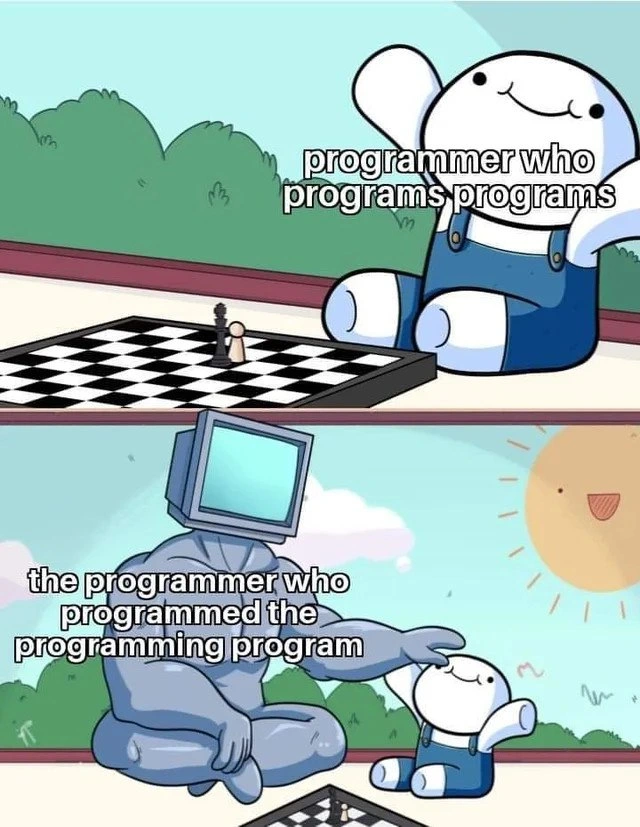
That’s exactly what’s happening in this meme. The small cartoon character is like the kid who built a simple LEGO creation (the everyday programmer), and the big stone statue is like the LEGO inventor (the legendary programmer who created the tools for programming). The little one is happy and waving, and the big one pats them kindly, like, “Nice job, kiddo.” It’s funny and sweet because it shows how a normal person might feel when they meet the genius who made their work possible. It’s a big moment of awe and respect – and a little bit of feeling small – wrapped in a cute, sunny cartoon scene.
Level 2: Code that Makes Code
Let’s break this down in simpler terms. When you write a program (say, a little game or a website), you are a programmer who programs programs – literally someone who writes code to create software. Now, how does the computer actually run the code you write? This is where the compiler or interpreter comes in. A compiler is itself a program – think of it as a special translator. It takes the code you write (in a language like C++, Java, or Go) and translates it into a language the computer can understand (like machine code made of 0s and 1s, or an intermediate code like Java bytecode). Without compilers (and their friend, the interpreter, in languages like Python or JavaScript), your code would just be text that the machine doesn’t know what to do with.
Now, the funny labels in the meme basically point out two kinds of programmers:
- The application programmer (the cute character on top) writes normal programs for a living – for example, a mobile app or a website. They’re using existing languages and tools to build something.
- The compiler/tool programmer (the big stone statue below) writes the programs that other programmers use to do their job. This could be the person (or team) who created the programming language itself or the compiler that translates code. In other words, they make the programming tools like compilers, editors, or frameworks – the foundational stuff.
The text “the programmer who programmed the programming program” is a mouthful, but it’s basically saying “the developer who coded the compiler (the program) that you use for programming.” It’s a playful way to describe someone who works on meta-level software. For instance, imagine the people who work on GCC or Clang (which are popular C/C++ compilers), or those who develop the JavaScript engine in your browser that runs all the web’s scripts. Those folks are writing code that helps run other people’s code. They’re not adding new features to your app; they’re enabling every app by maintaining the language or the compiler that all app developers rely on.
So why does the meme show the little guy and the giant? It’s showing the relationship and difference in scale. The little guy, captioned “programmer who programs programs,” is proud and happy – that’s any developer feeling good about the app they built. The giant statue labeled “the programmer who programmed the programming program” represents meeting someone who made the actual language or compiler you’re using. The sun is smiling, the scene is calm – it implies a kind of wholesome admiration. If you’re a newer developer, picture meeting the creator of your favorite programming language or the lead engineer of the tool you use daily. You’d probably be excited and a bit star-struck! After all, without their work on the compiler or language (the programming program), you wouldn’t be able to easily create the software you do. The meme exaggerates this difference to make it funny: it’s like “Here’s me, just coding along, and then here’s the genius who made the thing I’m coding with. Whoa.” It’s a playful reminder that for every app or game we make, there’s a lot of deeper technology behind it built by other developers. And sometimes, those other developers feel like legends because they tackled problems we only skim the surface of.
In short, the meme is contrasting two layers of the software world. If you’re new to these concepts: programs are what you make, and compilers (or similar developer tools) are what make your programs run. The “legendary dev who coded the compiler behind your code” is basically saying – imagine getting to meet the wizard behind the curtain, the person who made the magic wand (compiler) that all of us use to cast our coding spells. Pretty cool, right?
Level 3: Shoulders of Giants
For seasoned developers, this meme elicits a knowing grin. It highlights a tongue-in-cheek hierarchy among programmers. On the top panel, we have the everyday developer – captioned as the "programmer who programs programs." That’s basically any of us writing applications, whether it’s a web app, a mobile app, or even a simple script. We feel pretty good about ourselves, much like that cute marshmallow character proudly sitting at the chessboard. But then the meme delivers the punchline: the bottom panel introduces "the programmer who programmed the programming program," depicted as a massive stone deity with a CRT monitor for a head, gently patting the little one. This is the legendary compiler developer or tool builder. In the world of developer humor, there’s an ongoing joke about this meta-level programmer – the one who writes the tools that the rest of us use to write our code. It’s a classic case of standing on the shoulders of giants (to borrow Newton’s phrase): everyday devs stand tall only because these toolmakers built the foundations for us.
The humor here comes from the power imbalance and reverence. It’s as if the meme is saying, “Aw, you write programs? That’s cute. Here’s the person who wrote the thing that makes your programs possible.” It’s meta humor at its finest, turning the mirror onto the development process itself. We developers often joke about how writing a compiler or a programming language is a sort of god-tier achievement in coding. Many of us have experienced that humbling moment of realizing that the frameworks, languages, and developer tools we rely on daily (our IDEs, our compilers, our runtime engines) were created by other humans – often brilliant, legendary engineers we might never meet. When that realization hits, you get a mix of admiration and imposter syndrome: “I struggle with my app’s bugs, and someone out there built the language I’m coding in!” This meme captures that feeling with a fun visual: the tiny pawn-mover meeting the grandmaster who designed the game.
In real software industry terms, the top character could be a typical application developer, and the bottom character might represent folks like compiler engineers, language designers, or the creators of major frameworks. Think of meeting Bjarne Stroustrup (creator of C++), or Guido van Rossum (creator of Python), or one of the architects of the GNU Compiler Collection (GCC). To an application dev, these people are living legends – they not only understand how to program, they invented or implemented the very languages and compilers that the rest of us use. That’s why the stone statue in the meme exudes calm and wisdom; it’s the guru tier of programming. There’s an inside joke here about compiler_author_superiority – not that compiler devs actually look down on others, but we jokingly elevate them because their work enables everyone else’s. It’s a lighthearted exaggeration of how we view the folks who tackle such hardcore problems.
The chessboard with only a king and pawn in the first panel hints that the application programmer might be playing a much simpler game (possibly a single scenario or a high-level problem), whereas the compiler writer deals with the entire chess game’s rules. In practice, an app dev might focus on one domain (say, building a shopping cart or a game feature), using languages and APIs. The compiler dev, meanwhile, has to consider every possible program that could be written in a language – that’s a vast scope! They handle edge cases we don’t even think about until the compiler flags an error. Ever gotten a weird compiler error and thought, “Who on earth came up with this message?” The answer is that giant stone figure’s real-world counterpart: a compiler engineer who anticipated that situation. This shared experience is what makes the meme relatable to developers (DeveloperRelatability is a key ingredient of such jokes). We’ve all been the small marshmallow at some point, excited about our code, then awestruck by a tool or person who operates on a whole different level of abstraction.
In essence, the meme is playfully showing a tooling inception scenario. Just like in the movie Inception where there are layers of dreams within dreams, in software we have layers of programming within programming. There’s the code you write, then the compiler’s code that processes your code, then even the code that might have compiled the compiler, and so on. It’s programs all the way down. The DeveloperExperience (DX) we enjoy – smooth coding, helpful error messages, optimized executables – is thanks to those deeper-layer developers. Seasoned devs appreciate this, and the humor carries a hint of gratitude beneath the jest. We laugh because it’s true: compiler design and building programming tools demand a level of expertise and foresight that can make the rest of us feel like that happy little marshmallow, just glad to be patted on the head by the giants who made our work possible.
Level 4: Turtles All The Way Down
At the deepest level, this meme touches on the metaprogramming wonders of computer science. The phrase "programmer who programmed the programming program" playfully hints at a compiler – the ultimate program that creates programs. In technical terms, a compiler is a complex piece of software that takes our source code (in a high-level language like C++ or Python) and translates it into a lower-level form (like machine code or bytecode) that computers can execute. It’s a multi-stage process: first comes lexical analysis (breaking the code into tokens, almost like splitting an essay into words), then parsing (organizing those tokens into a syntax tree structure, an AST or Abstract Syntax Tree), followed by semantic analysis (checking types and meanings), optimizations (improving efficiency), and finally code generation (producing actual machine instructions). Each of these stages is rooted in deep computer science theory – think formal grammars, state machines, and algorithms from the famed Dragon Book of compiler design.
What makes compiler development legendary among programmers is the sheer level of abstraction and complexity involved. The meme’s chessboard imagery is fitting: the small developer is playing with just a pawn and king (a super-simplified game), whereas the legendary compiler writer has mastered the entire game of chess, possibly even invented it. This reflects how compiler engineers operate on a grander scale of problem-solving. They worry about things like register allocation, instruction scheduling, and ensuring that programs from thousands of developers all behave correctly on any machine. These are problems that involve everything from low-level bit manipulation to high-level mathematical proofs of correctness. It’s the realm of Turing completeness, Chomsky hierarchies, and algorithms that have to deal with potentially infinite cases (like recursive code or unbounded loops). In short, it’s code that writes code, which feels like an inception moment in computing – an almost recursive tooling inception where each layer of software creates or supports the layer above it (hence the humorous phrase "turtles all the way down").
One fascinating aspect is that many compilers are themselves written in the languages they compile – a self-hosting compiler. For example, the first C compiler was written in assembly, but later versions of C were written in C (using an existing C compiler to build them). This bootstrapping process is a rite of passage for mature programming languages and contributes to the almost mythic status of compiler authors. They have to create a language, write a compiler for it (often using another language), then eventually rewrite that compiler in its own language. It’s a bit mind-bending: a programmer writing a program that will eventually compile itself. No wonder the meme portrays the compiler engineer as a wise stone giant – it symbolizes the architect at the foundation of all software. These are the folks who deal with the ultimate developer challenges: turning human logic into something a CPU can execute efficiently, managing memory at the byte level, and ensuring your code doesn’t just compile, but compiles into something fast and correct. In essence, this meme humorously glorifies those who can tackle that metaprogramming hierarchy head-on, using theoretical computer science and practical systems hacking to empower all the "normal" programmers out there.
Description
A two-panel meme in a comic art style, likely from 'TheOdd1sOut'. The top panel shows a small, cheerful, white cartoon character in blue overalls, labeled 'programmer who programs programs'. This character is sitting at a chessboard, representing the tangible, application-level work most developers do. The bottom panel reveals a much larger, muscular, god-like figure with a CRT monitor for a head, sitting cross-legged behind the first character. This powerful figure, labeled 'the programmer who programmed the programming program', is gently patting the smaller programmer on the head. This meme humorously illustrates the layers of abstraction in software engineering. It highlights the foundational, often invisible work of systems programmers who create the languages, compilers, and operating systems (the 'programming programs') that all other application developers rely on, presenting them as the powerful creators in this tech ecosystem
Comments
14Comment deleted
The app developer ships features. The systems programmer ships the `malloc` that the features are built on
Spent a sprint hand-unrolling a critical loop - then met the compiler engineer whose optimizer deletes the loop entirely at -O2
The real power move is being the engineer who wrote YACC, then used it to generate the parser for the language that YACC itself would eventually be rewritten in - the ultimate bootstrapping flex that makes even Lisp developers question their metacircular evaluators
The real existential crisis hits when you're debugging a compiler bug in the compiler you wrote to compile the compiler that compiles your compiler. At that point, you're not just writing code - you're negotiating with the fundamental nature of computation itself, three abstraction layers deep, wondering if the bug is in your logic, your meta-logic, or your meta-meta-logic. It's like playing 4D chess, except the chess pieces are writing the rules of chess while you're playing
Full-stack until the compiler engineer pats you on the head and calls your microservice “a macro expansion around a couple of syscalls.”
GigaChad AI crushes chess grandmasters; its creator still debugs Kubernetes YAML at 3AM
I'm debating DI frameworks; they just fixed a register allocator bug that compiled my "pure function" into a Heisenbug at -O3
reject ide return to text editor Comment deleted
Reject text return to 01 Comment deleted
Reject 01 return to magnetised needle and a steady hand Comment deleted
Just write it on paper goddamt Comment deleted
And compile in your head Comment deleted
In my head it always works 😸 Comment deleted
Sounds like a typical ukrainian IT university Comment deleted