Skip to content
DevMeme
2665 of 7435
Java Programmers and Their Fear of Pointers
Languages Post #2944, on Apr 11, 2021 in TG

Java Programmers and Their Fear of Pointers

Why is this Languages meme funny?

Level 1: Scary Code Monster

Imagine you have a friend who’s only ever ridden a bike with training wheels, and you show them a big BMX stunt bike with no training wheels – and then perform a wild trick on it. They’d probably get scared or at least very nervous, right? In this meme’s story, the Java programmer is like the friend with training wheels, and the crazy C pointer code is like that stunt bike trick. Java is the nice safe bike with training wheels: it’s designed so you don’t fall over easily. You don’t have to worry about the deep nitty-gritty stuff, like balancing on two wheels alone (in programming terms, that’s managing memory or using pointers). C, though, is the high-flying stunt bike: you can do a lot of cool, daring moves with it, but you better know what you’re doing or you might crash.

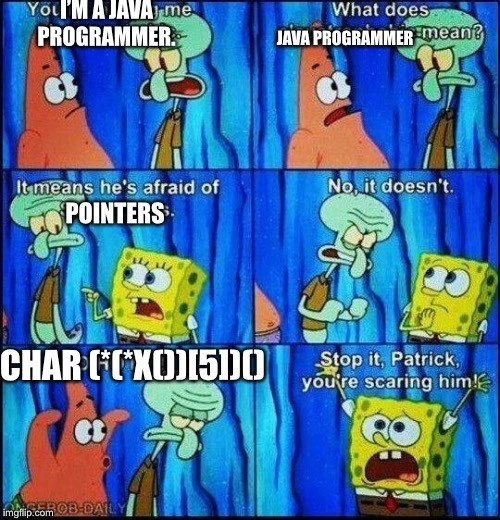
So the meme shows a scene with SpongeBob characters where one character basically says, “I’m a Java programmer,” and another teases, “Oh, that means he’s afraid of pointers.” The Java programmer protests, “No, I’m not!” But then he’s shown an incredibly complicated code snippet from C (full of those "*" stars and brackets) – that’s the equivalent of the scary stunt. It’s so confusing and unexpected that it’s like a monster popping out and our Java friend jumps in fright. SpongeBob (another character in the scene) even shouts, “Stop it, Patrick, you’re scaring him!” which is like telling the friend, “Hey, stop showing off that crazy thing, you’re freaking them out!” It’s funny because it exaggerates a real feeling: when people who are used to a gentle, safe environment see something from a wild, complex environment, they often react with fear or confusion. In simpler terms, it’s like if you’ve only ever seen friendly cartoon movies and someone suddenly shows you a super scary horror film scene – you’d scream “Ahh, turn it off!” Here, the horror film clip is that weird-looking C code. And the Java programmer is the person who’s spooked because they’ve never seen something so strange. It’s a goofy way to say different tools and languages can seem really scary if you’re not used to them – and that’s okay to laugh about, because every expert was a beginner once who looked at advanced stuff and went “What on earth is that?!”

Level 2: Pointing at Data

Let’s break down the basics behind this meme for a newer developer or someone not deeply familiar with the terms. The key concept here is pointers (in C) versus references (in Java). A pointer is a variable that holds a memory address – basically, it “points” to a location in memory where some data is stored. In C and other C-family languages like C++, you use pointers all the time. You’ll see the * symbol in C code to denote pointers (for example int *p; means p is a pointer to an integer). You also use * to dereference a pointer, which means “go to the memory address stored here and get the value.” There’s also the & operator to get the address of a variable. With these, C lets you do pointer arithmetic: for instance, p + 1 moves the pointer to the next integer in memory. This is powerful for low-level array manipulation, but it requires you to be very careful – go out of bounds or use an invalid address and your program can crash or, worse, corrupt data silently. Managing memory in C means you manually allocate memory (e.g. with malloc) and free it (with free). If you forget to free memory you no longer need, you get a memory leak. If you free it too early or use a pointer after freeing, you get a dangling pointer that points to garbage. These issues are the infamous bugs C programmers deal with. It’s like having a super sharp knife: very useful, but if you’re not trained, you can easily cut yourself.

Now, Java, on the other hand, doesn’t expose raw pointers in its syntax at all. Java uses references for objects – you can think of a reference as a pointer that you’re not allowed to do arithmetic on or see the actual address of. When you do something like MyObject obj = new MyObject(); in Java, under the hood obj is a reference (an abstract pointer) to the newly created object. But Java doesn’t let you increment that reference or manually free the object. Java has a Garbage Collector (GC), which automatically finds objects that are no longer in use and frees up their memory. As a result, Java programmers don’t worry about manual memory management; there’s no malloc or free in pure Java. And there’s certainly no equivalent to writing char (*(*X())[5])()! In Java, if you want something like a list of functions, you’d probably use an interface or a higher-level construct like a list of objects that implement a certain interface (or since Java 8, maybe a list of lambda functions). The syntax stays relatively straightforward. Java intentionally avoids having things like pointer-to-pointer or pointer-to-function in the language. So the language quirks are very different: C gives you low-level control (with quirks like having to use * and & and dealing with pointer math), while Java provides a more uniform, high-level way to handle objects (with quirks like automatic garbage collection pauses, but no direct memory address fiddling).

In the meme, when they talk about being “afraid of pointers,” it’s highlighting that a Java programmer might not be familiar with or comfortable using pointers because Java simply doesn’t require that knowledge day-to-day. It’s like if you grew up driving automatic transmission cars (Java), and someone suddenly asks you to operate a stick shift (C pointers) – you know it’s technically how the car works, but you’ve never had to manually change gears before, so it’s intimidating. The specific example shown, char (*(*X())[5])(), is a deliberately scary-looking C declaration. Let’s demystify it a bit:

  • char at the start means the end result is something related to a char (a character).
  • The () at the very end means this thing is a function (because in C, something() is either a function call or function type). Here it’s part of a declaration, so it indicates a function type returning char.
  • The [5] means we have an array of 5 of something.
  • The * before that array means a pointer to that array.
  • Another * before X() means that X() returns a pointer. And X() itself means X is a function.

Put together, as we did above: X is a function that returns a pointer to an array of 5 pointers to functions (that return char). You can see how layered that is – pointers inside pointers, arrays and functions all in one line. This isn’t a common thing you’d write in everyday C programming unless you are doing something like an array of callback functions, but it’s valid C. To someone who’s new to C or never had to think that way (like many Java devs), it looks like complete gibberish. It’s practically a tongue-twister for code.

The SpongeBob meme format uses that crazy code as the punchline because it represents the epitome of “scary C stuff” to a Java dev. Patrick, labeled as the Java programmer, announces himself, and SpongeBob explains the joke: “It means he’s afraid of pointers,” spelling out that stereotype. Squidward says “No, it doesn’t” (he’s like the skeptical straight man in the joke, questioning the stereotype). Then Patrick unleashes that monstrous code snippet as if to prove the point, and SpongeBob yells “Stop it, Patrick, you’re scaring him!” The “him” could be Squidward or basically any Java dev reading that code. The characters and text visually exaggerate what happens in real life: show a complex pointer example to a Java-only programmer and watch them blanch or freak out a little. Of course, this is all in good fun – it’s developer humor based on the truth that different programming languages require different knowledge. Java and C are often contrasted in computer science: one is higher-level with automatic memory management (no explicit pointers), and the other is lower-level with manual memory management (lots of pointers!).

So if you’re a newer developer: don’t worry, the meme isn’t gatekeeping or saying Java devs are actually cowards. It’s just playing on a common feeling. Many programmers who start with a language like Python or Java get a bit of a shock when they first dive into C or C++ and encounter direct memory handling. It feels like going from a comfy automatic car to the cockpit of a fighter jet with all sorts of controls – exciting for some, but scary for others! This meme uses that concept to get a laugh. And hey, if you learn C pointers, you’ll find they aren’t black magic after all – but it does take some practice to read something like char (*(*X())[5])() without your brain tying itself in knots. Until then, memes like this are a lighthearted reminder of the learning curve we all face in different areas of programming.

Level 3: Pointer Panic

This SpongeBob-themed meme perfectly captures a classic inside joke in programming culture: Java vs. C, and the Java dev’s mortal fear of C’s pointers. The humor works because it’s rooted in a real industry dynamic – ask any group of developers, and you’ll find stories of Java programmers (accustomed to Java’s cushy, pointer-free world) getting wide-eyed and nervous when confronted with raw C pointer syntax or pointer arithmetic. It’s a shared trauma and a rite-of-passage all at once. Many of us senior devs remember the first time we saw a declaration like char (*(*X())[5])(): our reaction was probably a mix of confusion and dread. It’s the stuff of legend – a C code snippet so gnarly that it looks like cartoon cursing (all those stars * and parentheses might as well be “@#$%!” to the untrained eye). Seeing it slapped in a meme panel is an instant trigger for that memory, and we can’t help but chuckle and cringe at the same time.

The meme plays out a little scene: Patrick Star, proudly declaring “I’m a Java programmer,” inadvertently admits to a stereotype – that Java devs are afraid of pointers. Squidward’s skeptical “What does that mean?” / “No, it doesn’t” retort sets up the punchline: Patrick (or SpongeBob on his behalf) conjures the ultimate C pointer nightmare as proof. The scary text CHAR (*(*X())[5])() appears like a jump scare, and SpongeBob yells “Stop it, Patrick, you’re scaring him!” Here “him” is the poor Java developer (or Squidward representing us all) who is now horrified. This exaggerated scenario hits home because, honestly, it’s not far from reality – a Java dev reading hardcore C code can feel spooked.

Why is this so funny (and true) from a senior perspective? For one, it riffs on the long-standing language wars and friendly ribbing between programming camps. C and C++ folks sometimes tease Java folks as living in a comfy managed-memory sandbox with a garbage collector safety net, while Java folks joke that C developers enjoy pain with manual memory management and cryptic syntax. Here, the meme leans into the notion that Java programmers carry a “security blanket” (managed memory, no direct pointers) and that waving a gnarly pointer syntax at them is like showing a horror movie to a kid. We all know that pointers in C can be powerful and perilous: they give you fine-grained control over memory, but also the power to shoot yourself in the foot (ever heard the phrase “pointer rope to hang yourself”? It exists for a reason). A single * or & in the wrong place can cause a segfault (segmentation fault) or corrupt data, which is a far cry from Java’s worst-case scenario of a NullPointerException (which, while an error, won’t usually bring down the whole JVM or corrupt memory outside your program). Seasoned developers have seen the dark side of both approaches. We’ve debugged C programs at 3 AM where a stray pointer bug caused heap corruption – the kind of bug that doesn’t just crash cleanly, but might subtly ruin data or intermittently fail. That leaves a lasting impression (and maybe a few nightmares). Conversely, we’ve also seen Java programs chug along safely, at the cost of higher memory usage or pauses for garbage collection. Each paradigm has its trade-offs, and that’s the underlying truth behind the joke.

This meme is also poking fun at CS education and the background of developers. Many university CS programs start with languages like Java or Python for simplicity, only later (or never) introducing C pointers. So you get a generation of programmers who might not have internalized low-level memory concepts. When they finally encounter them, it’s legitimately scary and foreign. The meme’s pointer declaration char (*(*X())[5])() is an extreme example that professors might show as a challenge or that appears on Stack Overflow as “What does this even mean?” For those of us who went through it, the memory of learning to handle pointers – debugging endless “segmentation fault (core dumped)” errors – is both painful and nostalgic. We laugh because we sympathize: “Haha, yes, I too was terrified of that once.” And we laugh also because as seniors we know that fear is somewhat justified – even experts can get tripped up by complex pointer uses. It’s the kind of bug factory that high-level languages tried to eliminate.

On an industry level, the meme reflects real patterns. A company might have their critical performance-sensitive module written in C or C++ (for speed or system access), while the higher-level business logic is in Java. The Java devs might groan and shudder when they have to dive into that native module to fix a bug, perhaps muttering “it’s always the pointer code causing trouble.” There’s a reason the phrase “Fear of pointers” exists – it’s practically a cliché that managing memory manually is scary for those who haven’t done it. And hey, even among C developers there’s an understanding: you treat complex pointer code with a mix of respect and caution, because it’s powerful mojo. The meme takes that common understanding and exaggerates it into a SpongeBob skit for comedic effect. It’s a way for experienced devs to nod knowingly and say, “Yep, been there. Pointers can be a real horror show if you’re not used to them.” In short, the humor lands so well because it’s grounded in the truth of low-level programming being a different universe from managed languages. The contrast between a high-level Java environment and raw C pointer arithmetic is huge – and this meme finds the sweet spot where that contrast becomes a joke everyone in on it can laugh at.

Level 4: Arcane Declaration Spiral

At the deepest level, this meme exposes the arcane syntax of C pointers that can befuddle even seasoned developers. The infamous code snippet char (*(*X())[5])() is like a hieroglyph to anyone not fluent in C’s declaration grammar. Let's decipher it step by step (yes, it’s possible!):

  • First, notice the final (). This means that *(*X())[5] is something callable – a pointer to a function returning a char.
  • Next, (*X())[5] suggests we are indexing into an array of five elements (that [5]). So *X() must be pointing to an array of 5 function pointers.
  • Finally, X() itself is a function (because of the X() part) that returns a pointer (*) to that array. In plain English, X is a function returning a pointer to an array of five pointers to functions returning char. Whew!

In C’s type system, pointers can point to data or even to functions in memory – basically any address. The declaration syntax is designed to mirror usage, which is why it feels like solving a puzzle. There’s even a known trick called the “clockwise/spiral rule” to read such declarations: start at the identifier X, then spiral outwards following precedence (parentheses, brackets, etc.) to decode the type. The above code is a notorious example often used in quizzes and obfuscated C contests to terrorize newcomers. In reality, no sane C programmer writes a declaration that convoluted without using typedef to simplify it. For instance, we could rewrite the “scary” snippet with intermediate typedefs for clarity:

typedef char (*FuncPtr)();      // FuncPtr is pointer to function returning char
typedef FuncPtr FuncPtrArray[5]; // FuncPtrArray is an array of 5 such pointers
FuncPtrArray *X();              // X is a function returning pointer to that array

See? Much clearer. Internally, the C compiler has no issue understanding char (*(*X())[5])(), because it follows the language’s grammar strictly. It’s us humans who find it cryptic. This touches on a deeper CS fundamental: how languages balance complex type systems with readability. C gives you minimal abstractions – just the raw power to combine pointers, arrays, and functions arbitrarily – resulting in declarations that can resemble line noise. Languages like Java deliberately avoid this kind of complexity in syntax. Java’s designers famously left out pointer arithmetic and explicit memory addresses to prevent exactly the kind of mental swirls that char (*(*X())[5])() induces. Under the hood, the Java Virtual Machine does use pointers (every object reference is essentially a pointer to a memory location in the heap), but these details are abstracted away, hidden behind a managed memory system. This means the JVM and the garbage collector handle those arcane address manipulations for you. So when a Java programmer looks at that C code snippet, it’s like peering into an underworld of memory they never usually have to visit. It’s not just the clutter of asterisks and parentheses – it represents a world where one wrong move can misalign a pointer and crash the program or corrupt data. In academic terms, it’s the difference between a high-level memory model with safety rails and a low-level one where you are juggling raw addresses. The meme cranks this contrast up to eleven: a single C declaration that encapsulates pointers-to-pointers-to-functions (the stuff of nightmares for the uninitiated) is presented as a jump scare. It’s a playful nod to the esoteric knowledge required to read complex C types, knowledge which feels almost like dark magic to those who haven’t delved into low-level programming. By starting with this intense pointer declaration as the “monster,” the meme sets the stage for the humor in the levels that follow.

Description

A six-panel meme using the 'SpongeBob pointing at Squidward' comic format to joke about Java programmers' relationship with pointers. In the first panel, Squidward, representing a Java programmer, introduces himself to Patrick. In the second, Squidward asks Patrick what he thinks 'Java programmer' means. The third panel shows SpongeBob pointing at Squidward, saying, 'It means he's afraid of POINTERS.' Squidward denies this in the fourth panel. In the fifth panel, Patrick confronts a terrified Squidward with a complex C-style pointer declaration: 'CHAR (*(*XO)[5])()'. The final panel shows SpongeBob yelling, 'Stop it, Patrick, you're scaring him!'. The humor comes from the abstraction of memory management in Java, which eliminates the need for direct pointer manipulation common in languages like C or C++. For experienced developers, this meme is a relatable jab at the perceived comfort bubble of higher-level languages and the intimidating complexity of low-level memory management

Comments

7
Anonymous ★ Top Pick A Java object and a C pointer walk into a bar. The pointer orders a beer, drinks it, and leaves. The Java object orders a beer, but the garbage collector cleans it up before it can take a sip
  1. Anonymous ★ Top Pick

    A Java object and a C pointer walk into a bar. The pointer orders a beer, drinks it, and leaves. The Java object orders a beer, but the garbage collector cleans it up before it can take a sip

  2. Anonymous

    Show a Java dev “char (*(*x())[5])();” and suddenly a 300 ms safepoint pause feels like an all-inclusive resort

  3. Anonymous

    The real horror isn't the pointer syntax - it's explaining to the PM why the Java microservice needs 8GB of heap just to parse JSON while the C service runs on a potato with 64KB of RAM

  4. Anonymous

    The real horror isn't the pointer syntax - it's realizing that after 15 years of Java, you'd need to spend an afternoon with cdecl just to parse what you wrote, and another debugging why it segfaults only on Tuesdays when the moon is waxing

  5. Anonymous

    char (*(*x())[5])() - because in C even a type needs a parser generator; Java renamed it ‘reference’ and outsourced the nightmares to GC

  6. Anonymous

    Explain char(*(*x())[5])() to a Java team and you’ll have them proposing Rust before the second asterisk

  7. Anonymous

    Java devs flee pointers like architects flee COBOL mainframes - one wrong * and your monolith segfaults

Use J and K for navigation