Skip to content
DevMeme
1336 of 7435
A Recursive Visualization of Merge Sort
CS Fundamentals Post #1498, on May 6, 2020 in TG

A Recursive Visualization of Merge Sort

Why is this CS Fundamentals meme funny?

Level 1: Sorting Simplified with Friends

Imagine you have a big pile of cards numbered 1 through 10 all mixed up, and you want to put them in order from 1 to 10. Doing it all in one go is hard, so you try a clever trick: split the pile into two smaller piles. You hand one half of the cards to your friend and keep the other half. Now each of you sorts your little pile separately (that’s much easier than tackling all 10 at once!). Once both half-piles are sorted, you put them back together by comparing the tops of each pile and arranging the cards in the right sequence from smallest to largest. In the end, you get a fully sorted deck of 10 cards, and it felt quicker because you broke the job into parts. This is exactly the idea behind merge sort – solve little sorting tasks and then merge them. The meme is doing the same thing with a picture: it breaks a big image into tiny pieces and then brings them back into one. It’s funny and satisfying because it shows a complicated idea (like a magic sorting trick) in a simple, visual way. Even if you don’t know the term “merge sort,” you can giggle at the fact that the guy in the picture literally divides his photo into bits and then conquers the task by fitting them back together. It’s a goofy way to explain a smart idea, and that’s why it makes people smile.

Level 2: Divide and Conquer, Defined

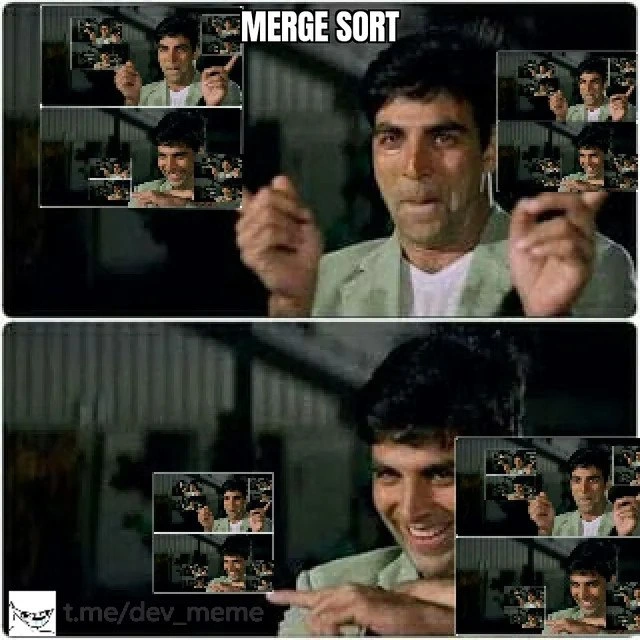
Merge sort is a classic sorting algorithm that uses the divide-and-conquer approach to organize data. In plain terms, that means it sorts a list by dividing the problem into smaller chunks, solving each chunk, and then merging those solutions back together. The meme shows this in a two-panel format: the top panel (captioned “MERGE SORT”) represents the dividing step, and the bottom panel represents the merging step. The actor’s image is replicated into many tiny thumbnails in the first panel – this is a visual metaphor for the algorithm breaking a big list into lots of little lists. The result looks like an infinite recursion effect (picture a picture inside itself, over and over), which is a common way to illustrate recursion. Recursion means a function is calling itself on a smaller problem. Here, the smaller problem is sorting each half of the list. Every time you split the list into halves, you call the same sorting routine on those halves – that’s recursion! Eventually, you get down to lists of length 1 (or 0), which are so small they’re already sorted.

After that, the merge sort algorithm starts putting everything back together. The bottom panel of the meme shows the thumbnails becoming larger and fewer in number, as if those tiny pieces are recombining. This corresponds to the merge step in code: take two sorted halves and carefully merge them into one sorted whole. If you’ve seen merge sort code, it often has a helper function (let’s call it merge) that takes two sorted lists and returns a single sorted list by comparing the front elements of each and repeatedly picking the smaller. The actor pointing downward humorously mimics the action of “bringing together” those halves.

Let’s connect this to actual code. A simplified Python-like pseudocode for merge sort might look like:

def merge_sort(arr):
    # Base case: 0 or 1 item is already sorted
    if len(arr) <= 1:
        return arr
    # Divide step: split the list into two halves
    mid = len(arr) // 2
    left_half  = merge_sort(arr[:mid])
    right_half = merge_sort(arr[mid:])
    # Conquer step: merge the sorted halves
    return merge(left_half, right_half)  # assume merge() combines two sorted lists

In this code, merge_sort calls itself on the left half and right half of the array. That’s the recursive divide happening in code form (just like those shrinking thumbnails in the meme). The merge function (not shown fully here) will take the two sorted halves and merge them by sorting the elements from both halves together. The key idea is that merging two already-sorted lists is straightforward: you just keep picking the smallest front item from either left or right list until you’ve exhausted both. This divide-then-merge procedure guarantees everything ends up in order.

What about the O(n log n) the meme hints at? That’s Big O notation, a way to describe how an algorithm’s run time grows as the input size (n) grows. For merge sort, O(n log n) means its performance scales really well: if you double the number of items to sort, it doesn’t quite double the sorting time – it grows a little slower than that (because of the log n factor). For example, sorting 1,000 items might take on the order of 1,000 × log₂(1000) ≈ 1,000 × 10 steps (about 10,000 units of work), whereas a simple approach like bubble sort would take about 1,000 × 1,000 = 1,000,000 units of work. That difference becomes huge as n grows larger! So merge sort is much more efficient for big lists. This efficiency comes from the algorithm’s balanced use of splitting and merging: there are about log₂(n) levels of splitting, and at each level, combining all the pieces back together costs roughly n steps – multiply those, and you get roughly n log n operations.

If you’re a newer developer or a student, you probably encountered merge sort in a CS fundamentals course or when prepping for coding interviews. It’s often one of the first examples of recursion that “clicks” because you can clearly see how small sorted parts build up to a fully sorted result. The first time you trace through merge sort’s recursive calls can be a bit mind-bending (“wait, it’s sorting the first half by... calling itself again?”), but once you see the pattern, it’s enlightening. The meme above is great because it visualizes that pattern: many of us understand things better with a picture. The infinite thumbnail effect isn’t just for laughs – it actually helps show what recursion is doing. You can imagine each tiny version of the image is like a smaller sub-task of sorting a part of the list. Then the bottom image shows those sub-tasks resolved and combined. It’s pretty neat to see a tricky concept like recursion explained with a simple picture-in-picture trick, right?

Also, note the format of the meme itself. It’s a two-panel format using a scene from an Indian movie. This format is popular in coding humor: one panel sets up the scenario, and the next delivers the punchline or result. Here, the setup is “MERGE SORT” being demonstrated by the actor splitting into many copies, and the payoff is the actor happily merging them back. The actor’s face is pixelated likely to keep the focus on the concept rather than the celebrity, but the expressive gestures still come through. And in the bottom-left corner, you’ll see a tiny cat icon and the text t.me/dev_meme – that’s a watermark from the source (a developer meme Telegram channel), basically the meme’s signature. Little details like that watermark are common in online meme sharing; it’s how you know where it originated. Overall, this meme takes a fundamental concept from computer science (sorting algorithms, recursion, and complexity analysis) and wraps it in a bit of movie silliness. It’s educational, sure, but it also gives you a chuckle – a perfect combo for coding humor that junior and senior devs alike can appreciate.

Level 3: The Splitting Image

In this meme, Merge Sort is cleverly visualized through a dramatic movie scene, turning an algorithm lesson into a visual gag. The top panel’s cascade of miniature images around the blurred actor is a literal illustration of recursion in action. It’s like an infinite thumbnail or hall-of-mirrors effect: the scene repeats itself in smaller and smaller frames. That’s exactly how divide-and-conquer works in a sorting algorithm. Merge Sort first divides data into ever-smaller parts – in technical terms, splitting an array of length n into two subarrays of size n/2, then those into n/4, and so on. Do this recursively and you get a tree of subproblems about log₂(n) levels deep. As the images get tinier and more numerous, the meme is hinting at the algorithm’s recursive depth. Eventually, you reach pieces so small (a single element) that they’re trivially sorted.

The bottom panel then delivers the payoff: the actor gestures downward as the smaller thumbnails recombine into larger ones, representing the merge phase. After recursion hits the base case, Merge Sort begins to conquer by merging sorted pieces back together. Each merge operation takes two sorted halves and weaves them into one sorted whole. Technically, at each level of this recursion tree there’s some combining work to do — and across roughly log₂(n) levels, each element gets handled a few times. This adds up to the hallmark O(n log n) time complexity. The meme subtly nods to this: the number of little pictures doubles each time we split (1, 2, 4, 8, ...), but because those pieces are easier to sort and then merge, the overall effort grows moderately with n. In other words, sorting double the number of items doesn’t double the work – it grows a bit slower, thanks to that log₂(n) factor from the divide-and-conquer strategy. An experienced dev can practically feel the efficiency: it’s the difference between a modest n × log₂(n) steps versus the brutal n × n steps of a naive sort. No wonder we chuckle proudly seeing that big O(n log n) plastered on a meme – it’s the efficient-sorting badge of honor we all learned in CS class. (Anything is better than the dreaded O(n²) bubble sort we initially write before discovering recursion!)

Beyond the textbook theory, this meme resonates because it connects academic concept to real-world practice with humor. Many programming languages’ libraries actually use Merge Sort or its variants under the hood – for example, Python’s built-in sort uses Timsort, which merges runs of sorted data, and Java’s Arrays.sort for objects is a merge-based sort too. So when a developer sees this, it's not just an inside joke about CS fundamentals; it’s a nod to the reliable algorithms quietly powering our software. The choice of a popular Indian movie scene (the actor’s face is pixelated, but the meme format is recognizable) adds a layer of comedic flair. The actor’s enthusiastic hand motions sync perfectly with “splitting” and then “joining” actions, almost as if he’s excitedly walking us through the algorithm. It’s a fun collision of developer humor and pop culture – the dry complexity of an algorithm suddenly feels playful. And indeed, as the watermark t.me/dev_meme suggests, this was shared in a developer meme channel to educate and entertain. In the end, the meme does a fantastic job of turning the abstract idea of a divide-and-conquer sorting algorithm into something you can see and laugh at. For those of us who struggled through sorting algorithms in school, it’s both amusing and satisfying to watch an actor literally divide and conquer an image. This #educational meme truly delivers: taking a core CS_Fundamentals concept and making it click with a bit of visual comedy.

Description

An educational meme explaining the Merge Sort algorithm using a recursive visual metaphor. The meme is a two-panel image featuring Indian actor Akshay Kumar. The top panel has the text 'MERGE SORT' in a bold, white, sans-serif font. In both panels, the main image contains smaller, recursive instances of itself, creating a Droste effect where the picture appears within itself, seemingly infinitely. This visual structure cleverly represents the core mechanism of the Merge Sort algorithm. Merge Sort is a 'divide and conquer' algorithm that works by recursively breaking down a list into two or more sub-lists until each sub-list contains a single element, and then merges the sub-lists back together to produce a new, sorted list. The recursive image serves as a perfect analogy for this process of a problem containing smaller versions of itself
Comments

7
Anonymous ★ Top Pick Explaining recursion with a recursive image is the only acceptable base case. Any other method results in a stack overflow of confused junior developers
  1. Anonymous ★ Top Pick

    Explaining recursion with a recursive image is the only acceptable base case. Any other method results in a stack overflow of confused junior developers

  2. Anonymous

    Merge sort is just our microservice strategy with better Big-O notation: shard until it fits in L1, spend the next sprint reconciling contracts, and wonder why the PM still expects it to be real-time

  3. Anonymous

    The only thing more explosive than Tony Montana's empire collapse is your call stack when you forget the base case in merge sort - both end with 'Say hello to my little stack overflow!'

  4. Anonymous

    Merge sort in production: recursively splitting your problems into smaller problems until you realize you've created a stack overflow of meetings to discuss how to merge the solutions back together - at least it's O(n log n) efficient, unlike the O(n²) bubble sort approach of cc'ing everyone on every email

  5. Anonymous

    Merge sort: the only reorg that scales - split folks until comms are O(1), then pay the O(n log n) coordination tax to merge; at least it’s stable, unlike our roadmap

  6. Anonymous

    Merge sort is the only merge that stays stable and O(n log n); my Git merges are O(n²) in review comments and unbounded in weekend hours

  7. Anonymous

    Merge sort: Guaranteed O(n log n) where quicksort's pivot roulette meets quicksort's production nightmares

Use J and K for navigation