Forced Shipping Cadence via Intentional Memory Leak
Why is this Bugs meme funny?
Level 1: The Leaky Bucket Trick
Imagine you have a bucket with a hole in it, and you’re using it to water your garden. Because of the hole, water keeps leaking out steadily. What happens? You have to run back to the faucet to refill the bucket again and again before you can finish watering all the plants. It’s inconvenient and silly, right? Normally, you’d want to patch the hole. But now imagine someone jokingly says: “Hey, don’t fix that hole! It will force you to exercise more because you’ll be running to refill so often!” That’s basically the humor of this meme.
In the software world, a memory leak is like that leaky bucket, but instead of losing water, a program loses available memory the longer it runs. The meme jokes that if you leave this “hole” in your app, you’ll be forced to work more often on releasing updates (or restarting the app) just to keep it running. It’s saying a bad thing (the leak) will make a good thing happen (shipping updates frequently) – which is pretty backwards and funny. It’s like saying “Don’t fix your broken car engine; pushing the car every day will keep you in shape!” Clearly, that’s not real advice – it’s sarcasm. Developers find it funny because it’s a goofy twist on what you should do. Instead of fixing the problem, the joke suggests embracing it to get an absurd benefit. So the core idea is simple: something that constantly goes wrong can push you to act constantly. It’s making us laugh at the absurd idea of using a mistake as a motivational tool.
Level 2: Runaway RAM and Rapid Releases
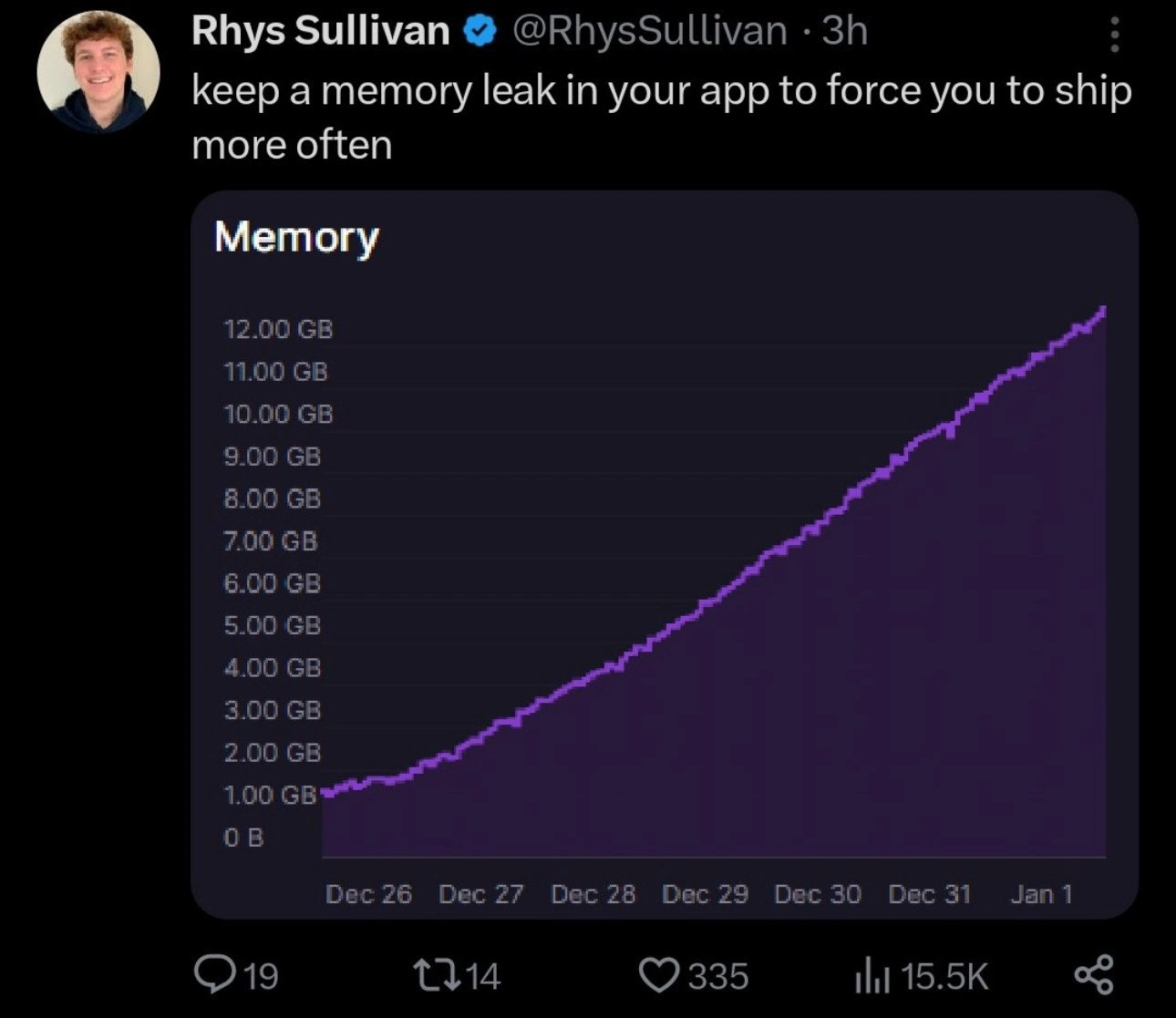
So what exactly is going on here? Let’s break down the terms and joke in simpler tech speak. The meme is about a memory leak – a classic kind of software bug. Memory (specifically RAM, the working memory of a computer) is where programs store data they’re actively using. A memory leak happens when a program keeps asking for more memory but doesn’t give it back when it’s done. It’s like borrowing books from a library and never returning them; eventually the library has no books left for anyone else. In a computer, RAM is finite, so if an app leaks memory continuously, its usage will climb over time until there’s none left. At that point, the program might slow to a crawl or crash entirely. The chart in the meme (the purple line labeled “Memory” from 0 to 12 GB) visually shows this: the app started just above 1 GB of usage and steadily “leaked” up to nearly 12 GB within a few days. That’s a huge spike – think of it like your phone battery draining faster and faster; here memory is draining (or rather, filling up) uncontrollably.
Now, “to ship more often” means to deploy new releases of the software frequently (shipping = releasing code to users or to production). Frequent shipping is generally seen as a good practice in modern agile development – it means you’re iterating fast, delivering updates continuously. But usually, you want to ship often because you’re adding features or improvements, not because the last version is on fire! The tweet jokes that by keeping a bug (the memory leak) in your app, you’ll be forced to make new releases regularly. Why forced? Because if you don’t release a fix or restart the app in time, that memory leak will overload the system (maybe crash the server or start seriously hurting performance). In other words, the only way to keep the app running is to frequently deploy a fresh version (ideally one that resets the memory usage, even if it still has the leak). It’s a tongue-in-cheek way to schedule maintenance: the bug itself dictates when you must intervene. It’s “bad performance as a feature” — obviously not how things should be, but the joke is presenting it as if it were a clever tactic.
For example, imagine a simple program:
leaky_list = []
while app_is_running:
big_object = get_large_data_chunk() # allocate some large data (e.g., 100 MB)
leaky_list.append(big_object) # keep it forever in a list
do_work(big_object)
# Oops, never remove or free big_object after using it!
# The list grows and grows, using more and more memory...
In this pseudocode, the program is continuously running (maybe it’s a server handling requests). Each loop, it grabs some large chunk of data and stores it in leaky_list but never releases it. Over time, leaky_list gets bigger and bigger, consuming more RAM. That’s a memory leak: memory that’s no longer needed isn’t returned or cleared. If app_is_running goes on for hours or days, this program’s memory usage will just keep climbing (like the chart) until it hits a limit. At that point, the program might throw an out-of-memory error, or the operating system might step in and terminate it to protect the machine.
Now, normally as developers we consider memory leaks serious bugs to fix. They’re a form of Technical Debt too: maybe you wrote some quick-and-dirty code that didn’t clean up properly, and it’s tolerable at first, but over time it becomes a big problem. Technical debt is like taking a shortcut in code that you’ll eventually pay for with extra work or issues later. A memory leak is a perfect example — initially, nobody notices the small extra memory usage, but give it a few days in production and suddenly your app is hogging 12 GB of RAM and slowing everything down. Often teams will schedule time to fix such issues or, if they can’t immediately, they put in a workaround (for instance, restarting the application every so often to clear the memory). That’s not a real fix, just a temporary bandage. It’s akin to knowing your bucket has a hole and just refilling it periodically instead of patching the hole. Some systems even automate this: for instance, web server processes might be auto-restarted every 24 hours to preempt any slow leaks – it’s an acknowledged but somewhat defeatist strategy.
The meme joke takes this scenario and says, “Hey, look on the bright side: this leak is making us deploy a lot. Isn’t that great for Developer Productivity? We’re shipping updates all the time!” Of course, in reality those updates are probably emergency patches or restarts, not planned feature releases. The tweet format (with the engagement numbers: 19 replies, 14 retweets, etc.) shows other developers found this notion amusing or relatable. It’s DeveloperHumor born from pain: only people who’ve dealt with production ProductionIssues would “like” such a tweet, because they get the ironic twist. The context tags call it an “intentional_bug_strategy” or “release_driven_by_leaks”, and that’s exactly what’s being mocked. It’s suggesting a deliberately bad practice as if it were a savvy tip. No one is seriously advising to leave bugs in your code; rather, it’s poking fun at the fact that sometimes our bad practices end up dictating our workflows anyway.
For a newer developer, the takeaway is: MemoryLeaks are something to watch out for. They cause PerformanceIssues (using lots of RAM can slow everything else, possibly leading to crashes). In a well-run project, you’d monitor memory (maybe with a chart like the one shown) and fix leaks when you find them. The meme assumes you know that and plays with the opposite idea for laughs. Also, “ship more often” hints at the pressure devs face to constantly release new versions (whether for features or fixes). There’s a bit of truth wrapped in the joke: teams under heavy ReleasePressure sometimes end up shipping hotfixes frequently because bugs force their hand. It’s much better to ship often due to planned improvements, not because your app breaks, but unfortunately the latter can happen if quality is compromised. So the joke lands because it’s a comically exaggerated version of a real challenge: balancing speed and stability.
In summary, at this level: a memory leak is when your app forgets to give memory back, leading to runaway RAM usage. This meme jokes that such a bug will naturally make you deploy a lot (since you’ll have to keep fixing or restarting), thus sarcastically calling it a “strategy” to increase release frequency. It’s a wink to developers: “we’ve all seen this kind of madness, haven’t we?”
Level 3: Memory Leak-Driven Releases
The meme’s punchline is a sarcastic twist on agile practices:
“keep a memory leak in your app to force you to ship more often”
Here a memory leak, normally a nasty bug, is repackaged as an absurd “feature” to accelerate release cycles. In real-world software, a memory leak means your application keeps allocating memory (RAM) without freeing it, causing usage to climb relentlessly – just like the jagged purple line in the chart rising from ~1 GB on Dec 26 to nearly 12 GB by Jan 1. That chart labeled "Memory" is essentially a creeping doom visualization: as days pass, the app’s RAM usage spikes exponentially (a textbook PerformanceIssue). By New Year’s Day, the process is probably one malloc away from crashing or getting OOM-killed by the OS. This is clearly bad performance – but the tweet jokingly frames it as a productivity hack. The humor targets seasoned devs’ shared experience: we often joke that some “features” exist only to deal with our own messes (like adding a leak so we have to do frequent deployments). It’s sarcastic deployment advice playing on the notion of “not a bug, but a feature.”
Why is this funny to an experienced engineer? Because it’s tech sarcasm at its finest. In healthy practice you’d fix a leak ASAP, but here someone suggests intentionally leaving it as a crude scheduler for releases. It’s a wry commentary on how teams end up doing release management in crisis mode. We’ve all seen systems that require a weekly reboot or daily redeploy to avoid meltdown – essentially relying on a bug as a timer. The tweet exaggerates this into a “strategy”: let memory consumption balloon until it threatens production, thereby forcing your hand to cut a new release (or at least restart things) before everything goes ablaze. It’s funny because it rings true in a dark way: teams drowning in TechnicalDebt sometimes live by the mantra “if it ain’t on fire, don’t touch it.” Well, a memory leak guarantees a fire regularly. OnCall_ProductionIssues become your new sprint planner – “Oops, memory’s at 95%, time to ship version 2.3.1!”
This taps into the cynical reality that often the only time you get approval to update a service is when it’s about to crash. A senior dev reads this and chuckles (or groans) because they’ve been there: the DeveloperHumor lands close to home. Maybe their old Java service had a slow leak and they literally set up a cron job to restart it every night at 2 AM (a common bad practice turned band-aid). Or they remember management ignoring bug reports until users start complaining or the server dies – then suddenly there’s ReleasePressure to push a fix immediately. It’s release-frequency-by-disaster. The tweet is basically saying: Can’t convince the boss to let you ship continuously? No worries, just let the app degrade until you have to redeploy! That’s obviously tongue-in-cheek. It lampoons the dysfunctional way some orgs operate, where only acute pain (like a memory outage) triggers action. The sarcasm also highlights the backward logic: continuous delivery is supposed to be driven by proactive improvement, not by existential threats. Yet in practice, many teams only deploy when something goes horribly wrong. This meme weaponizes a BugInSoftware (the leak) as a forced DeveloperProductivity tool – an insane idea that makes us laugh and cringe because it satirizes our industry’s habit of turning crisis into process.
On a deeper level, it’s hinting at perverse incentives. Measure your team by how often you ship? Well, a memory leak will jack those numbers right up, since you’ll be shipping patch after patch just to keep the service alive. It’s like a twisted inversion of Continuous Integration/Continuous Deployment (CI/CD): instead of automating good practices, you’ve automated failure as a driver for deployments. Seasoned devs recognize the absurdist truth here: sometimes a Performance bug does dictate your entire schedule. If critical microservice X has a nasty leak that crashes it every 48 hours, guess what – you’ve effectively got a 48-hour release cycle for patches or restarts. We jokingly call this “leak-driven development.” It’s funny because it’s painful – a sign of a system barely held together. The meme shines light on that shared pain with dark humor: “Shipping often is good, right? So here’s a hack: make your app so unstable you’ll have no choice but to deploy constantly!” 🤦♂️ It’s an insight into how TechDebt can ironically drive behavior. Veteran engineers laugh, then cry a little, because they know the proper solution is to fix the leak – but they’ve also lived in environments where quick fixes and fire drills were the norm. This tweet is the laugh of recognition: turning a ProductionIssue into faux advice captures the insanity we sometimes face in software development.
Description
Screenshot of a tweet from Rhys Sullivan. The text of the tweet humorously suggests, "keep a memory leak in your app to force you to ship more often." Below the text is a dark-mode graph titled "Memory," which clearly visualizes this concept. The y-axis ranges from 0 B to 12.00 GB, and the x-axis shows dates from Dec 26 to Jan 1. A jagged purple line plots a relentless, steady increase in memory consumption over the week, starting around 1 GB and climbing past 12 GB, a textbook illustration of a memory leak. The humor is derived from reframing a critical software bug as a bizarrely effective, albeit catastrophic, project management strategy. Forcing frequent deployments to reset the application's memory prevents an inevitable crash, satirizing the 'ship fast and break things' culture by taking it to its logical, absurd extreme. This resonates with senior engineers who have witnessed terrible workarounds being justified as quirky features
Comments
11Comment deleted
We don't have a memory leak; it's a 'stateful resource allocation feature' designed to enforce our aggressive CI/CD cycle. The server gets a reboot every time it runs out of RAM, which, coincidentally, is just after sprint review
Forget CI/CD - our stack runs on RAM-driven agile: once the leak tips the heap past 12 GB, Kubernetes kills the pod and the restart officially counts as a release
Nothing quite motivates a team to embrace continuous deployment like knowing the production servers have exactly 72 hours before the OOM killer becomes your most active contributor - it's like Scrum, but with actual consequences instead of story points
Ah yes, the 'OOMKiller-Driven Development' methodology - where your deployment cadence is directly proportional to how quickly you exhaust available RAM. It's like having a built-in SLA enforcer that doesn't care about your sprint planning. Bonus points if you've configured your orchestrator's memory limits just low enough that the pod gets evicted before the on-call engineer finishes their coffee. Who needs CI/CD pipelines when you have inevitable process termination as your release trigger?
Release cadence hack: leak a tiny reference cycle so the pod hits OOM on schedule; ArgoCD redeploys, DORA looks stellar, and the only up-and-to-the-right KPI is RSS
New CD strategy: tie deployment KPI to heap size - when prod hits double digits, the pipeline auto-releases; we call it error-budget-driven garbage collection
Engineers' secret to elite DORA deployment frequency: one intentional memory leak per sprint
*to shit Comment deleted
I had an aneurysm reading this Comment deleted
force you to shit more often Comment deleted
All because he used C Comment deleted