Skip to content
DevMeme
5828 of 7435
The Painful Realization That You Are Your Own Worst Enemy in Tech Debt
TechDebt Post #6385, on Nov 15, 2024 in TG

The Painful Realization That You Are Your Own Worst Enemy in Tech Debt

Why is this TechDebt meme funny?

Level 1: Tripping Over My Toys

Imagine you quickly shoved all your toys and junk into your closet instead of properly putting them away. The room looks clean, and you think, “Great, I solved the problem!” But later, when you open the closet, bam! – everything you stuffed in falls out and bonks you on the head. It turns out the mess you made is now making a mess of you. This meme is joking about the same idea, but with computer code. It’s saying that when we take lazy shortcuts (like hiding the mess), we’re only hurting ourselves later (like the stuff falling on our head). In simple terms: you made the mess, so now you have to fight that mess. And sometimes, the mess fights back!

It’s like drawing a doodle on the wall and then later having to clean it up – you can get mad at the stain, but really you’re the one who put it there. The feeling is both funny and frustrating: “I can’t believe I’m getting beaten up by something I did!” In kid terms, it’s like leaving your toys all over the floor and then tripping over them later. You might want to yell at the toys, but deep down you know it was your choice to leave them out. This meme just uses a boxer and some text to share that same silly truth: sometimes we cause our own problems, and we end up exclaiming, “ouch, I guess I have only myself to blame!”

Level 2: Refactoring Reality Check

This meme might look silly with its low-poly boxer, but it’s talking about a very real software engineering concept: technical debt. Technical debt is a metaphor that compares writing quick-and-dirty code to taking on financial debt. Imagine you skimp on doing something the proper way (to meet a deadline or because you didn’t know a better method). That’s like borrowing time. It feels easy now, but it comes with interest – later on, you’ll have to pay back more effort to fix or improve it. In other words, those shortcuts and CodingMistakes make future development harder. Refactoring is the process of cleaning up that code later without changing what it does (kind of like reorganizing a messy closet without buying anything new). When developers schedule time for RefactoringNeeded, they’re essentially “paying down” technical debt to improve the code’s structure and CodeQuality.

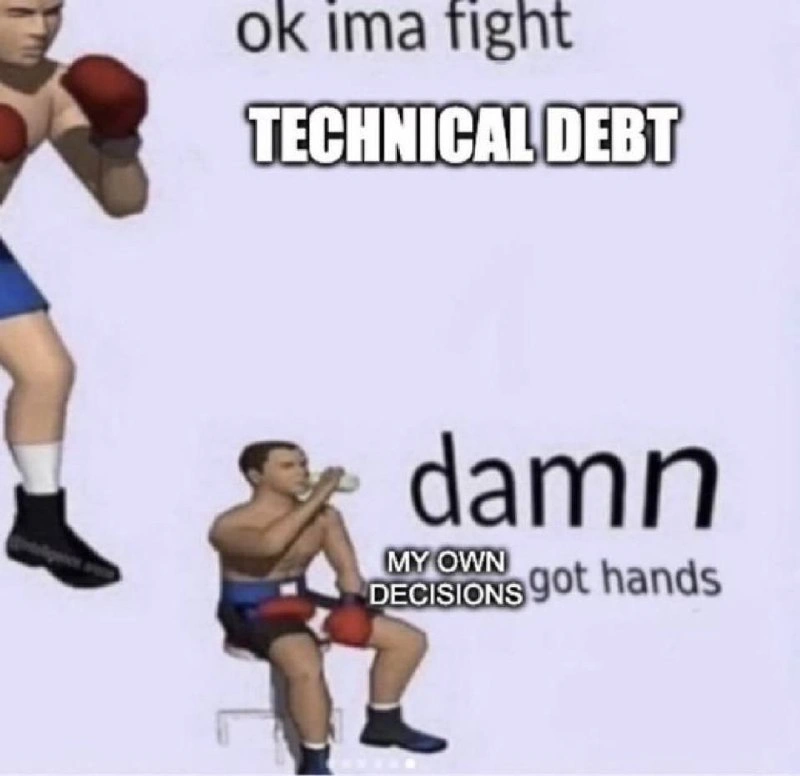
In the top panel of the meme, the text “ok ima fight TECHNICAL DEBT” shows a confident developer (represented by the cartoon boxer) preparing to tackle these long-overdue code improvements. He’s ready to fix the messy LegacyCode and solve issues that were left in the codebase. Legacy code just means old code that’s already in use – often it’s code written by others or by yourself long ago, and it can be hard to understand or work with (especially if it’s full of quick fixes). The developer is hyped up to wrestle this beast and make the software better. This feeling might be familiar if you’ve ever opened an old project you wrote and said, “Alright, time to clean this up for real.”

But then comes the twist in the bottom panel: the same boxer is sitting down, battered and bruised, with text implying “damn my own decisions got hands.” In plainer terms, he’s saying “Wow, my own choices can punch hard!” The slang “got hands” means someone (or something) is good at fighting. So the joke is that the programmer’s own past decisions are what’s beating him up in this fight. The enemy “Technical Debt” turned out to be made of all the little shortcuts and bad ideas the developer himself added to the code in the past. It’s a comical way to highlight self_inflicted_issues – problems we cause ourselves. The meme format (a two-panel boxing scene) emphasizes that what was supposed to be a heroic battle against a foe becomes an embarrassing bout of essentially fighting a mirror.

For a junior developer, this is a valuable reality check. It’s common early in your career to write code that “works for now” and then later discover it’s a nightmare to change or debug. Maybe you’ve hard-coded a value (like fixed a number in the code instead of making it adjustable) or duplicated some code in two places because it was faster than refactoring into a single function. It works at first, so you move on. That’s adding TechnicalDebt unknowingly. When you later try to add features or tidy up, those decisions come back as obstacles – e.g. “Why on earth did I do it this way? It’s so hard to update!” That feeling is exactly what the meme portrays: DeveloperRegret when confronting the consequences of earlier choices. The phrase “my own decisions got hands” is humorously saying my own past coding decisions are fighting me and winning. It’s a funny way to admit “I did this to myself.”

This scenario is a DeveloperPainPoint many relate to. Even if you’re new, you might have experienced working on a school assignment or small project where you took a shortcut (like not commenting your code or not separating logic properly). Later, when something breaks or you need to extend it, you struggle, feeling frustrated at the original code (and thus at yourself). That’s technical debt in action on a small scale. The meme basically tells us: when you go to fix old issues (fight technical debt), be prepared – you might be wrestling with the consequences of your own earlier work. Refactoring isn’t always a gentle process; it can feel like a fight with your past self, who unfortunately left a mess.

The humor also carries a bit of advice: try to write code with future-you in mind, because future-you will be the one dealing with any CodingMistakes you make today. But since perfect code doesn’t exist and deadlines often force our hand, every developer accumulates some technical debt. The key is acknowledging that refactoring old code can be surprisingly hard. Don’t be too shocked when a “simple” cleanup task turns into a bug-fixing marathon. As the meme jokes, sometimes your past code fights back. Understanding this helps junior developers see why seniors harp on code quality and good practices — it’s not just nitpicking, it’s saving your future self from a black eye!

Level 3: Self-Inflicted KO

Every seasoned developer eventually faces the technical debt monster they helped create. You step into the ring confidently: "ok ima fight TECHNICAL DEBT". You’ve got your refactoring game plan, determined to improve that gnarly legacy code you inherited (or wrote under duress). It feels like preparing for a title bout to boost CodeQuality. But in this meme’s punchline, the prizefighter gets floored by an unexpected opponent: his own past decisions. The bottom panel’s caption, “damn my own decisions got hands,” nails that dark realization – the very shortcuts and architectural compromises you made earlier are now hitting back like a prizefighter with a grudge. It’s a sardonic twist: fighting technical debt often means shadowboxing with the ghost of code you wrote at 2 AM last year.

This joke lands because every experienced dev has had a humbling “I am my own worst enemy” moment. We charge in to fix things, blaming the “idiot” who wrote this spaghetti, only to run a git blame and see our own name. DeveloperRegret and DeveloperFrustration ensue. The meme encapsulates that gut punch when you realize the villain behind the awful hack is your younger self. It’s a common DeveloperPainPoint: the self-inflicted issues we created in crunch time become today’s blockers. High on optimism, you planned a clean refactor sprint to pay off the TechnicalDebt. But those “quick fixes” and CodingMistakes you once dismissed as harmless are now throwing haymakers, turning your refactoring into a maintenance boxing match.

Why is your past code so good at beating you up? Because it knows all your weaknesses – you coded them in. That function you copy-pasted everywhere to save time is now a tangled mess impossible to update. The global state you used for convenience creates unpredictable side effects each time you touch it. All those "temporary" hacks left in the codebase have accumulated interest like a predatory loan, and payback time is brutal. It’s like programming’s version of a boomerang effect: cut corners and they’ll come swinging back around to smack you in the face. The humor has a bitter truth: resolving TechnicalDebt feels less like noble heroism and more like getting KO’d by your own bad “creative” ideas.

Let’s be real, refactoring legacy code can turn into a full-on maintenance_battle. You start with Rocky-like enthusiasm to set things right, but end up on the ropes, sweat dripping, muttering “Damn, that code hits harder than I remembered.” It’s past-you vs. present-you in the ring. Past-you was in a hurry – maybe product launch was looming or you thought “I’ll clean this up in v2.0”. Present-you now has to untangle that rushed job. The past_decision_consequences are everywhere: one “quick fix” triggers five new bugs when removed; an old library you never upgraded now breaks the build; a giant God object class you built as a catch-all is now an untestable nightmare. It’s common to find yourself refactoring one line only to discover your own decisions booby-trapped the entire module. In other words, “damn, my old code’s got hands.”

Consider a classic scenario: you litter the code with TODOs promising to fix things later, but “later” never came until now. Suddenly, each // TODO: fix this hack is like a glove to the jaw. For example:

def process_user_data(data):
    # TODO: remove this quick fix when proper validation is implemented
    if "name" not in data:
        data["name"] = "Unknown"  # quick patch for missing name, will fix later
    # ... some complex processing ...
    return data

This seemed harmless when you wrote it. Fast-forward a year: that "temporary" patch is still in production, and now half the user reports have "Unknown" names, wrecking analytics. Fixing it “the right way” means rewriting how data flows through the system, which is punching way above the weight class you expected. No wonder present-you is slumped on the stool, sipping water, stunned that the little hack you wrote packs such a punch. TechnicalDebt has a way of getting hands and fighting back when you try to undo it.

The meme’s boxing format perfectly captures this ironic showdown. In the first panel, the dev-boxer represents us bravely confronting Tech Debt, the sum of messy code and maintenance battles we’ve been putting off. In the second panel, that same boxer is beaten and exhausted, labeled “MY OWN DECISIONS.” It’s a cheeky visual of the revelation that we’re essentially wrestling with ourselves. It resonates with senior devs because we’ve lived it: refactoring a system only to feel every past design decision punching us in the gut. The phrase “got hands” in vernacular means “can fight well,” so saying “my own decisions got hands” is a tongue-in-cheek way of admitting your previous choices are alarmingly good at making life difficult. DeveloperRegret hits hard – literally in this meme – as you endure a self-inflicted knockout.

Description

A two-part meme using a low-polygon 3D model of a boxer to illustrate the struggle with technical debt. In the top section, the boxer is standing confidently, ready to fight, with the text 'ok ima fight TECHNICAL DEBT'. The bottom section shows the same boxer, now defeated and sitting on a stool, drinking from a water bottle. The text reads 'damn', and a label over the boxer clarifies the opponent: 'MY OWN DECISIONS'. The punchline is completed with the slang phrase 'got hands', meaning the opponent is a formidable fighter. The technical humor lies in the deeply relatable experience of a developer deciding to tackle the accumulated technical debt in a project, only to realize that the most challenging and poorly designed parts of the codebase were the result of their own past shortcuts, compromises, and decisions made under pressure. It's a humorous take on the cyclical and often self-inflicted nature of software maintenance and the pain of confronting one's own past mistakes
Comments

9
Anonymous ★ Top Pick Technical debt is just a high-interest loan you took out from your future self. It turns out your future self is a ruthless loan shark who's here to collect
  1. Anonymous ★ Top Pick

    Technical debt is just a high-interest loan you took out from your future self. It turns out your future self is a ruthless loan shark who's here to collect

  2. Anonymous

    Kicked off the tech-debt sprint, opened git blame, and realized I’m sparring with 2010-me and his “refactor-later” TODOs - compound interest never skips leg day

  3. Anonymous

    After 15 years in the industry, you realize the most dangerous opponent in any codebase isn't the junior who doesn't know better, or the architect who over-engineers everything - it's Past You, who knew exactly what they were doing was wrong but had a deadline and thought 'I'll refactor this later.'

  4. Anonymous

    The real plot twist in every senior engineer's career: spending years accumulating the expertise to recognize technical debt, only to realize you're now qualified enough to understand exactly which of your own past 'pragmatic' decisions created it. It's like becoming a code archaeologist who keeps finding artifacts with your own signature on them

  5. Anonymous

    You don’t fight technical debt; you spar with past-you, who trained on “ship now, refactor later” and still has merge rights

  6. Anonymous

    Tech debt is the only loan where the lender, collector, and leg‑breaker are your past architecture decisions - and the interest compounds per deploy

  7. Anonymous

    Tech debt: the shadowbox where past-you always lands the uppercut on future-you's refactor

  8. @AmindaEU 1y

    result: the codebase is even more obscure and dysfunctional?

  9. @HalaMadridJC 1y

    https://t.me/+rHRp3-nI504wOGVh

Use J and K for navigation