The Perfect Library with Russian-Only Documentation
Why is this Documentation meme funny?
Level 1: Treasure Map in Another Language
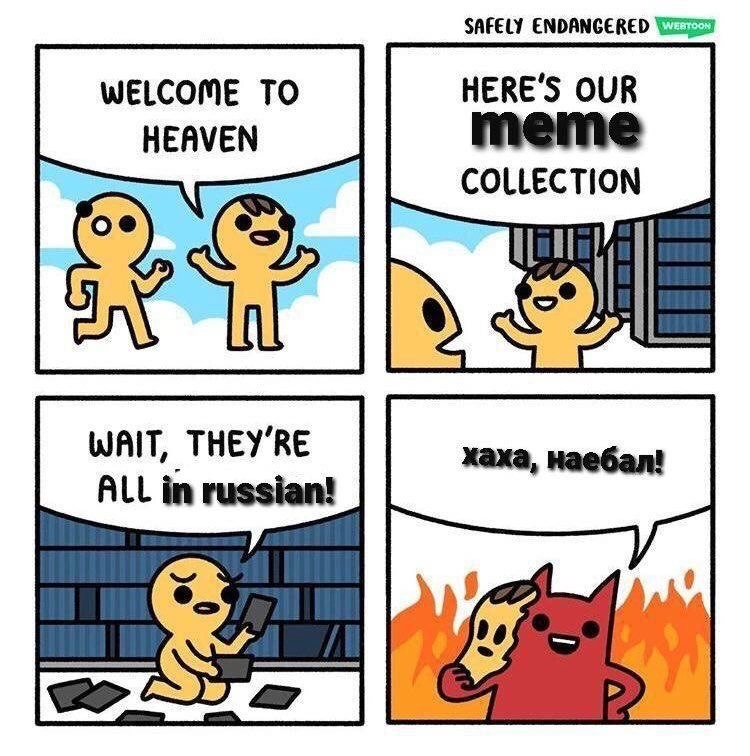
Imagine you finally get a map to a hidden treasure that you’ve been seeking. You’re overjoyed – it shows the big red X where the treasure is, and it looks like everything you need to reach paradise! But then you notice something upsetting: all the directions and clues on the map are written in a language you don’t understand. No English, no familiar words – just strange letters like secret code. In the comic, that’s exactly what happens. The little character thinks they’ve arrived in a perfect place (“heaven”) full of all the answers (like a giant library of memes or instructions). It feels like opening a storybook that has every answer to every question. But suddenly, they realize all the pages are in Russian, a language they can’t read. It’s as if someone played a prank: “Here are all the toys you ever wanted… but oops, you can’t use them!” In the last scene, the friendly guide turns out to be a sneaky trickster (like a friend wearing a mask the whole time) saying “Haha, I fooled you!” The feeling is a mix of excitement turning into frustration. It’s like being promised your favorite candy and then finding out the label and instructions to open it are in another language, so you can’t even taste it. The joke is funny because we can all understand that disappointment: the thing you need is right there, but you just can’t read it.
Level 2: Language Barrier Blues
This meme highlights the classic language barrier problem in software development. The scenario is straightforward: a developer finds what looks like perfect information (the equivalent of a dream documentation library or meme collection for their problem), but there’s a catch – it’s entirely in a foreign language (Russian, in this case). In the comic, the newbie arriving in “heaven” represents a programmer discovering an amazing trove of knowledge. “Heaven’s meme collection” symbolizes something like a well-stocked repository of answers, tutorials, or README files that any dev would love. But then comes the shock: “Wait, they’re all in Russian!” – meaning none of it is in a language the developer can read. This is a moment of DeveloperFrustration many have experienced. For instance, imagine finding the exact Stack Overflow question that matches your bug, but all the answers are written in Russian or Chinese. It’s a sinking feeling. In technical terms, this is about internationalization and localization (often abbreviated as i18n and l10n). Internationalization (i18n) is the practice of designing software (or documentation) so it can be adapted to different languages and regions without engineering changes. The term “i18n” is shorthand: it starts with “i” and ends with “n” with 18 letters in between. Localization (l10n) is the actual adaptation process – like translating text into Russian, English, Spanish, etc. So, when the comic shows all the content only in Russian, it’s poking fun at a lack of localization for an international audience. The tag missing_localization fits perfectly: it means the docs weren’t translated where they should be. A new developer might not expect this, but not all documentation or code comments are written in English. There are huge developer communities in Russia, China, Japan, and elsewhere that produce content in their native languages (that’s what the category DevCommunities hints at). If you only speak English, discovering a detailed README or manual in Russian can feel like hitting a wall. The phrase “DocumentationHumor” applies because this is a joke about documentation itself being the source of trouble. Usually, documentation is supposed to help you – here it’s causing grief because you can’t read it. It’s a DocumentationGap scenario: the gap isn’t that documentation is missing, but that it’s not in a useful form for you. The third panel of the comic, where the character shouts in distress on the library floor, captures that “oh no!” moment. He’s holding a tablet with Russian text, surrounded by towering shelves of unfamiliar script. This reflects a relatable DeveloperExperience_DX blunder: even though the dev has resources available, the experience is terrible because it’s like they’re written in code they can’t crack. Many junior devs encounter something similar when googling errors – you might find a forum page where someone solved your exact issue, but all the discussion is in, say, Russian. You might try to use Google Translate on it, and sometimes that works well enough to get the gist, but other times the technical context makes machine translation garbled. (Ever seen an error message translated incorrectly? That can send you on a wild goose chase!) The meme’s punchline, in the last panel, is the red devil revealing that this “heaven” was a prank. In the drawing, the devil literally pulls off a mask that looked like the friendly guide. This is a devil_bait_switch – a bait-and-switch trick. We thought we were in documentation heaven, but we were actually being led into translation_hell. The devil is laughing in Russian text “хаха, наебал!”, which is Russian internet slang for “Haha, I fooled you!” This detail emphasizes the joke: even the punchline isn’t translated for you. For a developer, it humorously mirrors the feeling of betrayal when you realize the perfect solution you found is useless to you without spending time translating it. It’s as if the documentation itself is laughing and saying “Gotcha! You don’t speak this language, do you?” The categories here like Documentation and DeveloperExperience_DX are highlighted because good documentation is a huge part of a smooth developer experience – and language is a big part of documentation quality for a global audience. If an open-source project’s docs are only in the maintainer’s native tongue (be it Russian, Japanese, etc.), then other programmers might struggle or give up. This can fragment DevCommunities, because you end up with knowledge silos by language. That’s why many projects and communities encourage writing docs in English or providing translations – it bridges these gaps. However, not everything gets translated, especially community-contributed tutorials or niche libraries. So developers often joke about encountering that one blog post with the answer which Google found, and… surprise, it’s all in a language you can’t read. In summary, this comic is a funny take on a very real rookie (and veteran) experience: the content you need exists but you’re locked out by language. It’s showing the importance of localization in a humorous way. If you’ve ever felt stuck because instructions were only available in another language, this meme’s scenario probably feels too real. But at least we can laugh about it – after all, it’s a shared frustration in our worldwide dev community.
Level 3: Paradise Lost in Translation
At first glance, this comic paints a picture of developer heaven: imagine stumbling upon an exhaustive trove of documentation or memes that promises to answer all your questions. In the first two panels, a cheerful guide presents a celestial library – a metaphor for the ultimate knowledge base (the shelves of tablets representing a comprehensive documentation collection). This is every coder’s dream: all the answers neatly stored in one place, a utopia of Developer Experience (DX) where nothing is missing. But the humor (and horror) kicks in with the bait-and-switch. In panel 3, the enthusiastic visitor discovers “Wait, they’re all in Russian!” – the entire glorious collection is written in a foreign language (Cyrillic script, no less). For seasoned engineers, this scenario hits home as a form of knowledge_base_betrayal: the information you desperately need exists, but it’s locked behind a language barrier. It’s like finding the holy grail of README files or API docs, only to realize it’s a russian_only_readme you can’t decipher. This is a very real pain in global developer communities – a literal example of missing localization. In professional terms, it’s an i18n fail: an internationalization oversight where documentation wasn’t translated for a broader audience. The meme’s final punchline reveals the welcoming angel was a fraud all along – the last panel shows the devil holding up a discarded “angel” mask amidst flames, laughing in Russian: “хаха, наебал!” (essentially “haha, fooled you!” in colloquial Russian). Not only has heaven turned into hell, but the devil’s punchline itself is in untranslated Cyrillic, forcing the audience to experience the very predicament being mocked. This clever detail is meta-humor: if you don’t read Russian, you literally can’t read the joke without translation – driving the point home. It’s the devil’s bait_switch for developers: that heavenly GitHub repository or documentation stash that looked perfect until you realize you need Google Translate (or a Russian-speaking colleague) to make any sense of it. The comic format (a homage to Safely Endangered style) uses this heaven/hell imagery to dramatize what software folks often joke about: the trip from documentation heaven to translation hell. From a senior engineer’s perspective, it satirizes how even in 2020 we still grapple with language barriers in tech. One moment you’re rejoicing, “Yes! The answer to my bug is here,” and the next you’re slumped over, recognizing the text as gibberish Russian. This captures an all-too-relatable industry pattern: crucial knowledge hiding in plain sight, but not in a language you understand. Seasoned devs have war stories of scouring forums on the other side of the world – finding a promising code snippet on a Russian blog or a Chinese forum – only to be halted by the realization that every explanatory comment and error discussion is in a foreign tongue. The humor is equal parts DeveloperHumor and trauma: we’ve been fooled by beautifully organized docs that we simply can’t read. It underscores a systemic gap in DevCommunities and documentation practices: English might be the lingua franca of code, but not necessarily of documentation. The CAPTCHAs of the coding world aren’t always code – sometimes they’re human languages. A senior dev will chuckle (or groan) because they know the feeling of slipping into “internationalization purgatory,” where implementing that urgent feature now means deciphering pages of translated text or pleading for help on forums. As funny as it is, it’s also a nod to why localization matters: that awesome open-source project with all its guides in one language can feel like a cruel trick if you’re outside the intended audience. And of course, the devil cackling “ха-ха!” is basically every bugfix blog that looked promising on Google Search until you clicked and realized you’re about to have a crash course in Russian. The DocumentationGap here isn’t the absence of docs – it’s the absence of accessible docs. The meme expertly exaggerates this moment as a literal trip to hell, something an experienced developer might smirk at while recalling the time they debated whether to learn Russian at 3 AM or attempt to read API signatures in isolation. In summary, this panel gag encapsulates a deep truth in programming: sometimes the “heavenly” solution is right in front of you, but просто не на вашем языке (“just not in your language”). The devil truly is in the details – or in this case, in the documentation’s default language.
Description
A four-panel comic strip by 'Safely Endangered'. In the first panel, a cheerful yellow character welcomes another to a heavenly setting with clouds, saying 'WELCOME TO HEAVEN'. The second panel shows the guide presenting a vast library, announcing 'HERE'S OUR meme COLLECTION'. In the third panel, the new arrival is on the floor, looking at screens in dismay, exclaiming, 'WAIT, THEY'RE ALL in russian!'. The final panel reveals the trick: a red devil character has removed the guide's face as a mask, standing before flames and saying in Russian, 'хаха, наебал!', which translates to a vulgar 'Haha, fooled you!'. This comic serves as a potent metaphor for a common developer frustration: discovering a powerful open-source library or a critical piece of legacy code, only to find that the documentation and comments are written exclusively in a language one doesn't understand (like Russian, Chinese, or Portuguese), rendering it almost useless and a kind of personal hell

Comments
7Comment deleted
That feeling when you find the perfect zero-dependency library on GitHub, but the README is just a single Cyrillic sentence. You either trust the code blindly or start learning a new language, and both options feel like a deal with the devil
When the shiny new OSS repo looks like a silver bullet - until you realise every README, commit message, and variable name is in Cyrillic and Google Translate just became your de-facto senior engineer
Finding the perfect Stack Overflow answer with 500 upvotes, only to realize the critical part is a link to a Russian forum where someone solved it in 2009 but Google Translate just returns "potato magnificence achieved."
The real hell isn't poorly documented code - it's discovering that the *only* documentation exists in a language you don't speak, usually written by the one developer who left the company three years ago. At least with no documentation, you can pretend the code is self-explanatory; with Russian-only docs, you're just one Google Translate hallucination away from deploying to production on a Friday
Nothing says enterprise-ready like the runbook being a cp1251 Confluence export and the i18n fallback picking ru-RU because someone deleted en-US to shrink the bundle
Nothing says production ready like geolocating by IP, ignoring Accept-Language q-values, caching without Vary: Accept-Language, and calling it personalization
Like landing on Habr.com's killer sysadmin thread: elite insights, zero decode without Translate extension