When the Code Works but You Don't Know Why
Why is this Documentation meme funny?
Level 1: A Silly Fix
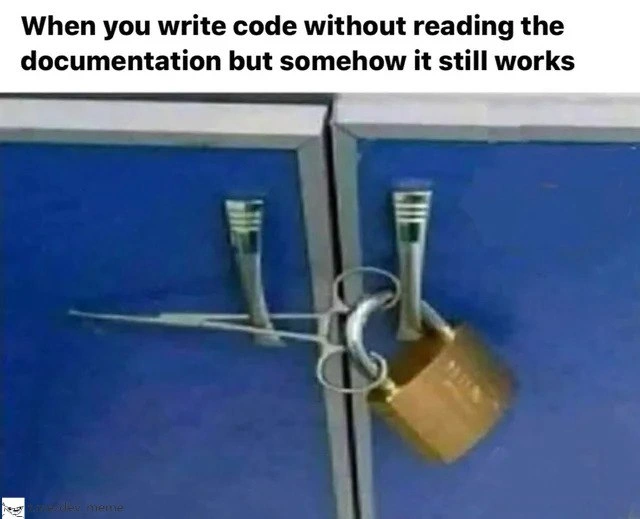
Imagine you have a toy or gadget that’s supposed to be put together a certain way, but you don’t read the instructions. Instead, you just force the pieces together in a way that looks right to you. Amazingly, it kind of works – your toy car rolls or your bookshelf stands – but it’s a bit wobbly and weird. For example, say your door’s lock is broken and, rather than using a proper fix, you stick a pencil through the door handles to keep it closed. The door stays shut, and you feel proud that you “fixed” it, but anyone who sees it will probably giggle. They know the pencil could fall out if someone jostles the door, and it’s not how locks are supposed to work. This is funny because it’s like you found a goofy shortcut and got lucky. You didn’t follow the real instructions, yet somehow things haven’t fallen apart (at least not yet!). The meme shows that feeling in a single picture: a lock and scissors doing a job together in a ridiculous way. We laugh because we’ve all tried something a bit silly like that – not doing it the “right way,” but being happy it works anyway – and deep down we know it probably won’t last!
Level 2: No Docs, No Problem
In simpler terms, this meme is about documentation – those instruction manuals or API guides for code – and what happens when developers ignore it. The text says: “When you write code without reading the documentation but somehow it still works.” Imagine you’re a new programmer using a library or tool. The proper thing is to read the docs to learn how to use it correctly. But let’s be honest: many of us have skipped the reading and just started coding, hoping for the best. This often leads to weird, lucky solutions. The image of the locker shows exactly that kind of solution in real life: two locker doors are being kept shut by threading a pair of scissors through the handles and locking them with a padlock. It’s a workaround – a quick fix – because the proper latch is missing or broken. Amazingly, it does hold the doors closed (so it “still works”), but it’s obviously not the right way to lock a door!
Let’s break down why this is a coding joke. In software, code quality refers to how well-written and maintainable the code is. Good code is like a sturdy, well-designed lock – it’s meant to solve the problem and is easy for others to understand and use. Bad code (low code quality) is like this scissor-padlock contraption: confusing, held together by unconventional means, and likely to cause problems if anything changes. Documentation is supposed to prevent these contraptions. It’s the official guide or reference for how to use a piece of software or an API function. If you don’t read the docs, you might miss crucial details. For example, maybe a function you’re using requires you to call another setup step first – if you didn’t read that, your code might only work in certain conditions or might be quietly doing the wrong thing. That’s akin to not knowing how a real padlock is supposed to latch and instead improvising with scissors.
When a developer writes code by guesswork (or by copying something from the internet without fully understanding it), we sometimes call it “cargo cult programming.” This term comes from the idea of imitation without understanding – just like how in the past some isolated groups built fake airports out of bamboo, hoping to attract real airplanes, because they saw that airports brought goods (true story!). In coding, it means you’re using code you found or remember, hoping it will magically do what you need, without truly knowing why. And sometimes, amazingly, it does work – at least for a while. This meme is funny because every programmer who has done this (that’s most of us early on) recognizes the feeling of surprise and relief: “Wow, it runs! 🎉 I kinda duct-taped it together, but hey, no errors!” It’s like tying a knot in something broken just to keep using it.
However, as any mentor or senior dev will tell you, these makeshift solutions are dangerous. Just as that padlock through scissors could fail if you bump the locker or try to actually secure something valuable, code written without understanding is fragile. It tends to produce bugs when something slightly different happens. Maybe it works on your machine or with yesterday’s data, but tomorrow one small change (like an unexpected input or a software update) and the whole thing could fall apart. That’s why this scenario is both humorous and educational: it reminds developers of the classic lesson “Read The Docs” (often phrased as RTFM, which politely stands for “Read The Fine Manual”). Skipping documentation can lead to bizarre fixes that are hard for others to figure out later. If someone else comes and sees two scissors used as a lock, they’ll scratch their head and think, “What on earth is going on here?” – the same reaction a new developer on a project has when they encounter some hacky code with no comments explaining it. It’s a relatable experience: thinking you got away with not reading instructions, only to realize later (or have someone point out) that you created a bit of a mess. The meme playfully pokes at that very common developer habit: not reading the manual, improvising a solution, and feeling both triumphant and anxious about it.
Level 3: Cargo Cult Contraption
This meme nails a classic CodeQuality nightmare: an improvised solution that technically works but screams code smell to anyone experienced. The photo of scissors and a padlock acting as a locker latch is a perfect visual metaphor for writing code without reading the documentation. In software terms, it’s like a developer skipping the API docs and just guessing how to use a library – maybe copying a Stack Overflow snippet – and miraculously the program doesn’t crash. Sure, the doors stay shut, but this approach is what we call a scissor-padlock anti-pattern (not a real design pattern, of course, but it should be named for how often we see such hacks). It’s a prime example of duct_tape_engineering: cobbling together a quick fix with whatever is at hand, rather than a robust solution.
Why is this funny to seasoned engineers? Because we’ve all seen (or written 😅) code held together by figurative chewing gum and prayers. Picture a function call with wrong or misunderstood parameters that somehow gives the right output. The code passes CI tests by sheer luck, similar to how that padlock through the scissor handles manages to keep the locker closed. It works, so it gets shipped to production with a triumphant “🚢 Ship it!” attitude. But any senior developer immediately recognizes the fragility. This is cargo cult coding in action: using a tool or API in a ritualistic way without truly understanding it, just because others did it or it “seems to work.” The humor (and horror) comes from knowing how precarious this is. The scissors could slip out if someone pulls a bit too hard – just like brittle code will explode when a slightly new use-case appears or a minor update occurs.
Under the hood, such unorthodox solutions often rely on coincidence or undefined behavior. Perhaps the coder used some function defaults incorrectly but got lucky with input that didn’t trigger any errors. Maybe the code ignores a return status or exception (the classic try/except pass silencing all errors) so everything appears fine. In the image, the padlock gives a false sense of security; in code, a passing test suite can give a false sense that the implementation is solid. In reality, this approach accumulates technical debt: every hack like this is a debt that will have to be paid back with interest when things inevitably go wrong. The caption “ship-it now, understand later” culture is being lampooned here. It highlights how teams sometimes prioritize immediate functionality over correctness – a habit that leads to bugs and frantic patching down the line. As an industry inside-joke, we laugh (maybe a bit nervously) because we recognize the pattern: code that’s held together by a makeshift lock will become a maintenance nightmare for whoever inherits it. In short, the meme humorously exposes the gap between “it works in production” and “it’s actually done right.” Every experienced developer knows that just because something hasn’t broken yet doesn’t mean it’s a good solution – and that lurking fear is exactly why this image is so relatable and darkly funny.
Description
The meme displays a prominent caption at the top on a white background that reads: 'When you write code without reading the documentation but somehow it still works'. Below the text is a photograph of two blue locker doors. Instead of being secured properly, a large golden padlock is locked through the finger loops of a pair of surgical forceps, which are in turn clamped onto the locker's handles. This creates a makeshift, precarious lock. The visual gag is a metaphor for a fragile and incorrect solution that surprisingly functions. For developers, this represents the common scenario of integrating a new library or API without understanding its intended use. The resulting code might pass initial tests (the padlock is 'locked'), but it's fundamentally wrong, inefficient, and likely to fail spectacularly later (the forceps are a weak link). It's a humorous take on survivorship bias in coding, where a flawed implementation works by sheer luck

Comments
7Comment deleted
This code passed its security audit because the pen tester was too busy laughing to write up the report. It's not a vulnerability, it's a feature guarded by absurdity
That padlock is basically undefined behavior - still compiles, but the moment someone refactors the handles, your whole threat model segfaults
It's like deploying to production with a Dockerfile that starts with 'FROM latest' and a package.json full of '^' dependencies - sure, it works today, but you're one upstream change away from discovering why semantic versioning was invented in the first place
This is the architectural equivalent of using reflection to access private fields because you didn't read that the class has a proper public API - it works, you're not entirely sure why, and you're terrified someone will ask you to explain it in code review. The real kicker? It'll probably survive in production longer than the 'proper' implementation would have, because nobody dares refactor something they don't understand. Classic case of 'I have no idea what I'm doing but the integration tests are green.'
It ‘works’ because the API’s permissive defaults turned your misuse into a no‑op - classic security theater for business logic
It’s the Express app with auth middleware mounted after the router - compliance sees a padlock; everything else walks right through
Like an enterprise API with auth headers: padlocked tight, but the cables snake right through