The Agonizing Choice of Owning a Broken Build
Why is this BuildSystems CICD meme funny?
Level 1: Nobody Wants to Clean Up
Imagine a group of kids who all made a big mess together – toys thrown everywhere and paint spilled on the floor. The teacher walks in and says, “The classroom has been messy since this morning, and no one has cleaned it up.” Then the teacher puts out two choices: either point to one person to clean it (and basically blame them for the mess), or one of you can say “I’ll clean everything” (even if it’s not all your fault). What do you think happens? All the kids start sweating and looking at each other. Nobody wants to be the one to get in trouble or do all the work alone. If you blame one friend, that’s mean and you’ll feel bad. But if you volunteer to clean the whole mess yourself, you’re stuck doing a huge chore while everyone else watches. It’s a lose-lose situation, and everyone just freezes. That’s exactly the feeling this meme is joking about – when something’s wrong and everybody is responsible, it can end up feeling like nobody is responsible, because everyone is afraid to step up first. The picture of the sweating guy with two buttons is just a funny way to show how nervous and torn you feel deciding what to do.
Level 2: Failing Since Day One
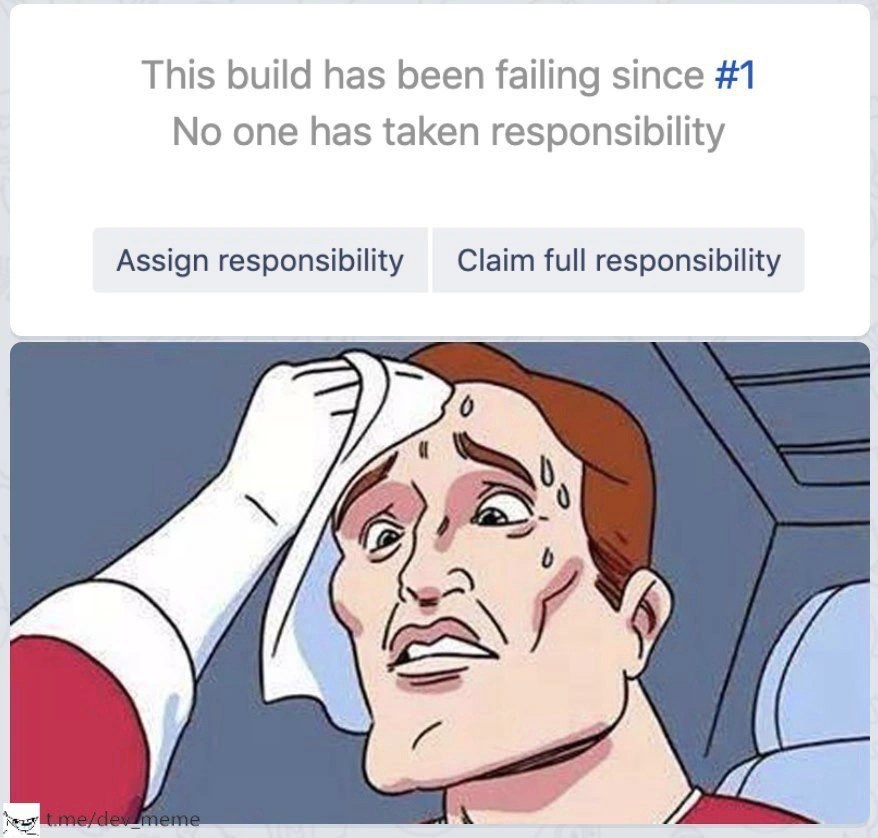
Let’s break this down in simpler terms. The top part of the meme looks like a screenshot from a Continuous Integration dashboard (think of tools like Jenkins or TeamCity which developers use to automate builds and tests). It says, “This build has been failing since #1. No one has taken responsibility.” In plain language, that means the very first build of the project failed, and ever since then it’s been failing. Build #1 usually refers to the first time the code was compiled and tested by the CI system. So “failing since #1” is exaggerating that right from the start something was wrong, and it never got fixed. Imagine turning on a game for the first time and it crashes immediately, every single time, and for weeks nobody bothers to figure out why – that’s the situation here. A build failure means the code didn’t pass all the checks: it could be a compile error, or (more likely) some tests did not pass. In a CI pipeline, green is good (everything passed) and red is bad (something broke). This project’s pipeline has been red from day one. 🚨
Usually, in a team, a broken build is a big deal. It’s like a team rule that if you break the build, you stop whatever else you’re doing and fix it. That’s because a failing build blocks progress – you can’t confidently add new features when the baseline is broken. So, why would a team let it slide? It might be a mix of confusion, lack of ownership, or just being overwhelmed. Maybe the tests were misconfigured initially and everyone thought “oh, someone else will sort that out eventually.” For a new developer (or junior engineer) joining such a team, seeing a perpetually broken build can be really confusing. You might think, “Isn’t this important? Why is nobody fixing it?” You might even feel nervous bringing it up.
Now, about those two buttons in the meme: “Assign responsibility” and “Claim full responsibility.” In real Continuous Integration tools, you normally don’t have literal blame buttons 😅. This is a joke. But it’s based on reality – often if a build breaks, the system will highlight who likely caused it (for example, showing the name of the person who made the last code change). Some advanced setups let you manually assign an owner to a failing build or automatically create a ticket for it. The meme exaggerates that idea by presenting it as a dramatic choice: either assign the problem to somebody else or volunteer to take it on yourself.
Why is that funny (and stressful)? It touches on the idea of blame and responsibility in a team. Modern developer culture, especially in DevOps and SRE, encourages a “blameless” approach. Being blameless means when something goes wrong, you don’t accuse a person outright or punish them. Instead, the team treats it as “let’s all figure out why this happened and how to prevent it.” It’s meant to make people feel safe to admit issues. The phrase “blameless post-mortem” might come up: after an outage or failure, the team discusses it without finger-pointing.
However, “blameless” doesn’t mean “do nothing.” Someone still has to fix the issue. Collective responsibility means everyone is responsible, but sometimes that can lead to confusion about who will actually do the work. For example, on a junior level, think of a group project in school: if the teacher says the whole group is responsible for a task, sometimes each person might hesitate, thinking another team member will handle it. If no one specifically is assigned, the task might not get done at all. That’s what happened with this build: it was everyone’s job, so it became no one’s job.
Let’s define a few terms from the meme for clarity:
- CI (Continuous Integration): A practice where developers frequently merge their code changes into a shared repository, and each merge triggers an automated build and test process. This helps catch problems early. Tools like Jenkins, TeamCity, or GitLab CI are common.
- Build Pipeline: The stages code goes through in CI. Typically compile -> run automated tests -> maybe package the app. If any step fails, the pipeline is marked failed.
- Build Failure: When the code doesn’t compile or a test fails, the pipeline stops and marks the build as “failed” (often shown in red). This signals something in the latest changes didn’t work.
- Build Owner / Responsibility: The person who is currently in charge of fixing a broken build. Some teams rotate this role or automatically assign whoever broke it. In the meme’s fake UI, “Assign responsibility” suggests choosing someone to be that owner, while “Claim full responsibility” means volunteering yourself.
- DevOps: A set of practices that combines software Development and IT Operations. It emphasizes automation (like CI pipelines), collaboration, and shared responsibility for delivering software quickly and reliably.
- SRE (Site Reliability Engineering): A discipline related to DevOps, focused on keeping services running reliably. SREs often implement things like blameless post-mortems to learn from failures without punishing people.
- Blameless Culture: The idea that when something breaks, you focus on fixing the problem, not on punishing the person who caused it. It encourages honesty – if engineers aren’t scared of blame, they’ll report issues and mistakes faster. In a blameless culture, instead of saying “John broke the build, bad John!”, the team says “The build broke due to this commit; let’s all help fix it.”
- “Blame Game”: The opposite of blameless culture – it’s when people start pointing fingers to avoid getting in trouble. It’s unproductive and creates tension, which is why modern teams try to avoid it.
In the meme’s story, the team likely avoided the blame game so much that they ended up with no one fixing the problem. The sweating cartoon man in the bottom panel is a popular image used to portray someone facing a tough decision or feeling pressure. Here he represents a senior developer (or really anyone on the team) staring at those two buttons, freaking out internally. It’s the face you make when your manager asks, “So who is responsible for this never-working build?” and you have to decide whether to speak up or stay quiet. Every developer, even juniors, can relate to that anxious feeling—like when you wonder if you should admit your code might have caused an issue or just hope it slides by unnoticed.
For a junior developer, this situation is a bit like being new on a team and discovering a big bug that’s been around forever. You might think, “Should I be the one to try to fix this? Is it even my place to touch this code? What if I mess up? Will I get blamed for all the past failures if I take it on?” That’s why the meme hits home: it exaggerates that anxiety in a funny way. The truth is, teams work best when someone takes ownership of issues quickly, but getting to that point can be uncomfortable when a problem has been ignored for a long time. This meme humorously shines a light on that silent standoff — everyone’s looking at the broken build, everyone knows it’s bad, but taking responsibility is scary, so they all sit there sweating, waiting for a hero (or a scapegoat) to press one of those buttons.
Level 3: The Tragedy of the Build Commons
Of course the build has been failing since day one—why wouldn't it? This scenario is a textbook example of what happens when everyone owns the code in theory, but in practice nobody owns the fix. In an ideal world, a failing CI/CD pipeline (Continuous Integration/Continuous Deployment pipeline) is a blaring siren that someone addresses immediately. In reality, this team has been stepping around a broken build since the very first commit. The result is essentially a tragedy of the (build) commons: because the responsibility is shared by all, each individual quietly assumes someone else will deal with it. Over time, the constantly red pipeline becomes background noise—like a fire alarm chirping so often that everyone just tunes it out.
Now the meme confronts us with a deliciously awkward choice: the CI system pops up two big buttons, “Assign responsibility” and “Claim full responsibility.” This is the classic two-button dilemma (depicted by that sweaty cartoon guy) transplanted into DevOps culture. Both options are terrible in their own way, and an experienced developer recognizes the dark humor instantly. Option 1, Assign responsibility, means pointing the finger at someone else. That’s essentially throwing a teammate under the bus, a big no-no in any modern blameless culture. Option 2, Claim full responsibility, means volunteering as tribute to be the build martyr: you admit the whole mess is your fault (even if it isn’t) and take on the herculean task of fixing a build that’s been broken forever. No wonder the poor guy in the meme is sweating bullets – neither choice is a win for him.
This highlights a real industry paradox. DevOps and SRE (Site Reliability Engineering) practices preach blameless post-mortems and collective responsibility. In theory, when something breaks, we focus on what went wrong in the system, not who caused it. It’s all about avoiding the blame game and encouraging openness. But here’s the catch: blameless doesn’t mean ownerless. If everyone keeps saying “not my problem,” nothing gets fixed. The meme is poking fun at that exact point: despite all the feel-good talk of “we’re in this together,” when faced with a long-standing failure, even senior devs may freeze up and hope someone else steps forward first. It’s a quiet standoff — each person waiting for another to hit one of those buttons.
The caption about “collective responsibility doctrine” is dripping with irony. Sure, in healthy engineering culture the entire team is responsible for build health. But in unhealthy practice, that doctrine can devolve into responsibility hot-potato. Everyone nods in meetings about owning quality, yet when the CI dashboard flashes “failing since #1, no owner”, all those noble principles fly out the window. It’s painfully relatable: we’ve all seen scenarios where a critical test has been read for weeks or a deploy script is broken and met with collective shoulder shrugs. Seasoned developers recognize that “uh oh” moment when management finally notices and asks, “Why has this been broken for so long?” — cue the sweaty brow and nervous glances just like the meme’s character.
What makes this especially humorous (in a dark way) is how the CI tool itself becomes the enforcer of accountability. The fake UI in the meme looks a lot like Jenkins or TeamCity, and it’s practically guilt-tripping the team: “This build has been failing since build #1. No one has taken responsibility.” It’s like the software is saying, “I’m not mad, just disappointed.” In real life, some CI systems do try to identify the culprit commit that broke the build, and some teams designate a build sheriff (or build cop) to fix broken pipelines. If this team had a rotating “build cop” from the start, someone would have been tasked to turn that red build green after commit #1. But clearly, that didn’t happen here. Instead, the failure has been festering so long that pressing “Claim full responsibility” now likely means walking into a minefield of accumulated problems. Any senior engineer can imagine the sludge of failing tests, misconfigured environment variables, and half-written code lurking since the initial commit. Stepping up to fix it is a noble way to earn team hero status… or it could turn you into the scapegoat if things go wrong. No wonder the seniors suddenly “discover” collective responsibility – it’s safer to say “we all own this” in principle than to be the lone sucker who owns it in practice.
Historically, this meme also winks at how far software culture has (or hasn’t) come. In the old days, teams would literally shame the person who broke the build – maybe stick a goofy hat on them, or send an email saying “Bob broke the build at 3:45 PM”. Some offices kept a physical trophy (or rubber chicken) that sat on the last culprit’s desk. Modern DevOps tries to get away from that blame culture. Yet here we are in 2020, and our “blameless” tools are effectively asking, “So who should I blame for this?” The senior devs in the meme are sweating because they’re caught between two eras and two mindsets. They know technically the right thing is just fix the darn build together, no drama. But culturally, nobody wants to be the fall guy or admit that they personally let it stay broken this long. It’s a comedic exaggeration, sure, but not an unfamiliar feeling on a chaotic team. In short, the meme lands a punchline that seasoned developers recognize immediately: when a build is red for ages, eventually someone’s finger will have to point – it’s just a matter of who gets pinned or who volunteers, and that moment is always awkward.
Description
A two-panel meme that captures a moment of intense anxiety for a developer. The top panel displays a build notification, likely from a CI/CD system like Jenkins or CircleCI. The text reads: 'This build has been failing since #1. No one has taken responsibility.' Below this alarming message are two buttons, offering a difficult choice: 'Assign responsibility' or 'Claim full responsibility'. The bottom panel features the popular 'Sweating Towel Guy' meme, showing a man with a strained expression, sweating profusely while a hand (or his own) wipes his forehead with a towel. The humor lies in the relatable dread of inheriting a perpetually broken build. 'Failing since #1' implies a fundamental, long-standing problem that everyone has ignored. The choice to either blame someone else ('Assign responsibility') or take on the Sisyphean task of fixing it ('Claim full responsibility') is a classic developer's dilemma, perfectly captured by the character's visible stress
Comments
7Comment deleted
That's the 'git blame' button in GUI form. 'Assign responsibility' is a gentle way of starting a turf war, while 'Claim full responsibility' is how you cancel your weekend plans for the next six months
If the build’s been red since the very first commit, does fixing it count as a breaking change?
The build's been failing since commit #1, which means it worked perfectly in someone's "works on my machine" environment that never made it to version control
When the build has been red since commit #1, you're not inheriting technical debt - you're inheriting technical bankruptcy. The 'Claim full responsibility' button is basically the engineering equivalent of falling on your sword for someone else's architectural sins, while 'Assign responsibility' triggers a game of hot potato that'll outlast your sprint cycle. Classic tragedy of the commons: everyone benefits from a green build, but nobody wants to be the one who admits they don't understand why the Gradle daemon is possessed
If your CI has been red since PR #1, that’s not a regression - that’s an organizational invariant; the “Assign responsibility” button probably just runs `git blame --rotate` while the flaky tests keep winning
A build failing since #1 isn’t a regression - it’s a process bug; those buttons just reimplement git blame at org scale
Build #1 failing since forever: where git blame loops to 'initial commit' like a circular dependency no linter can catch