Skip to content
DevMeme
4256 of 7435
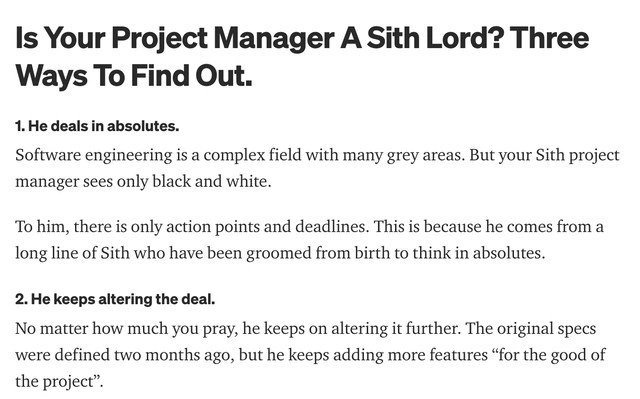
When Your Project Manager Goes Full Sith With Absolutes And Ever-Changing Requirements
Management PMs Post #4653, on Jul 6, 2022 in TG

When Your Project Manager Goes Full Sith With Absolutes And Ever-Changing Requirements

Why is this Management PMs meme funny?

Level 1: Changing the Rules

Imagine you’re playing a game where one person is in charge, and they set a strict rule like, “You must finish this level in 5 minutes or you lose, no excuses.” That’s an absolute deadline – no flexibility at all. Now imagine that same person keeps changing what you have to do in the game while you’re playing. First they said, “Just collect 3 stars to win.” But then, a minute later, they say, “Actually, collect 5 stars... for the good of the game!” And just when you’re about to get those 5, they add, “Oh, also defeat the dragon too, it’ll make the game better.” They keep changing the rules of the game, but they still expect you to finish in the same 5 minutes. Feels unfair, right? You’re working hard to keep up, and every time you think you know what needs to be done, something new gets added. And if you complain or say “This is too much,” they just insist, “No complaints – you have to do it, this is how it must be.”

This meme is joking that some project managers (the bosses in charge of software projects) act just like that rule-changing friend. They say everything is absolutely due by a certain time (no wiggle room), but they also keep adding new tasks or changing what they want. It makes the team feel frustrated, kind of how you’d feel in the game scenario. By comparing that boss to a Sith Lord (an evil character from a movie who likes to boss people around and doesn’t listen to others), the meme uses a funny storytelling shortcut. It exaggerates the boss’s behavior to show how extreme and silly it feels. In simple terms, it’s funny because it’s like calling your strict, ever-changing teacher a cartoon villain – it’s a relief to laugh about something that’s actually stressful. The heart of the joke is the feeling every kid (or developer) knows: when someone in charge gives you orders that never stop changing, it’s so ridiculous you have to laugh!

Level 2: Scope Creep Strikes Back

For those newer to software projects, let’s break down the joke. The meme compares a hard-charging project manager to a Sith Lord (the villains in Star Wars). Why? Because this manager does two notorious things that developers dread: dealing in absolutes and altering the deal. These phrases come straight from Star Wars lore, but they perfectly describe common problems in ProjectManagementHumor:

  • “He deals in absolutes.” In everyday terms, this means the manager sees things in black-and-white. Software development is usually full of uncertainties and gray areas – tasks can take more or less time than expected, and sometimes you discover new challenges along the way. A flexible, experienced manager understands that estimates can change. But a Sith-like project manager insists on absolute commitments: e.g., “You must deliver feature X by Friday 5:00 PM, no matter what.” There’s no room for nuance or adjustment. This phrase references Obi-Wan Kenobi’s quote, “Only a Sith deals in absolutes,” implying that seeing things as all-or-nothing is an almost villainous trait. In a project setting, that attitude can feel oppressive. The PM sees only success or failure, with nothing in between. If a developer tries to explain a potential delay or a technical complication, this kind of PM might just respond with something like “No excuses. A deadline is a deadline.” That’s why the meme jokes that he comes from a “long line of Sith” trained to think this way. It’s exaggeration, of course – real project managers aren’t evil space wizards – but it highlights the frustration when a manager is inflexible and treats every deadline as a do-or-die absolute.

  • “He keeps altering the deal.” This is about constantly changing requirements. In project terms, this refers to scope creep. Scope means the total set of features and tasks that a project is supposed to include. When the scope creeps, it grows beyond what was originally agreed. Maybe two months ago the team and the manager sat down and decided exactly what would be built (the specifications). But ever since, the manager keeps adding new features or making changes beyond that initial plan. The meme’s phrasing “keeps altering the deal” directly echoes a scene from Star Wars where Darth Vader keeps changing his agreement with an allied character, Lando Calrissian – Vader says, “I am altering the deal. Pray I don’t alter it any further.” In the workplace, a PM who does this will say things like, “I know we decided on Features A, B, and C, but let’s also include D and E, they’re small and for the good of the project.” That quote in the meme (“for the good of the project”) is the kind of justification a PM might use to add more work. It sounds positive – who wouldn’t want the project to be good? – but to the development team it often signals unplanned extra work and likely UnrealisticDeadlines since the deadline usually doesn’t move accordingly. No matter how much the team “prays” or begs for stability, this Sith-like PM keeps changing the requirements further. In Star Wars, Vader’s altering of the deal is a threat; in software, a manager altering the specs feels like a threat to the project’s success (and the team’s sanity!).

So why is this funny? It’s a form of TechHumor that exaggerates real experiences. Many developers have had a manager or a client who suddenly changes what needs to be delivered, or who expects certainty in an uncertain process. By using a star_wars_reference, the meme makes light of it. It’s easier to laugh at the situation when you frame your boss as a cartoonish villain. The project_manager_antagonist trope (where the PM seems like the bad guy) resonates because when you’re a junior developer working late to meet a deadline, a manager who keeps adding tasks can feel like an antagonist, even if they’re not evil in reality.

Let’s define a few terms clearly:

  • Scope Creep: This is when the scope (the list of planned features or tasks) keeps expanding over time. It often happens in projects that aren’t well defined or controlled. For example, you start building a simple website with agreed features, but then someone keeps saying “Oh, can we also add this? And that? And maybe this other thing too?” If you don’t manage it, you end up with a much bigger project than you signed up for – without more time or resources to do it. That’s scope creep: the project’s scope “creeps” larger and larger, often quietly until it’s a big problem.
  • Deadline: A deadline is the due date or final time by which something must be completed. Deadlines in software can be tricky because it’s hard to predict exactly how long complex tasks will take. A reasonable project plan includes some flexibility or buffers. But an “absolute” deadline means the date is fixed firmly – no matter what happens you’re expected to be done by that day. The meme’s manager treats deadlines as absolute, which is tough because in real projects, unexpected delays can occur. If someone “deals in absolutes” with deadlines, they might say things like “Failure is not an option” or “We will deliver on that date,” even if current progress or reality suggests otherwise.
  • Black-and-white thinking: This means seeing only two extreme options and nothing in between. In psychology, it’s also called all-or-nothing thinking. In a work context, black-and-white thinking would be like a boss saying “Either the project is a complete success and delivered on time or it’s an utter failure.” It ignores the subtlety that maybe a one-week delay could still lead to a great result, or that partial success is possible. The meme’s PM is depicted as having this trait, which is why he’s likened to a Sith (since in Star Wars, the Sith and Jedi are literally dark vs light with no middle ground).
  • Stakeholder: A stakeholder is anyone who has an interest in the project (clients, bosses, users, etc.). Stakeholder expectations are what those people hope or expect the project will accomplish. Often, changing stakeholder expectations (say a client suddenly wants a new feature after seeing a demo) are what cause scope creep. A good project manager normally manages these expectations and negotiates changes carefully. The meme suggests our Sith-like PM just accepts all changes (or imposes them) willy-nilly “for the good of the project,” without regard for the poor dev team.

Even if you haven’t seen Star Wars, the humor still lands because you recognize the situation: a boss who constantly shifts the goalposts and yet demands certainty and punctuality. It’s poking fun at a management style that is ironically both overly rigid (about rules and deadlines) and overly chaotic (about what’s being built). The title “Three Ways To Find Out” and the format mimic those internet list-articles, making it extra funny for anyone used to tech blogs or LinkedIn posts. The meme basically says: if your project manager behaves like this, you might joke that they’ve gone “full Sith.” And if you’re a junior developer encountering this, well, welcome to the real world of software projects – thankfully, not all managers are like this, but the ones that are have a way of turning projects into an epic struggle.

Level 3: The Dark Side of Deadlines

In this meme, a project manager is humorously portrayed as a Sith Lord – a villain from Star Wars – to highlight classic software project woes. It’s a piece of sharp DeveloperHumor mixing pop culture with workplace reality. The headline sets the scene: “Is Your Project Manager A Sith Lord? Three Ways To Find Out.” Immediately, seasoned developers recognize the signs of a manager succumbing to the Dark Side of ProjectManagement: rigid black_and_white_thinking (no nuance, “he deals in absolutes”) and relentless ScopeCreep (“he keeps altering the deal”). These are two infamous pain points in tech: UnrealisticDeadlines set in stone, and ever-changing requirements that expand infinitely "for the good of the project."

For veteran engineers, this scenario is all too real. We’ve met that Sith-like PM who sees only success or failure, with nothing in between. To such a manager, delivery dates are inviolable prophecies, and tasks are either completely done or not done at all – no extensions, no partial credit. Software engineering, of course, lives in the gray areas: unexpected bugs, integration hiccups, and StakeholderExpectations that evolve. But the Sith project manager ignores these realities, declaring absolute deadlines as if using a dark force. It’s ManagementHumor with a bite: only a Sith (or an overzealous PM) deals in the absolutes of “No delays, no excuses.”

The second sign, “He keeps altering the deal,” is a direct nod to Darth Vader’s famous line “I am altering the deal. Pray I don’t alter it any further.” In the developer’s world, that line translates to continuous scope expansion. A feature freeze was agreed upon two months ago, yet new features and changes keep getting tacked on each week. This is the dreaded scope creep incarnate. Every experienced dev knows that sinking feeling when a PM cheerily announces “Just one more tiny change” despite the plan being locked – it’s as if Vader himself strolled in to say he’s changing the agreement. The meme even jokes about the PM’s justification: “for the good of the project.” Seasoned teams recognize this as the standard excuse for piling on extra work late in the game. It’s practically Sith code for “I have altered the requirements; pray I do not alter them further.”

The humor works on multiple levels. First, it casts the project_manager as the antagonist (the project_manager_antagonist), letting developers identify as beleaguered Rebels under an Empire of endless Jira tickets and Gantt charts. There’s a shared catharsis in exaggerating a tough ProjectManagement situation into an epic struggle of good vs evil. Second, the Star Wars references – sith_lord with absolute edicts and endlessly altering deals – are spot on. The phrase “He deals in absolutes” echoes Obi-Wan Kenobi’s warning (“Only a Sith deals in absolutes”) and satirically describes a manager who only understands binary outcomes: delivered on time or total failure. Meanwhile, altering the deal perfectly encapsulates infinite_scope_addition: just when the developers think the requirements are final, there comes another “small tweak” that fundamentally changes the agreement. It’s a one-two punch of developer nightmares: no flexibility on timeline, but infinite flexibility on scope. The meme formats these as a tongue-in-cheek blog post (a listicle of warning signs), poking fun at how common these issues are.

In reality, such Sith-like behavior leads to late-night coding marathons and frayed tempers. A PM who “keeps altering the deal” without adjusting timelines is basically summoning a DeadlinePressure monster – one that senior devs know all too well. It’s the dark path to technical debt, burnout, and failed projects, as foretold by countless post-mortems. The dark humor here is that every developer either has experienced this or fears it. In meetings, we half-joke about “going to the Dark Side” when managers become unyielding or when requirements keep mutating. This meme nails it: it’s funny because it’s painfully true. When your PM embraces the Dark Side of management, you end up feeling like Luke Skywalker in the trench run with no targeting computer – expected to hit impossible goals through sheer faith. And if you dare voice doubt? Well, you can almost hear your PM intoning, “I find your lack of faith disturbing.” 😈

Description

The meme is a white page of black serif text, styled like a blog article. A large bold headline reads, “Is Your Project Manager A Sith Lord? Three Ways To Find Out.” Below, two numbered bold sub-headers appear: “1. He deals in absolutes.” and “2. He keeps altering the deal.” Each bullet is followed by paragraph text explaining that software engineering is full of grey areas but the Sith-like PM sees only black-and-white action points and deadlines, and that he continually adds new features despite agreed-upon specs. Quoted phrase marks around “for the good of the project” emphasize unwelcome scope creep. Technically, the joke skewers rigid management mind-sets, unrealistic deadlines, and constant requirement changes - classic pain points for engineers working with project managers

Comments

6
Anonymous ★ Top Pick Our PM froze the release date in carbonite, then force-pushed three new epics into the sprint - turns out he’s added a fourth axis to the CAP theorem: C for Creep
  1. Anonymous ★ Top Pick

    Our PM froze the release date in carbonite, then force-pushed three new epics into the sprint - turns out he’s added a fourth axis to the CAP theorem: C for Creep

  2. Anonymous

    The real dark side is when they say "I find your lack of velocity disturbing" while simultaneously adding three more epics to the sprint that's already at 200% capacity

  3. Anonymous

    Every senior engineer knows the PM who 'alters the deal' mid-sprint - you agreed on three story points, but now it's five 'because we're already touching that code anyway.' The Sith Lord comparison is apt: both wield absolute authority, both ignore the nuanced reality of complex systems, and both somehow convince leadership that adding 'just one more feature' won't delay the Death Star launch. The real tell? When your PM says 'I am altering the deal, pray I don't alter it any further,' except they definitely will, and your sprint retrospective becomes a therapy session about scope creep and the dark side of stakeholder management

  4. Anonymous

    When the PM says "pray I don’t alter it further," I rename the branch to release-2025-infinity and switch the burndown to a burn-up - entropy and scope creep are both monotonic

  5. Anonymous

    Sith PMs don't just alter the deal - they refactor requirements mid-sprint, praying you don't notice the breaking changes

  6. Anonymous

    Our PM is definitely Sith: estimates are absolutes, buffers are “a lack I find disturbing,” and any spec freeze is just carbonite until the next stand-up when he alters the deal

Use J and K for navigation