Skip to content
DevMeme
5580 of 7435
Misplaced Blame: The Muscle Memory of Internet Outages
OnCall ProductionIssues Post #6123, on Jul 19, 2024 in TG

Misplaced Blame: The Muscle Memory of Internet Outages

Why is this OnCall ProductionIssues meme funny?

Level 1: Blaming the Wrong Kid

Think of it like a classroom or a family situation. There’s one kid who usually causes all the trouble. Whenever something bad happens – a loud noise, a broken vase – the teacher or parent immediately shouts that kid’s name to stop them, “Johnny, no!” One day, a lamp falls over. The adult yells, “Johnny, no!” out of habit, because Johnny is always the troublemaker. But this time, Johnny wasn’t the one who did it. The adult pauses and says, “Oops, sorry, force of habit,” and then scolds the real culprit – maybe another kid who actually knocked over the lamp. It’s funny because the grown-up was so used to blaming the same kid that they almost blamed him even when he was innocent. In the meme, Cloudflare is like that usually naughty kid who often gets blamed, and CrowdStrike is the other kid who actually caused the problem this time. The joke shows how we can quickly point a finger at the usual suspect out of habit, then realize it was the wrong target and correct ourselves. It’s a silly reminder that old habits can make us jump to conclusions, and sometimes we have to say “sorry, force of habit” and find who’s really responsible.

Level 2: Blame and Switch

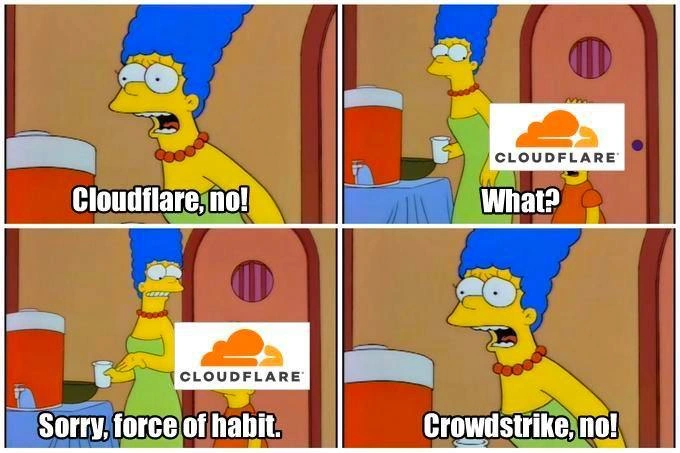
In this four-panel Simpsons meme, we see Marge Simpson reacting to a crisis. Here’s what’s happening in real-world terms: The Ops team (represented by Marge) is dealing with a production issue. Marge first yells "Cloudflare, no!" because Cloudflare is a CDN (Content Delivery Network) that many companies use to speed up and protect their websites. Cloudflare sits in front of websites (at the edge of the network), so if Cloudflare has a problem, it can make many sites go offline. Ops engineers have learned from experience (sometimes too well) to suspect Cloudflare during outages – it’s almost a running joke in OnCallHumor circles. That initial yell is basically Marge blaming the CDN provider, assuming it’s the cause of the outage.

In the second panel, Bart’s face is covered by the Cloudflare logo. This visually turns Bart into “Cloudflare” in the scene. Marge’s confused "What?" as a subtitle shows she realizes something is off. By the third panel, Marge says "Sorry, force of habit." This means she didn’t actually have evidence against Cloudflare – she just blamed them out of habit (a reflex from many past incidents). This is the blame and switch moment: Marge switches her blame when she catches herself. In truth, the outage isn’t coming from Cloudflare at all.

By the final panel, Marge is yelling "CrowdStrike, no!" Now CrowdStrike is actually a completely different thing – it’s a security vendor that provides endpoint protection (kind of like an advanced antivirus/monitoring software running on servers and laptops). If CrowdStrike malfunctions or misconfigures, it could block network connections or consume resources, causing an internal outage or performance issues. In this scenario, the Ops team discovers that the real troublemaker is CrowdStrike (for example, maybe a new security update started blocking the web server process by mistake). So Marge corrects herself and yells at the right culprit.

This meme humorously highlights how in a tense production incident, engineers might jump to conclusions. Cloudflare and CrowdStrike have similar-sounding names (both start with “Crow/Cloud”), which adds to the mix-up. Plus, they operate in different domains: Cloudflare is part of the cloud infrastructure (network/caching layer), whereas CrowdStrike runs on individual machines as a security measure. During an outage call (sometimes called a war-room), it’s easy to grab onto a familiar name. If a website is down, someone might immediately think “Cloudflare must be having issues” especially if that’s happened before. This is that blame_shift reflex. But then the team checks and sees Cloudflare is actually fine (no errors on the Cloudflare dashboard, no widespread internet issue). That’s the "What?" moment – the theory doesn’t hold up. Digging deeper, they might find clues of a security agent (CrowdStrike) causing the problem (like logs showing it quarantined a critical process). Then comes the realization "Oops, wrong blame," and they redirect focus to the actual root cause.

It’s funny and relatable in tech because every junior developer or newbie on call eventually sees this pattern: something breaks, people initially blame one usual suspect (maybe DNS, maybe a cloud provider like Cloudflare, etc.), then find out it was something else entirely. The meme uses Marge Simpson’s exaggerated reactions to make it comical. For someone new to OnCall_ProductionIssues: imagine being up late, your website is down, and you have multiple tools/vendors in your stack. You might see an error and instinctively think of the biggest, most failure-prone component first. The lesson is, don’t jump to conclusions – even if your habit (or a teammate’s habit) is to always yell “X service is down!” The correct approach is to gather data calmly. But under stress, habits take over, which this meme playfully points out. It’s a piece of OpsHumor that also serves as a gentle reminder: check your assumptions, because the real issue might be something else in disguise.

Level 3: Orange Cloud, Red Herring

The meme captures a classic on-call blame-game scenario: an outage hits, panic ensues, and someone instinctively shouts “Cloudflare, no!” before any evidence. Why Cloudflare? Because in modern cloud ops, Cloudflare (a huge CDN provider) is the go-to scapegoat whenever sites go down. It’s the new "it’s always DNS," except now "it’s always Cloudflare." The ops team has probably been burned by a cloudflare_outage before – maybe a misrouted BGP update or a bad WAF rule took down half the internet – so now they’ve got a knee-jerk reflex: blame the edge. This habit is so ingrained that even when the real issue is elsewhere, Cloudflare still catches the first accusation by sheer muscle memory.

In the meme, Marge Simpson’s frantic "Cloudflare, no!" represents that on-call reflex. We see Bart with the orange Cloudflare logo slapped over his face – literally making Cloudflare the usual suspect. The twist is Marge’s quick “What? … Sorry, force of habit.” She realizes she barked up the wrong tree. The actual culprit is CrowdStrike, a security vendor (think anti-malware agent on servers). So Marge corrects herself: "CrowdStrike, no!" This is hilarious to seasoned ops folks because it satirizes incident root cause confusion: you start by blaming the familiar CDN provider (the red herring in this case), then sheepishly pivot to the real issue – an overzealous security agent like CrowdStrike causing hiccups. It’s security_vendor_confusion at 3 AM – Cloudflare vs CrowdStrike, cloud vs crowd, edge vs endpoint – who can even keep them straight when everything’s on fire?

This simpsons_marge_meme nails the chaotic vibe of a war-room call. It’s poking fun at blame shift culture in on-call ProductionIncidents. Instead of methodically troubleshooting, tired engineers often shotgun-blame whatever burned them last time. If last month’s outage was Cloudflare, guess what gets blamed this time by reflex? It’s a darkly comic truth in Ops: our OnCallHumor coping mechanism is to develop “usual suspects.” Of course, a healthy blameless culture would encourage us to gather data first rather than shouting accusations – but in the moment, stress and habit win. The meme resonates because everyone in Ops has experienced that awkward moment of pointing at the wrong thing – “Oops, not you this time.” It’s an insider wink at how hard rapid incident_root_cause identification is in complex systems. When everything’s a distributed maze of cloud services and security tools, even the pros mix them up. This image is essentially Marge (the on-call engineer) yelling at the orange cloud (Cloudflare) out of habit, then realizing the real misbehaving child is the security software (CrowdStrike). It’s a CloudHumor snapshot of modern outages: OpsHumor born from the trenches of countless late-night triages.

Description

A four-panel meme using the 'Marge Simpson Krumping' format from The Simpsons. In the first panel, an alarmed Marge Simpson yells, 'Cloudflare, no!'. In the second panel, a small child, whose face is covered by the orange Cloudflare logo, looks up innocently and asks, 'What?'. In the third panel, Marge corrects herself with an embarrassed expression, saying, 'Sorry, force of habit,' while the child with the Cloudflare logo still looks on. In the final panel, Marge has correctly identified the source of the problem and yells with renewed alarm, 'Crowdstrike, no!'. This meme is a direct commentary on the massive global IT outage of July 19, 2024, which was caused by a faulty update from the cybersecurity company CrowdStrike. For years, Cloudflare has been the usual suspect for large-scale internet disruptions, and the meme humorously plays on the IT community's ingrained habit of blaming them first. It perfectly captures the collective moment of realization when the tech world had to update its mental model of 'who breaks the internet'
Comments

7
Anonymous ★ Top Pick Our incident response runbook now has a new Step 0: 'Confirm it's not actually Cloudflare this time.' We're thinking of automating it with a shell script that just returns 'It was CrowdStrike.'
  1. Anonymous ★ Top Pick

    Our incident response runbook now has a new Step 0: 'Confirm it's not actually Cloudflare this time.' We're thinking of automating it with a shell script that just returns 'It was CrowdStrike.'

  2. Anonymous

    We finally automated incident triage: the Slack bot blurts “Definitely Cloudflare,” waits 90 seconds, edits to “Actually CrowdStrike,” and while everyone debates vendors, Terraform silently rolls back our own bad deploy

  3. Anonymous

    When you've been debugging CDN issues for so long that you instinctively blame Cloudflare for everything, but then remember it was actually CrowdStrike's kernel driver that took down half the Fortune 500's Windows fleet - the muscle memory of incident response dies hard

  4. Anonymous

    When you've been on-call through enough Cloudflare incidents that your muscle memory kicks in before your brain processes which vendor actually pushed the bad update this time. The real joke is that we've architected ourselves into a world where a handful of companies can accidentally BSOD half the planet's endpoints or take down a significant chunk of the internet - and we just shrug and add it to our incident retrospective template

  5. Anonymous

    Incident reflex: blame Cloudflare/DNS; 2024 taught us the edge can be fine while your EDR ships BSOD-as-a-service across the entire Windows fleet

  6. Anonymous

    When your muscle memory confuses zero-downtime CDNs with global-meltdown EDRs

  7. Anonymous

    Runbook step zero: before paging the CDN, check whether your EDR shipped a kernel driver in BSOD-as-a-service mode

Use J and K for navigation