The Cardinal Sin of Friday Deployments
Why is this Deployment meme funny?
Level 1: A Mess at the Wrong Time
Imagine you’re in class on a Friday afternoon, just minutes before the final bell rings for the weekend. The teacher has reminded everyone not to start anything new and messy. But one kid decides that right now is the perfect time to open up a big box of glitter for an art project. 🌟 Boom! The glitter spills everywhere – on the desks, on the floor, all over their clothes – just as school is ending. Now, instead of going home to relax, the teacher and that kid have to stay late to clean up a sparkly disaster. Everyone else has left to enjoy their weekend, but they’re stuck dealing with the mess.
This meme is joking about the same kind of situation, but in a software office. Doing a big, risky software update on Friday is like making a huge glitter mess right before going home. If the update causes problems (the “mess”), the developers have to spend their weekend fixing it instead of resting. In simple terms: it’s funny because the person chose the worst possible time to do something risky, and of course it went wrong. The lesson? Don’t do really important or risky things right before you’re about to relax, or you might end up cleaning up a big mess when you should be having fun.
Level 2: Weekend Woes Guaranteed
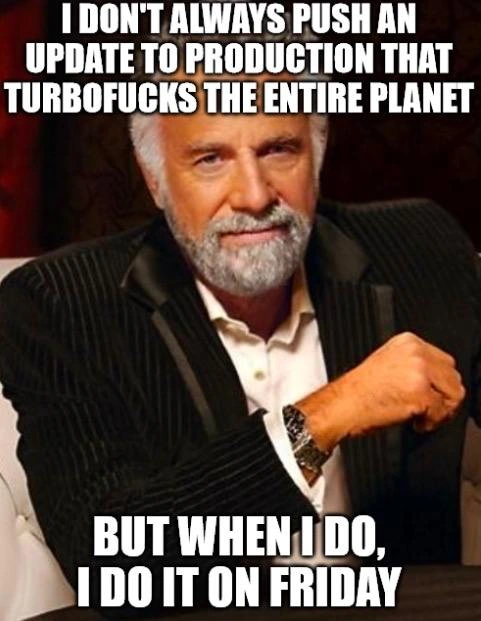
Let’s break down the joke in simpler terms. The meme shows the Most Interesting Man in the World (a popular meme character from a beer commercial) with text that reads: “I don’t always push an update to production that turbof**ks the entire planet, but when I do, I do it on Friday.” This is a humorous way of saying: “I rarely deploy a change that completely messes everything up... but when I do, I choose the worst possible time (Friday) to do it.” The humor targets a well-known rule among developers: “Don’t deploy on Friday.”
Why is deploying on Friday a bad thing? In software, deployment means releasing new code or updates to the production environment – that’s the live system users interact with (like a website or app). If something goes wrong with a deployment, it can cause a production issue or even a full production outage (meaning the site or service breaks or goes down). Now, imagine releasing a faulty update right before the weekend. A Friday evening deployment that “turbof**ks the entire planet” is an exaggerated way to say the update broke everything everywhere – of course it’s an overstatement, but it captures the feeling of an update causing widespread problems.
In real life, when a bad change causes a major production incident, someone has to fix it ASAP. Companies assign on-call engineers for this. Being on call means it’s your job to respond if the servers catch fire (hopefully figuratively!) at odd hours. If a deployment is done on Friday and causes problems, the on-call engineer is likely to get an alert on Friday night or over the weekend. That’s why we have the term OncallNightmares – because getting woken up at 2 AM on a Saturday to fix a broken website is basically a nightmare for developers and SREs. The meme jokingly implies that the person deploying on Friday is almost guaranteeing these weekend woes. Everyone else will be relaxing, but the development and DevOps/SRE team might end up scrambling to put out fires. There’s a lot of ReleaseAnxiety around end-of-week releases for this very reason.
This meme is rooted in DevOps culture and real practices. Many teams have a tradition or policy of no deployments on Fridays. Some even say “No deploys after 4 PM any day” as a safeguard. Why? Because if a bug slips through in a Tuesday deployment, you have all Wednesday to discover it and all hands available to fix it. But a bug in a Friday 5 PM deployment might not even be noticed until later that evening, and then half the team is offline or starting their weekend. It’s a worst-case scenario for ProductionIncidents. There are fewer people around to help, and those who are on-call might have to spend their Friday night or weekend debugging and patching the issue. Nobody wants to cancel their Friday plans or rush back to the office because a last-minute change broke the system. DeploymentRisks are simply higher when support is low.
To a newer developer (or someone outside tech), it might seem a bit superstitious – why is Friday any different from Monday? The difference is human factors and timing. Developers are human: by end of week, folks are tired, less inclined to rigorously test, or they may be eager to wrap up and start the weekend. If an issue arises, it might fester longer before anyone notices. There’s also something called prod push regret – that sinking feeling when you deploy something and immediately think, “Uh oh... should I have done that right before quitting time?” Experienced folks have felt that and learned from it (sometimes the hard way). The meme gets laughs because it’s basically a picture of a confident man joking about doing the very thing everyone’s been warned not to do.
It also helps to know the meme format. The “Most Interesting Man” meme always starts with “I don’t always do X, but when I do, I Y.” It was originally an ad featuring a cool, bearded gentleman and became a template for joking brags. Here, X = “push an update to production that breaks everything” and Y = “do it on Friday.” The devops_meme_reference here is calling out the classic folly of Friday deployments. It’s a bit of gallows humor among IT folks: we know doing a big deploy on a Friday is asking for trouble, so only a comically over-the-top character would be proud of it. The friday_deployment_culture reference is real – many tech teams talk about it. You might even see jokes on Twitter like, “It’s 4 PM Friday, time to deploy to prod and then log off 😈.” It’s sarcastic, of course, because the expectation is that something will break.
In summary, this meme is funny to developers because it jabs at a common DeploymentPainPoint. The top text sets up a rarely done, extremely bad action (breaking the entire system) and the bottom text delivers the punch: he does that right before the weekend, ensuring maximum chaos. It’s a shared joke about DeploymentRisks and how not to release software. Anyone who’s been through a ProductionIssue on a Friday night will relate (probably with a groan). The message: if you’re going to break the system, at least don’t do it at the start of your weekend!
Level 3: Friday Release Roulette
At the highest level, this meme highlights a notorious DevOps gamble: deploying a change to production on a Friday evening. In seasoned engineering circles, pushing code right before the weekend is like spinning a revolver’s cylinder – a terrifying round of Release Russian Roulette. The top caption’s hyperbolic phrase about an update that “turbofucks the entire planet” encapsulates those nightmare deploys that cascade into a global ProductionOutage. Think of an innocuous one-line config tweak that accidentally brings down a critical microservice cluster, or a database migration script gone rogue that locks up production databases worldwide. The meme exaggerates for effect, but every senior developer knows the sting of a change that unexpectedly wreaks havoc far and wide (it’s practically an industry trope that it’s always the tiny change that triggers the meltdown).
What really sells the humor is the Most Interesting Man meme format – a distinguished gentleman smugly proclaiming an outrageous deed. Here he boasts: I don’t always push code that nukes everything, but when I do, I make sure it’s on Friday. This tongue-in-cheek bravado speaks to a shared experience in DevOps/SRE culture. It satirizes that overconfident developer mindset right before a weekend: the misguided optimism of “It’ll be fine, what could go wrong?” just before all hell breaks loose. Seasoned Site Reliability Engineers (SREs) and on-call developers will smirk (or cringe) because they’ve lived this. They’ve been paged at 2 AM on a Saturday due to a Friday deploy gone bad. They’ve sat bleary-eyed in a war room (real or virtual) muttering expletives at a broken build while their families wonder why a “quick update” turned into an all-nighter. The DeploymentRisks are sky-high because when something breaks late on Friday, you’re often dealing with skeleton crew support and slower response, which can turn a minor glitch into a protracted outage.
This meme’s dark comedy lies in how relatable it is to experienced engineers. It riffs on the unwritten rule “Don’t deploy on Friday”, a rule forged by countless ProductionIncidents and painful OnCall experiences. In theory, with robust CI/CD pipelines, automated tests, and canary releases, deploying any day of the week (even Fridays) should be safe. Modern practices aim for “routine” deployments where day shouldn’t matter – in an ideal DevOps utopia, code flows to production continuously without drama. But reality often begs to differ. Humans get nervous; processes have gaps; monitoring might be imperfect. By Friday, people are tired, and if a serious bug slips through, the timing couldn’t be worse. The meme is essentially a cynical veteran’s in-joke: even though we strive for always-available services, Murphy’s Law loves to strike at week’s end. DeploymentPainPoints that could be handled swiftly on a Tuesday at 2 PM become all-hands emergencies when they occur Friday at 7 PM. And trust me, nothing bonds a team (or scars a team lead) like spending a weekend battling a prod outage triggered by a last-minute change.
To those in the know, the image conjures up PTSD and dark humor simultaneously. It’s not just making fun of an individual, but of a whole pattern: the overconfident deploy followed by the inevitable “oh no…” moment. The wise-cracking tone (“but when I do, I do it on Friday”) hints that this scenario, while rare, is the ultimate facepalm – a self-inflicted crisis at the worst possible time. Industry veterans swap stories of “that one Friday push” the same way war stories are told. Teams have learned (the hard way) to institute deploy freezes late in the week or to require extra sign-offs for Friday changes. Some implement feature flags and gradual rollouts as safety nets, yet even those measures can fail spectacularly if the change is fundamentally flawed. Thus, the meme gets a nod of appreciation from seniors: it’s funny because it’s true. We laugh, perhaps a bit bitterly, because we’ve walked in those shoes, frantically rolling back a bad release while the rest of the world enjoys their weekend.
Just to illustrate the scenario, here’s what that fateful Friday might look like in pseudo-command form:
$ git commit -m "Fix critical issue, hope it doesn't break anything"
$ git push origin main # 4:59 PM Friday: YOLO deploy begins
# ... 30 minutes later ...
# PagerDuty alarm: "Critical outage in production! Servers down 🚨"
In short, FridayDeployments are a daredevil move. The meme perfectly captures the mix of bravado and regret: it’s a satirical take on those infamous end-of-week releases that send everyone into ReleaseAnxiety mode. Seasoned DevOps folks chuckle because they’ve survived a few “Friday fiascos” themselves, and they appreciate the bold, ironic truth in the Most Interesting Man’s declaration.
Description
This image uses the classic 'The Most Interesting Man in the World' meme format. It features a suave, grey-bearded man in a pinstripe suit, looking confidently at the viewer. The text, in the typical bold impact font, is split into a top and bottom caption. The top text reads, 'I DON'T ALWAYS PUSH AN UPDATE TO PRODUCTION THAT TURBOFUCKS THE ENTIRE PLANET'. The bottom text completes the thought with, 'BUT WHEN I DO, I DO IT ON FRIDAY'. The meme humorously captures one of the most infamous anti-patterns in software development: deploying code on a Friday afternoon. This practice is widely discouraged because if the deployment causes a critical issue (i.e., 'turbofucks the entire planet'), engineers must sacrifice their weekend to fix it. The joke resonates deeply with any developer or operations professional who has ever experienced the dread of a weekend-long production incident, making the cavalier attitude of 'The Most Interesting Man' both funny and painfully relatable
Comments
7Comment deleted
My CI/CD pipeline has a special 'Friday afternoon' mode. It just runs `git stash` and sends a Slack message saying 'Let's circle back on this Monday.'
Friday deploys are like a single-node etcd cluster - technically allowed, but you’ll spend the weekend praying to the Raft gods
The real 10x engineer isn't the one who writes code 10 times faster - it's the one who can create a P0 incident that affects 10 different continents simultaneously, then disappear for the weekend while the on-call team discovers their 'minor config change' actually rewrote the laws of physics in production
The Friday 4:55 PM production deploy: where 'move fast and break things' meets 'I'll be unreachable until Monday.' It's the perfect storm of optimism bias, deadline pressure, and the mistaken belief that your monitoring will catch issues before your VP does. Bonus points if you're deploying a database migration that can't be rolled back, because nothing says 'I trust my code' like betting your weekend plans on a zero-downtime cutover
Friday deploys: Turning 'zero-downtime deployment' into 'zero-weekend for SREs' with elegant precision
Friday deploys are just unscheduled chaos experiments with an irreversible migration and a stale runbook - the canary is your weekend
We only deploy on Fridays if it’s a forward-only DB migration and a cache key change behind a “temporary” feature flag - gotta keep the DR runbook and our DORA change-failure rate in shape