Skip to content
DevMeme
5579 of 7435
CrowdStrike's Outage: Mimicking a Fraction of Its Own Power
Security Post #6122, on Jul 19, 2024 in TG

CrowdStrike's Outage: Mimicking a Fraction of Its Own Power

Why is this Security meme funny?

Level 1: Superhero vs Bullies

Imagine a superhero on the playground who’s incredibly strong. Now imagine a bunch of bullies decide to gang up to fight this one hero. They bring a whole bunch of friends, maybe even some big kids, just to have a chance. The hero easily handles them and laughs, saying, “Wow, look how many of them it took to even try to beat me!” This meme is just like that, but with computers. One very powerful protector (the superhero) is defending the computer, and the bad guys (the bullies) are all the viruses and hacked computers trying to cause trouble together. It’s funny because the hero is bragging a bit – he’s so strong that even a whole team of bullies isn’t enough to win. So the picture is joking that one good security program is like a superhero who can defeat lots of little bad programs without breaking a sweat.

Level 2: Botnet vs EDR

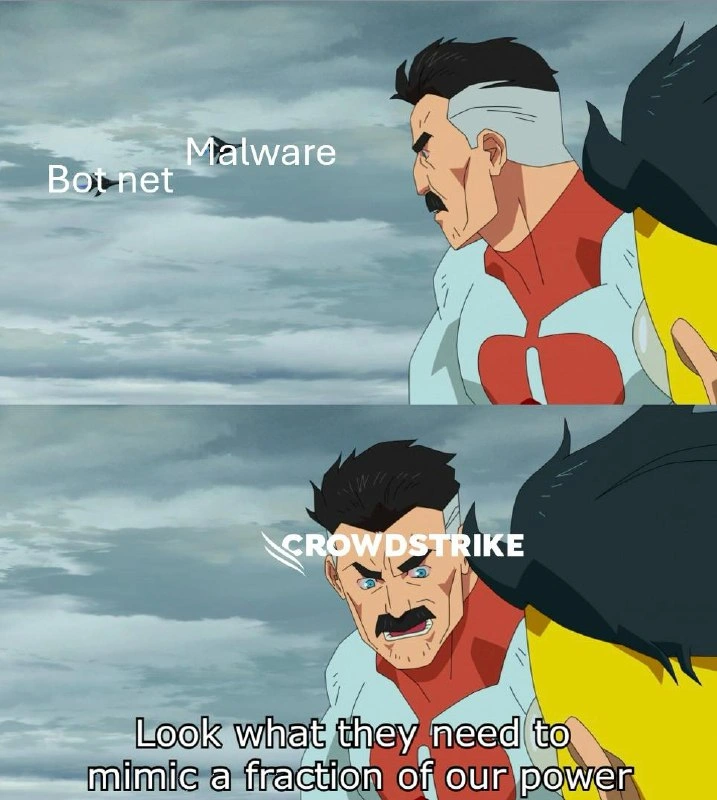
This meme uses a memorable scene from the animated series Invincible as a superhero analogy to explain modern cybersecurity. Omni-Man, the character in the white-and-red suit, is known for being extremely powerful. In the top image, he’s watching two small fighter jets zoom toward him. In the meme, those jets are labeled “Bot net” and “Malware,” representing common cyber threats. A botnet is basically an army of hijacked computers all controlled by an attacker – imagine hundreds or thousands of infected PCs acting together to attack a target. Malware is malicious software (like viruses or trojans) that bad actors use to break into systems or cause damage. So the meme sets the stage: a couple of typical bad guy tricks (a botnet and a piece of malware) are trying to take on a hero.

In the bottom panel, Omni-Man has the bold CrowdStrike name and falcon logo across his chest, showing that he symbolizes the CrowdStrike EDR product. CrowdStrike is a well-known cybersecurity company that makes an Endpoint Detection and Response (EDR) platform. EDR is like an advanced guard dog for your computers (endpoints). It constantly watches for suspicious activity on a laptop or server and can pounce on anything that looks malicious. Think of it as next-generation antivirus: not only does it find known viruses, but it also spots unusual behavior (for example, if a program suddenly starts trying to encrypt all your files or contact a weird server, an EDR will raise an alert or stop it). CrowdStrike’s EDR, in particular, is cloud-based – meaning each computer with the CrowdStrike agent reports to a powerful cloud system that analyzes threats using big data and even machine learning. That makes each endpoint’s protector much “smarter” and quicker to respond than old antivirus software that only knew about pre-listed virus signatures.

Now the text on the meme, “Look what they need to mimic a fraction of our power,” is originally Omni-Man’s line from the show. It’s basically a boast: “See how much effort they have to put in just to copy a little bit of what we can do.” In our cybersecurity context, it implies that attackers have to throw an entire arsenal (the combined force of a botnet and nasty malware) just to challenge a single EDR-protected machine – and even then, they’re only imitating a fraction of its defensive power. This is funny to security folks because on a daily basis, they see how easily good security tools handle basic threats. For example, a junior analyst might excitedly report, “We just blocked a malware file that came in via email,” and the senior engineer smiles because the EDR did it automatically in the blink of an eye. The meme exaggerates that scenario: it’s like the CrowdStrike software is a superhero saying to the malware, “Seriously? You had to use a whole botnet to even get my attention.”

It’s an EDR vs. malware showdown presented in comic form. The CrowdStrike Falcon (their mascot/logo) on Omni-Man’s chest signals that one security product is as mighty as a superhero. Meanwhile, the botnet and malware are depicted as tiny by comparison, implying they’re outmatched. This resonates with people new to cybersecurity as well: it highlights how far defensive technology has come. Not too long ago, a single virus could wreak havoc on an unprotected machine. But with a strong EDR in place, that same virus might not even make a dent – it’s stopped almost effortlessly. So the meme is a playful way of saying modern endpoint security is really powerful. It’s also a bit of a humble-brag on CrowdStrike’s part (or fans of it): endpoint protection so good that hackers feel like they’re fighting Omni-Man. For someone learning about security, the takeaway is clear: a well-designed security system can make life really hard for the bad guys, to the point where the bad guys need overwhelming force just to try to compete. And that’s both reassuring and a little bit amusing if you imagine it through a superhero lens!

Level 3: One Agent Army

In this meme, an endpoint security product is flexing like a comic-book demigod—and seasoned security engineers can’t help but smirk at the accuracy. The top panel shows two tiny fighter jets labeled Bot net and Malware rushing in vain at Omni-Man (a near-invincible superhero from the show Invincible). In the bottom panel, Omni-Man is emblazoned with the CrowdStrike logo (complete with its falcon), looking down at his defeated opponent and stating, “Look what they need to mimic a fraction of our power.” To a veteran security professional, this scene screams EDR vs. malware on any given day: even an entire botnet or a pile of viruses barely faze a modern endpoint defense platform. It’s an inside joke and a bit of a cyber defense brag, exaggerating how attackers must bring an army of threats to challenge a single well-fortified system.

What makes this so funny to those in the Security field is the kernel of truth inside the hyperbole. Products like CrowdStrike Falcon (a leading cloud-based EDR platform) are often touted as “next-generation antivirus” with nearly superhero levels of protection. A senior engineer knows that these tools combine multiple layers of defense—behavior monitoring, machine learning, kernel-level hooking, and global threat intelligence. So when we see Omni-Man (the ultimate one-man army) standing in for an EDR agent, it clicks instantly. Commodity malware and script-kiddie botnets feel like those tiny jets: annoying but ultimately swatted aside. The meme humorously captures that dynamic: “Look at these poor malware authors – they have to unleash a whole botnet or crafty malware strain just to even try to scratch us!” It’s a triumphant feeling any defender can relate to on a good day.

There’s also a wink here about the arms race in cybersecurity. Attackers often rely on strength in numbers or automation (spinning up countless infected machines in a botnet, or mass-spreading generic malware) hoping to overwhelm defenses. Meanwhile, a single EDR agent on a laptop is backed by a brain in the cloud and years of research – like Omni-Man backed by an entire Viltrumite empire of knowledge. One CrowdStrike-protected endpoint can automatically detect and block behavior that would slip past old-school antivirus. Security veterans have seen it firsthand: an employee accidentally runs some ransomware and boom! the EDR quarantines it within milliseconds. It almost feels unfair to the malware. Look what they need to even mimic a fraction of our power! – a senior engineer might chuckle at that thought during a malware analysis meeting.

Of course, this meme garners knowing grins because it satirizes vendor hubris as well. CrowdStrike being portrayed as Omni-Man (who, let’s face it, has a bit of an ego and a brutal streak) is tongue-in-cheek. Experienced folks know that no security product is truly invincible (there’s always a more advanced threat, a “Viltrumite-level” adversary, lurking out there). But the everyday reality is that low-tier threats get crushed by good EDR tooling. The meme takes that satisfying reality and dials it up to superhero proportions. It’s basically the infosec equivalent of a victory lap: our one agent can handle what your entire bot army throws at us. That mix of truth and exaggeration, delivered via a famous Omni-Man meme format, is what makes seasoned security engineers smirk and think, “Yep, been there – our tools were totally flexing on the bad guys today.”

Description

This is a two-panel meme using the 'Look what they need to mimic a fraction of our power' format from the animated series 'Invincible.' In the top panel, the character Omni-Man looks disdainfully at two distant figures labeled 'Botnet' and 'Malware.' In the bottom panel, Omni-Man's expression is fierce and angry. He is now labeled with the CrowdStrike logo, and the subtitle reads, 'Look what they need to mimic a fraction of our power.' The meme is a satirical take on the massive global IT outage in July 2024, which was caused by a faulty update to CrowdStrike's security software. The humor lies in the profound irony: CrowdStrike, a company that protects against threats like malware and botnets, caused a far more widespread and catastrophic disruption with its own bug. The meme sarcastically suggests that malicious actors can't even come close to the level of chaos that CrowdStrike accidentally inflicted upon itself and its customers
Comments

8
Anonymous ★ Top Pick CrowdStrike finally demonstrated a vulnerability with a 10.0 CVSS score, but the exploit could only be triggered by their own deployment pipeline
  1. Anonymous ★ Top Pick

    CrowdStrike finally demonstrated a vulnerability with a 10.0 CVSS score, but the exploit could only be triggered by their own deployment pipeline

  2. Anonymous

    “EDR flex: ‘Look what the attackers need to mimic a fraction of our power’ - right before it burns 2 GB of RAM, hooks half the kernel, fires ten false positives, and still lets a one-liner PowerShell invoke walk straight in.”

  3. Anonymous

    The real distributed denial of service was the enterprise security software we deployed along the way. Nothing says 'defense in depth' quite like having your entire security vendor become a single point of failure that takes down 8.5 million systems faster than any APT could dream of - and they didn't even need a zero-day, just a regular Thursday update

  4. Anonymous

    When your EDR solution achieves what nation-state actors could only dream of: a global kernel panic at scale. CrowdStrike's Falcon sensor proved that with great kernel-level privileges comes great responsibility - and occasionally, the ability to BSOD 8.5 million Windows machines simultaneously. Who needs a sophisticated supply chain attack when a single content update can ground airlines and halt hospitals? The real zero-day was the friends we crashed along the way

  5. Anonymous

    Attackers need a botnet and custom malware just to mimic a fraction of the blast radius from a mis-scoped terraform apply

  6. Anonymous

    CrowdStrike's update: Achieving botnet-scale disruption with zero C2 servers, just one bad YAML channel file

  7. Anonymous

    The most effective DDoS is device-driver-as-a-service - ship one signed EDR kernel update with auto-update enabled and you out-scale Mirai without renting a single bot

  8. @ZgGPuo8dZef58K6hxxGVj3Z2 1y

    This is underrated

Use J and K for navigation