Generative AI: The Ultimate Tool for Mutual Corporate Annihilation
Why is this AI ML meme funny?
Level 1: Not Without Each Other
Imagine you and your friend have to work together on a school project. You do the building (like writing or drawing the project), and your friend does the organizing (like planning it out and making sure it’s done on time). Now, pretend you both get a super clever robot helper. You start thinking, “This robot is so smart, maybe I don’t need my friend to plan things anymore – the robot can tell me what to do, so my friend can go away!” At the same time, your friend is thinking, “This robot is so smart, maybe I don’t need you to do the building – the robot can make stuff, so you can go away!”
The funny part is both of you are excited to use the robot to replace the other person. Each of you wants to be the only one left, with the robot doing the other person’s job. But if you actually tried that, you’d quickly find out it doesn’t work well. The robot might be helpful, but it can’t do everything your friend can do, and it can’t do everything you can do either. In real life, making something great (like a big project or, say, a piece of software) needs both the creative builders and the organizers. The new robot helper can make the work easier, but it can’t replace your teamwork.
So the meme is like a joke about two groups of people (the ones who build things, and the ones who organize things) each saying, “Haha, this new AI robot means we don’t need you anymore!” It’s silly because, just like you and your friend, they really do need each other. The big lesson: cool new tools are great, but people still have to work together to get things done.
Level 2: The AI Silver Bullet Myth
At a simpler level, this comic is pointing out how both managers and developers are jokingly afraid and excited that generative AI could replace the other’s job. Let’s unpack the terms and ideas for a junior developer or someone newer to the tech world:
Generative AI: This refers to AI systems (often Large Language Models, or LLMs) that can generate content. For example, ChatGPT can produce human-like text when you prompt it, and GitHub’s Copilot can suggest code snippets. It’s called “generative” because it creates new sentences, images, or code based on patterns it learned from vast amounts of data. It feels a bit like having an assistant that’s read the entire internet and can try to produce something that looks right.
Why the Hype? Generative AI is a hot topic (especially around 2023-2024) because it’s surprisingly good at tasks that were once thought to need a human touch. It can draft emails, write boilerplate code, create designs, even generate meeting summaries. This led to a lot of AI hype – people started thinking, “Wow, if AI can do that, what (or who) can’t it do?” In companies, this turned into buzz about automating jobs. Hence the layoff fears: folks worry their roles might be replaced by AI automation. This cartoon plays on those very automation anxieties – but in a tongue-in-cheek way, since each group only talks about the other group getting replaced.
The Roles in Question: In a software team you typically have:
Developers (software engineers) – the people who write the code and build the product. They convert ideas or requirements into working software by programming, debugging, and problem-solving.
Managers (this could mean project managers, engineering managers, product managers, etc.) – the people who organize and coordinate the work. They plan timelines, clarify what needs to be built, remove roadblocks, manage team communication, and align the project with business goals. In short, managers handle the “who does what by when” and developers handle the “how to build it”. Both roles are important in corporate culture: one makes sure the product is right and delivered on time, the other actually creates it.What Each Side Thinks AI Will Do:
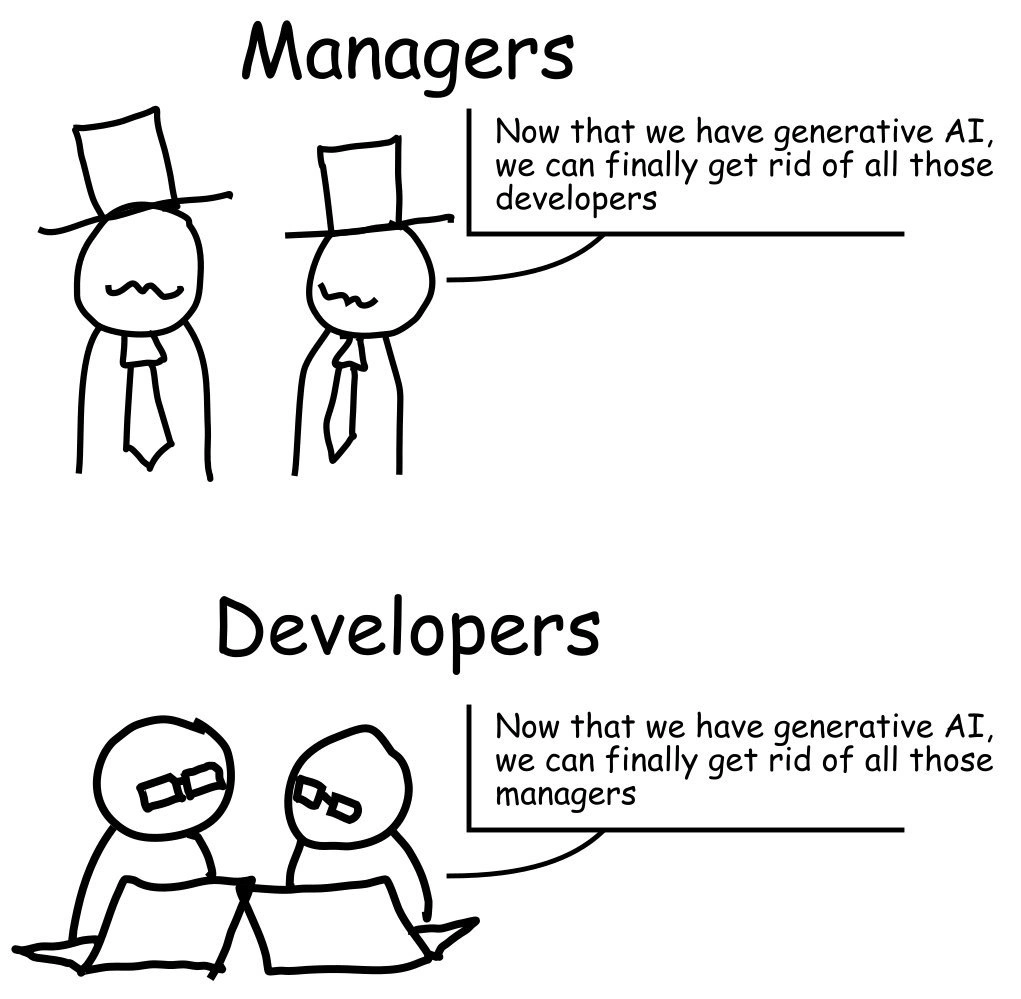
In the top panel (Managers): The managers say, “Now that we have generative AI, we can finally get rid of all those developers.” They’re thinking: if AI can write code, maybe we don’t need human programmers anymore. This reflects a real idea floating around management circles: “Perhaps we can rely on AI to produce software, and therefore hire fewer developers (who are often expensive and sometimes unpredictable).” Managers might imagine typing some requirements into an AI and getting a full application out, cutting down on salary costs and those tense meetings about delays or bugs. It’s an extreme scenario, but that’s the joke – they think AI is a magic solution.In the bottom panel (Developers): The developers say, “Now that we have generative AI, we can finally get rid of all those managers.” They’re thinking: if AI can handle project planning or routine management tasks, maybe we don’t need the managers telling us what to do. Many developers have felt the burden of what they see as “excessive management” – like sitting through long meetings or filling out status reports. With AI, they dream that a lot of that “paperwork and planning” could be automated by an intelligent system: maybe an AI tool that automatically creates a project plan, tracks progress, or answers the boss’s questions. Then, in theory, developers could just organize themselves using these AI-generated plans without a human boss. It’s a humorous exaggeration of a common developer gripe: “My manager doesn’t code, do we really need them?”
The “Silver Bullet” Reality: In software, there’s a famous saying: “No Silver Bullet,” meaning there’s no single technology that will magically solve all problems. Generative AI is the latest thing people mistakently see as a silver bullet. The reality is more nuanced:
- AI writing code: Tools like ChatGPT or Copilot can indeed produce code. For a junior dev, this might feel like a glimpse of the future – you type “Write a function to do X” and the AI suggests something. Cool, right? But anyone who’s tried this also knows the AI code often has issues. It might not handle edge cases, could contain bugs, or use outdated libraries. It has no understanding of why it’s writing that code; it just predicts something that looks right. So you still need developers to review and fix it. In fact, using AI is becoming a new skill for developers: knowing how to prompt it, then critically analyzing and testing what it gives you. Companies see AI as a productivity booster for devs, not a replacement.
- AI managing projects: Similarly, an AI can summarize a conversation, draft a generic project timeline, or even answer straightforward questions like “What’s a typical software release process?”. What it can’t do is truly lead a team. Management isn’t just shuffling paperwork; it’s also about human judgment. For example, if a client suddenly changes the project scope, a manager talks with stakeholders, reassigns priorities, and maybe has a tough conversation with the team about working overtime or negotiating deadlines. An AI wouldn’t autonomously know how to handle that situation appropriately — it would wait for someone to prompt it. And if two team members are having a conflict, an AI can’t step in to mediate or motivate them. Management is deeply human in that sense.
Mutual Dependency: The comic highlights a truth: software development needs both creation and coordination. If you only had developers and no one doing the managing, a project could lose direction (or developers might end up doing a lot of extra coordination work themselves, which they may not enjoy or be trained for). If you only had managers and no developers, well, nothing would actually get built! The fact that each group is joking about cutting the other out shows a bit of lack of appreciation for what the other side does. In practice, developers and managers rely on each other. A good manager empowers developers to do their best work by handling the noise around them. A good developer makes a manager’s planning worth something by delivering a quality product. The AI in the meme is like a new fancy tool dropped in the middle of this relationship, and each side immediately imagines, “Great, now I don’t need that guy anymore.” It’s funny because it’s one-sided thinking from both sides.
Current Context (AI Hype vs Reality): Around the time of this meme (mid 2020s), there’s a lot of talk about AI possibly replacing jobs. This is the AI replaces jobs meme you see in headlines. But usually, the reality is that AI changes jobs more than it outright removes them. For example, when calculators came out, people thought we wouldn’t need mathematicians or accountants anymore – but we still have those, they just use calculators to work faster and focus on harder problems. In the same way, generative AI might handle the easy, repetitive parts of coding or writing status updates, and humans handle the rest. Many companies are actually training their staff on how to co-work with AI rather than planning to fire one group entirely. The humor in the meme is that both the managers and devs are half-jokingly betting that this time the tech will wipe out the other side. It’s an exaggeration of real sentiments people have voiced in the tech industry. Developers really do make memes about “replacing my manager with a cron job” (i.e., an automated script) and some managers/executives have indeed mused “maybe in a few years we can have smaller dev teams, these AI tools are so good”. Both ideas are oversimplifications. AIHypeVsReality is exactly that gap between what people imagine and what really happens. The comic lives in that gap, pointing out the silliness of it.
Why it’s Funny to Tech Folks: If you’re new to developer humor, it helps to know that there’s often a lighthearted us vs them ribbing between roles:
- Developers sometimes joke that managers just create more work or don’t understand tech (“They keep asking for impossible features ASAP!” is a common frustration). So the idea of kicking out managers can feel like comical wish fulfillment.
- Managers (or more broadly, business people) sometimes joke that developers are divas or overly expensive (“They’re always behind schedule and say ‘it’s complicated’!”). So the idea of automating coding can sound temptingly simple – if only it were true. The meme exaggerates these feelings to make us laugh. Both groups are portrayed a bit caricatured: the managers in suits with top hats talking about firing devs (almost like villains in an old cartoon), and the nerdy devs plotting to remove management while pecking at keyboards. In reality, not all managers want to fire devs (they usually fight to hire and keep good devs!), and not all devs hate managers. But these stereotypes make the joke recognizable. It’s a form of corporate culture satire – exaggerating real attitudes just enough to be funny.
In essence, for a junior developer or someone learning about the industry, this meme is a reminder: don’t believe the hype that AI will overnight replace entire roles. History shows new tech often automates parts of jobs but also creates new responsibilities. Developers will likely always need people who understand the “why” and “what” of a project (often managers), and managers will always need skilled people to execute the “how” (developers and engineers). Generative AI is a powerful new tool for both sides: it can help write code faster or help draft plans, but it’s not a free human replacement. The comic just cleverly shows what happens if you take the hype to a ridiculous extreme – you end up with each side wishing for the other’s disappearance, which is funny because it’s so unrealistic and self-serving.
TL;DR (Too Long; Didn’t Read): Both panels show two groups in a software company (managers up top, developers at bottom) each saying: “Now we have AI, we don’t need them anymore!” It’s poking fun at the idea that AI will completely eliminate someone’s job. In reality, developing software needs both coding and managing, and AI is just another tool that helps with each – not a miracle that lets one group completely delete the other. Always be skeptical of the “one-click fix” or “all-tech-no-people” mindset; that’s the AI silver bullet myth this meme is joking about.
Level 3: Mutually Assured Redundancy
This meme hilariously captures a manager vs developer showdown in the age of generative AI hype. In two mirrored comic panels, each side gleefully imagines using AI to eliminate the other. It’s a case of mutually assured automation, where both think they’ve found a tech silver bullet to make the other team redundant. Experienced engineers and tech leads chuckle (perhaps darkly 😏) because they’ve seen this pattern before: whenever a new automation trend hits, someone in management thinks “Finally, we can trim those expensive devs!” Meanwhile, the developers joke “Finally, we can ditch those clueless managers!” It’s classic AI humor sliced with corporate cynicism, playing on real automation anxieties in today’s workplace.
Let’s break down why this scenario is so ironically on-point:
Symmetrical Hype Delusion: The humor comes from the perfect mirror image. In the top panel, two managers in cartoonish stovepipe hats (evoking that Monopoly-man vibe of old-school bosses) say, “Now that we have generative AI, we can finally get rid of all those developers.” In the bottom panel, two bespectacled coders at their laptops echo, “Now that we have generative AI, we can finally get rid of all those managers.” The punchline is that both groups share the exact same thought — each thinks AI will delete (read: fire) the other team. This role reversal joke highlights a corporate culture truth: managers and developers often undervalue each other’s contributions, each secretly thinking their role is indispensable while the other’s could be automated. Seeing both express that identical idea reveals the absurd bias: everyone imagines AI replacing someone else, not themselves.
Managers’ Fantasy – Auto-Code Utopia: Why would managers cheer for AI to replace devs? From a managerial perspective, developers are brilliant but costly resources (and occasionally, sources of headaches when deadlines slip). Generative AI like ChatGPT or GitHub Copilot promises to churn out code on prompt. To a non-coder executive enchanted by AI hype vs reality blur, it sounds like magic: “Just input requirements, get perfect code – no more moody engineers or blown estimates!” This meme riffs on that naive vision. Veteran devs know the trope too well: whether it was 4GL tools, low-code platforms, or outsourced teams, management has a history of hoping for ways to finally get rid of those developers and cut costs. Generative AI is just the latest shiny tool triggering those manager expectations. The seasoned cynics among us recall past buzzwords (anyone remember “CASE tools” or “expert systems”?) that promised to auto-generate software. Spoiler: those never eliminated the need for real developers. 🙄 In fact, when managers actually try this, they usually end up with spaghetti code and an emergency call to the dev team at 3 AM. It’s always some missing semicolon.
Developers’ Dream – Self-Driving Management: Conversely, why do developers jest about ousting managers with AI? There’s a long-running thread of developer humor imagining life with no project managers or PMs. To engineers in the trenches, managers sometimes seem to just schedule meetings, nag about TPS reports and shift priorities randomly. The fantasy is: “If only an AI could handle the planning, paperwork, and pep talks, we’d have no more status meetings or micromanagement!” In the meme’s bottom panel, the coders’ smug expression says it all. They think generative AI will automate all those status emails, gantt charts, and maybe even tell stakeholders “it’ll be done when it’s done” – freeing devs to code in peace. This reflects a real industry irony: devs often write scripts or bots to automate tedious management updates (auto-generating daily standup notes, anyone?) and joke that an algorithm might replace the boss. The comic exaggerates that sentiment to “get rid of all those managers.” It’s role displacement humor from the engineering side: the idea that an LLM (Large Language Model) could magically coordinate projects or make high-level decisions without human managers. Seasoned devs smile because they know how far-fetched that is – many have experienced chaotic projects where lack of good management was itself a nightmare. We might gripe about “pointy-haired bosses,” but we also know a good manager shields the team from even worse chaos.
The Reality Check: The AI hype is strong in 2024, but both groups are oversimplifying. In reality, software development is a team sport requiring both creation and coordination. The idea that “AI will replace X role entirely” is the height of AIHypeVsReality disconnect. AI is a powerful tool, but it’s not a cure-all. When managers pipe-dream about one-click code generation, they ignore that AI doesn’t understand nuanced requirements, can’t architect a whole system from scratch reliably, and often produces code that’s syntactically correct but semantically wrong (sound familiar? “It compiled, but didn’t actually do what we need”). Without developers, who will review, test, and maintain the AI-generated code? Who will handle unforeseen issues, edge cases, and technical debt? It certainly won’t be the exec in the stovepipe hat at 2 AM when the AI-written code causes a production outage. On the flip side, when developers fantasize about deleting managers, they gloss over the fact that someone needs to talk to users, set priorities aligned with business goals, and make tough decisions or trade-offs. Sure, an AI can draft a generic project plan or answer “what’s our next milestone?” based on data, but it has zero accountability or true understanding. Who handles the upset client when requirements change last-minute? Not the code-gen bot.
Why This Resonates: This meme resonates with anyone who’s lived through a corporate AI-hype cycle or the perennial “us vs them” tension between engineers and management. It’s management humor and engineering satire rolled into one. The absurdity lies in how both sides think the other is replaceable by tech, highlighting a lack of appreciation for each other’s work. In real life, good engineering needs good management and vice versa – an uncomfortable truth when budgets are tight or egos are big. The comic exposes that mutual dependency by showing the folly of each side’s wishful thinking. Both groups betting on AI to ax the other is like two sides of a company playing a bizarre zero-sum game, which in practice would be mutually destructive. If either “bet” came true, the whole operation would likely collapse. Seasoned professionals have seen what happens when organizations try to swing the pendulum too far: all tech and no coordination = products that never ship or meet customer needs; all management and no tech talent = vaporware and endless delays. The hype vs reality gap here is comical because it’s so extreme. We laugh, but a bit ruefully, because we recognize the seed of truth – how hype around new tech (be it AI or any automation) can make smart people seriously entertain some wild ideas about staff reorgs.
In summary, the meme uses AI-hype as the latest foil to poke at an eternal workplace dynamic. It underscores the folly of seeing generative AI as a magic wand to solve human problems (or settle grudges). Both the top-hat managers and the bespectacled developers are engaging in wishful thinking born from automation anxiety and a pinch of schadenfreude. The industry irony is that each side’s job looks easier to the other side than it really is – easy enough to imagine a computer doing it. Seasoned folks know better. As a wry veteran might say, “Go ahead, replace the devs with GPT-4 and the managers with a scheduling bot… I’ll grab popcorn and watch that deployment burn.” 🔥 In reality, successful teams leverage AI to assist humans, not to play Hunger Games with entire departments. This cartoon cleverly skewers the “AI will replace you (but not me)” mentality. It’s a funhouse mirror held up to corporate culture, reflecting our exaggerated hopes and fears about new technology. And as every battle-scarred engineer and manager knows, neither coding nor coordinating is as trivial as the other camp thinks – AI or no AI. The meme’s dark little ☺️ “🌚” emoji in the post caption even hints at that shadow of doubt: we’re laughing, but we’re also side-eyeing the AI revolution wondering if someone really might be plotting a team deletion somewhere.
To crystallize the expectations vs reality, here’s a cheeky comparison:
| Who | Believes AI will… | The Reality 😅 |
|---|---|---|
| Managers | auto-generate perfect code, hence no more pesky developers needed. | AI can produce code snippets, but it often needs debugging, context, and maintenance. Without developers, the codebase (and the AI itself) quickly falls apart. |
| Developers | auto-manage projects & people, hence no more meddling managers needed. | AI can churn out reports or schedules, but it can’t truly lead a team, handle human nuances, or adapt to changing business priorities. Managers (or someone in that role) are still needed to steer the ship. |
Each side imagines the other’s job is linear enough for a bot to do. But as seen above, AI augments work; it doesn’t eliminate the need for human judgment. The table is basically the meme in text form: a role displacement wish followed by a dose of reality. It’s both funny and informative, reminding us that however advanced our tools get, building real software products is a collaborative effort. Generative AI layoff fears might be the talk of the town, but this cartoon reminds us with a wink that if you actually tried to remove “all those developers” or “all those managers,” you’d just trade one set of problems for another (and likely end up rehiring in the end).
So, the seasoned perspective on this meme: it’s a witty reality check. It jabs at the manager vs developer rivalry and the current AI craze, highlighting a core truth in tech: there’s no free lunch and no complete “automate-my-colleague” button. We still have to work together, whether we like it or not. In other words, AI isn’t coming for your whole team, but it might just make the team laugh at itself – as this meme does brilliantly.
Description
This is a two-panel, black-and-white comic with a simple, hand-drawn stick figure style. The top panel is labeled 'Managers' and depicts two figures in top hats and ties. One manager says, 'Now that we have generative AI, we can finally get rid of all those developers'. The bottom panel, labeled 'Developers', shows two figures with glasses sitting at laptops. One developer mirrors the sentiment, saying, 'Now that we have generative AI, we can finally get rid of all those managers'. The meme satirizes the corporate tension and differing perspectives between management and engineering teams regarding the impact of AI. It humorously suggests that both groups see AI not just as a productivity tool, but as a means to make the other's role obsolete, reflecting the perennial friction over perceived value and necessity within a company structure

Comments
10Comment deleted
Of course managers think AI will replace developers. They've been operating under the assumption that a one-line JIRA ticket is a sufficient spec for years
When generative models hit prod, the only job left will be whoever still holds write access to the Terraform state
After 20 years of arguing whether we need product managers or if engineers should just talk to users directly, both sides finally found common ground: believing ChatGPT can do the other's job while mysteriously being unable to explain what they actually do all day
The beautiful irony here is that both groups fundamentally misunderstand what generative AI actually replaces: neither role, but rather the uncomfortable middle ground where they'd have to communicate effectively with each other. Turns out LLMs are great at generating code and documentation, but terrible at navigating the organizational politics, architectural trade-offs, and strategic prioritization that require actual human judgment - the very things that make both roles irreplaceable. The real automation threat isn't to developers or managers; it's to the fantasy that either role can function effectively in isolation
LLMs won’t replace devs or managers; they’ll just automate the status reports while hallucinating commitments - finally aligning OKRs with fantasy roadmaps at O(∞) scope and O(0) budget
GenAI generates code flawlessly - until the manager's 'just one more pivot' turns it into tech debt at scale
If an LLM can replace your devs, it can probably automate your managers’ status decks too - just pipe Jira to GPT and cron the PowerPoint
I bet developers will win. Comment deleted
Fr Comment deleted
AI: Now that we have generative AI we can finally get rid of all those meatbags Comment deleted