GitHub's Unofficial Feature: A Goldmine for API Keys
Why is this Security meme funny?
Level 1: Keys Under the Welcome Mat
Imagine you have a secret clubhouse that only you and your friends can enter using a special key. You’re supposed to keep that key hidden. But oops – you accidentally put a copy of that key on the community bulletin board in the town square. Now anyone who walks by can take the key and get free access to your clubhouse and all the candy and toys inside. Pretty silly, right?
That’s basically what happened in this joke. GitHub is like a big public bulletin board for programmers’ code. An OpenAI API key is like a secret key that lets you use a cool toy (an AI service). Some people accidentally leave their secret keys visible on that board. So the joke says GitHub is the easiest place to find free keys – just like a town where lots of folks leave their house keys under the welcome mat. It’s funny (and a bit absurd) because nobody would deliberately give away their secrets like that, but it happens by mistake. It’s a reminder: keep your special keys safe, or someone else might use them before you even know it!
Level 2: Public Repo Perils
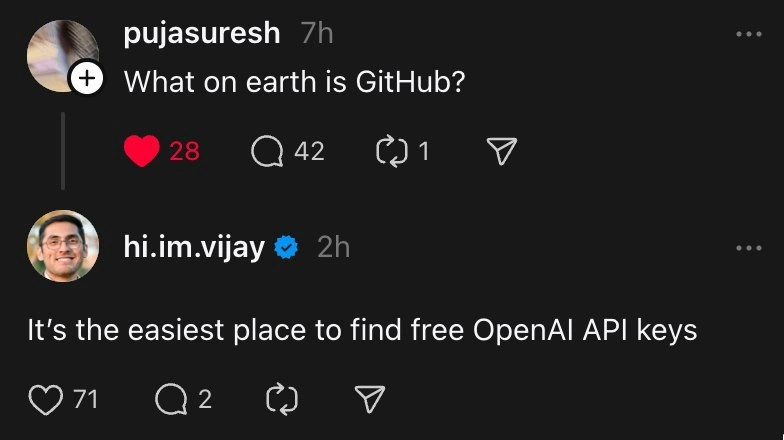
Let’s break down the meme in simpler terms. In the image, one person asks, “What on earth is GitHub?” and someone replies with a joke: “It’s the easiest place to find free OpenAI API keys.” Why is that funny to developers? Because it hints at a common rookie mistake that causes security headaches.
GitHub is an online service for version control where developers store and share code. Think of it as a giant library of code projects. Some projects are private (only you or your team can see them), but many are public – meaning anyone on the internet can peek at the code. Now, within code, there are sometimes secret values – like passwords or special keys – that you’re not supposed to share. One example is an OpenAI API key. OpenAI (the company behind ChatGPT and other AI services) gives developers an API key so they can use its AI in their own apps or scripts. That key is like a password or a credit card: it lets you access a service and potentially incur costs. You’re supposed to keep it very secret, using something called secrets management (storing it in safe configuration files or environment variables, instead of directly in your code).
However, many beginners (and even stressed-out experienced devs) accidentally do the one thing you shouldn’t: they include these secret keys in the code they upload to GitHub. For instance, they might have a file named .env (short for “environment,” often used to keep secret settings) that looks like this:
# .env file committed by mistake
OPENAI_API_KEY=sk-12345ABCDEF-very-secret-key
DB_PASSWORD=supersecretpassword
If that file ends up in a public repository, it’s essentially shouting out your secrets to the world. Anyone can find it. In fact, people have learned that by using GitHub’s code search feature, they can literally search for terms like "OPENAI_API_KEY=" or known key patterns like sk- to discover these leaked gems. It’s like a scavenger hunt for sensitive data. Some unscrupulous folks or bots do this to find leaked_api_keys and other credentials. If they find your OpenAI API key, they could start using OpenAI’s services with your key – meaning they get to play with the AI on your dime or your account. “Free keys for them, big problem for you.”
This is why the reply in the meme is so pointed. It calls GitHub “the easiest place to find free OpenAI API keys” – implying that a lot of people’s keys are just lying around there due to mistakes. It’s a form of SecurityMisconfiguration or oversight. In proper practice, you’d use tools and practices so this doesn’t happen:
- Developers use .gitignore files to tell GitHub/Git not to upload certain files (like those
.envfiles full of secrets). - Companies and devs use secret scanning tools (some built into GitHub, some external) to catch if any secret snuck into the code. GitHub will even send secret_scanning_alerts if you accidentally push something that looks like, say, an AWS key or an OpenAI key.
- Good commit hygiene (carefully reviewing what you’re about to commit) is taught to avoid committing passwords or keys.
The humor has an edge of truth: everyone in development hears stories of someone committing an API key publicly. It’s basically a running joke in the dev world that “if you need a free API key, just search GitHub—some newbie has probably uploaded one.” Of course, it’s also a cautionary tale. What’s funny to insiders is also a lesson: be careful with your credentials!
In summary, the meme uses VersionControlHumor to highlight a security oopsie. The first person asks what GitHub is (perhaps earnestly, or maybe to set up the joke), and the second person quips that GitHub is effectively a free key distribution service. This implies that GitHub has tons of public code where people have accidentally included their API keys (like those from OpenAI). Seasoned developers chuckle because they know this happens a lot – and it shouldn’t. The meme is basically poking fun at the many times we’ve facepalmed seeing someone’s secret token sitting in a public repo. It underscores the importance of SecretsManagement: keep your keys out of public version control!
Level 3: Open Source, Open Secrets
Ah, GitHub – the world’s largest repository of open code and, unintentionally, open secrets. This meme hits close to home for seasoned developers in Security and APIDevelopmentAndWebServices: an innocent question, “What on earth is GitHub?”, gets a brutally honest answer, “It’s the easiest place to find free OpenAI API keys.” It’s funny because it’s totally not wrong. We’ve all seen it: someone pushes code to a public repo and accidentally includes an OpenAI API credential (those magic keys starting with sk-...). Suddenly, what should be a private key becomes a public good. It’s an SecurityMisconfiguration nightmare and a textbook case of SensitiveDataExposure.
Let’s unpack why this quip resonates (and stings) for experienced devs:
Leaked API Keys Everywhere: Code search on GitHub can feel like a treasure hunt for malicious actors. Type in
"OPENAI_API_KEY"or"sk-"and you’ll unearth dozens of.envfiles, config snippets, or hard-coded constants where unwitting developers left their API credentials in plain sight. A public repository inadvertently becomes an accidental key distribution service, basically a free credential marketplace. It’s a well-known problem – so common that secret-scanning bots patrol commits 24/7. The moment a naive developer commits an API key, automated secret_scanning_alerts might already be on their way to the repo owner’s inbox (or to OpenAI’s security team to auto-revoke the key). Yet in the few minutes before a leak is caught, there are scripts and bots scouring GitHub, ready to pounce. Veteran engineers have learned (sometimes the hard way) that leaked_api_keys can be exploited almost immediately. The meme’s dark humor comes from that very reality: GitHub isn’t meant to be a key-sharing platform, but it often ends up looking like one due to human error.The .env Files of Doom: The mention of “free OpenAI API keys” instantly evokes the image of a poor soul who committed their
.envfile to a public repo. In modern development, a.envfile is where you keep secret tokens, passwords, and config variables outside your code – a cornerstone of SecretsManagement. But when developers ignore their.gitignore, these files full of goodies end up version-controlled for all the world to see. It’s the ultimate dotenv_woes scenario. Seasoned devs have caught this in code reviews or pull requests: “Umm, you might not want to put your API key inconfig.json a public repo.” The meme’s second commenter (with that smug verified check) basically voices every senior engineer’s sarcastic internal monologue upon discovering yet another committed secret: “Ah yes, GitHub – great place to share all your passwords with the universe.”Security Vulnerability and Real Consequences: Behind the humor lies a serious SecurityVulnerabilities lesson. Exposing an API key is like leaving the front door not just unlocked, but with a neon sign saying “FREE ENTRY.” In cybersecurity terms, it’s an Sensitive Data Exposure leading to potential breaches. For example, a leaked OpenAI API key can be abused: strangers can rack up usage on your account (burning through your credits or running up a bill) or violate service terms under your name. And if it were something like an AWS secret key, within minutes you’d likely find your cloud account spinning up expensive servers for crypto mining – a classic nightmare many veterans can recount with a shudder. There’s industry lore of huge compromises caused by public_repos_credential_leak: one infamous case saw an engineer’s personal GitHub repo leak company AWS keys, leading to a massive data breach. So when we chuckle at this meme, we’re also grimacing – it’s funny because it’s true, and true in a way that has kept IT security folks up at night.
Why Does This Keep Happening? You’d think by now everyone knows not to commit secrets. But in practice, mistakes happen. Junior devs or hurried hackers prototype some code, hardcode an API key to get it working, then push to GitHub without thinking. Or they simply don’t configure a
.gitignoreto exclude that.envfile. Sometimes they’re unaware that their new repo is public by default. Other times, it’s a teammate who accidentally publishes internal code to a public fork. The ecosystem responds with tools: GitHub offers secret scanning, workflows fail builds if they detect keys, and there are bots like TruffleHog or GitGuardian that sniff out secrets and yell at you. Yet, commit_hygiene isn’t universal – humans are forgetful and often under pressure. The result? Even in 2024, you can probably find an OpenAI key on GitHub in a few seconds of searching. The meme exaggerates only slightly: GitHub search abuse by opportunists is real enough that companies monitor it. It’s a senior-dev inside joke that “GitHub is the easiest place to find free keys” precisely because we’ve spent time cleaning up those spills and setting up guardrails to prevent them.
In short, this meme lands with a punch because it mocks a VersionControlHumor failure mode we all recognize. It’s equal parts hilarious and horrifying. The next time someone naïvely asks “What is GitHub?”, a jaded coder might quip: “It’s a code hosting platform… and apparently the world’s busiest accidental key vault.” 🔑💀 (Because if you don’t laugh, you might cry.)
Description
This image is a screenshot of a social media interaction with a dark background. The first post, from a user named 'pujasuresh', asks an innocent question: 'What on earth is GitHub?'. Below it is a witty and cynical reply from a verified user 'hi.im.vijay', who states: 'It's the easiest place to find free OpenAI API keys'. This meme is a classic piece of gallows humor for developers. It satirizes the common and serious security mistake of accidentally committing sensitive information, such as API keys, into public code repositories on GitHub. For senior engineers, the joke is painfully relatable, as they've often been the ones to clean up the mess after a junior developer makes this mistake. It highlights a real-world security vulnerability and the ongoing challenge of secrets management in software development
Comments
21Comment deleted
A junior's first commit is 'hello world'. Their second is '.env'. Their third is a frantic `git filter-branch` after the finance department asks about the $20,000 OpenAI bill
Amazing how we spend millions on LLM inference security, then push the entire `config.json` to `main` - truly a full-stack vulnerability
After 15 years of teaching junior devs about .gitignore, I've realized GitHub's true business model isn't hosting code - it's running the world's most successful honeypot for AWS credentials and OpenAI keys. The real CI/CD pipeline is Commit, Indexed, Compromised, Deleted
The real tragedy isn't that GitHub has become the world's largest unintentional secrets manager - it's that 'git-secrets' and pre-commit hooks remain perpetually on everyone's 'TODO: implement before next sprint' list, right below 'add comprehensive logging' and just above 'write that postmortem from 6 months ago.'
GitHub: Where .gitignore is more suggestion than rule, and your OpenAI bill funds the next dev's prompt engineering spree
We call it Continuous Secrets Delivery: every merge to main ships credentials to the world - and a Sev2 to security
GitHub's 'sk-' scrapers have better MTTD than our SOC - rotate your keys, not your blame
delicious training data, yum Comment deleted
Microsoft revitalising their age-old triple-e strategy! embrace-extend-extinguish Comment deleted
and free fonts (not kidding) Comment deleted
And websites too which have open directories. Comment deleted
please use English in this chat Comment deleted
https://t.me/dev_meme/3667 rule 3 Comment deleted
When in Rome, do as the Romans do Comment deleted
You are expected to obey the rules of this chat Comment deleted
And yes, please save time for others Comment deleted
🙄 This is an English-speaking chat. Comment deleted
So that's you translating every message versus everyone else translating all your messages Comment deleted
Doesn't sound quite fair to all the 253 people here Comment deleted
Oops Comment deleted
Oops x2 Comment deleted