A Web Developer's Vietnam Flashback: The AngularJS Migration
Why is this Frameworks meme funny?
Level 1: The Board Game That Changed All Its Rules
Imagine you spent years getting really good at a board game. Then the company releases "Edition 2" — but it's not an update: the board is different, the pieces are different, and none of the rules you memorized work anymore. They kept the same name on the box, so everyone expected a small improvement and got a brand-new game instead. The first comment jokes about companies skipping numbers to sound fancy — like a kid claiming to be "basically 10" at age 8 — and the reply says the real outrage isn't skipping numbers, it's when "the next version" secretly means "throw away everything you know."
Level 2: Reading the Version Number Tea Leaves
- Version numbers typically follow
MAJOR.MINOR.PATCH(semantic versioning): patch = bug fixes, minor = new features that don't break anything, major = breaking changes — code written for the old version may stop working. - Breaking change: any update that forces you to modify your own code to keep it running. A migration guide is the difference between an upgrade and a hostage situation.
- AngularJS vs Angular: AngularJS is the original 1.x JavaScript framework from Google; "Angular" (2+) is its TypeScript-based successor — same brand, essentially a different framework. Teams "upgrading" discovered their skills and codebases didn't transfer; that's the "complete fucking mess."
- Hacker News threading: the
>prefix quotes the parent comment — the screenshot format itself, deadpan setup then one-line demolition, is half the joke's delivery. - The early-career lesson lurking here: before adopting a framework, look at how its maintainers handled their last major version. A project's migration history predicts your future weekends better than its benchmark charts.
Level 3: Versioning as an Act of Marketing
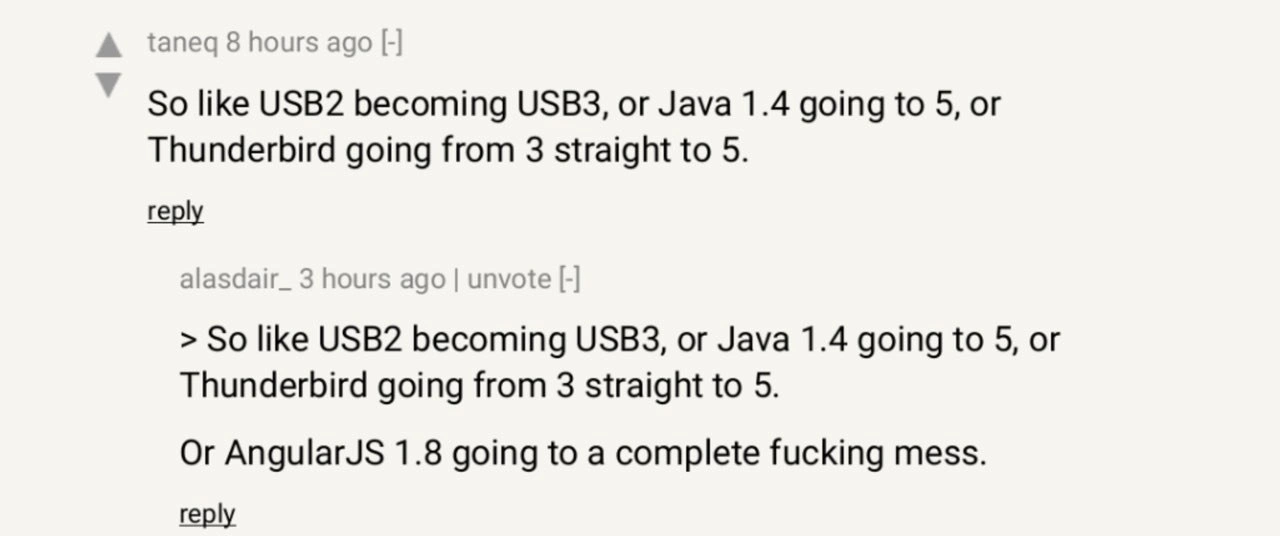
The screenshot is a two-comment ambush. The setup, from taneq, catalogs the industry's most shameless version-number stunts:
So like USB2 becoming USB3, or Java 1.4 going to 5, or Thunderbird going from 3 straight to 5.
Then alasdair_ quotes it and detonates the reply:
Or AngularJS 1.8 going to a complete fucking mess.
Each example in the setup is a real piece of versioning archaeology. Java 1.4 → 5 (2004) dropped the "1.x" prefix because Sun's marketing decided "Java 5" sounded like more progress than "1.5" — internally it remained 1.5.0, a duality that confused classpath debugging for a decade. Thunderbird 3 → 5 happened when Mozilla synced it to Firefox's new rapid-release treadmill, skipping 4 entirely. The USB naming saga is its own circle of hell: USB-IF retroactively rebranded USB 3.0 as "3.1 Gen 1," making spec sheets actively adversarial. The shared pattern: version numbers stopped being engineering metadata and became marketing surface — incremented, skipped, or renamed to manufacture a sense of progress.
But the punchline inverts the whole premise, which is what elevates it. AngularJS's crime wasn't number inflation — it was the opposite. Angular 2 (2016) was an honest major version concealing a dishonest magnitude: a ground-up rewrite in TypeScript with a new component model, new template syntax, and effectively no in-place migration path from the 1.x $scope/digest-cycle world. Enterprises with hundreds of thousands of lines of AngularJS faced a choice between a rewrite-scale "upgrade" or a slow death on a legacy branch — and many, mid-rewrite, asked the fatal question "if we're rewriting anyway, why not React?" The community fracture was so severe the framework had to be split into two names (AngularJS vs Angular), and the team swore off ever repeating it — subsequent Angular majors became deliberately boring. It's the canonical case study in why semantic versioning describes compatibility, not pain: semver permits breaking changes in a major release, but it has no integer large enough for "every file you own is now wrong."
The channel's own caption — "Not really a mess. But memes? Sure" — is the fair counterweight: post-rewrite Angular was a solid framework. The mess was never the code; it was the transition, and transitions are what people remember.
Description
A screenshot of a two-comment thread from a developer forum, likely Hacker News or a similar platform. The first comment, by user 'taneq', lists examples of significant but logical version jumps in technology: 'So like USB2 becoming USB3, or Java 1.4 going to 5, or Thunderbird going from 3 straight to 5.' The second comment, by 'alasdair_', quotes the first and adds a much more painful example: 'Or AngularJS 1.8 going to a complete fucking mess.' This exchange perfectly captures a major historical pain point for web developers. While the initial examples represent progress, the AngularJS to Angular (2+) transition was a complete, non-backward-compatible rewrite. This forced developers into massive, costly, and difficult migrations, effectively abandoning the original framework and creating a significant schism in the community. The blunt, profane summary resonates deeply with experienced engineers who lived through that chaotic period
Comments
8Comment deleted
AngularJS migration was the only project where the answer to 'Are we there yet?' was 'We're in a different car, on a different road, and we're not sure where it goes.'
Industry pattern: USB2→3, Java 1.4→5, AngularJS 1.8→existential crisis - the unwritten semver contract is “n+1 breaks your code, n+2 breaks your org chart.”
The AngularJS to Angular migration was so traumatic, we started measuring technical debt in units of therapy sessions
Angular 2 was technically semver-compliant: a breaking change so major it broke the version number, the framework, and the community in one release
Ah yes, the classic tech industry move: skip a version number to signal 'maturity,' then immediately prove you needed those missing versions for actual stability testing. Angular's jump from 1.x to 2+ wasn't just a version skip - it was a complete framework divorce where they kept the name but changed everything else, leaving millions of codebases in an awkward 'it's complicated' relationship status
Semantic versioning is a social contract - until marketing needs a headline; then 1.8 becomes “Angular Next” and your ‘upgrade’ turns into a quarter-eating replatform
SemVer says MAJOR = breaking APIs; MarketingVer says MAJOR = whatever number looks fastest - hence Java 1.4 became 5, USB2 became 3, and AngularJS 1.x became “start a new repo.”
USB3: Backward compatible. Angular2: Backward to the Stone Age of SPAs